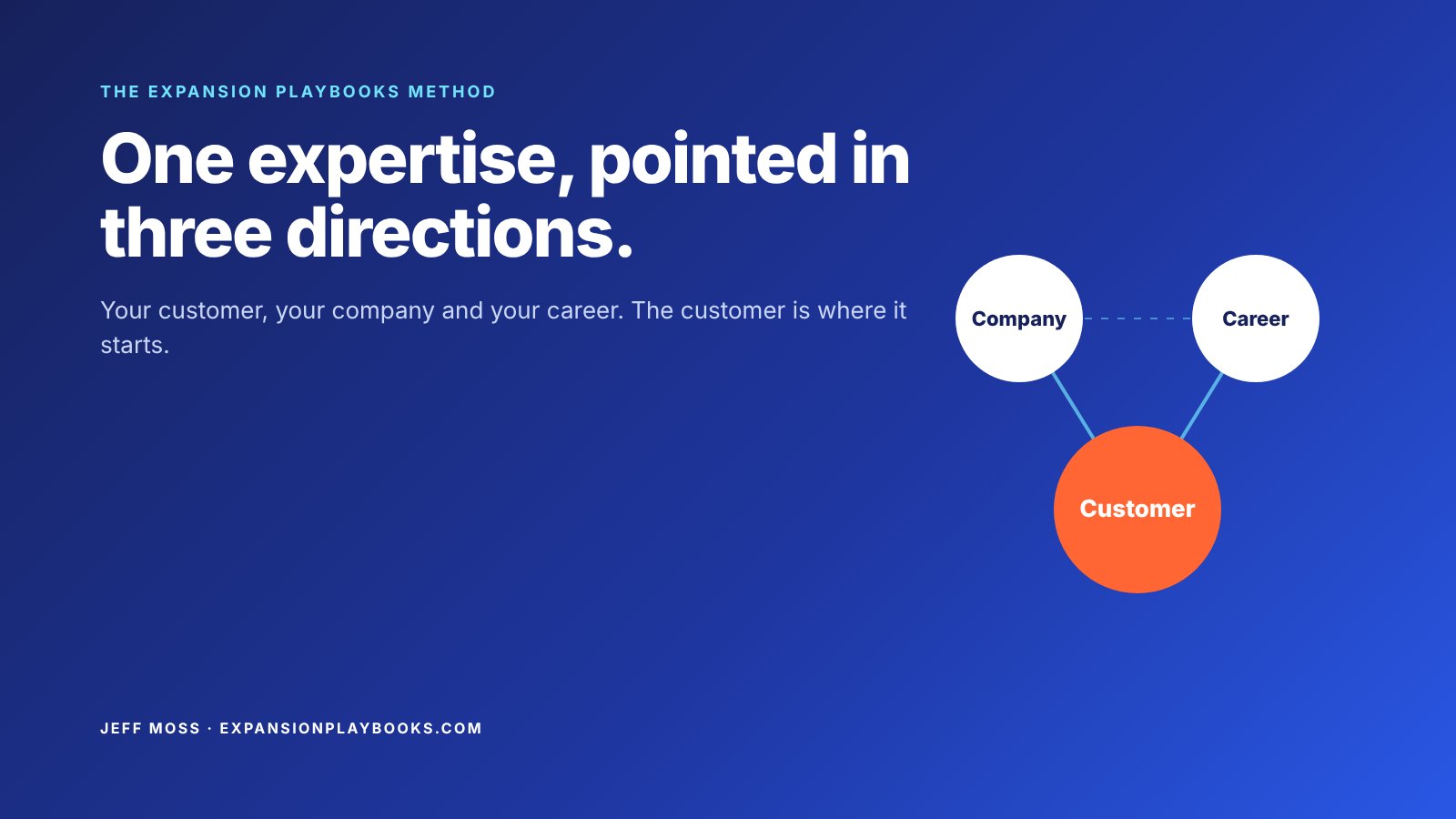
The short answer. In 2026, two things matter: expertise and execution. AI made execution cheap, and almost everyone is talking about it. Almost nobody is talking about how you get the expertise. The Expansion Playbooks method builds that expertise in three domains: your customer, your company and your career. The customer is the root. The other two grow out of it.
The three domains:
- Your customer. How your customers win, written down: how they make money, the results they're after, the work that gets them there, the people involved, who they serve, what comes next and what goes wrong.
- Your company. How every team has to run to make those wins happen: the money, how a customer moves through the company, who owns what, and where it's breaking.
- Your career. The record of what you've proven, and the craft to do it again in any room, any role, any company.
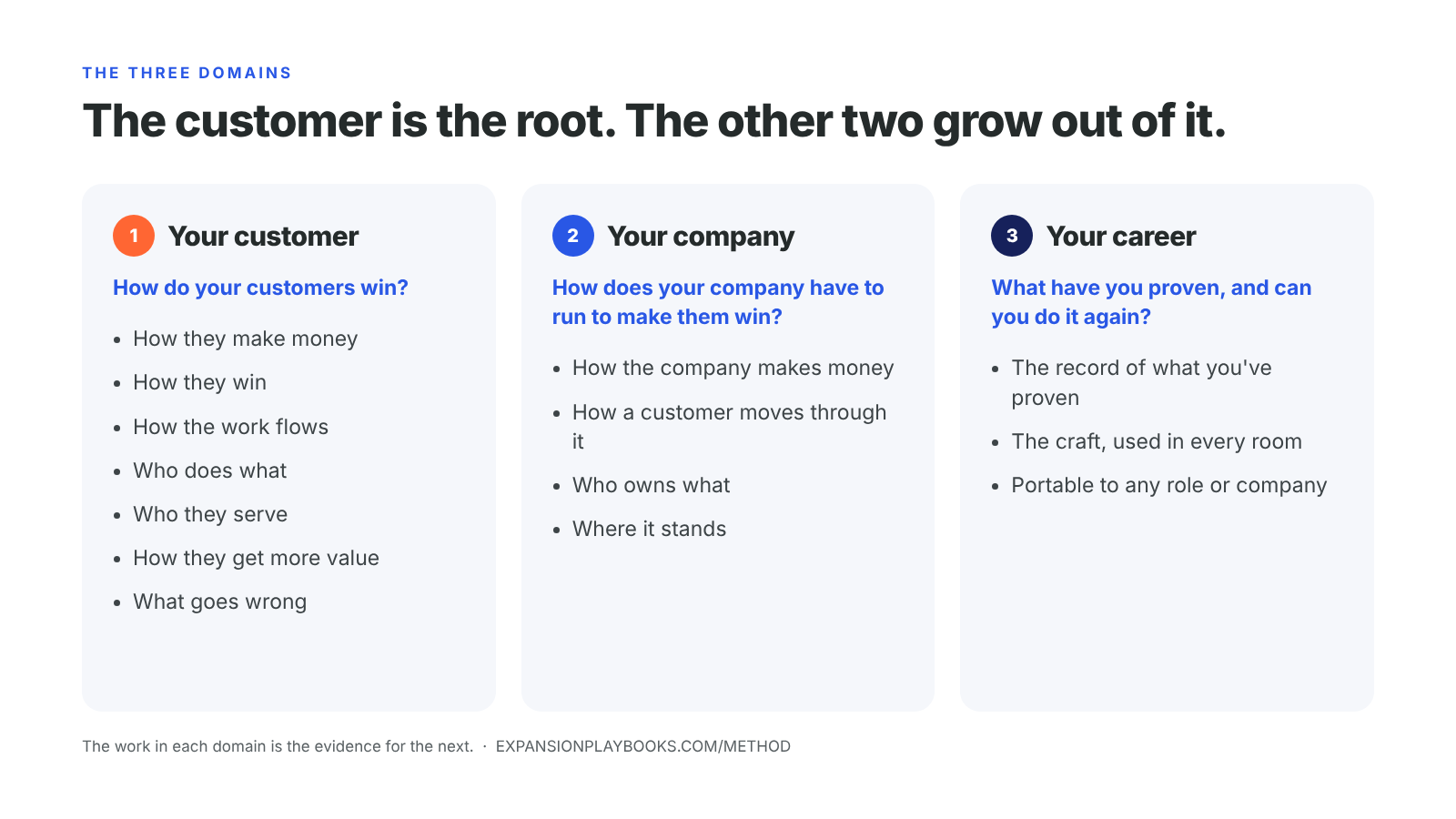
Your customer, your company, and your career are not three problems. They are one expertise, pointed in three directions, and the customer is where it starts.
Why does expertise matter more now?
Two things matter: expertise and execution. And almost the whole conversation in our market is about execution: the agents, the automations, the workflows, the tools.
At Moment 26 in New York this year, Rob Hardy, Global Head of Forward Deployed Engineering at Anthropic, put one line on the screen:
"So what's a vendor worth? Knowing how your customer's business actually runs."
He said one more thing I wrote down as fast as I could: expertise is what customers will be paying for in the future. I would argue they're paying for it now. I would argue they've been hoping and trying to pay for it for many years, but we have not answered that call.
MIT's NANDA initiative found that for 95% of companies in its 2025 dataset, generative AI implementation was falling short. I believe that's because everyone assumed AI would give them the answer. We wanted to believe we could just hand over the reins. When it comes to execution, you can hand over a lot. When it comes to expertise, that's the struggle you need to go through and figure out yourself. Once you own it, you can use AI to its fullest.
So AI is the great divider. It makes experts more capable and leaves everyone else stuck. The expert with AI is faster at the half that was never the hard half. Everyone else gets the output without the understanding, and that's renting competence.
We help you become smarter, not just look smart.
Why isn't training enough?
People have been given training. People have learned the principles. And it still falls down, because application is expertise, and so expertise is the barrier.
I need to see it with my own furniture in the house. I need to see it applied to my own use case, for my own customers. That's where things are falling down, and that's where people are struggling.
I learned this the hard way. A few months after I had delivered a training, one of the reps told me the truth: things had gone back to normal. People hadn't changed how they think, how they work, or how they operate, because nothing showed up on Monday inside the actual work.
And it's why knowledge isn't enough either. Knowledge is knowing there's a million ways I could throw a basketball. Expertise is knowing if you get your feet squared, it's going to go in consistently from any distance every time. Expertise is knowing the two or three things that matter most, and the order to do them in.
The mistake everybody makes is treating these as three different skills
Everyone thinks knowing your customer, running your company, and managing your career are three different skills. And so we buy three different tools for them. There's a system of record for the customer. There's a strategy deck for the company. There's a resume for the career. Nothing connects them, and nothing in any of them helps you in the meeting that starts in twenty minutes.
What I've found, across 75+ companies, is that it's one skill. Study how people win, and work backwards from it. What result are they going for? What proves they got it? What are the few things that produce it, in what order? And when you apply that to a business, the person whose win you study first is the customer.
Every company has a customer. Every role in every company exists to help that customer win, whether the role ever talks to a customer or not. Even in an IT role, your customers are the internal departments. So figuring out how the customer wins is far more than the customer-facing person's version of expertise. It's the truth the whole company is organized around, and the whole career is built on.
Domain 1. Your customer
How do your customers win?
Start with the customer and what they're trying to achieve. Then work back to how your solution helps facilitate the things the customer would need to do regardless of your existence.
The mistake is starting with you and your product. When I was a first-time customer success leader at SalesRabbit, our most successful customers were heavy users of our dashboard, so I spent months getting everyone else to use it. Nothing changed. When we finally asked our best customers how they used it, the answer was competitions and coaching. The dashboard was just where they ran them. Once our onboarding taught customers to run their first sales competition, it helped contribute to a 30% increase in our 90-day retention.
The seven questions
The model of how a customer wins has the same shape everywhere. Customers fail in diverse ways, but they succeed in homogeneous ways. So knowing your customer exceptionally comes down to seven questions:
- How do they make money? Their business on one line: revenue on one side, cost on the other, in the use case you serve. Every product you sell moves one term.
- How do they win? The three or four outcomes they're trying to achieve, in order. Under each: how it's measured, the actions that move it, and the products that make those actions easier. Read it down one column, never across all of them.
- How does the work flow? Their work in three to five stages, in their words. Executives care about economics. Managers care about initiatives. End users care about the work itself.
- Who does what? The owner of each stage is who you call. What they care about is how you open the conversation.
- Who do they serve? Your customer's customer, and how your outcomes show up for them. Almost everybody overlooks this.
- How do they get more value? The Expansion Pathway: what they own, what comes next, and the signal that says they're ready.
- What goes wrong? Risk is the absence of success. The setup that has to be done in the first 45 days, the habits that have to form, the numbers that should have moved, the people who should be involved.
If you can answer those seven questions, you know your customer. You know their economics, what they have to do to win, the workflows that matter, who does what, who they ultimately serve, their next value and what could go wrong.
The result is the signal
At Expansion Playbooks, we've analyzed over a million customer records. When a customer gets a positive result, retention goes up two times. When they get a good result, six times. The result is the signal.
And the customer has to see it. A result the customer cannot see is a result that did not happen.
Watch for death by proxy
There's a time and place for proxies. But proxies only work if they still tell you whether you're succeeding. You can have death by proxy by saying, "Our proxy for success is launching an agent by the end of the month." You can hit that and still fail to make your team more successful or more efficient, or whatever the real outcome is. Logins, usage and health scores work the same way: the number moves and nothing real changes.
What you do with a customer
Once you know how a customer wins, every conversation you have with them is one of five things, or a mix of them:
- Align: agree on the outcomes and the number before anything is built.
- Activate: turn a purchase into achieved outcomes, in the order a customer can take things on.
- Prove: show the outcome moved, with the metric as evidence rather than a claim.
- Repair: clear what is broken before asking for anything.
- Expand: grow value continuously from results already won, never a price list.
When you're expanding a customer, you're getting retention for free.
Domain 2. Your company
How does your company have to run to make customers win?
Once you can say how the customer wins, the second domain falls out of it: how does the company have to operate to make that happen?
Kaveh Rostampor, CEO and co-founder of Planhat, named the shift at Moment 26. In the old world, there were all the different roles: salesperson, CSM, support rep, implementation manager, renewal manager. In the new world, there's a commercial operator: someone who understands the customer, understands revenue, understands the product, understands delivery, and can orchestrate people and agents. His advice was to learn the business, not only your function. Rob Hardy, at the same event, said to stop drawing the line between pre-sales and post-sales.
I still believe there will be roles and definitions. Every responsibility in a company needs a single owner. But the bar is rising on what each person needs to understand, and we all have so much more influence than we realize.
The four questions about your company
- How does the company make money? The headline numbers, and the metrics each department moves to reach them.
- How does a customer move through it? Department by department: marketing, sales, onboarding, customer success, support and product. What the customer cares about at each one, the outcome it owes, and the processes behind it.
- Who owns what? Who leads each department, what it's accountable for, the roles in it and the processes it owns.
- Where does it stand? The problems that are true of this company today, laid over the operating model so you can see where they sit.
The fundamentals of how a company wins are the same too. You still have to onboard a customer. You have to understand their goals. You have to report progress and measured results against those goals. You have to reduce risk, and have a process for when you find it. You have to renew. You have to drive expansion. You have to resolve support issues and bugs. You have to hand the customer from sales to customer success. I don't care what you call them. They all exist.
And the order matters. Onboarding first, always. Renewals are won at month two, not month eleven.
You can't do this domain first
If you try to design how the company operates before you can say what the customer is trying to achieve, you get processes that look right and are impotent. The customer model is what puts your own business in context: marketing knows who to go after, sales assembles the right solution for the right use case, onboarding gets to the first result faster, customer success lines up the next win, support knows what's at stake when something breaks, and product builds what actually works.
Don't wait for permission
Where responsibility is abdicated, opportunity lies. You don't need the title to see how the whole machine works, or to start fixing the part in front of you. And when you need the company to move, bring the model, not the frustration. Emotion earns sympathy. Data earns action.
Domain 3. Your career
What makes your expertise portable?
The third domain is the one almost nobody thinks of as expertise at all. It's the same model, turned on yourself.
The first consulting engagement I ever took, I was sitting across from a VP of customer success with 15 more years of experience than me, at a company 10 times the size of the one I had just left. What I found out in the first few weeks is that it wasn't a fluke. What I had gained at SalesRabbit wasn't knowledge of one industry. It was the process of gaining domain expertise, and that process turned out to be universal.
So career expertise is knowing what you're capable of, being able to say it, and being able to prove it. The framework doesn't change when you change roles, companies or industries. A move up, from individual contributor to lead to director, runs on it. A move across, from support to onboarding or from sales to success, runs on it.
You don't know it until you can say it
I don't think you actually know something until you've actually had to speak to it. Explaining the model to your team, to a customer, to an executive, with no notes, is where it becomes yours. That's the difference between feeling confident and actually being confident: confidence comes from proof.
Where the craft lives
The craft is the set of skills you use in the room: asking the right discovery questions, running a meeting, presenting a result, calming an escalation, making a recommendation and standing behind it. There are three domains, and the craft is how you apply each one. You carry it with you as part of your career.
The record follows you
Everything you prove in the first two domains accumulates: the outcomes you delivered, the judgment calls that held, the model of who you are and what you're for. You built amazing things at your company, and when you leave, they own all of it. The record of what you learned and proved should go with you.
The one thing that doesn't change is that there's a human, and that human needs to become more capable.
How the three work together
The work you do in each domain produces the evidence for the next one. Running your accounts on the customer model is what qualifies you to shape how the company runs. Shaping how the company runs is what makes you the person they promote, or the person the next company hires. Every account you model, every process you fix, every result you can point to is a deposit into all three at once.
Every journey is an expansion journey. A customer relationship, a company seat or a career that stops adding value has quietly agreed to shrink. The same expertise keeps all three growing. And it's learnable, because I learned it, and I've watched people in every seat on the customer flywheel learn it since.
What we believe
- Every role exists to help a customer win. That includes the roles that never talk to one. In IT, the customers are the internal departments.
- AI made execution cheap, so expertise decides who wins. Anyone can produce the deck, the email or the agent now. Knowing which one matters for this customer is the hard part.
- Expertise is knowledge applied to your own customers. Training teaches the principle. Expertise is seeing it work with your own furniture in the house.
- Customers fail in diverse ways, but they succeed in homogeneous ways. That's why how a customer wins can be learned, written down and repeated.
- Start with what the customer is trying to achieve, then work back to your product. Your product is one of the ways they get there, never the goal itself.
- Measure the result the customer can see. Logins, usage and health scores are proxies, and a proxy only counts while it still tells you the customer is winning.
- Expansion is earned with results already delivered. When you grow a customer on what they've already won, retention comes with it.
- Where responsibility is abdicated, opportunity lies. You don't need the title to understand the whole business, or to fix the part in front of you.
- You don't know it until you can explain it. Saying it to a customer, a team or an executive, with no notes, is what turns knowledge into confidence.
- Your expertise belongs to you. The results you've proven and the way you think go with you to every role and every company.
We help you become smarter, not just look smart.
Where to start
Start at the root.
- Pick one customer, this week. Write down how they win: the result they're going for, the measure that shows it, and the three or four actions that move it, in order. Write how they win, rather than the features they use.
- Ask what your company would have to do differently to deliver that. Which of the core processes is set up for it? Which one is missing? Which one has a name and a Slack channel and doesn't actually produce the result?
- Read what you just wrote as if you were the hiring manager for your next role. That page is the first page of your next interview. It's the promotion case. It's the 30-60-90 plan. You wrote it for one customer, and it works for all three, because it was always the same model.
At Expansion Playbooks, we've trained over 1,000 reps across support, customer success, onboarding, sales, product, and marketing, and worked with 75+ companies. Every one of those teams works better when it can see the whole system.
If you want help doing it on your own accounts, the app walks you through it. Land the role and Own the role build the customer side. Lead the team builds the company side (coming soon). The first look is free.
You already run all three every day. The only question is whether they run on one model, or on three guesses.