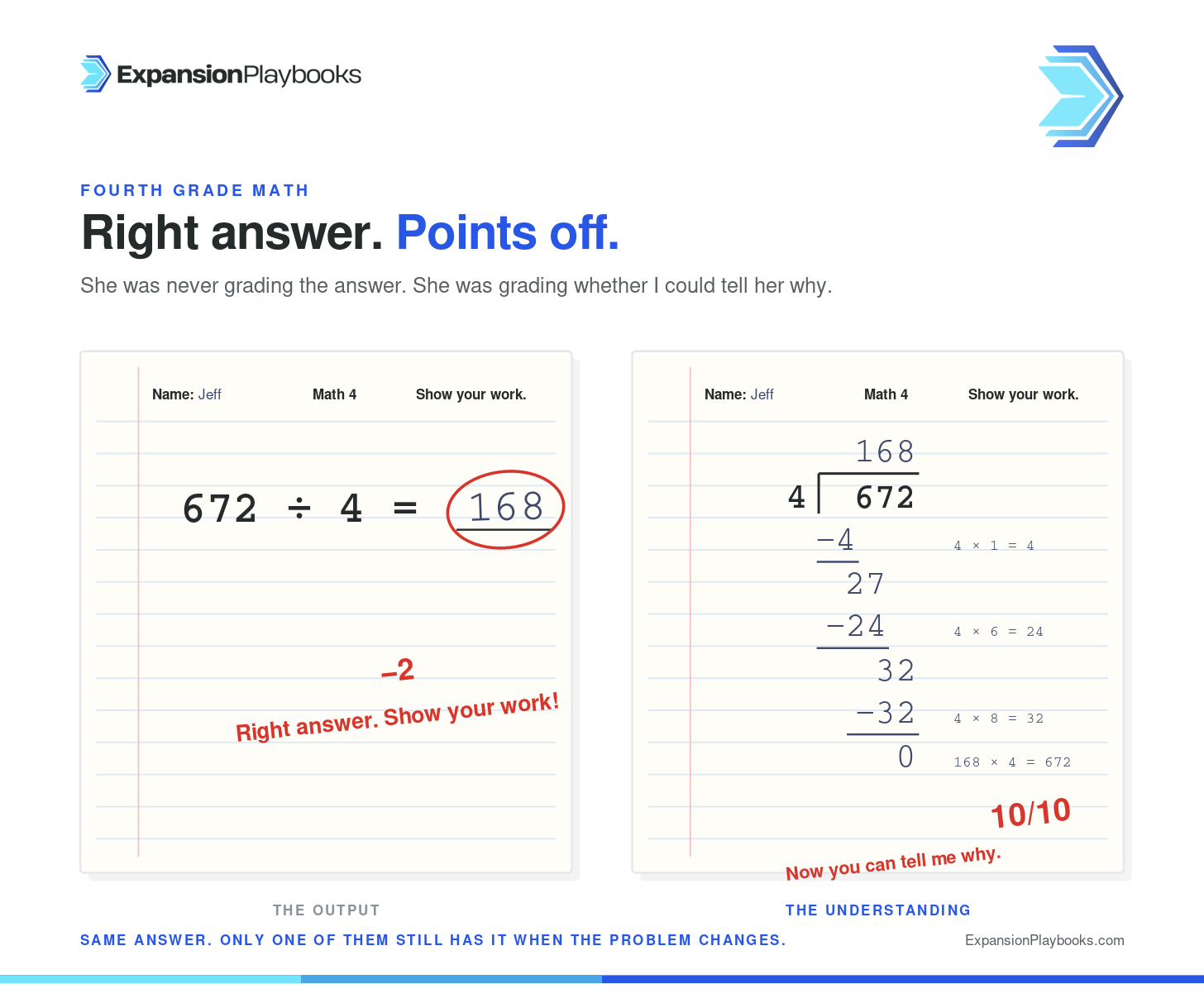
When I was a kid, I loved staring at a math problem, figuring it out in my head, and writing down the answer.
And every time, I got points off. Not because the answer was wrong. Because I didn't show my work. My fourth-grade math teacher was relentless about it, and I never understood why. The answer was right. What else did she want from me?
It took me about 30 years and one technology shift to figure out what she wanted. She didn't care about the answer. She cared whether I could tell her why it was the answer, because that was the only part I would still have when the problem changed.
I've been thinking about her a lot this year, because right now everyone's freaking out about all these capabilities. Am I going to lose my job? Is AI going to do what I do? Is everybody else already ahead of me? And almost nobody is asking the question that matters, which is what AI does to the person using it.
Here's what I've seen.
The mistake everybody makes is thinking AI levels the field
Everyone thinks AI is the great equalizer. Give a junior person the right prompt and they perform like a senior person. Close the gap, level the field, everybody gets good at once.
That is not what is happening. What is happening is that AI is the great divider.
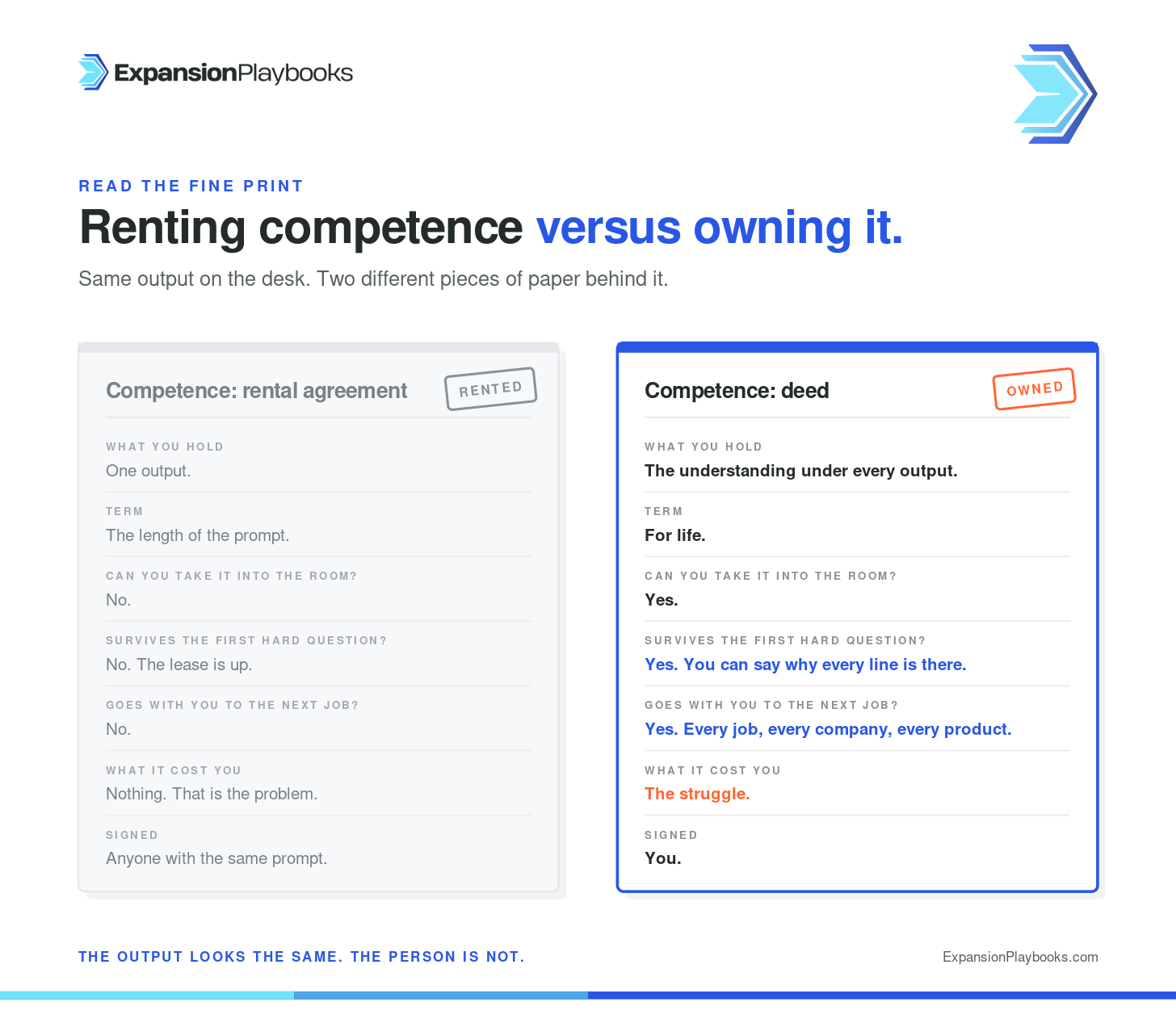
In the age of AI, it makes experts more capable, and it keeps novices stupid, dumb, and stunted, because you never actually have to struggle and figure something out. The expert types a prompt and gets back something they can judge in 30 seconds, correct in five minutes, and defend in a room full of people who push back. The novice types the same prompt and gets back something that looks exactly as good. And that is the whole problem. It looks the same. It is not the same, because one person can tell you why every line is where it is and the other one cannot.
So the split is not between the people who use AI and the people who don't. Everybody's using it. The split is between the people who understood the work before the prompt and the people who let the prompt stand in for understanding.
I think it was Carl Jung who said, beware of unearned wisdom. He meant something a little different, but the warning fits. What a prompt hands you is unearned expertise. The output is not necessarily worse than what you would have produced had you gone through the struggle. The problem is you. You skipped the part that was supposed to make you good.
Renting competence
Here's the name I've landed on for it: renting competence.
Renting competence is getting the output without the understanding. You have it for the length of the prompt. You can paste it into a doc, drop it in a deck, send it to a customer. But you don't own it. You can't take it into the room with you, and the moment somebody asks the one question that wasn't in the output, the lease is up.
Owning competence is the opposite. You went through the struggle. You figured out why the pieces are where they are. And so when the customer pushes back, or the plan hits reality, or the thing needs to be corrected and refined, you can do it, because you understand why every decision led to where it led.
Three things follow from this, and together they change what "getting good" means.
Execution went to zero, so output stopped proving anything
For 20 years, producing the thing was the proof. If you could build the onboarding plan, design the renewal sequence, write the account strategy, that meant you knew what you were doing, because nobody could produce it who hadn't earned it.
That is over. AI will design an onboarding and it will look right and it will have all the general components. But it will be impotent. It takes minutes, it looks finished, and it proves nothing about the person who ran the prompt.
So the question you have to ask yourself has changed. Not "did I produce a new onboarding motion?" or "did I produce a new strategy for this account?" The question is: this thing has been produced. Do I know it's correct? Can I say why? Can I defend it? Can I talk about why everything is where it is?
Because if you can, you can get it implemented, get it successful, correct it, and refine it. And if you can't, you're technically no better off than before you ran the prompt. You may actually be worse off, because now you have a thing you're responsible for and can't do anything about.
What's left is judgment, and judgment is built by struggle
Show your work. That is what my teacher was trying to install in me, and it is the exact skill that separates the two kinds of people above.
Judgment is deciding whether a thing is true. It is looking at a plan and knowing which two or three lines are wrong and fixing them. It is saying the thing out loud, with no notes, and holding it while the room pushes back. None of that comes out of a prompt. It comes from having contended with the realities, having had to figure it out, having been wrong and corrected it.
Let me be clear about what I'm not saying. I'm not saying you can't use AI to assist in these things. Use it. I'm not saying you have to sit there for four hours justifying every line to the second. You don't. What I mean by that is you have to have gone through the actual motion to have learned it. Once you've developed that expertise, that's what makes you more effective. That's what makes the improved outcome more likely. The output was never the thing. The understanding underneath it was.
Here's how I learned that, the hard way.
The fundamental is the same in every customer-facing job, and it is knowable
I was the first customer success hire at SalesRabbit, back when customer success was barely a thing. And things were not working well. We were losing 25% of new customers in the first 90 days. I was doing everything a customer success person was supposed to do: onboarding, training, checking in, configuring the tool.
So finally I just started interviewing our most successful customers. Not the average ones. The ones who would stand on stage and tell you the product changed their business. And I asked them how they win. What are the real economics of succeeding at door-to-door sales? What are the handful of actions that are central to it? What does a week look like when it's working?
I had never knocked a door in my life. But once I understood how they won, the whole job changed. I wasn't in the business of providing technology and configuring it. I was in the business of helping door-to-door sales companies drive weekly sales. So I took what I'd learned and built it into our onboarding, our processes, our tooling. The dashboard stopped being a feature and became the scoreboard for a weekly sales competition. And the thing we tracked in onboarding was laughably simple: did the customer run that competition by week three?
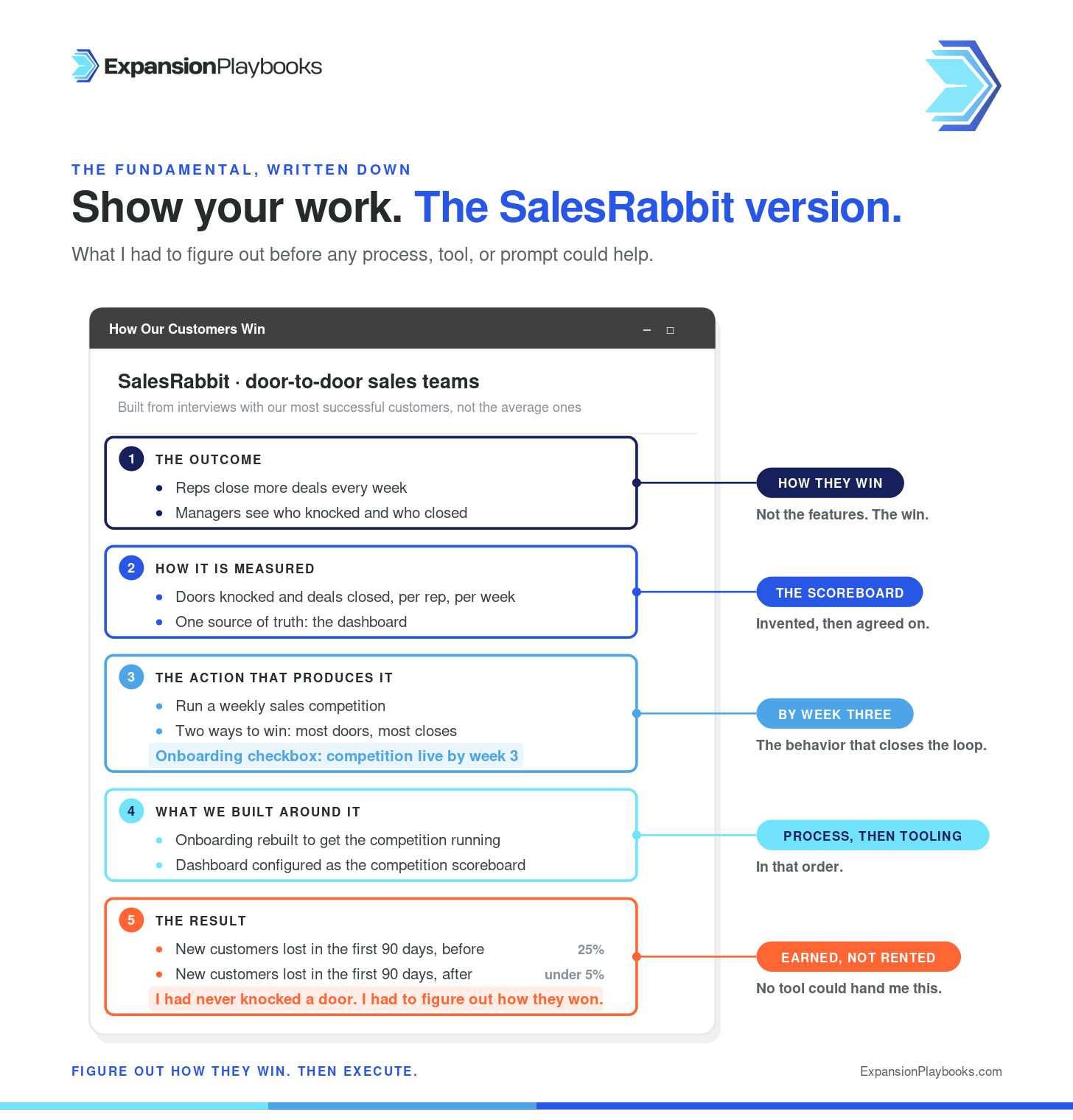
We brought that 25% down to less than 5%. But the point of the story is not the number. The point is that I had to go through that struggle. I had to figure out how they won. And once I had that real expertise, I had something so valuable that I could execute against it in every direction, and no tool could have handed it to me.
That is the fundamental, and it is the same in every customer-facing job I have looked at since. I've analyzed millions of customer records across more than 75 companies. The most highly correlated factor for retention is, did the customer get a measurable outcome. A positive result, retention goes up two times. A good result, six times. And so every job that touches a customer is one loop: figure out how this customer wins, then do the things, in the right order, that make that happen. It does not change by industry. It does not change by product. If you understand that, AI and execution have been made easy.
What to do about it
When things like this happen in the world, you get back to the fundamentals. While everybody is freaking out, the people who are figuring out how the sausage is made don't go collect random generic AI skills. They figure out how to make customers successful. They understand the fundamentals of how work gets done that produces results.
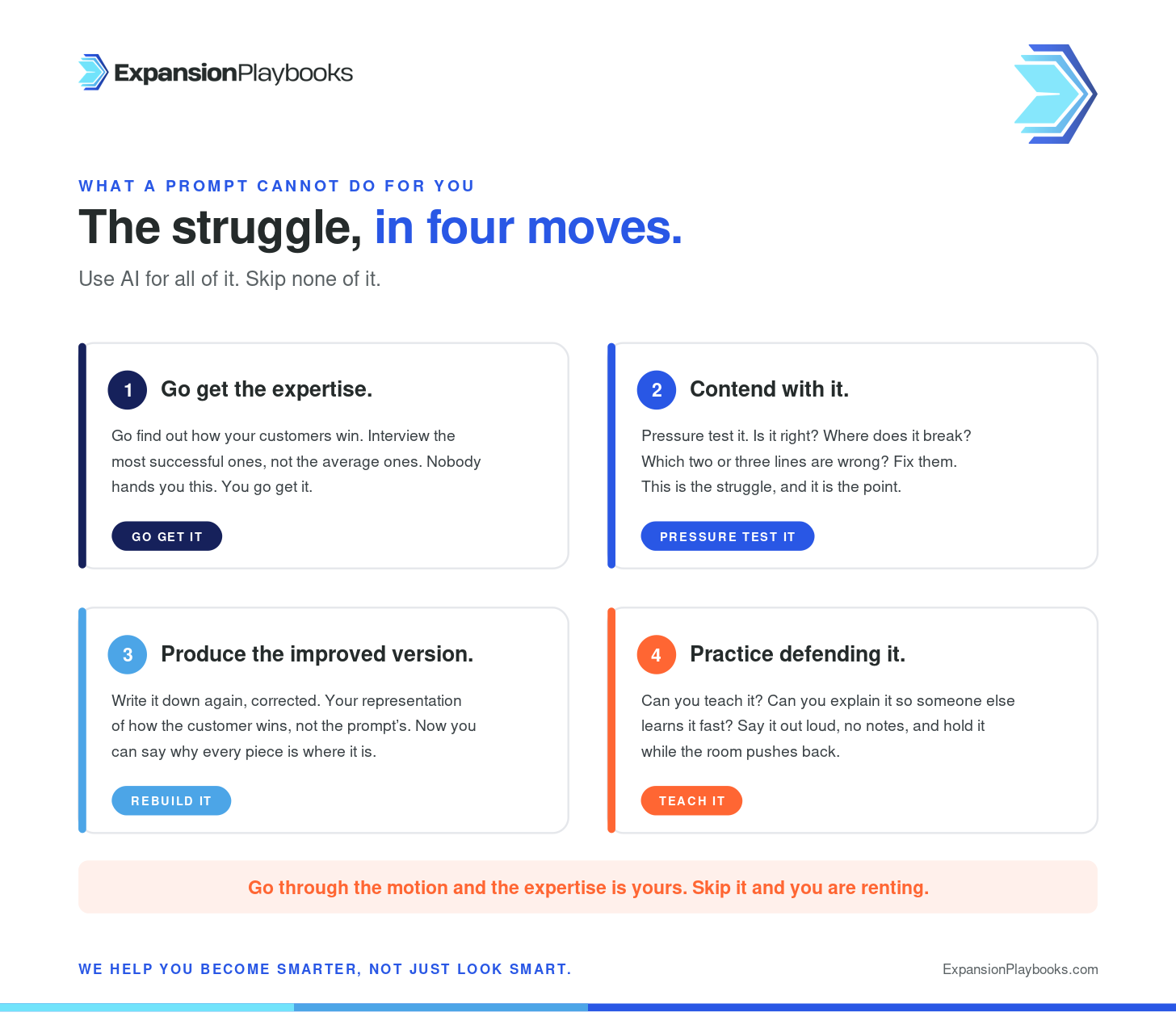
So here is the fundamental, and here is the struggle, in four moves.
Go get the expertise. Go find out how your customers win: the two or three outcomes they are trying to achieve, how those get measured, and the four or five actions that produce them. Interview your most successful customers, not the average ones, the way I did. Nobody hands you this. You go get it.
Contend with it. Pressure test it. Is it right? Where does it break? Which two or three lines are wrong? Fix them. Let AI draft as much of this as you want, but the contending is yours, because the contending is where the expertise gets built.
Produce the improved version. Write it down again, corrected. Your representation of how the customer wins, not the prompt's. Now you can say why every piece is where it is. Show your work.
Practice defending it. Can you teach it? Can you explain it so someone else learns it fast? Say it out loud, to a peer, to your manager, to a customer, with no notes, and hold it while the room pushes back. If you can't explain why the pieces are where they are without notes, you're still renting.
Then run your accounts on it. Every onboarding, every renewal, every expansion conversation, judged against how the customer wins.
Do that and AI becomes the thing that makes you faster. Skip it and AI becomes the thing that makes you replaceable, because a person who can only produce the output is competing with a tool that produces it for free.
What I'm building
I've spent the last year building something for exactly this problem. It does the gathering for you: it pulls together the domain expertise on how your customers win, so you're not starting from a blank page. Then it keeps the struggle, and makes it the most efficient struggle you've ever been through. You refine it. You edit it. You verify it's correct. Then you practice it, you show your work, and you get coaching that confirms you've comprehended it and made it your own. Not the output. The understanding.
And that is what is going to protect you. Not in the next quarter. In the next 5 to 10 years, when every tool you know today has been replaced twice. Mastering AI will not protect your career, because everyone around you is mastering the same AI. Becoming the person who knows how customers win, and can prove it in the room, is what protects you. That expertise is yours. You take it to every job, every company, every product. It is the one thing nobody can prompt their way past you on.
I have never been more excited about anything I've built. It opens in the next few weeks, and the first look is free. If you want to be first, and you want the founding price that comes with being first, join the founding member waitlist.
We help you become smarter, not just look smart.
The question was never whether AI is coming for your job. It is whether you understand your customers well enough that it cannot.
I'd love to know where you've felt this. Hit reply and tell me about the last time an output looked finished and fell apart the moment someone asked why. Or tell me where you think I've got this wrong. I read every reply.