

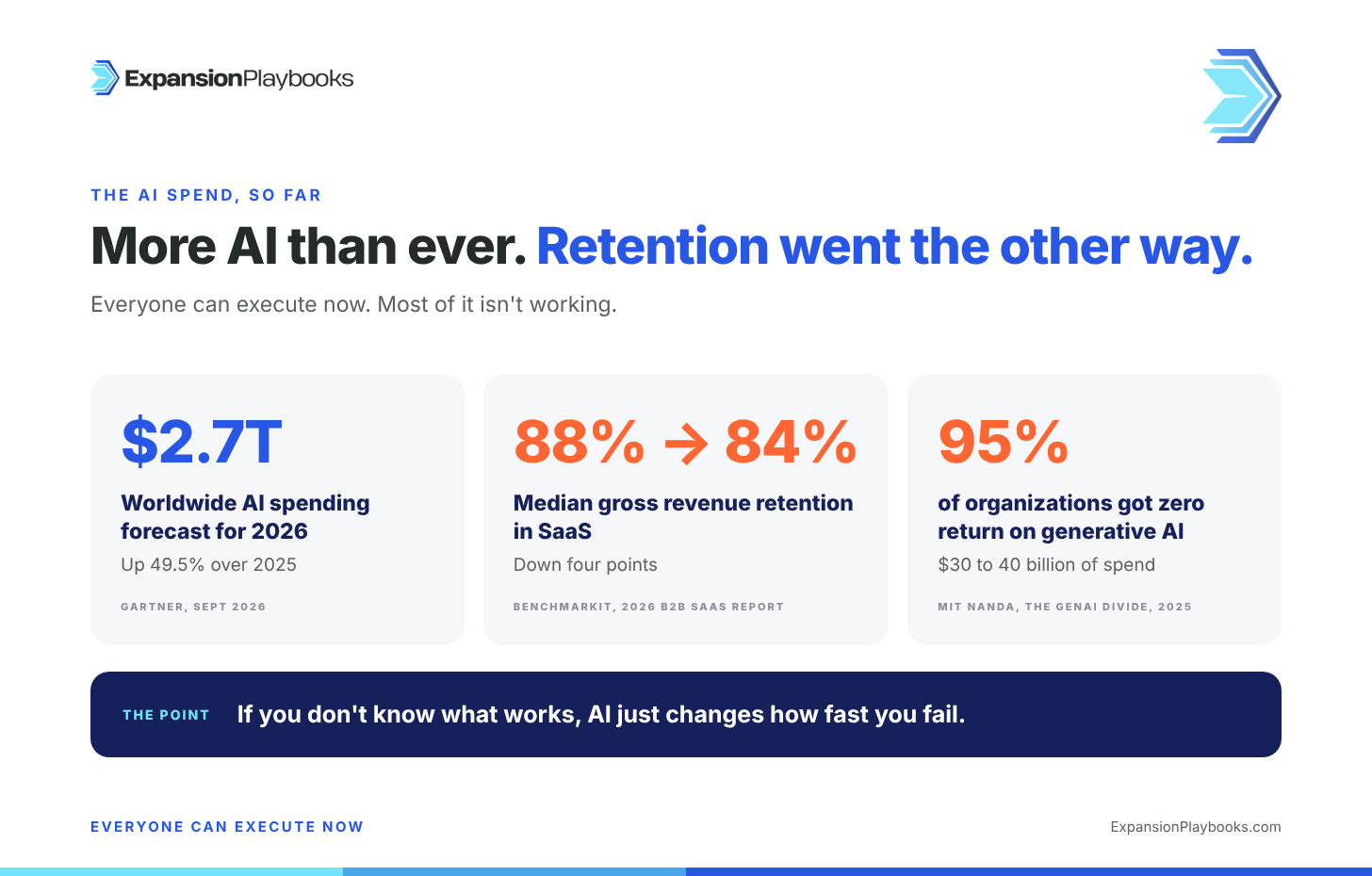
Gartner now forecasts the world will spend about $2.7 trillion on AI this year. That's a 49.5% jump over last year.
And everyone believes it's going to work. We've built support agents, onboarding agents, account summaries that run every morning, health scores with an AI layer on top. Some of it is powerful. There have been real efficiency gains.
But look at the numbers that matter in our world. Benchmarkit's 2026 SaaS report has median gross revenue retention falling from 88% to 84%. And MIT's research on generative AI found 95% of organizations got zero return on $30 to 40 billion of spend.
So here's the question I'd ask any customer success leader right now. After everything you built this year, are your churn and expansion any better?
For most teams, the answer is no. And the reason has nothing to do with the tools.
What are brakes for?
My mentor, Greg Daines, taught me a lesson I still open almost every talk with. It starts with one question: what are brakes for on a car?
People say they stop you. They slow you down. And I'd say that's what they do.
Then someone says they keep you safe. But I can be safe just by not getting in the car.
So what are they for? Why do I choose a car over a bike? To go fast.
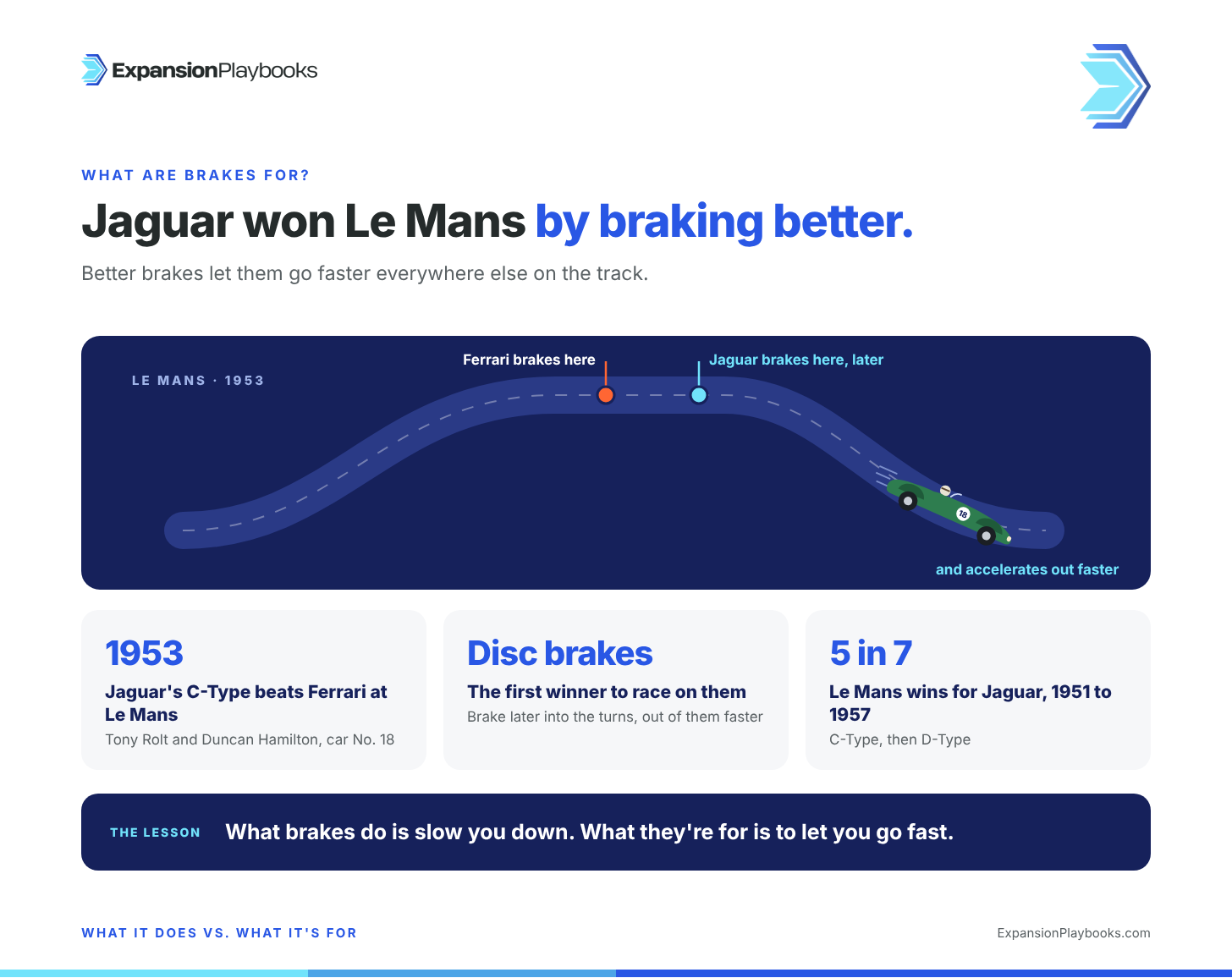
What brakes do is the opposite of what they're for. What they do is slow you down. What they're for is to let you go fast. Jaguar beat Ferrari at Le Mans in 1953 on disc brakes. They could brake later going into the turns and accelerate out of them faster than everyone else, and they went on to win Le Mans five times in seven years.
The reason this matters is that if I define brakes by what they do, I could line up three brakes:
1. One that stops you, but only at low speed.
2. One that stops you, but only over a long distance.
3. One that stops you at high speed and in a short distance, but only once.
If brakes exist to stop you, all three qualify. But you would never get in a car with any of them. They're antithetical to the purpose of the car.
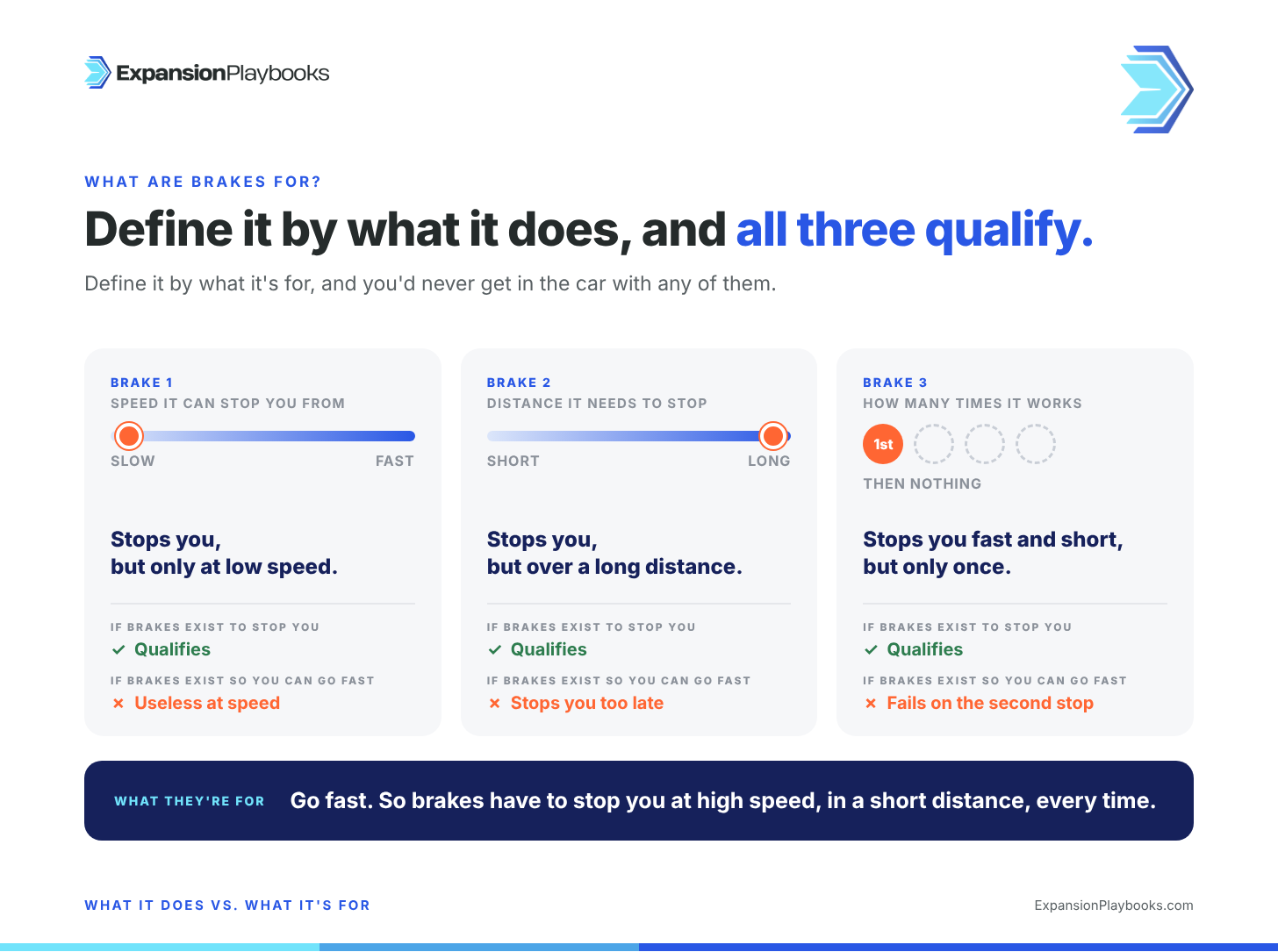
When we instead say the purpose is to go fast, what the brakes have to do becomes extremely clear. They have to stop you at a high rate of speed, in a short distance, every time. And when they do that, they help you achieve the outcome consistently: going faster.
We keep building the three bad brakes
This is the essence of anything you build. And we've all lived it with our product teams.
We frame what the customer needs in terms of what it does. "Hey, we need a feature that does X, Y, and Z." Product goes and builds a feature that technically does X, Y, and Z. When it comes in, we say, "Well, that's not what we wanted. That's not what we asked for. That won't help the customer."
And we wonder why this continues to fail. Why do we continue to miss the mark?
Because we never understood what we were building for. What was the purpose? What were the outcomes we were building for? Once you have the outcome in mind, that's what we should have been communicating to our dev teams. Then product could operate in a way that achieves it.
The same thing is true for anything else we're doing. And it's exactly what happened with AI.
AI does what you tell it to do
The mistake everybody makes is believing AI was going to solve it for them.
AI helps with execution. It does what you tell it to do. It operates based on how you built it, how you constructed it, and the methodologies and theories you applied to it. If you defined the work by what it does, AI will build you three beautiful brakes faster than you ever could before.
Jim Collins wrote it 25 years ago in Good to Great: "Technology is an accelerator of momentum, not a creator of it."
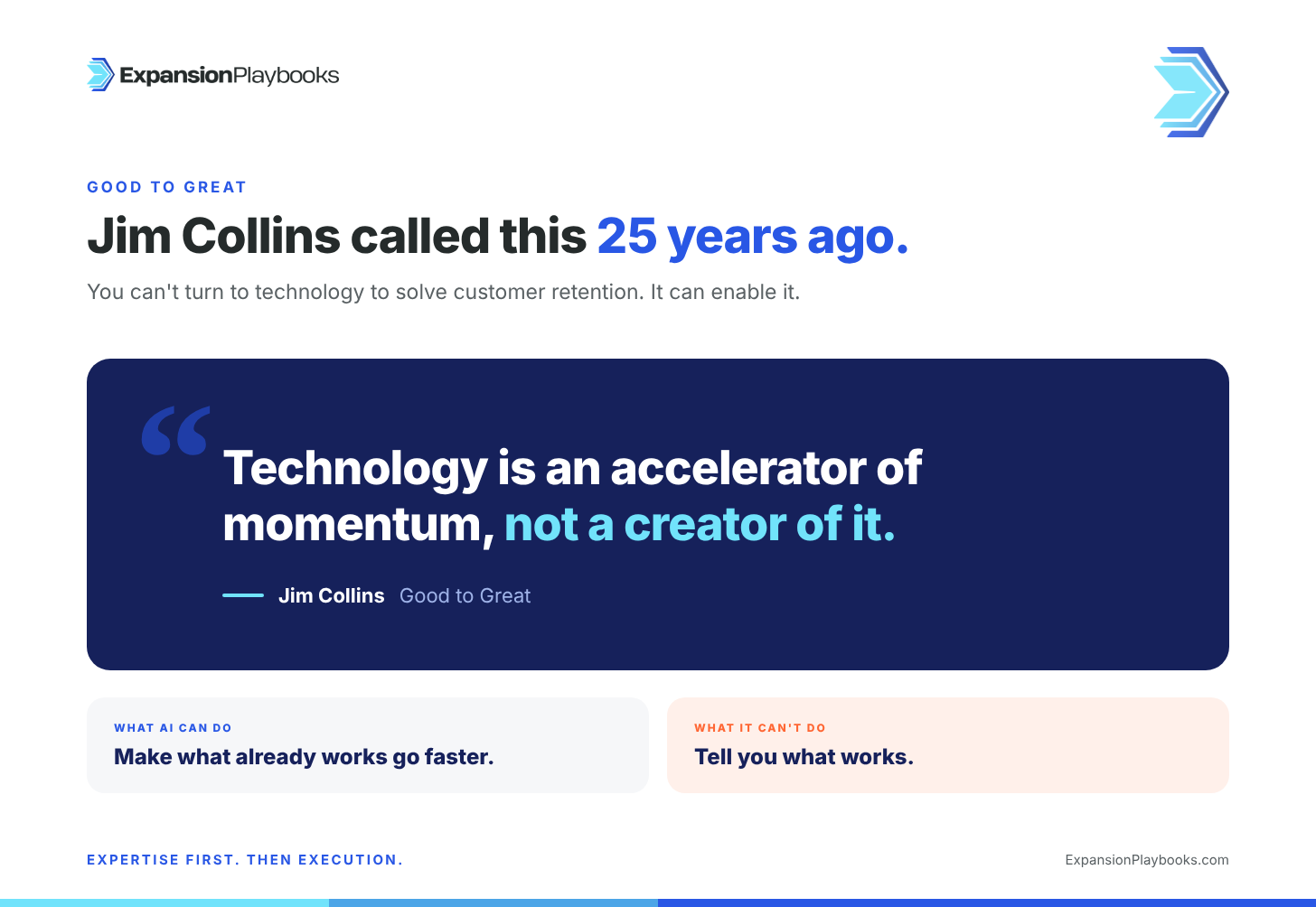
If you don't know what works, AI just changes how fast you fail.
This was the clearest thread at Moment 26 in New York. The speakers agreed on three steps: know exactly how your customers win, build the processes that deliver it, and make it real with people and agents. The room got excited about steps two and three. Step one is the one nobody showed how to build.
Rob Hardy, Global Head of Forward Deployed Engineering at Anthropic, put it on one slide: "So what's a vendor worth? Knowing how your customer's business actually runs." He said expertise is what customers will be paying for in the future. I would argue they're paying for it now. They've been hoping and trying to pay for it for many years, and we have not answered that call. (I wrote up Rob's full talk here.)
I worked with a company in the experience management world that had a severe churn problem. When I went through their post-churn interviews, one theme kept coming up. Customer after customer said, "When we bought from you, we thought you were going to tell us the best way to do these surveys. Instead, you just kept asking us what we wanted to put in them."
The customers thought they were buying expertise. The technology was just a bonus.
And now we have a new problem
There have been efficiency gains, and some cool things have been built. But now we have a new problem.
We have a proliferation of internal tools that aren't talking to each other properly, or that are doing the same job in different ways.
And we have teams that are worse off, because they turn to AI for everything rather than developing their own acumen, their own skill set, their own knowledge and expertise. Not only about how their customers win and their use cases, but about specific customers. There's no need to store all that information. There's no need to retain it yourself as you're hearing it.
You can argue that's more efficient. But it robs you of the ability to have true insight into where customers are, what needs to be done, and how to actually move things forward.
The two things you never figured out
We never confronted the real problem. And it comes down to two things:
1. You never understood what your customers are trying to achieve, and how they actually achieve it. Those two have to go together: the why and the how. The why is the result they're after. The how is what to do, and in what order, to actually get it. That's what expertise is. On the customer side, it's customer domain expertise, and it has to hold whether or not your product even exists.
2. You never understood how your company should operate to get them there. That's company domain expertise: what the processes should be and how they should interwork.
Execution is where almost everyone is focusing. And there's some blocking and tackling there you need to do. But I can promise you it will not be effective unless you've developed your expertise on how your customers win in your specific use cases.
Solve both of those first. Then you can construct tooling that drives them.
Your customer speaks three languages
Let's start with the customer, because it's the thing nobody does. Customer domain expertise comes down to three things: the why, the how, and the who.
The why, at three levels
It's one thing to understand how a customer makes money. They typically aren't going to lay that out for you, and they rarely go to that realm. They speak in terms of outcomes: the big initiatives they're trying to achieve. And the people doing the work talk about their workflows.
You have to satisfy all three levels:
1. The money. The actual economic ways you impact their business.
2. The outcomes. The core results they care about, and how those matter to their business initiatives.
3. The workflows. How what you do impacts the day-to-day for the end users, the people doing the actual work, and the outcomes tied to each one.
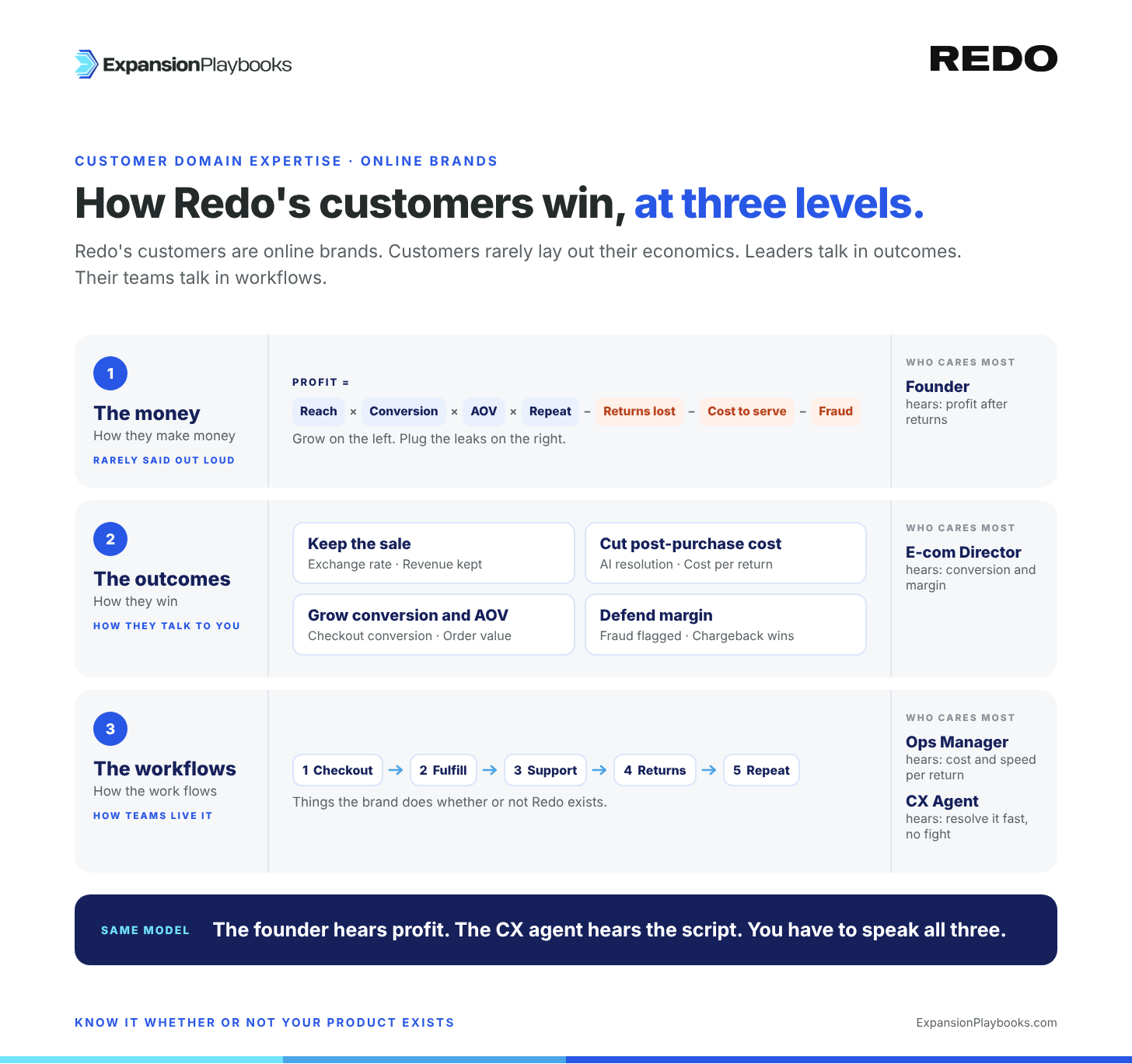
I walked through this in my iHub keynote using Redo, a local company here in Utah that is growing like crazy. Redo is in the e-commerce space, and their customers are online brands. Here's what it looks like.
The money. If a brand wants to be profitable, it needs to increase reach, times conversion, times average order value, times repeat purchasing. If any one of those goes up, they're making more money. On the cost side, it's reducing returns lost, the cost to serve customers, and fraud. These are the factors that matter to their customers regardless of Redo existing. They also happen to be the factors Redo helps drive.
The outcomes. Brands don't think in that equation. They think in initiatives: keep the sale, cut post-purchase costs, grow conversion and AOV, and defend margins. Then you ask how you'd measure each one. Keeping the sale is exchange rate and revenue kept. Post-purchase cost is AI resolution rate and cost per return.
The workflows. Checkout, fulfillment, support, returns, and repeat purchasing. These are things the brand is doing regardless of our existence.
The how: what to do, and in what order
Once you know the why, you ask what actions the customer has to take to move those metrics, and in what order. To keep the sale, the brand publishes an exchange-first policy, then sets up its returns portal to offer the exchange first, then trains the CX team on the script.
These actions have nothing to do with your product. But if they're essential to success, we have to teach them. Only then do you map your products to the actions they make easier.
The who: the roles are the change management
The roles are a different thing from the three levels. The levels tell you why the customer is buying and what has to move. The roles tell you who has to change for any of it to happen. That's the change management, and it's the part almost everyone skips.
For every workflow, you're looking at two things: who owns the process, and who participates in it. If we're not engaging each of those roles and making sure they're successful in their part of the process, the likelihood of the customer getting a measurable result goes down.
At an online brand, the founder owns the outcome and cares about profit after returns. The e-commerce director owns the outcome too, and cares about conversion and margin. The ops manager runs the process and cares about cost and speed per return. The CX agent does the work and wants to resolve it fast, with no fight. The founder hears profit. The CX agent hears the script. Same model, right altitude.
This is also where you see risk coming. If the customer isn't getting results and the ops manager who's supposed to be helping the support team hasn't been involved at all so far, that's your gap. Now you can shore it up and start making a difference.
When you put the why, the how, and the who together, you can be conversant with your customers in every frame. Here's how to win in terms of your economics. Here's how to win in terms of the outcomes you care about. Here's how to win in terms of your workflows.
It also shows you how to expand. You might start in one workflow, helping them with returns, and then eventually sell them support AI. Now you're in a second workflow. And if you're expanding a customer, you're getting retention for free.
The money, the outcomes, the workflows, and the roles are the first four of the seven questions I laid out in my piece on Kaveh Rostampor's talk. The other three: who is your customer's customer, how do they progress from value to value, and what goes wrong. Answer all seven and you know your customer.
One more: SalesRabbit
This works for any company, in any space. Here's one more, from SalesRabbit, where I built customer success from scratch.
SalesRabbit's customers run door-to-door and field sales teams. The owner thinks in revenue per rep: doors knocked, times close rate, times deal value, minus the fully loaded cost of each rep. The sales manager thinks about who to coach, and on what. The rep lives at the door and wants to win the competition.
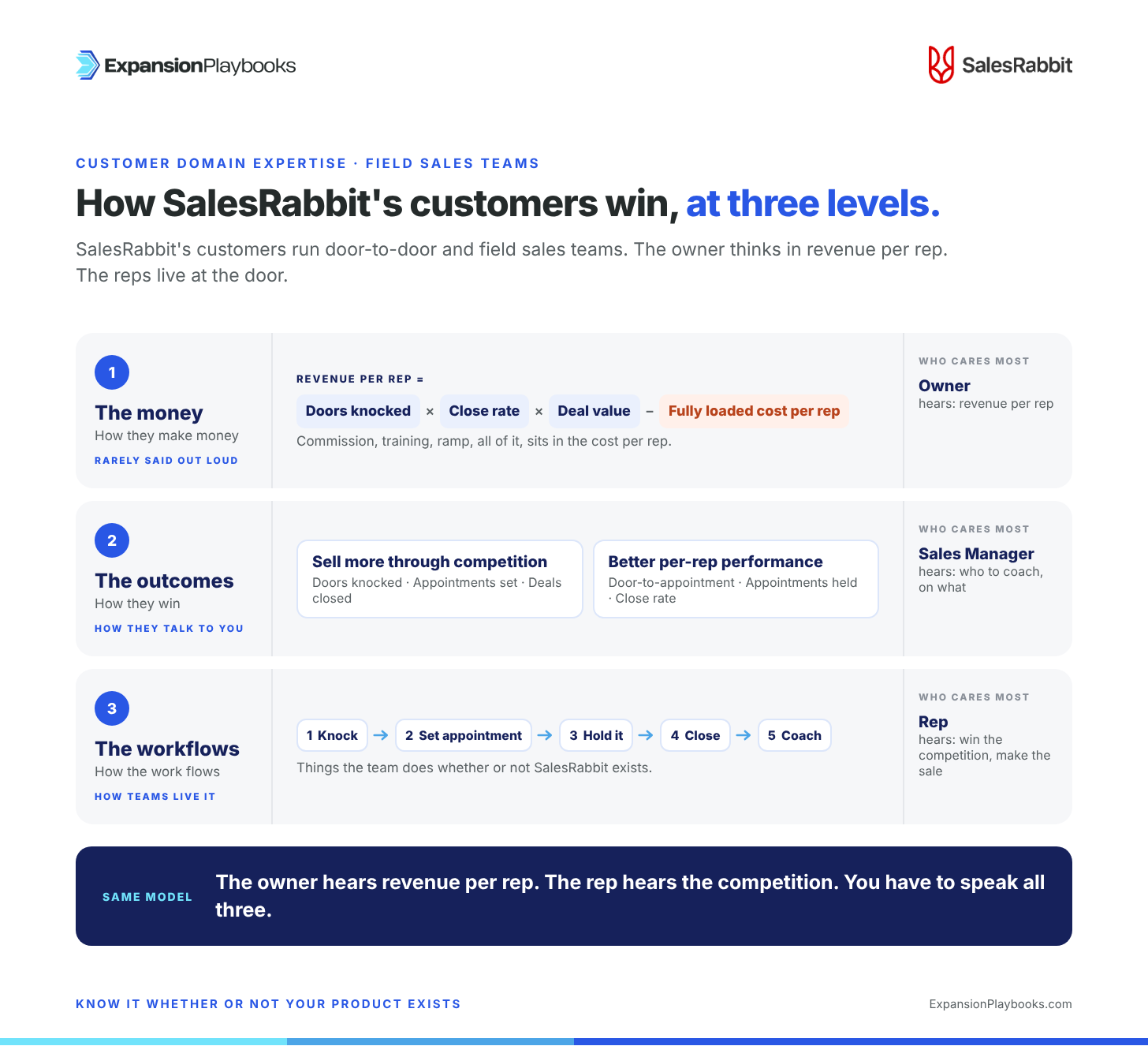
Different industry, different words. Same three levels underneath.
Want to see what this looks like for your business? Message me on LinkedIn, tell me what your company does, and I'll walk through it with you.
What happens when you start with yourself
Lovable told a story on stage at Moment 26 that shows exactly what skipping this costs. Monica Perez and Holly Goodliffe walked through how they hunted for the real early trigger among their long-tail customers. (The full write-up is here.)
First, they identified load-bearing apps: features associated with the customers who were successful. They tried to get everyone else using them. That didn't work. Then they found that load-bearing features are enabled by connectors, so they sent out their agents to get customers connecting. That still wasn't successful.
What they finally realized was that customers didn't know what to build. They didn't know what was possible, so they were getting stumped. When their interventions helped people figure out what to build, the connectors and the load-bearing features followed.
I want to give them praise for following that thread and not stopping until they figured it out. But they only got there through trial and error, because it started with them and their product instead of the customer. Start with what the customer is trying to achieve, work backwards, and you get there a lot faster.
That's the difference expertise makes to your AI. The agents worked fine. They were pointed at the wrong thing.
Now flip it onto your company
Kaveh Rostampor, CEO of Planhat, gave the room at Moment 26 three things to do to stay relevant. One of them was "learn the business, not only your function."
It sounds obvious. Proof that we don't is the fact that most of our processes are siloed. Sales doesn't get the information we need in onboarding. Product builds something close to what the customer was asking for, but not really, and it ends up being a flop once it's released.
Every framework we just ran on the customer flips over onto our side:
1. The money. How does your company make money? Net new ARR is new ARR plus expansion ARR, minus churned ARR, minus contraction. Every department has metrics that reach that line.
2. The outcomes. What does each department drive for the customer, and what does it drive for the company? Marketing helps the customer believe the result is possible, and brings the company right-fit pipeline. Onboarding gets the customer set up, running, and seeing first value, and the company measures it in time to first value. Customer success proves the full value and pursues the next one, and that shows up as gross revenue retention, net revenue retention, and expansion revenue.
3. The workflows. The processes each team runs: discovery, solution mapping, a clean handoff, the implementation plan, value realization, issue resolution.
4. The roles. Who owns each process, and who takes part.
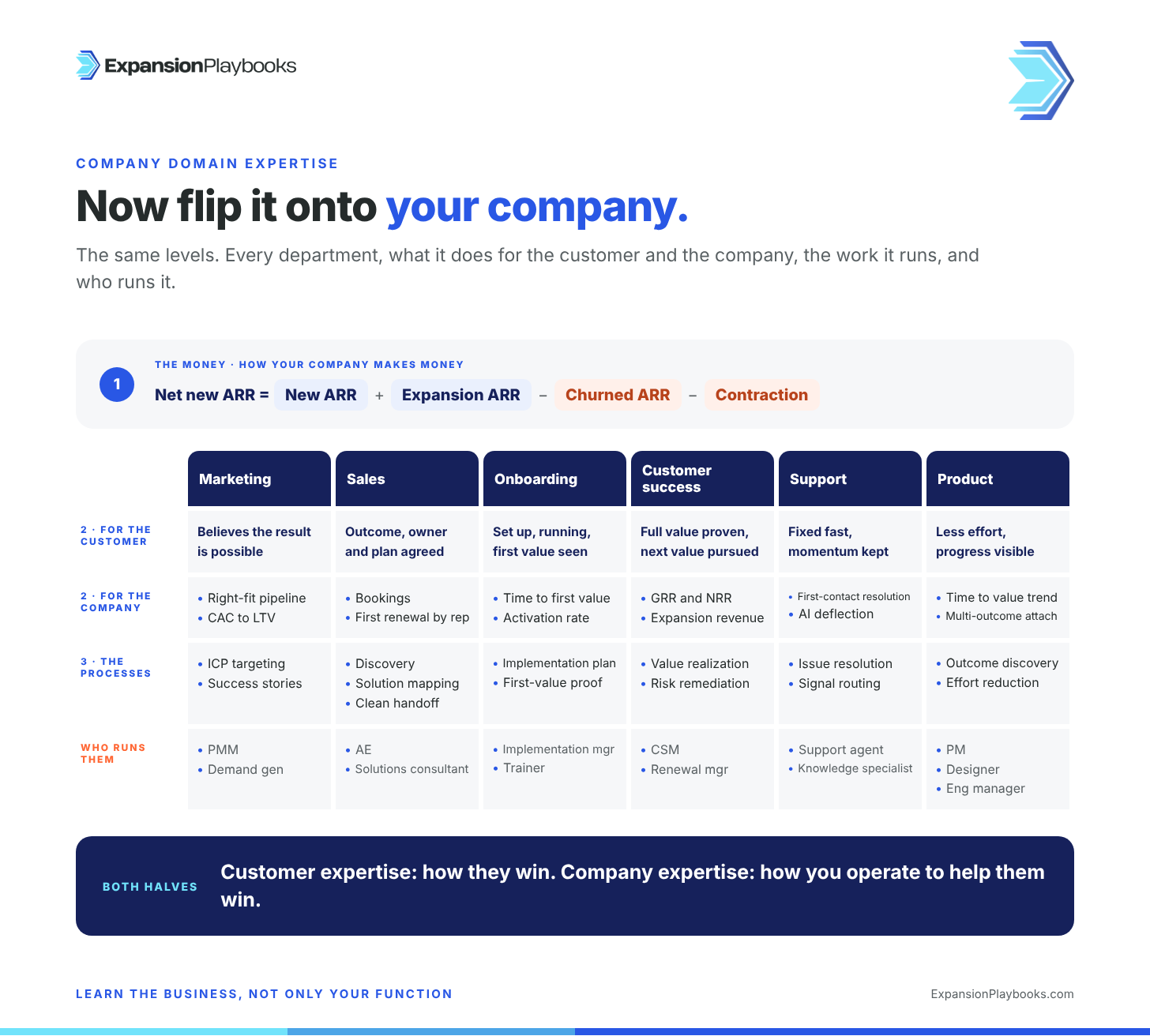
Only when you understand both those worlds can you start to build.
Then build, in this order
First and foremost, build AI tools that make your customers more successful. Second, build tools that make you more efficient and consistent at making them successful.
That order matters, because the second one drives the metrics we care about only when the first one is true. Gross revenue retention, expansion, and everything on top of it come from customers getting results.
At Expansion Playbooks, we've analyzed over a million customer records. When a customer gets a positive result, retention goes up two times. When they get a good result, six times.
So that's the brake that works every time. Know what the result is, and build every tool to get your customers there.
"Can't AI just figure this out for me?"
That's the reason so many AI projects have failed: everyone assumed AI would give them the answer. We wanted to believe we could just hand over the reins.
When it comes to execution, you can hand over a lot. When it comes to expertise, that's the struggle you need to go through and figure out yourself. Once you've owned that, you can leverage AI to its fullest.
Brakes are for going fast
Technology can never be the source of solving this problem. It's an enabler.
Your customers are trying to win at something. They need your expertise to get there, and they need someone to help them know they've achieved it.
So figure out how your customer wins. Figure out how your company operates to help them win. Then build the tools. Everyone can execute now. Expertise decides whether any of it works.
Where to start
This is why I built Expansion Playbooks. It reads your own material (your website, your call transcripts, your decks) and drafts the model of how your customers win from it. Your customers, your product, your use case. Nothing generic. Then it makes you correct that model until it's yours. From there it turns that model into the playbooks, strategies, and artifacts you run every week, and you can carry it into whatever AI you already use.
We help you become smarter, not just look smart.
See the plans and start with your own customers.
If your best customer came to you tomorrow and said, "You're the expert. I'll do whatever you say. What should I do to win?", could your team answer it? Hit reply and tell me what you'd say.