

How do you find the signal that actually predicts customer success?
The answer is what's always been true. Start with the customer and what they're trying to achieve. Then work back to how your solution helps facilitate the things the customer would need to do regardless of your existence.
That was the insight underneath one of my favorite talks at Moment 26 in New York. Monica Perez, VP of Customer Success at Lovable, and Holly Goodliffe, Head of AI-Scaled Customer Programs, walked through how they built an AI-scaled motion to help their customers actually get value from Lovable. We should be using all these amazing technologies we now have to make our customers successful. And their story shows exactly where that starts.
The short version, in three steps:
1. Interview your most successful customers first, and forget about your product for a moment.
2. Find what they have in common: the use cases, the metrics, the behaviors.
3. Turn those into your leading indicators, and engage every other customer on them.
The progression they went through
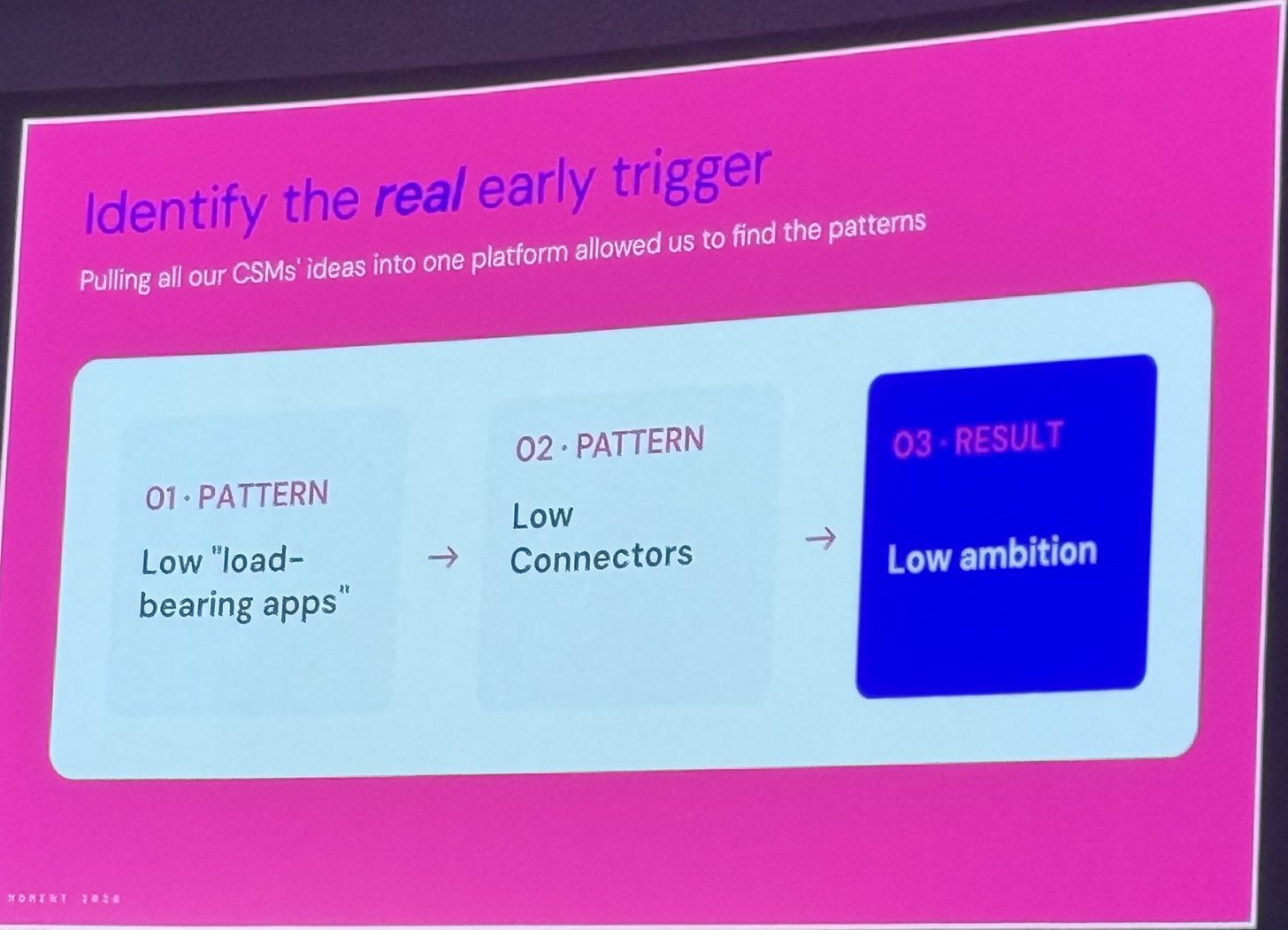
1. Load-bearing apps. They identified load-bearing features: the features associated with customers who were successful with the product. They looked across their customer base for customers who weren't using those features and tried to get them to start. That didn't work.
2. Connectors. They reasoned that load-bearing features are enabled by connectors, so if someone uses a connector, they're more likely to use a load-bearing feature. They sent out their agents to engage customers, encourage them, and invite them to use connectors. That still wasn't successful.
3. Low ambition. They framed it as low ambition. What they essentially realized was that customers weren't connecting and using the load-bearing features because they didn't know what to build. They didn't know what was possible, so they were getting stumped. When their interventions started to focus on helping the customer identify what they should build (something that would benefit them in their job or their personal life), people were more likely to add connectors and start using the load-bearing features.
That's the whole story, and I want to reinforce the value of it. Ultimately they got the right answer, and the right answer is based on what the customer is trying to achieve.
I definitely want to give Monica and Holly praise for following that thread and not stopping. "Okay, maybe it's not exactly load-bearing features. Now maybe it's connectors. Okay, maybe it's not just connectors, it's something else." Where they landed is the closest to what the customer is actually benefiting from. The customer doesn't think in terms of load-bearing features.
It was such an interesting example because their sole focus was figuring out how to make the customer successful. Because they got really specific about it, they could test different signals, and see not only whether they'd found the right signal, but whether their intervention actually moved the needle in helping customers consistently succeed. One of their slides said it plainly: "The customer work comes first."
The mistake: starting with your product
Here's the part I want to highlight. They got there through trial and error. They could have gotten there a lot faster if, instead of focusing on their own features, they had started with the customer's success and the outcomes customers need to achieve, and worked backwards.
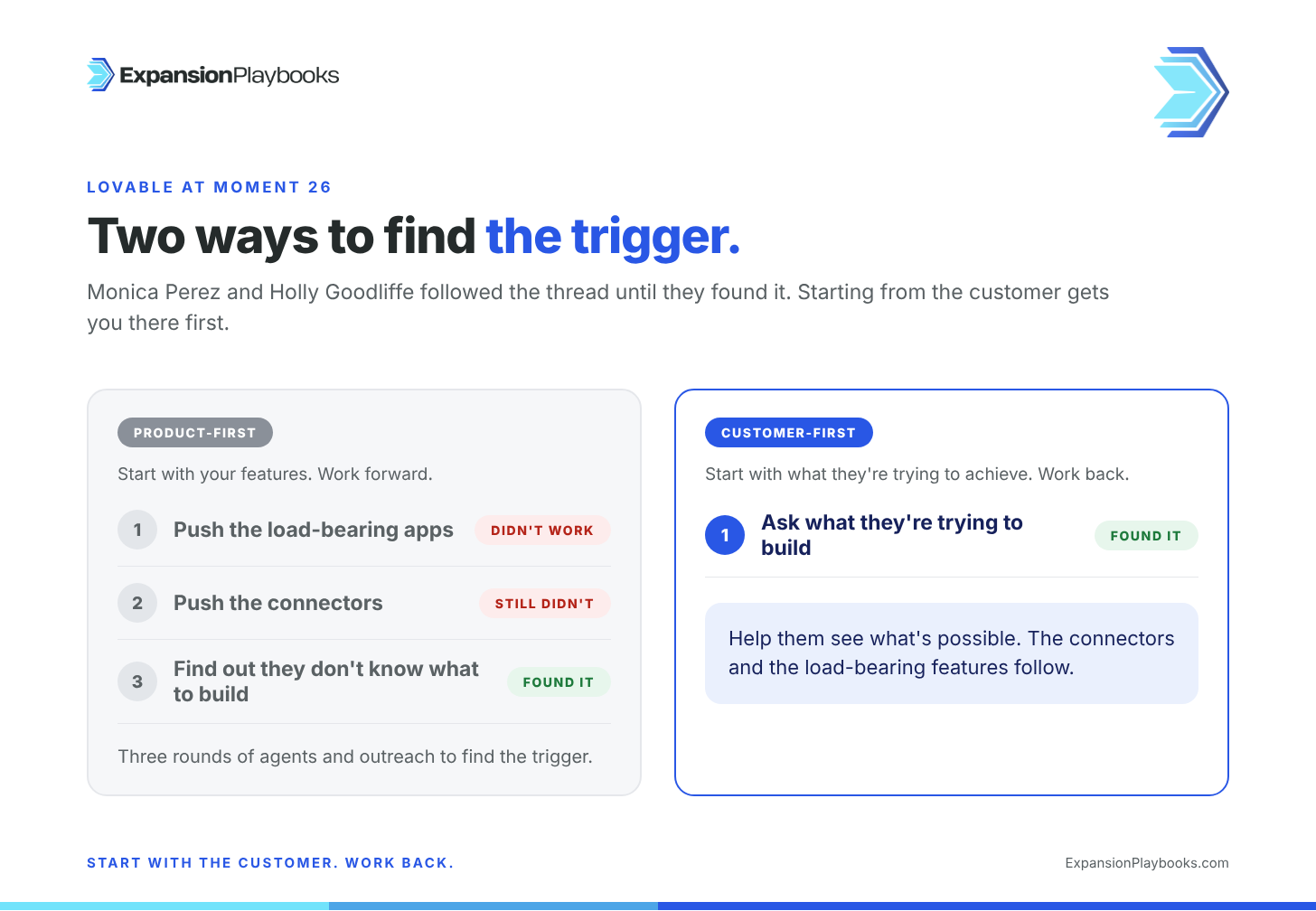
The mistake everybody makes is starting with you and your product instead of the customer. We have this common idea: "We have these products, and people like these products, so we have to get people to use the products that people like." That approach clouds your vision because it lacks real context.
I made the same mistake at SalesRabbit
When I was a first-time customer success leader, I was at SalesRabbit, an app for door-to-door sales companies and field sales teams. I did the same thing. I identified that our most successful customers were heavy users of our dashboard performance tracking tool.
What did I do? I said, "Let's look at all of our customers that aren't succeeding, get them on email campaigns, and call them up. We're going to train them as much as they want on how to use our dashboard. We're going to help them set it up. We're going to help them build out all their tracking widgets, and we're going to do whatever it takes to get them to start using it."
We even created a leaderboard of how many customers were trained and how many had built out their stats. Nothing changed. Successful customers were still using the dashboards heavily, and the customers who were failing still weren't using them at all. That stumped us. We knew the successful customers used it a lot. Shouldn't the answer just be getting the failing customers to use it?
We were starting from our product and trying to project it onto the customer. We should have started with the customer: what they're doing, what they're trying to achieve, and how they operate their business. Then worked back to where our product fits in.
"How are you using our dashboards in your day-to-day work?"
So we started interviewing our most successful customers, and we asked them that one simple question. The first one broke it down for us: the dashboard is the heart and soul of our competitions.
If you're doing door-to-door or field sales, one of the keys to doing it well is creating competition among your sales reps. They'd pick a stat, whether it was doors knocked, appointments set, conversion rate, or deals closed, and run a competition. The only way to win the prize (and it was a pretty meaningful prize, like a $100 gift card to Ruth's Chris) was based on your stats in SalesRabbit.
That not only drove competition, it drove buy-in for tracking everything in the system. It wasn't the dashboard itself that made them successful. The dashboard facilitated running competitions, and running competitions is what the most successful sales teams were doing. The teams that were struggling were the ones that weren't running competitions every week with a prize.
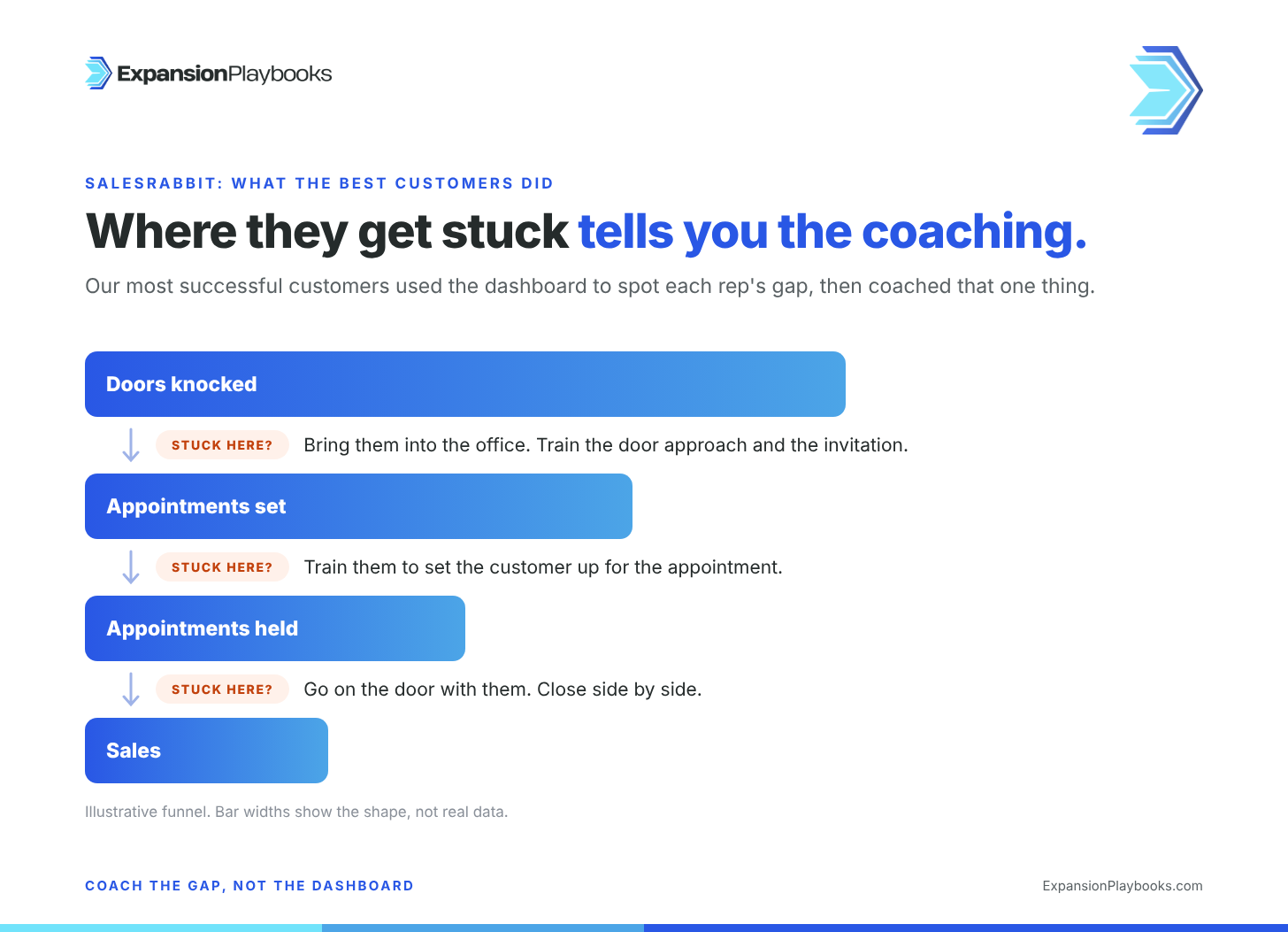
The other thing we learned is that they used the dashboards to coach, and to spot each rep's training needs:
- If a rep was getting a lot of door knocks but not enough appointments, they'd bring them into the office and train them on their door approach and their invitations.
- If a rep was getting a lot of appointments but the appointments weren't holding, they'd train them on how to set the customer up for the appointment.
- If the appointments were holding but they weren't closing sales, they'd go on the door with them and help them learn to close, side by side.
That gave us what the customer was really trying to achieve:
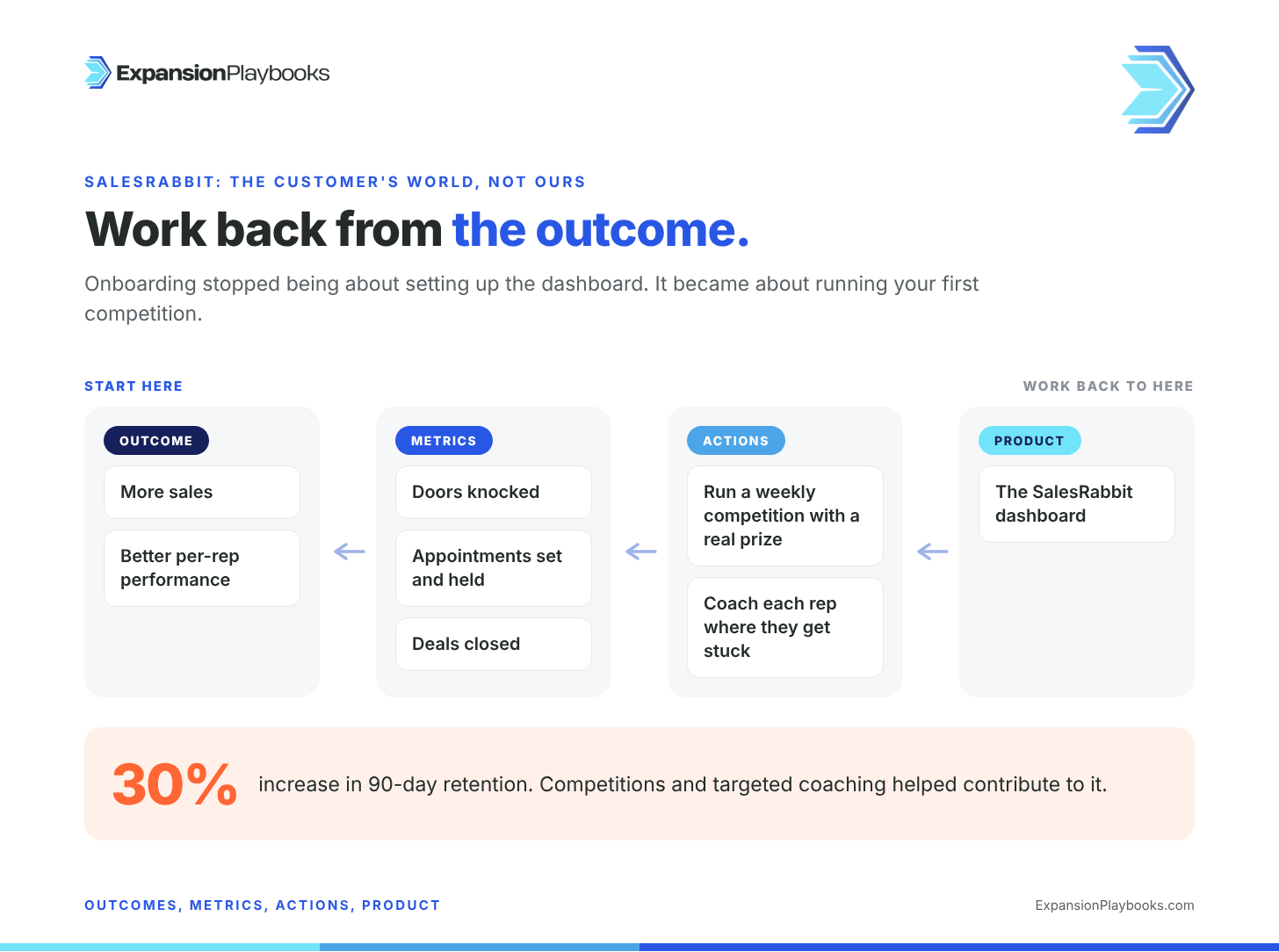
1. More sales through better competition
2. Better per-rep performance through targeted coaching
We made our interventions about their outcomes
From there, we could work back and focus our efforts on the customers who were failing or struggling. We stopped asking them to adopt the dashboard or offering trainings on how to set it up. Instead, we made our interventions about those customer outcomes.
During onboarding, instead of a session where we set up the dashboard, we set it up for them ahead of time. Then we'd say, "This session's about how we're going to run your first sales competition to kick things off." We'd talk about what competitions they'd run in the past. If they hadn't, we'd walk them through setting up their first one.
That led to higher adoption of the dashboard. More importantly, it led to more sales, with the team using the app to sell more efficiently. Same thing with coaching: we had another session on how to use the data to give your reps targeted coaching and feedback. No more sessions about how to use the dashboards more. Running competitions and targeted coaching this way helped contribute to a 30% increase in our 90-day retention.
How to use the dashboard is our world. Our product. That's how we think. We need to think in terms of the customer's world: what the customer is trying to achieve. That's the same insight from Monica and Holly's talk.
At Expansion Playbooks, we've analyzed over a million customer records. When a customer gets a positive result, retention goes up two times. When they get a good result, six times. The result is the signal.
How do you do this?
Interview your most successful customers first. In whatever areas you have a hunch there's an opportunity to make customers more successful, understand what those outcomes are. Forget about your product for a moment. When you talk to your most successful customers, figure out:
- What are they trying to achieve?
- How have they achieved it?
- What mattered?
- What behaviors needed to change?
- What process needed to be put in place?
Then work back to how they're using your product to do that. Talk to three or four successful customers. I promise you there will be commonalities: in the use cases, in the metrics they're trying to push, and in the behaviors that are key to their success.
Capture those as your leading indicators of risk and your leading indicators of opportunity. Then engage your customers with expert content, expert insights, and expert recommendations, delivered through AI agents, targeted emails, and other outreach that actually makes them more successful. That, in turn, drives far more effective adoption of your solution.
In Lovable's case, it's figuring out what this customer needs to build to be better at their job, more efficient in their work, or to get promoted. In SalesRabbit's case, it was running sales competitions that drove meaningful sales, and enabling managers to coach so their reps could perform at a higher level.
So before you build the next agent, the next campaign, or the next playbook, go talk to your three most successful customers. Ask what they're trying to achieve. Then work back.
What's the "load-bearing feature" your team keeps pushing? Hit reply and tell me.