
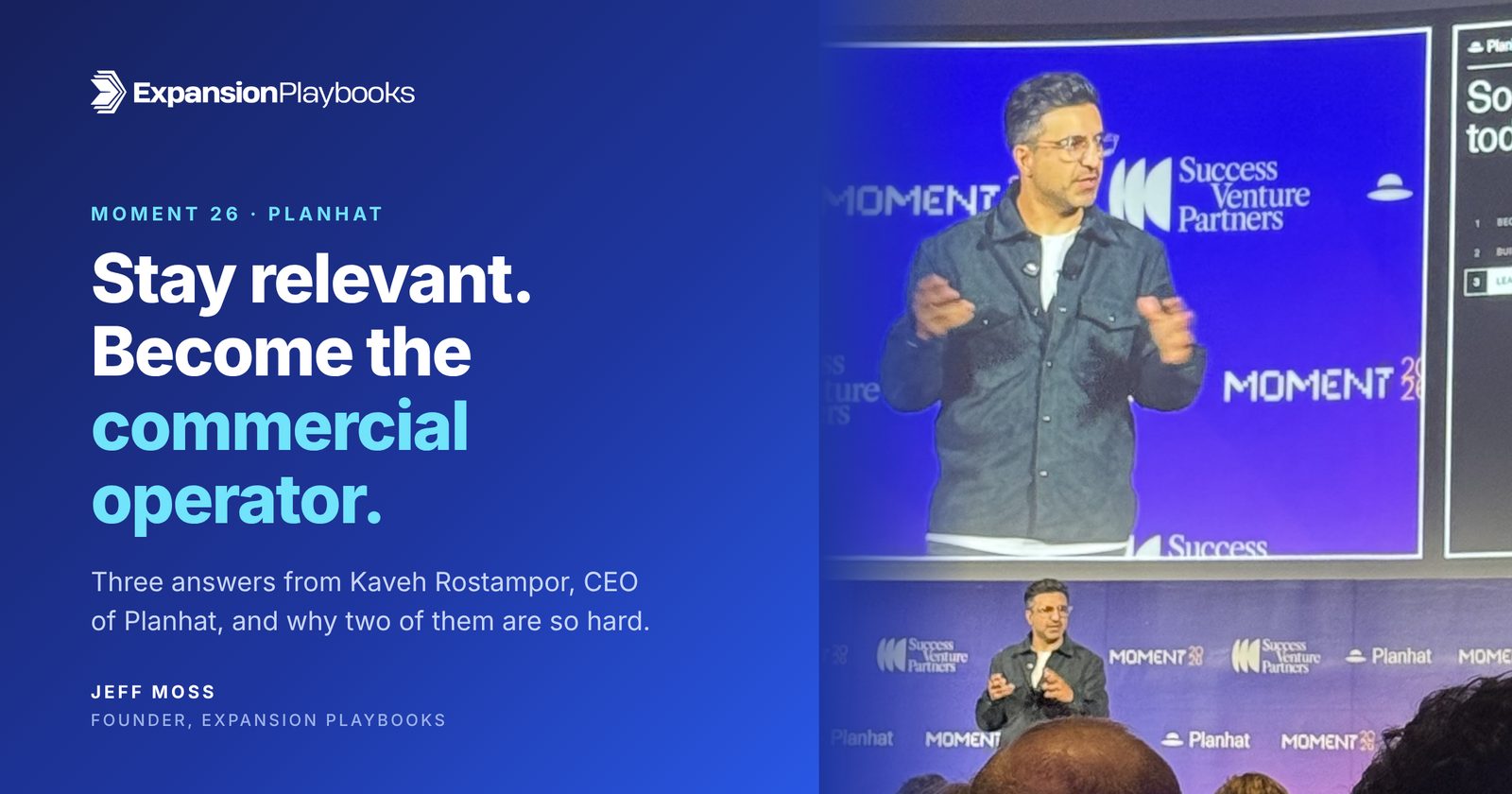
At Moment 26 in New York, Kaveh Rostampor, CEO and co-founder of Planhat, asked the question everyone in customer success is asking in 2026: what should you do today to stay relevant? He meant all of us: the leader, the CSM, the onboarder.
He opened with why the question matters. His slide cited McKinsey ("39 percent of respondents expect AI to decrease their organizations' overall head count over the next year") and the World Economic Forum ("41% expect to downsize their workforce as AI takes on more of the work people do today").
Then he gave three answers:
1. Become exceptional at understanding customers.
2. Build your own workforce.
3. Learn the business, not only your function.
I agree with all three. And I think people are already getting pretty good at the second one. They're building agents and setting things up. Whether those are working is a different question, but they're learning the skill of setting them up and creating those force multipliers.
Numbers one and three are the problem. On the surface they seem like things we should know almost intuitively. They're actually the biggest barriers to why so many AI solutions are failing, and why so many implementations and strategies are failing at companies. Neither has ever truly been articulated.
Rob Hardy said the same thing
Rob Hardy, Global Head of Forward Deployed Engineering at Anthropic, spoke at the same event and reinforced one and three from a different angle:
1. Be the consultant in your vertical. Understand your customer exceptionally.
2. Stop drawing the line between pre-sales and post-sales. Understand how your business operates, so you can facilitate success instead of focusing only on your job.
When the CEO of Planhat and the head of forward deployed engineering at Anthropic land in the same place, it's worth paying attention.
From the old world to the commercial operator
Kaveh's other big insight was the shift from the old world to the new one. In the old world, there were all the different roles: salesperson, CSM, support rep, implementation manager, renewal manager. In the new world, there's a commercial operator: someone who understands the customer, understands revenue, understands the product, understands delivery, and can orchestrate people and agents.
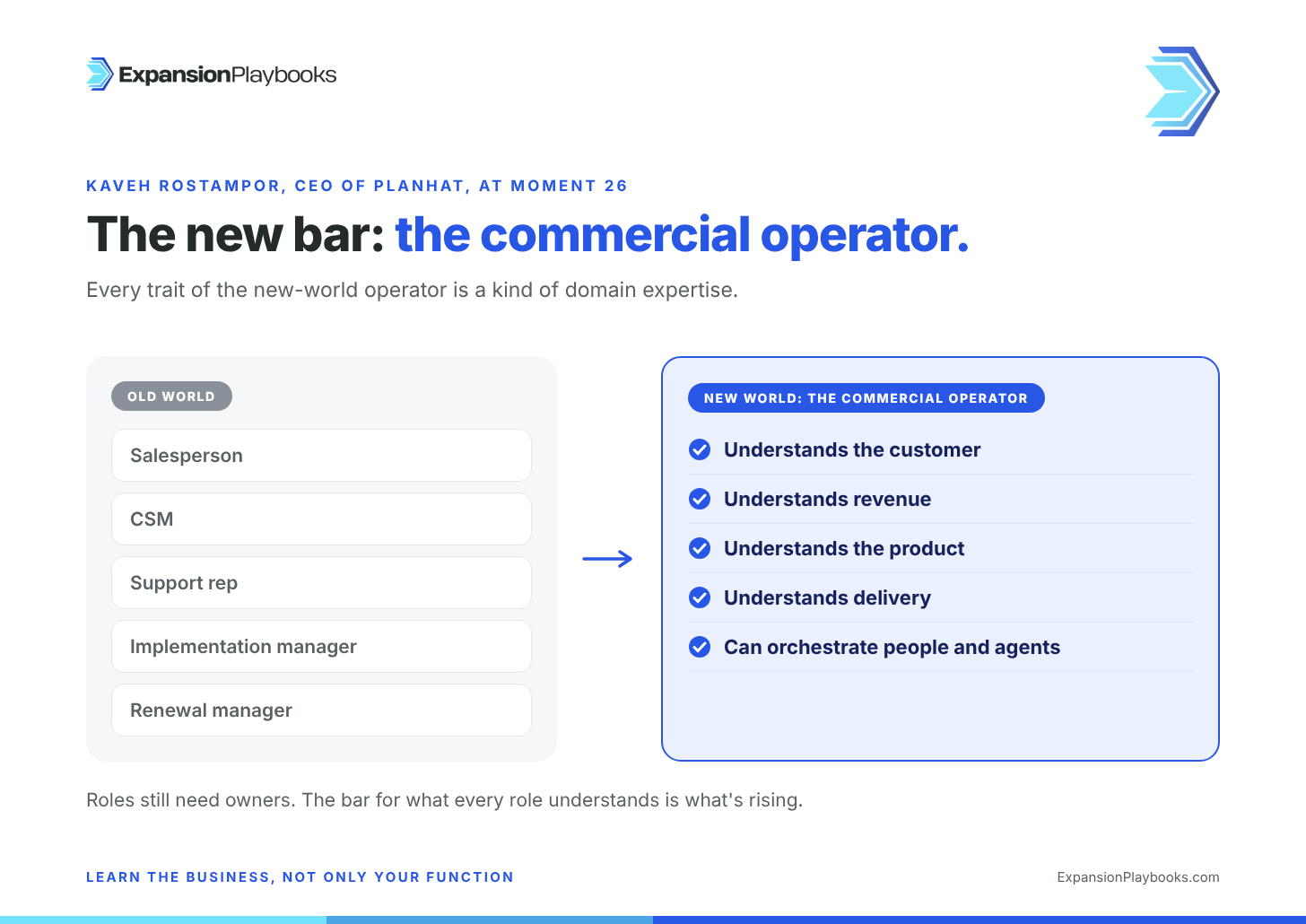
I totally agree, especially about becoming this commercial operator. Even if all those roles don't go away, I still believe there will be definitions. There are still roles and responsibilities, and every responsibility in a company needs a single owner.
But the bar is rising on what each person in a company needs to understand, not only to succeed in their role but to help the broader organization succeed. We all have so much more influence than we realize. Technology can take the insights and expertise each of us has developed and scale them to influence so much more: beyond our own role, beyond our own team, and ultimately to make our customers more consistently successful.
Kaveh's advice for getting there was to think like a commercial leader:
- Know your value proposition. Why your product? Why now? Why are customers struggling? Who's successful, and why?
- Know it across every function. Customer success, sales, support, product, services, marketing, and more.
In the old world of SaaS, you could be lazy
Especially in customer success, we know this firsthand. In the old world of SaaS, you could be pretty lazy. You could focus on logins. You could focus on license utilization, because technically that's what they were paying for, even though you never should have. It was a temptation, and you could get away with it most of the time.
We said we were focused on outcomes. We said we were strategic and consultative and helping customers be successful. It wasn't what was happening in most conversations with customers, at most companies, and it still isn't. I don't even blame people for it, because I don't think they ever dealt with the first thing Kaveh named: becoming exceptional at understanding your customers.
What does that even mean? Who is your customer? You have end users, project managers, executives, and each of them cares about different things. Sometimes you can't even meet with half of them. You serve different use cases, in different industries and verticals, at different sizes: enterprise, mid-market, SMB. And almost always, we start with ourselves and try to understand our customers from that perspective.
How do you understand your customer exceptionally?
It maps to seven core questions I believe everyone has to answer. If you want an easy way to do it, I've built a tool (Land the role) that walks you through them.
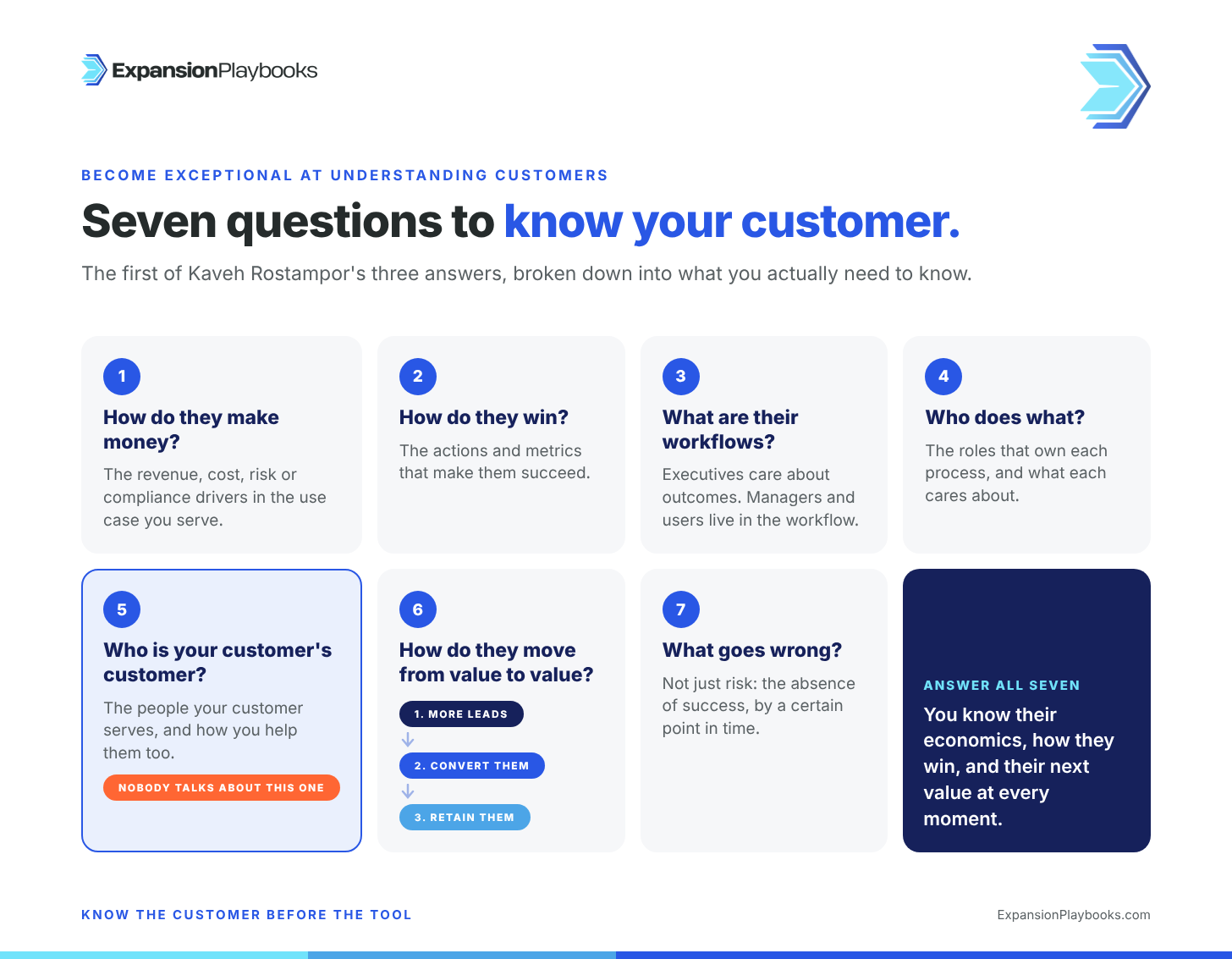
1. How does your customer actually make money in the use case you serve? What revenue drivers are they going after? What cost drivers, risk, or compliance?
2. How do they win? What are the actual actions, products, and things necessary to help them succeed? What metrics are they trying to move?
3. What are their workflows? It's one thing to understand the outcomes you drive. But the executives care about certain outcomes, while the managers and end users care about certain parts of their workflow.
4. Who does what? Within those workflows and outcomes, which roles own which processes? What do they care about? Who's involved in which process?
5. Who is your customer's customer? This is the one nobody talks about when we say "know your customer." If you help IT teams, your solution is most likely helping the IT team serve the departments they support. If your product helps ecommerce companies with email marketing, they're also serving their shoppers. How does your product help those shoppers find the products they need, with the discounts they want?
6. How does your customer progress through value? What's the first thing they should go after? The second? What's the expansion pathway? I don't mean us selling more products, although we will and our products should facilitate it. There's a sequence of value, for example:
- We're going to help you get more leads.
- We're going to help you convert those leads.
- We're going to help you retain those customers.
There has to be a sequence for how someone succeeds and moves from value to value.
7. What goes wrong? What are the leading indicators, the signals? The mistake is to think of these purely as risk. I'd call it the absence of success: the things we know lead to success that aren't present at a given customer by a certain point, which we should be addressing.
If you can answer those seven questions, you know your customer. You know their economics: how they make money. You know what they have to do to win. You know the workflows that matter to their business and who does what. You know who they ultimately serve. And you know their next value at every moment, and what could go wrong.
Learn the business, not only your function
Kaveh's third answer is another big missed opportunity. It sounds obvious: "Well, yeah, I know what marketing does, and what sales does, and what product does." The proof that we don't is that most of our processes are siloed:
- Sales doesn't get the information we need for onboarding before they hand the customer over. And we don't give them back what they need to know: what's working in onboarding, what isn't, and what would help them give us.
- Product builds something that's kind of what the customer was asking for, but not really, and it ends up a flop once it's released.
This is where the two answers build on each other. If we first understand exceptionally what our customer is trying to achieve, it puts our own business in context:
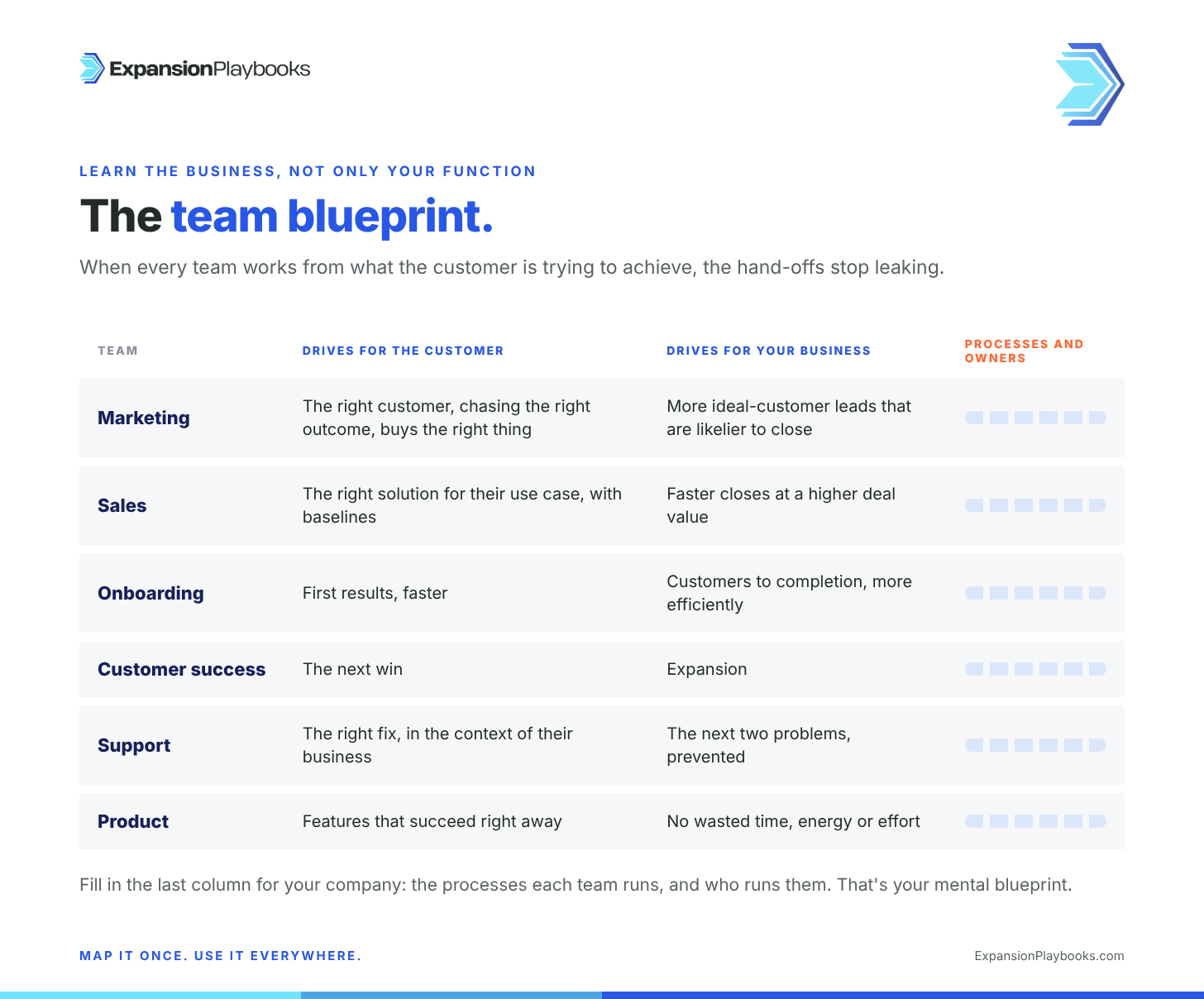
- Marketing knows who to go after, and what information they need to target the right customer, interested in the right outcomes, for the right use cases.
- Sales can assemble the right solution for the right use case, so the customer comes in knowing what they're trying to achieve, with baselines. They close deals not only faster but at a higher deal value.
- Onboarding gets customers not only to completion but there more efficiently, and delivers first results faster.
- Customer success queues the customer up for the next win, and drives their expansion.
- Support always knows the context when a customer is struggling or something's broken. Is it impacting their business? What exact solution would resolve the immediate need and also prevent the next two problems they might run into?
- Product gets our suggestions promptly, and builds them in a way that succeeds immediately without wasting time, energy, and effort.
Each of those teams has processes and metrics they drive. You have your own role with specific responsibilities. But when you have that mental blueprint, there's no limit to the influence you can have, as Kaveh says, as a commercial operator.
At Expansion Playbooks, we've trained over 1,000 reps across support, customer success, onboarding, sales, product, and marketing. Every one of those teams works better when it can see the whole system.
How do you build that blueprint?
I've built a blueprint (Lead the team) you can use, but you can also do this yourself:
1. Map out the departments. All the core ones: marketing, sales, onboarding, and the rest.
2. Write down the outcome each one drives for the customer.
3. Write down the outcome each one drives for your business. Marketing brings in the right customer, trying to achieve the right outcome, so they buy the right thing. For the company, that means more ideal-customer-profile leads with a higher likelihood of closing.
4. Map out their processes. Marketing runs ads, does events, publishes success stories, writes the blog, and runs webinars. What are all the processes each team runs?
5. Name who runs them. Is it the content manager, the product marketing manager, or the VP of marketing?
6. Look for the synergies. When you're solving problems in your own area, I promise you'll find them. Making your customers more successful naturally produces success stories you can funnel to marketing for more targeted promotions, and to sales to help them close faster and model new deals after successful customers.
That's why technology becomes a catalyst to your understanding rather than the source of your expertise.
Which of the seven questions would your team struggle with most today? Hit reply and tell me.