I was recently running a training session for a customer success team at a company that builds AI for personal injury law firms. Their product is a set of AI agents that take work off a firm's plate: drafting demand letters and other documents, handling client intake, summarizing medical records.
Near the end, one of the CSMs brought up an account he was worried about. The customer, a solo attorney, was complaining that the software was clunky and wasn't doing what he'd hoped it would. One feature in particular: the agent that drafts his documents wasn't writing them the way he wanted. And the CSM could feel the account slipping. If that one agent didn't work the way the attorney pictured it, the attorney was ready to decide the whole product didn't work.
So what do you do with a customer like that?
It's the right question, because almost every CS team has this customer. The one who zeroes in on the thing your product doesn't do the way they wanted, and lets it decide everything.
My answer was that the whole framing of the problem was wrong. The attorney was asking, "Does this agent do exactly what I pictured?" The real question is, "Is this helping me run a better law firm?" Are cases getting resolved faster? Is the firm operating better than it was? Is the practice growing?
None of that comes down to a single feature. It comes down to several things, including plenty the attorney could be taking advantage of beyond that one agent.
The mistake everybody makes is starting with the product
The mistake everybody makes is starting with what the product does and working backward to why it matters. Here's the agent. Here's the feature. Let's get it set up. And then, once it's live, we try to attach some value to it.
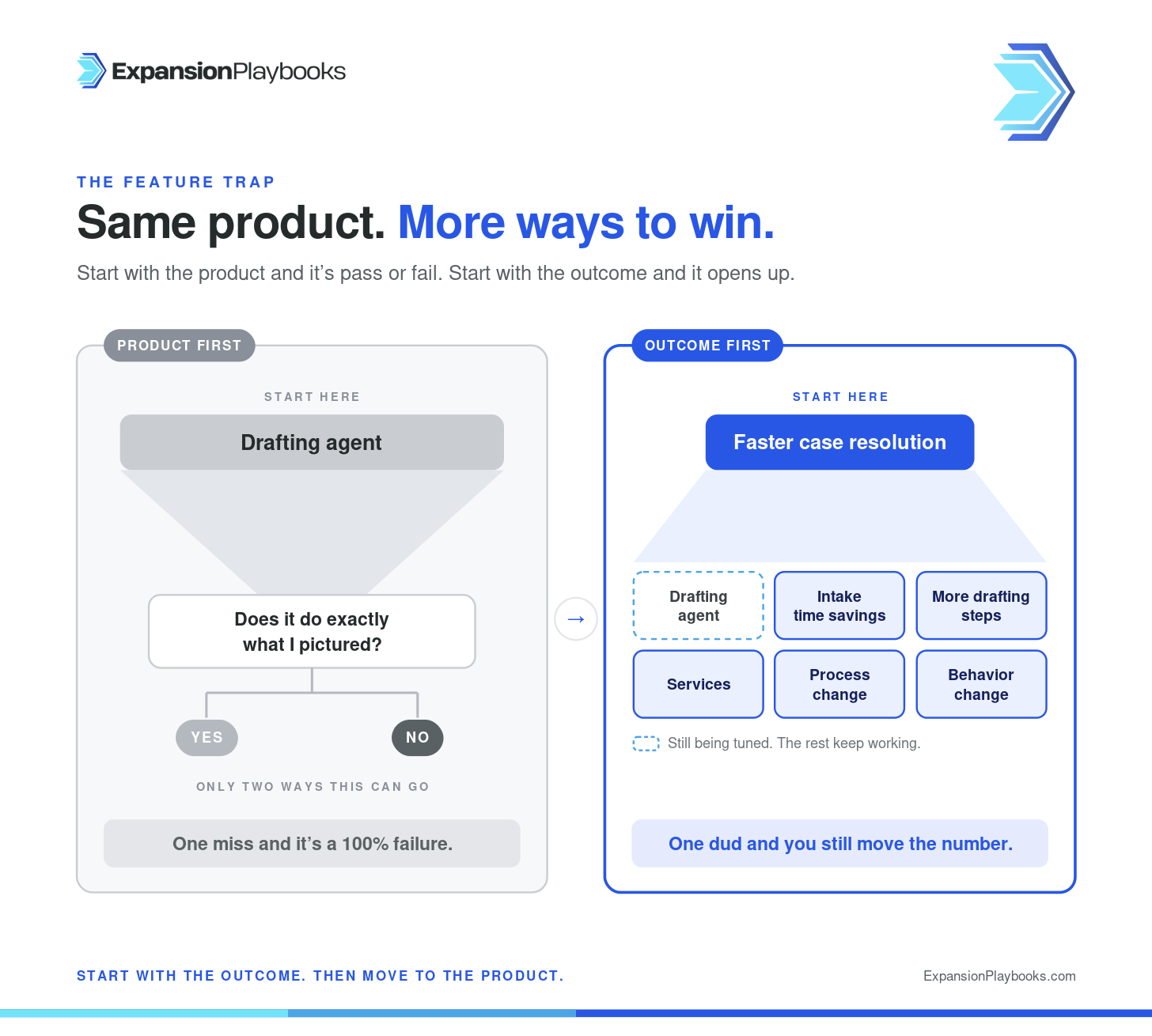
When you start with the product, you create a binary. Either it does exactly what the customer envisioned, or it doesn't. And if it doesn't do exactly what they envisioned, it's a 100% failure. There's no middle ground.
But think about that for a second. Why would any product do exactly what the customer envisioned? The product isn't built on what one customer thought they needed. It's built on the outcomes you're trying to achieve for customers in their given use cases, across hundreds or thousands of them.
And the customer usually isn't doing things the best way. They don't always have the best process. That's the whole reason they bought your product. Even if they won't admit they need to change, the act of purchasing is an admission that things could be better. We probably need to change some things if we want better results.
Even with that as the underlying truth, change is still hard. People don't want to change. They want the thing automated so it does it for them. But if you want better results, even with the most effective technology, you will need to change how you work.
So start with the why, then move to the what. Start with the outcome, then move to the product. Never the other way around.
The Feature Trap
I call this the Feature Trap: when you lead with the product, the whole relationship shrinks down to one yes-or-no question about one feature, and you hand the customer the power to fail you on it.
Picture a funnel. If you start with the product, the product is the widest part, and it only gets narrower from there. Here's this product, and it works. Or here's this product, and it doesn't.
Now flip it. Start with the outcome, and the funnel opens up. All of a sudden you have:
- the metrics you can start driving
- the actions the customer can take
- the products and services you can bring to bear
- the process and behavior changes that make it stick
When you start with the outcome, there are multiple things that can move the needle. If one thing isn't perfectly right, you can still move the number with other parts of the solution.
Two customers, same product, opposite verdicts
I ran into this in my first role in customer success at SalesRabbit, and it confused the heck out of me.
I could onboard two customers that looked nearly identical. One would take it on and get tons of value. The other would say, "Well, if you don't have this one feature, I wouldn't even pay for the features you do have."
Meanwhile I had other customers using fewer features than that customer was asking about, and they were happy to pay the fee and happy to grow their use of it.
How can that be? How can two customers that look so similar end up in opposite places? Why is one using the product successfully, paying, and expanding, while the other is nonstop complaining that it's worthless and looking for the exit?
This is the fear everybody carries in customer success. It's oftentimes why we don't get into the weeds with customers, or why we steer around certain topics. We think, "Whenever customers really dig into this product, they get disappointed."
But for every customer who goes into a specific feature and says, "This thing's junk, it doesn't do what I was hoping," there are hundreds, if not thousands, of customers paying you right now for what your product does do. They don't have the same doom-and-gloom reaction to what it can't do.
Same product. What I found out was that the difference was where we started. With the unhappy customers, we had started with the product, and we'd set ourselves up with the narrowest possible definition of success: the product does exactly what I hoped, or it doesn't. That can only go two ways. We were doing everything backwards.
The customer who should have gone live six weeks ago
The lesson that stuck came at SalesRabbit too, and I learned it from our CEO.
I was helping onboard a new large customer alongside one of our CSMs, and I fell right into the trap. We were working with their head of IT, and we were stuck in a long, drawn-out onboarding. We weren't launching, because the head of IT kept saying, "We can't really go live until you fix and improve your integration. We really can't start using this product until you add these other three features. This thing isn't what we expected."
And I was nodding along. I was focused on everything the customer said was missing, and I was saying, "Well, I guess you're right. We can't go live until those things are corrected."
Then I talked to my CEO. He said, "What are you doing? This customer should have gone live six weeks ago. They're missing out on all this value. They could have been tracking their leads already. They could have been using this for competitions with their reps. They could have been getting data they'd never had before."
Yes, it would be great to get more into the integration. Yes, some enhancements would help, and we'd work on those. But every week that went by, they were missing out on massive value from improving their field sales team's performance.
When we got on the phone with the CEO of that company, he was frustrated, and it wasn't with us. He reprimanded his head of IT: "Why are we delayed on this?" He saw the exact same thing my CEO did. You're missing out on tons of value by waiting for perfection. The whole reason they bought was to give their sales team better visibility into their leads, and to give their leaders better visibility into the performance of the team. They could get that today. It might not be exactly how they imagined it. It might not be fully automated yet. But they were missing out every day that went by.
That taught me to think the other way. Start with the outcome:
- Improve how we track our sales team's lead funnel when door knocking.
- Increase our close rate by giving leaders better data on how reps are performing at the doors they knock and the contacts they make.
With outcomes that clear, nothing hinges on one feature. The lead management product helps. The dashboards and analytics help. The out-of-the-box integration, imperfect as it was, helps. The data integration could give the team better insight into the leads they'd be working in a given neighborhood. Each one contributes to better lead management, a higher close rate, and a more efficient team, because leaders can finally see where reps are struggling.
Waiting for perfection is the Feature Trap in its purest form. A feature is either finished or it isn't, and while you wait, the customer gets nothing.
Put every way to win on one map
This is exactly why I build what I call a Customer Results Map. The outcomes go on top. Underneath each one goes everything that can move it.
Here's what that looks like for SalesRabbit today. Their customers are trying to win on four outcomes:
- Increase time spent selling
- Increase lead conversion from selling
- Increase quota attainment across the team
- Improve visibility into field activity and pipeline
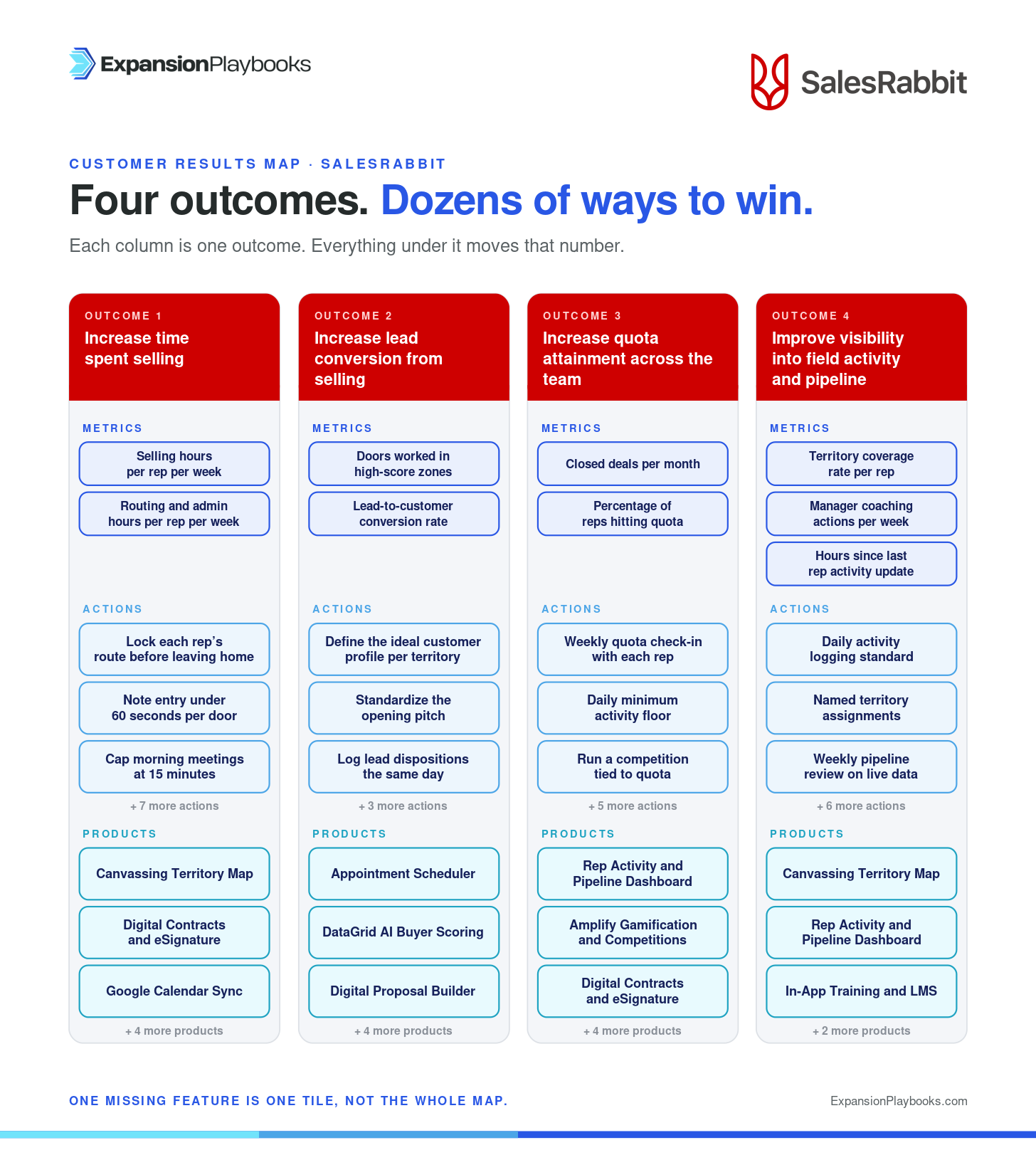
Under each outcome there are three layers.
The metrics: how you know it moved. As an example, for time spent selling, it's customer-facing selling hours per rep per week.
The actions: what the customer does to move it. Build and lock each rep's daily route before they leave home. Keep note entry at each door under 60 seconds. Cap the morning team meeting at 15 minutes.
The products: what helps them do it. The canvassing territory map. Digital contracts and e-signature. Calendar sync.
Every outcome has two or three metrics, six to ten actions, and five to seven products underneath it. Count them up across all four and there are dozens of ways to move the numbers that matter.
Now put three missing features next to a map like that. They're a handful of tiles out of dozens. Real, worth building, worth fixing. But nowhere near the whole story. When a customer can only see the one feature that isn't working, your job is to put the whole map in front of them.
If you're clear about what you're trying to achieve, that's where the creativity begins. That's where you find new and unique solutions, combining different products, different services, different behavior change, and different best practices to start moving the needle.
The outcome is your leverage
So back to the solo attorney. Here's what I told the CSM.
If you start with "Here's the drafting agent, it's going to be awesome, let's get it up and going," and it doesn't handle the attorney's specific way of working, you're stuck. That's a binary. Either the drafting agent worked or it didn't.
But if you start with the outcome, the conversation changes. "You want to resolve cases faster and run a better firm, is that correct?" Now you're not talking about one agent. You're talking about everything that moves that number.
Here's what that looks like on a Customer Results Map for a personal injury firm. There are three outcomes that matter most, in this order: faster case resolution, greater case volume, and higher case value.
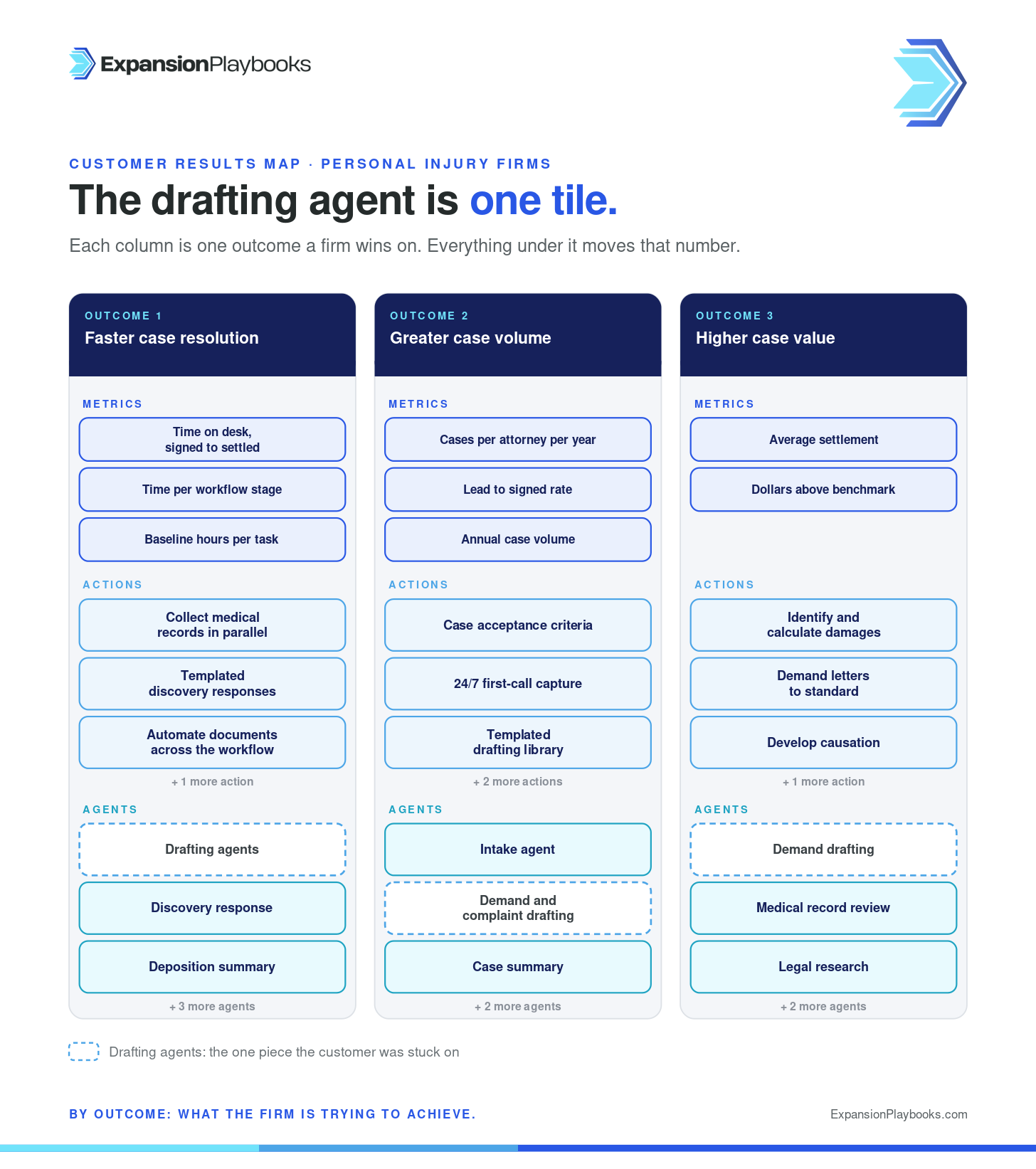
Each outcome has a primary metric. Faster case resolution is time on desk, the days from signing the client to settling the case. Case volume is cases per attorney per year. Case value is the average settlement. Under each one sit the actions the firm takes and the agents that help.
Look where the drafting agent lands. It's one tile. Under faster case resolution alone, there's collecting medical records in parallel, templating discovery responses, and automating documents across the whole workflow, plus agents for discovery responses and deposition summaries.
You can look at the same map a second way: by workflow. A case moves through four stages: intake, pre-litigation drafting, discovery, and litigation. Each stage has its own measures, its own actions, and its own agents.
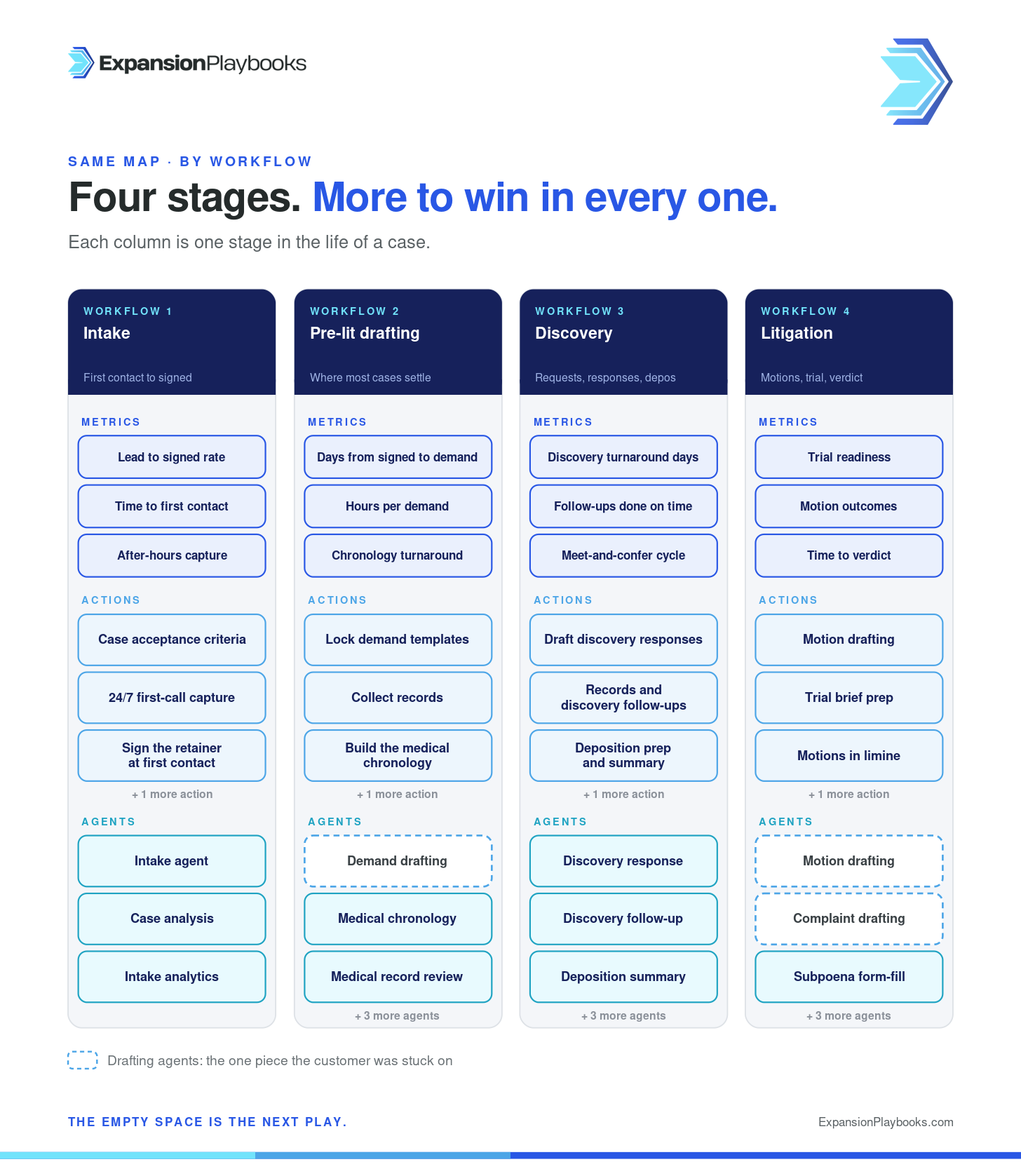
Now the conversation with that attorney has somewhere to go. Which outcome matters most to you right now? Where in the life of a case are you losing the most time? Is it intake, with calls coming in after hours? Is it discovery, chasing records and follow-ups? Wherever the empty space is on his map, that's the next play.
And so you have multiple things working toward the same number. Maybe the drafting agent is a dud for the way he works today. You're still going to work on optimizing it and getting it right for him. In the meantime, you're helping in these other parts of his practice, and he's already starting to see the benefit.
The outcome also helps when different people at a customer see the same feature differently. At a bigger firm, the paralegal might say, "This is annoying. It's not how I wanted it." The attorney looks at the same thing and says, "I get that it's annoying, but compared to what we were doing before, by hand, we're still saving tons of time. I'm happy." Without the outcome, you get myopic about one person's frustration with one feature. With the outcome, now you have leverage.
"Isn't this a way to dodge product gaps?"
No. You still fix the bug. You still push for the feature. You keep reaching for the stars and making it as automated as possible.
What the outcome gives you is the ability to diagnose. Is this issue stopping you from getting the result? Or is it just annoying? Is it something we need to fix right now, something we can work around, or a sign you need a different part of the solution?
Ask those questions and the urgency drops to its real size. Sometimes it's a ticket. Sometimes it's training the team on a new process. Sometimes the customer needs the part of the product they haven't bought yet. That's what it means to be the adult in the room.
Success is a combination. It always has been.
In customer success, we exist to make customers successful. And success isn't the customer implementing the product, or the product doing everything they wish it did. Success is defined by their business outcomes. Have they improved their performance? Are their numbers getting better in the areas of their business they care about?
Getting there will always be a combination of behavior change, process change, services, and product, knit together with your specific expertise about what it takes to achieve the outcome.
Start with the product, and you're betting everything on one piece of that combination. Start with the outcome, and you get to use all of it. Success drives adoption, not the other way around.
Start with the why. Then move to the what.
Two steps for your next "it doesn't do what I wanted" call
1. Start with the outcome baseline. Where is the customer today, and what are their current and previous processes? How many hours a week are reps actually selling? How long are cases taking to resolve? How did they do it before you showed up?
2. Bring everything to bear. List every lever that can move that number: product, services, process change, behavior change. Then pick the first two and get after it.
The next time a customer tells you the product doesn't do what they hoped, don't argue about the feature. Ask what they're trying to achieve, find out where they are today, and start building the combination.
I built the Customer Results Map into Expansion Playbooks so you can do this for your own customers: the outcomes on top, and every metric, action, and product that moves them underneath. It opens October 15. Get founding access: create an account, request your founding spot, and on October 15 you walk straight in with your founding rate locked. No card, no charge to get on the list.
The founding rates: Land the role is $29 a month, Own the role is $59 a month, and Lead the team is coming soon. Founding means you keep that price for as long as you stay.
What's the feature request you hear most from customers right now, and what outcome do you think is sitting underneath it? Hit reply and tell me. I read every reply.