

At Moment 26 in New York, Rob Hardy, Global Head of Forward Deployed Engineering at Anthropic, put one line on the screen:
"So what's a vendor worth? Knowing how your customer's business actually runs."
That's the answer for 2026. And it came from someone leading one of the top technology teams at one of the top AI companies in the world.
He said one more thing I wrote down as fast as I could: expertise is what customers will be paying for in the future. I would argue they're paying for it now. I would argue they've been hoping and trying to pay for it for many years, but we have not answered that call.
The three things Rob said to do
My biggest takeaways had nothing to do with technology, nothing to do with the tip of the spear of AI, though that is what he is doing tons of and it has been essential to their success. He highlighted three things:
1. Be the consultant in your vertical. Figure out how your customers win in their given use case.
2. Build primitives, not playbooks. Lego blocks, not houses.
3. Stop drawing the line between pre-sales and post-sales. Focus on the outcomes you deliver.
Forward deployed engineering is the hottest title in customer success
Of course, Rob is at the tip of the spear when it comes to forward deployed engineers, which is the hottest topic in customer success, post-sales, and beyond. It's what everybody's going after. It's also quite a loaded title. Some people see it as a technical mastermind with some commercial skills. Some see it as more on the pre-sale side, some on the post-sale side, and some a little bit of both.
He talked about how they've gone from building individual point solutions to building orchestrated graph engineering that models out the whole business of their customers, and identifies ways in which different processes can be automated, interplayed, and interwoven together.
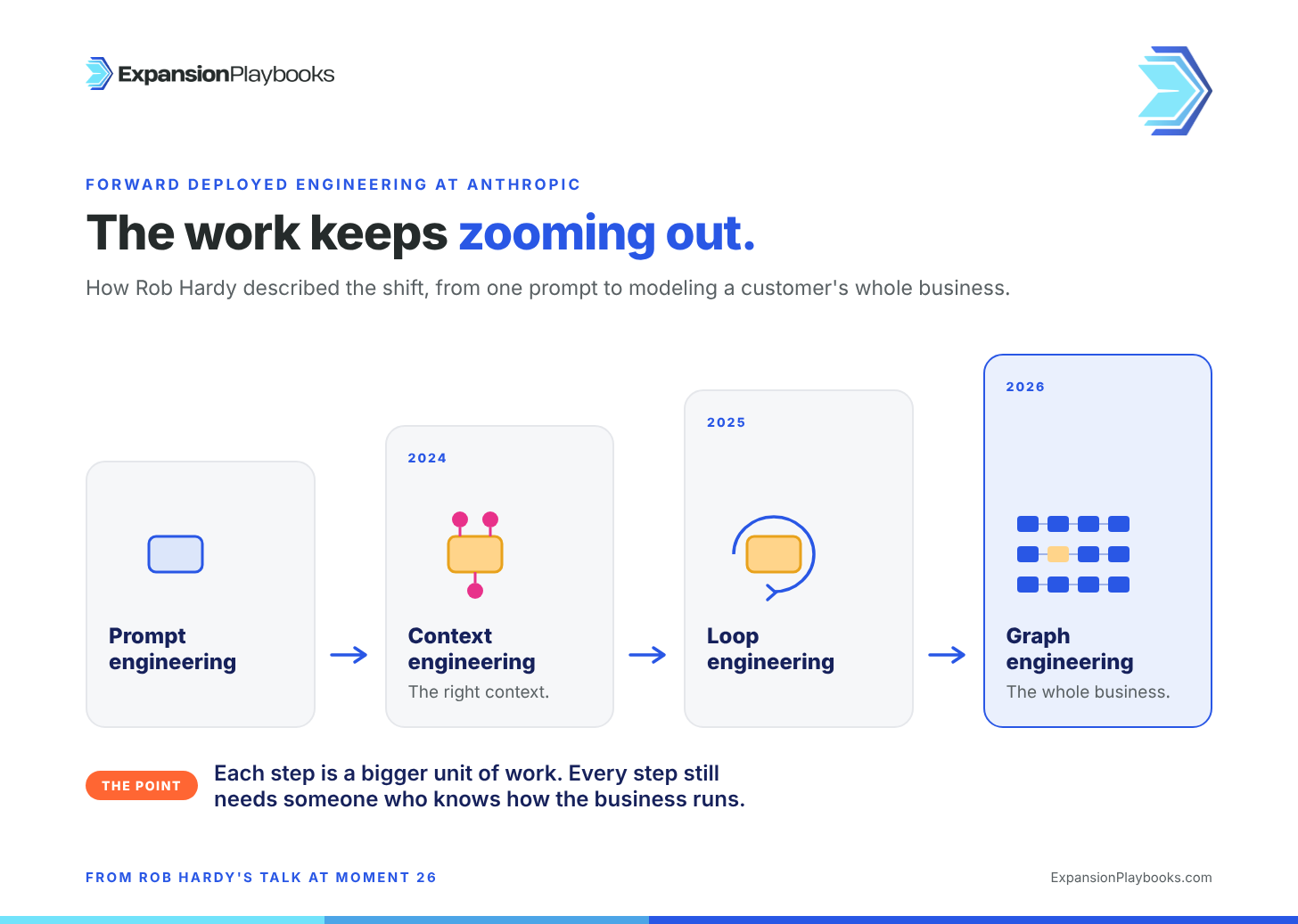
He is truly pushing the envelope. But the part of his talk I keep coming back to is what makes all of that possible.
1. Be the consultant in your vertical
Figure out how your customers win in their given use case. Develop your domain expertise so you know what matters most, so that you can help them identify exactly the solutions they need to achieve the outcomes that matter to their business.
Now, I borrow from The Challenger Sale all the time. It talks about how the most effective Challenger reps understand their customers' business better than they do. Which, again, sounds crazy. Your customer has been in their business for 20 years and lived and breathed it. But there's a difference between knowledge and expertise. Knowledge can be gained over many, many years, but that doesn't mean it's been translated into wisdom and expertise.
Expertise is knowing what matters most. It's about breaking it down so that you can actually apply it, and diagnose the most important actions your customer needs to take to move the metrics that matter most to their business.
At Expansion Playbooks, we've analyzed over a million customer records. When a customer gets a positive result, retention goes up two times. When they get a good result, six times. Knowing which results matter is the whole game.
The fascinating thing about that is, although it's enabled by AI, it's a skill. It's work that needs to be done. Something needs to be figured out, and without it, you can't build the amazing graph engineering.
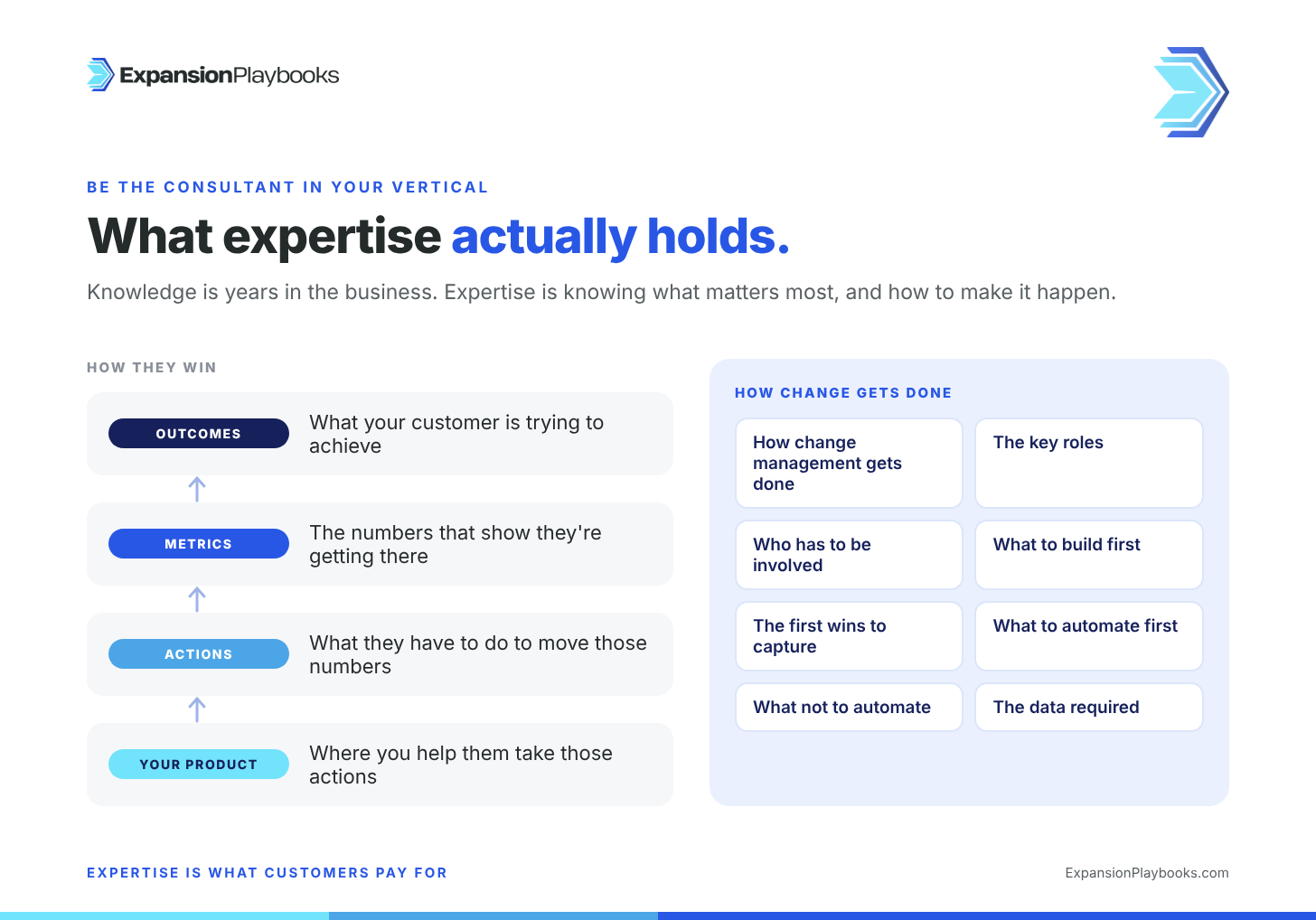
And that expertise runs even deeper than you realize. It's one thing to understand the outcomes that matter to your customers and the actions that need to be taken to achieve them. It's also about:
- How does change management get done at those companies?
- Who are the key roles?
- Who has to be involved?
- What should be built first?
- What are the first wins that should be captured?
- What process should be automated first?
- What shouldn't be automated?
- What data is required?
The customers thought they were buying expertise
I worked with a company that had a severe churn problem. When I went through their post-churn interviews, one theme kept coming up again and again. They worked in the experience management world, so it was all about surveys. Customer after customer that had churned said:
"When we bought from you, we thought you were going to tell us the best way to do these surveys. Instead, you just kept asking us what we wanted to put in them, what questions we wanted to ask."
The customers thought they were buying expertise. They thought they were buying what the best were doing, and the technology was just a bonus.
Now you have it from someone leading one of the top technology teams at one of the top AI companies in the world. What does he say people will be paying for? Expertise.
2. Build primitives, not playbooks
I think what Rob means is: build Lego blocks. Build things that capture expertise in actual tooling, so you can assemble them with the customer in a tailored way to make them successful.
Don't be completely rigid. If you've truly understood your customer's vertical, how they win, and how things get done, then you can start to assemble premade solutions that facilitate that time and time again for each customer that comes your way. You'll still need to tailor it and assemble it for a specific customer. But if you know your use case well, then you also know what's universal.
3. Stop drawing the line between pre-sales and post-sales
Just focus on the outcomes you're delivering for your customers. I think there will still be roles and definitions, and there are responsibilities that need a single owner. But I agree with Rob: you need to think about the whole system. Just as we need to think about the whole system for our customers, we should be thinking about our whole commercial system on our side. It should always be in the context of how it makes our customers successful, consistently, every time.
How do you do this?
There are two things you have to do, the same two I laid out in my piece on Kaveh Rostampor's talk, the CEO of Planhat:
1. Answer the key questions about your customer's domain. How does your customer make money in the use case you serve? How do they win? What are their workflows? Who does what? Who is your customer's customer? How do they move from value to value? And what goes wrong?
2. Understand your company context. How every team in your business works together to deliver for that customer.
If you can understand both of those things, you can take advantage of everything AI now makes possible.
Rob gave the room a test, and it's a good one. Pick your top five customers. Could someone on your team map their core processes and use cases, and then map how your product helps? If not, you have a problem.
You have the missing link
MIT's NANDA initiative studied this in 2025. Their report, The GenAI Divide: State of AI in Business 2025, was based on 150 interviews with leaders, a survey of 350 employees and an analysis of 300 public AI deployments. For 95% of companies in the dataset, generative AI implementation was falling short. Only about 5% of AI pilot programs achieved rapid revenue acceleration.
I believe that's because everyone assumed AI would give them the answer. We wanted to believe we could just hand over the reins. When it comes to execution, you can hand over a lot. When it comes to expertise, that's the struggle you need to go through and figure out yourself. Once you own it, you can use AI to its fullest.
So run Rob's test this week. Pick your top five customers. How many could your team map today? Hit reply and tell me.
Source: MIT report: 95% of generative AI pilots at companies are failing, Fortune, August 18, 2025.