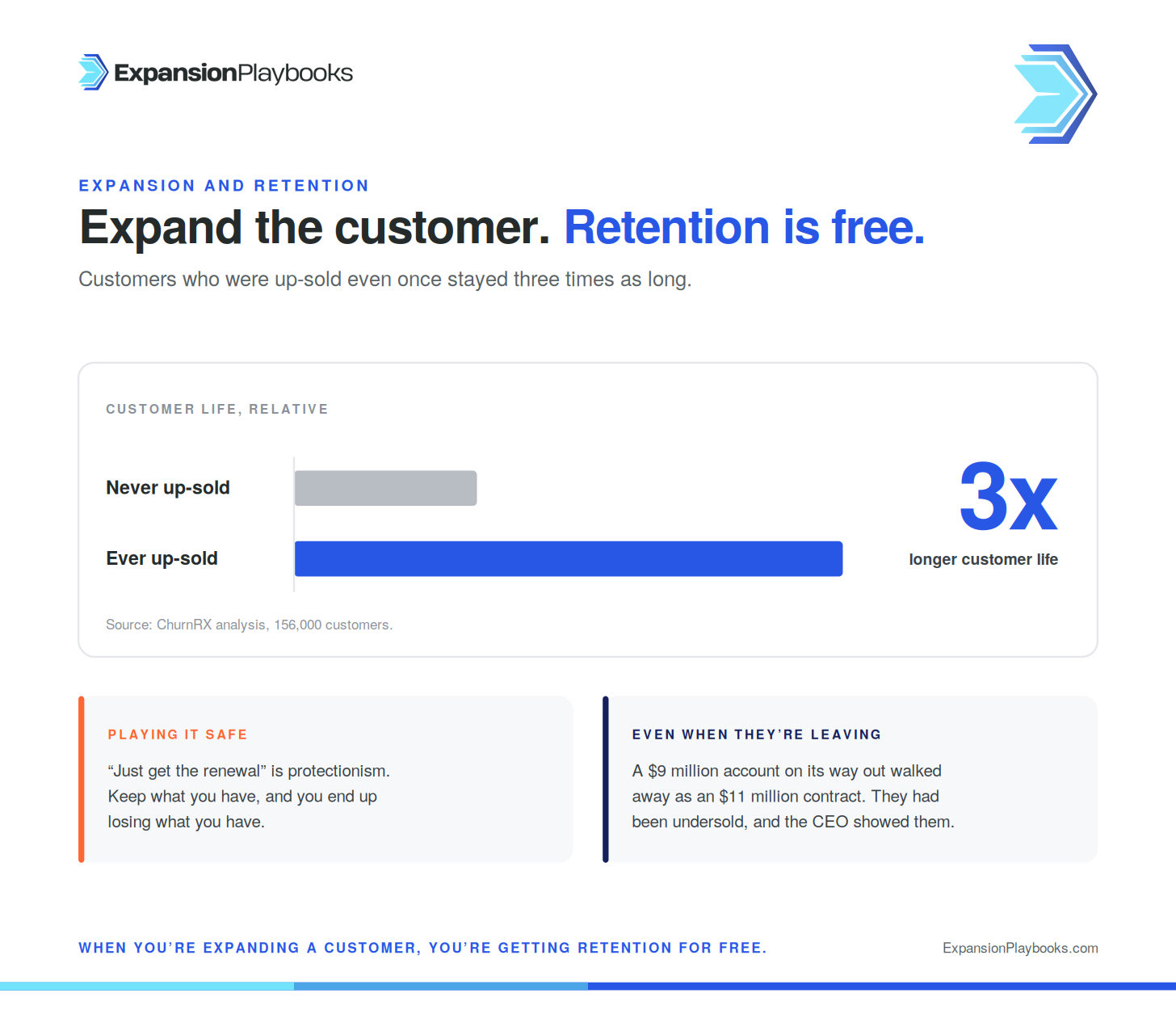
At ChurnRX, we ran a big data analysis on 156,000 customers. We split them into two groups: customers who had never been up-sold, and customers who had been up-sold at least once. The customers who had been up-sold lasted three times as long.
Three times.
And yet almost every company I work with treats expansion as an afterthought. The typical approach is "just get the renewal." Get the customer to retain with whatever they've already purchased, and if we get the expansion, we'll take that as icing on the cake.
Nobody can figure out who should own it, either. It bounces between "the CSM owns it" and "the sales rep should own it." If sales owns it, they go after the low-hanging fruit with their new logo customers and never farm enough. If the CSMs own it, they spend their time saving the renewal, and expansion gets whatever is left over. And the only strategy anyone talks about is "find your white space and get after it."
Here's what I've found. Most companies are terrible at expansion. If they do have high NRR or strong account growth, it's usually because of things they aren't doing proactively at all. Those customers were already expanding. They had a multi-phase rollout planned after their initial purchase, and it was in the works before anybody on your team picked up the phone.
So the number looks good, and the motion behind it doesn't exist. I think all of it comes from one mistake, and the mistake is about which direction we're facing.
The mistake everybody makes is starting with what you sell
The way most people think about expansion is simple. I have a bunch of products to sell. Let me go see what my customers haven't bought yet, go engage them, and see if there's anything that I sell that they could buy.
That's the white space report. Customer A has two of our seven products, so there are five things to pitch. Go.
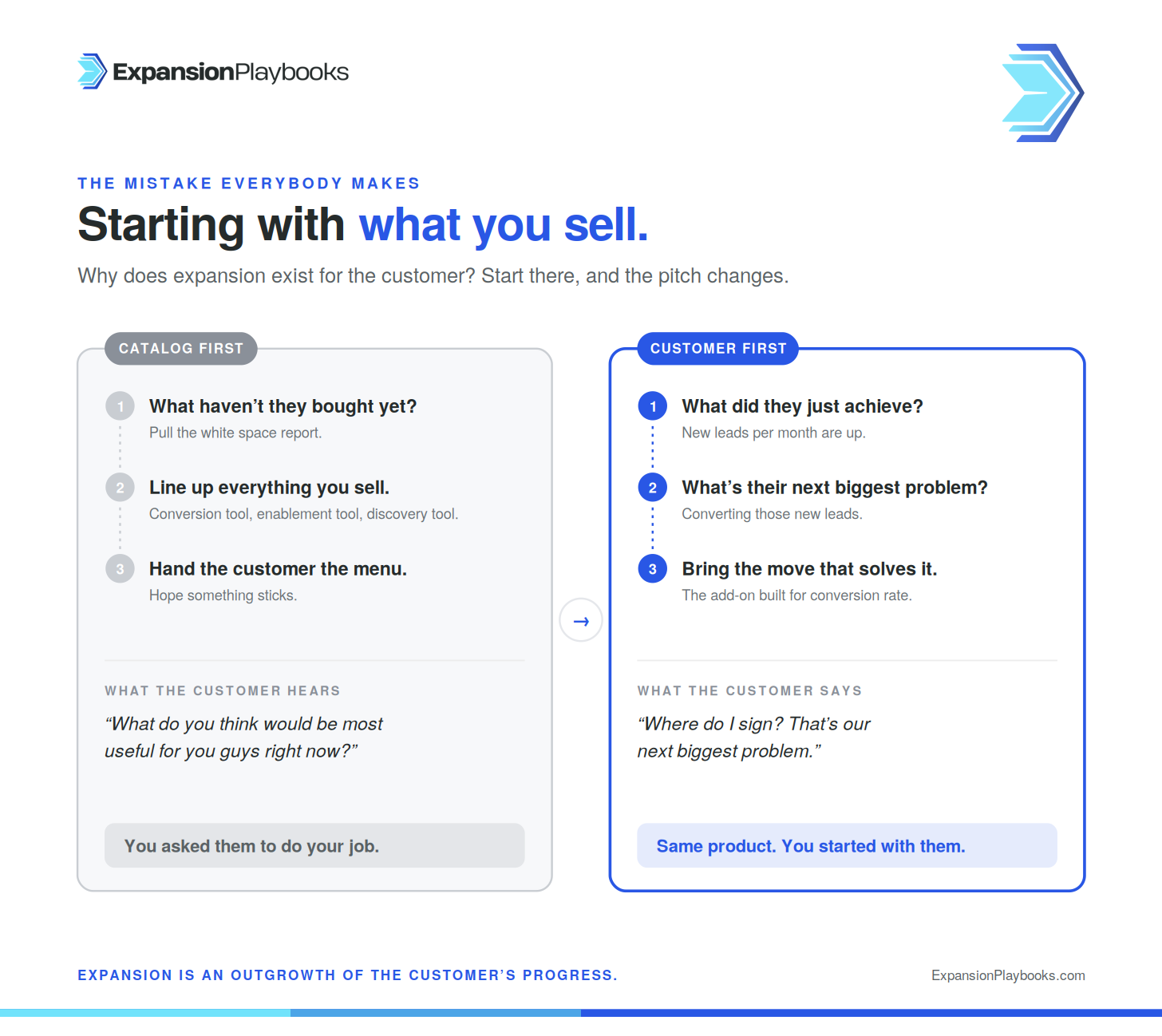
The problem is the orientation. We think about expansion in terms of how it benefits us as a company, and we skip the most basic question: why does expansion exist for the customer?
It exists because your customers have increasing needs. They need to get more value than they're getting right now. They have additional teams that need to get more efficient and more effective. They have new performance targets they're trying to hit. And your job is to provide the things that help them do more.
You can hear the difference in the conversation. When you're a hammer looking for a nail, it sounds like this: "Hey, we have a conversion tool, we have an enablement tool, we have a discovery tool. What do you think would be most useful for you guys right now?" You've handed the customer a menu and asked them to do your job for you.
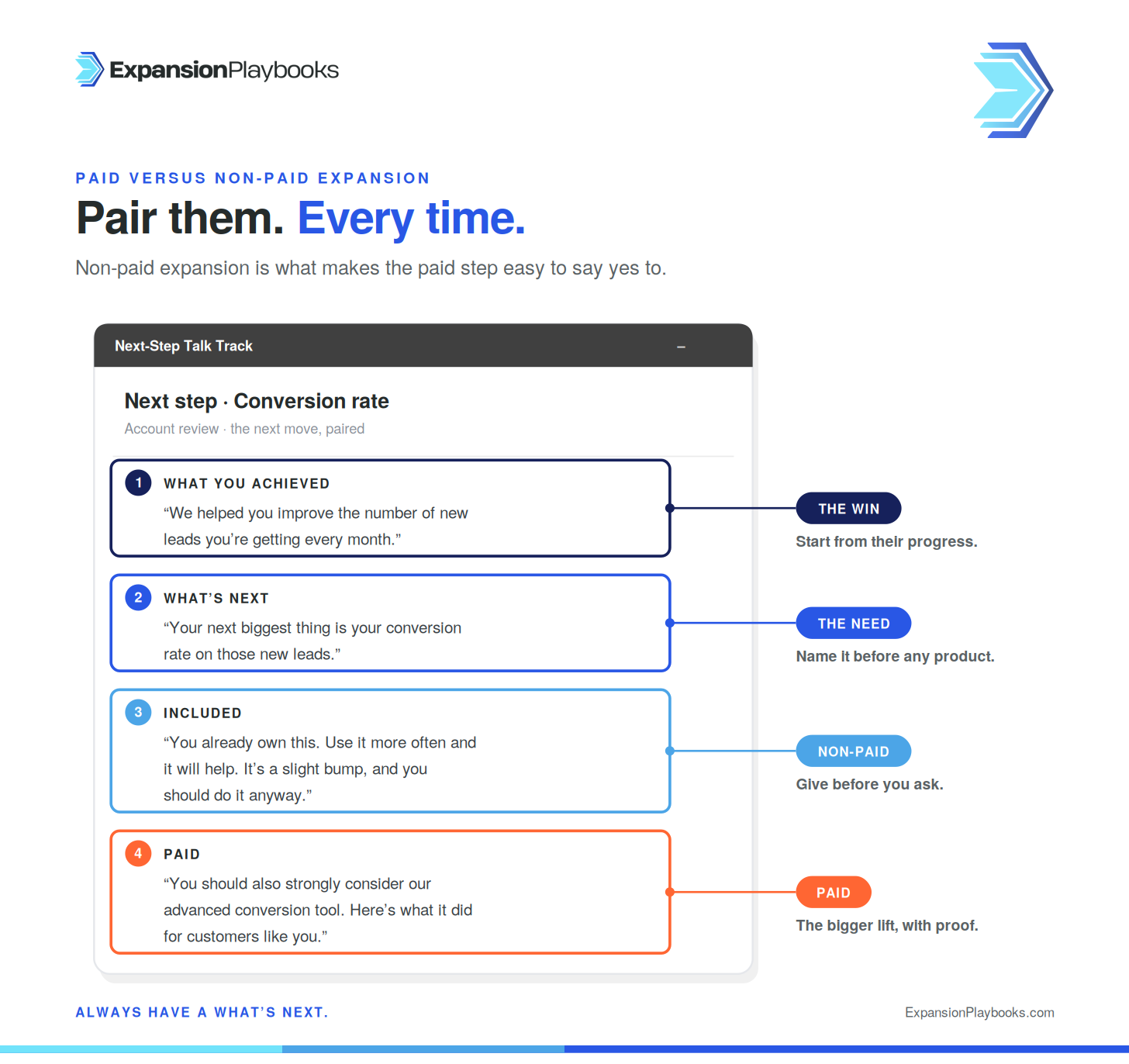
Now flip it. "We helped you improve the number of new leads you're getting per month. Now your next biggest thing is your conversion rate on those new leads. Here's our add-on that will help you improve your conversion rate." When it's laid out like that, the customer says, "Where do I sign? Yeah, that's our next biggest problem. Let's get after it."
The product is the same in both conversations. What changed is where you started.
Market share versus wallet share
This goes a lot deeper than a sales conversation.
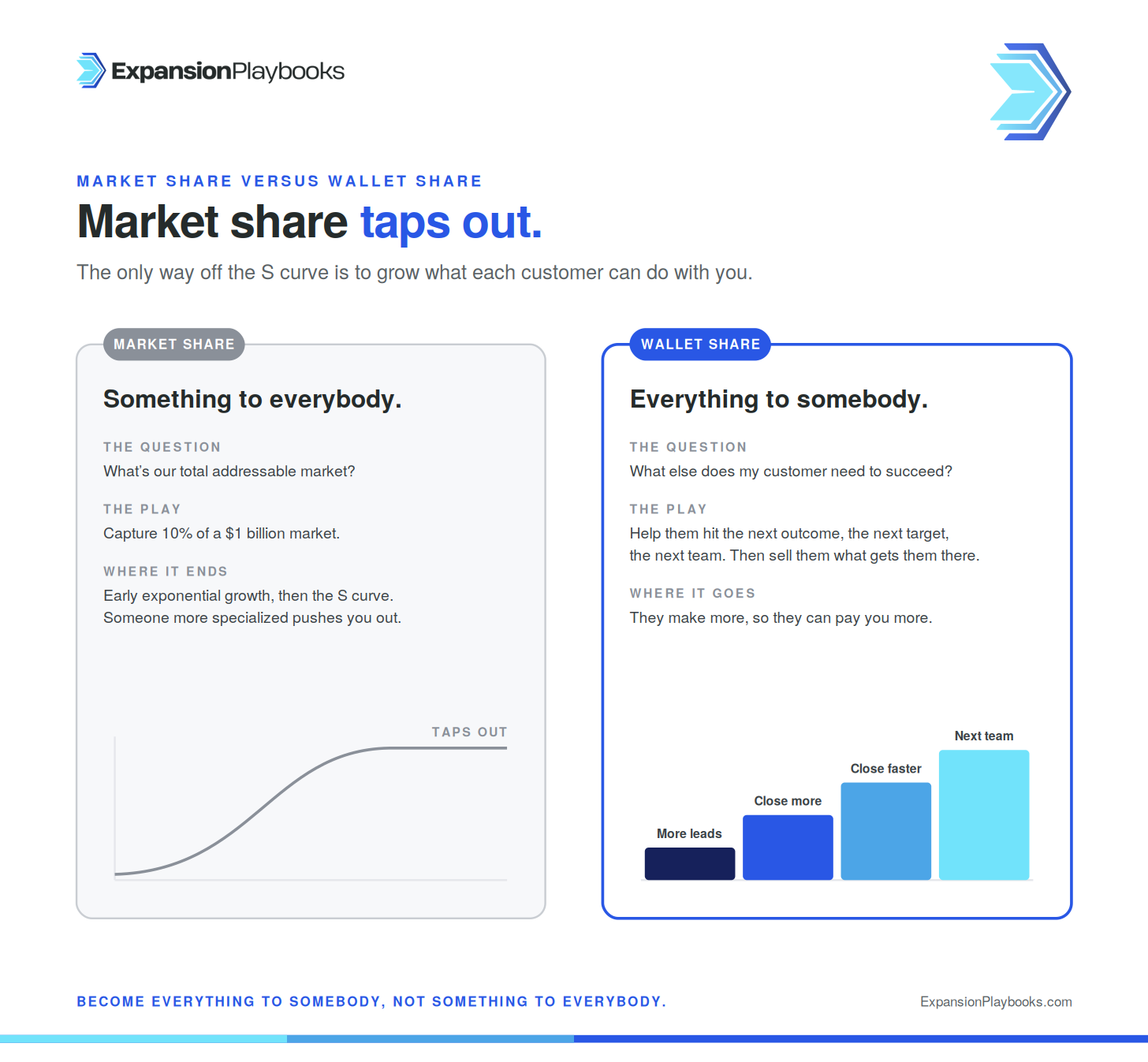
The last 50 years of business have been defined by market share. Figure out your TAM, your total addressable market, and go after it. If we can capture 10% of a $1 billion market, we're in a great position. And that works for a while. It leads to early exponential growth, and then it taps out. Everybody hits the same S curve.
The only way to break free of it is to think in terms of wallet share. If I can make the customer more money, if I can drive more value in their business, then they can pay me more money. And so the work becomes a set of questions. What else does my customer need to succeed in their business? What other outcomes do they need to start achieving? What increased performance should they be achieving? Then figure out ways to help them achieve it, and sell it to them so they get the benefit they want and, in exchange, pay us more for the services and solutions that got them there.
This is one of the most important points in this whole piece.
The businesses that succeed long term are the ones that work to become everything to somebody, not something to everybody.
Something to everybody is a market share strategy, and it's a losing one, because somebody more specialized and more focused will come in and push you out. Everything to somebody is what lets you capture wallet share. You become deeply embedded in making your customers successful.
And when you operate that way, nothing you "sell" as expansion is ever inappropriate or pushed on the customer incorrectly, because it's a natural outgrowth of the customer's progress.
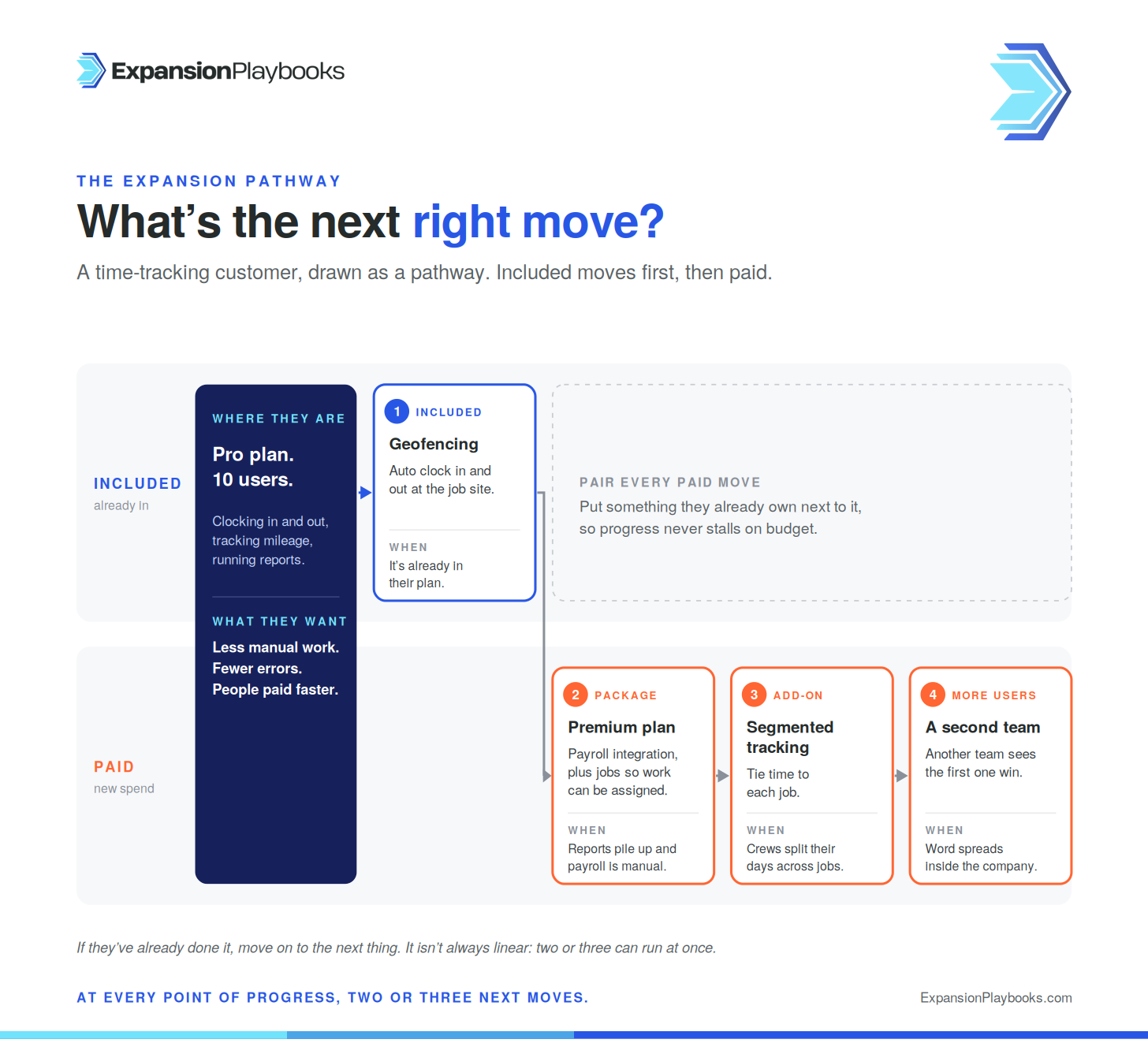
I call this the Expansion Pathway. At every single point of progress, there are always two or three things a customer could do next to get more value. Some of them are included in what they already bought. Some of them are paid. Every one of them ties to an outcome the customer is going after and the workflow they're working in. It's also not purely chronological. A customer might be working on two or three of these at once, in completely different parts of their business. The pathway answers one question: what's the next thing this customer should be doing?
Three shifts get you there.
1. Start with what the customer is trying to achieve next
Think about the customer first, and then align your expansion solutions, products, and offerings to what they're trying to achieve.
There are two ways that plays out.
The first is increasing a result the customer already has. "We got you from 50 new leads a month to 100. If you add this other solution, we get you to 200." That's the same outcome with a bigger number.
The second is adding a new result. Going from helping them get more leads, to helping them close more of those leads, to helping them do it faster. Those are three different outcomes, and each one opens up once the one before it is working.
And so the job is to always have a what's next. Every customer, at every point, should have an answer to "what are you trying to achieve next?" Most teams can't give that answer for their own customers, which is exactly why the conversation defaults to the catalog.
2. Separate paid from non-paid expansion, then pair them
This is where I think we get adoption wrong.
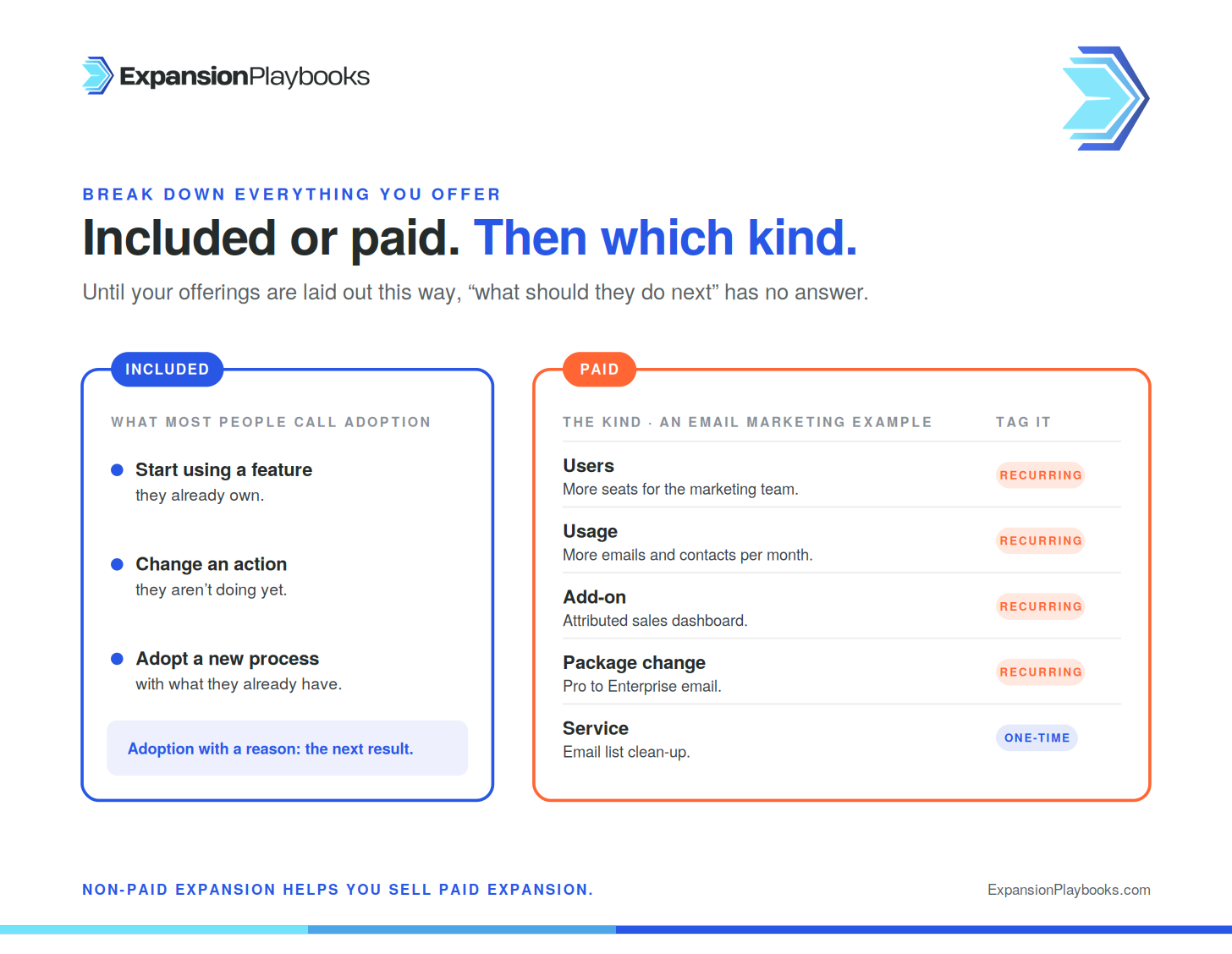
Everyone focuses on getting customers to adopt more of the product. I would argue that's non-paid expansion, and it counts. But most customers use 10% of your product, and you have to beg them to use more, because we're asking them to adopt more for the sake of adopting more.
Flip the orientation. Tie every piece of adoption to what the customer is trying to achieve, and adoption goes up. Success drives adoption, not the other way around.
Here's what that looks like at a time-tracking company I work with. A customer signs up on the Pro plan with 10 users. They're clocking in and out, tracking mileage, and running reports. What they want is less manual work, fewer errors, and people getting paid faster.
The non-paid move. They aren't using geofencing yet, and it's already in their plan. "Let's get geofencing going, so your team can be even more efficient by not having to clock in and out for every single job they go to."
The paid move. Their reports are piling up, and payroll still takes a bunch of manual work. "Let's move you to Premium. That opens up the integration, so all of this flows right into your payroll system, your team gets that time back, and people get paid faster."
That's the pair. The included move gives them a quick win and keeps them progressing even if the budget isn't there this quarter. The paid move gets them the bigger result. And because you led with something they already own, the paid move lands as the obvious next step.
From there the pathway keeps going: segmented tracking once crews split their days across multiple jobs, then more users once another team sees the first one win. Every step ties back to the same three things they bought for.
Then get specific about what paid actually means for your company. Paid expansion covers a lot of ground:
- Adding users
- Additional usage or consumption
- Product add-ons
- Package changes, like going from Pro to Premium
- Services, paid separately
And every one of those carries a second tag: is it recurring, or is it a one-time fee? Most teams have never laid their offerings out this way. Until you do, "what should this customer do next" doesn't have a real answer.
3. Define upsell and cross-sell by the use case
Upsell and cross-sell get thrown around so loosely that they stop meaning much. What's helped me is defining them from the customer's outcomes first. That may not be what the rest of the world uses, but I find it a lot more useful.
It starts with what a use case is. A use case is a set of outcomes, for a specific team, inside a specific set of processes. Helping a sales team get more leads and then close more of those leads is one use case. Helping that same company run onboarding is a different one.
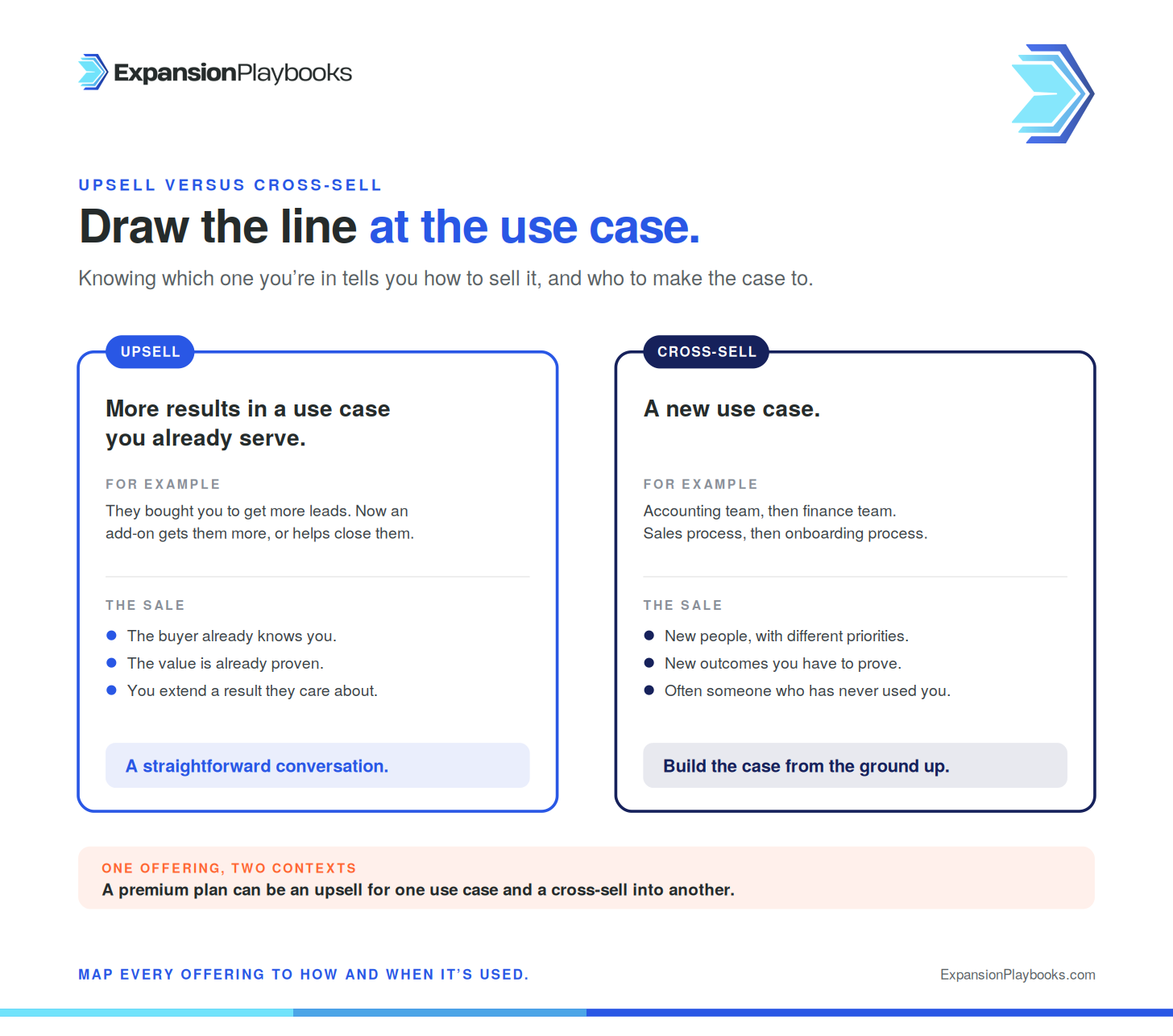
Upsell is selling additional products or features that help the customer improve the results they already bought you to achieve. They bought you to get more leads, and now there's an add-on that gets them even more leads. You're selling more within the use cases you're already working on. That can mean a bigger number on a result they already have, or the next result inside that same use case. Both are upsells.
Cross-sell is adding a new use case. We implemented a solution to help your accounting team be more efficient, and now we're bringing it to your finance team. We helped you with your sales process, and now we have a tool that helps with your onboarding process.
Why does the distinction matter? Because they are two different sales motions, and this is where teams get jammed up when they try to expand a customer.
When the use case is already established and you're upselling against it, the conversation is straightforward. The buyer knows you. The value is proven. You're extending a result they already care about.
A cross-sell starts from the ground up. You have to understand the difference in the use case, the difference in who's involved and what they care about, and the difference in the outcomes they're trying to achieve. You're making the business case all over again, often to someone who has never used you.
And this is the part most teams miss: the same product can be either one. A premium plan can be an upsell for one use case and a cross-sell into another. So map out every offering you have and how and when it's used. This, when it's used in this context, is an upsell for these existing use cases. This, in that context, is a cross-sell. Knowing which one you're in tells you how to sell it and who you need to make the case to.
Expansion is how you keep what you have
Go back to the "just get the renewal" mindset for a second.
When push comes to shove, it means you aren't aggressive. You're not pushing for the customer's best interest. You're playing it safe for your own benefit, not the customer's. And when you're a protectionist, when you're just trying to keep what you have, you end up losing what you have.
That's what the ChurnRX data showed. We tell ourselves, "I don't want to expand and upset things. I just want the renewal." But because you're not pushing the customer toward their next value opportunity, you eventually lose the renewal anyway. Go after the expansion, and you get retention for free.
It's even true for customers who are about to leave. I've worked with several companies whose at-risk customers were failing because they had been undersold. They were undercommitted, and the result they bought the product for was on the other side of buying more of it. Maybe they rolled it out to a fourth of their team, so they're still managing two separate systems, which adds cost and complexity. Maybe they want email engagement up 70%, but they only bought a fraction of the sends it takes to get there.
One company I worked with in healthcare had a $9 million account on the verge of leaving. The CEO went in and walked out not only having saved the account, but with an $11 million contract. He did it by keying into what the customer was actually trying to achieve and showing them the reason they were failing: they had underinvested.
If you were selling random things to hit an expansion quota, walking into an angry account with an upsell would make zero sense. But customers are buying a win, and with what they had purchased so far, that customer was not winning. Leaving you doesn't mean everything turns into rainbows and daisies. They still have to buy another solution, because they still want to win. And you're the one in the room who can tell them why it isn't working.
The customer's progress is the pipeline
Stop asking what you can sell your customers, and start asking what they need to achieve next. Expansion done that way is a natural outgrowth of the customer's progress, and so you grow the account faster and keep it longer, because growing it and keeping it were never two separate things.
If we're ever going to build durable businesses with consistent growth, it won't come from getting more new customers in the door. It will come from being so obsessed with making our customers successful that we keep finding new ways to drive value across their business, and that value creates the revenue they use to pay us for it.
What to do about it
Three things, this week.
- List everything you sell. Every plan, add-on, service, and usage tier. Tag each one included or paid, recurring or one-time.
- Place each one on your customer's workflow. For every stage of how your customer works, what outcome is it serving, and which offerings move it? Then mark each offering as an upsell or a cross-sell in that context. Expect the same offering to show up in more than one place.
- Write the next two or three moves for your top ten accounts. At least one included, at least one paid. If you can't write them, that's your real white space.
I built the Expansion Pathway into Expansion Playbooks to do exactly this, and it's coming live in the next couple of weeks. Join the founders list. Add your email here and you'll be the first to know when it's available.
I'd love to hear how this works at your company. Hit reply and tell me who owns expansion today, and what the next move is for your best customer. I read every reply.