
Earlier this week, Jon Cheney posted this:
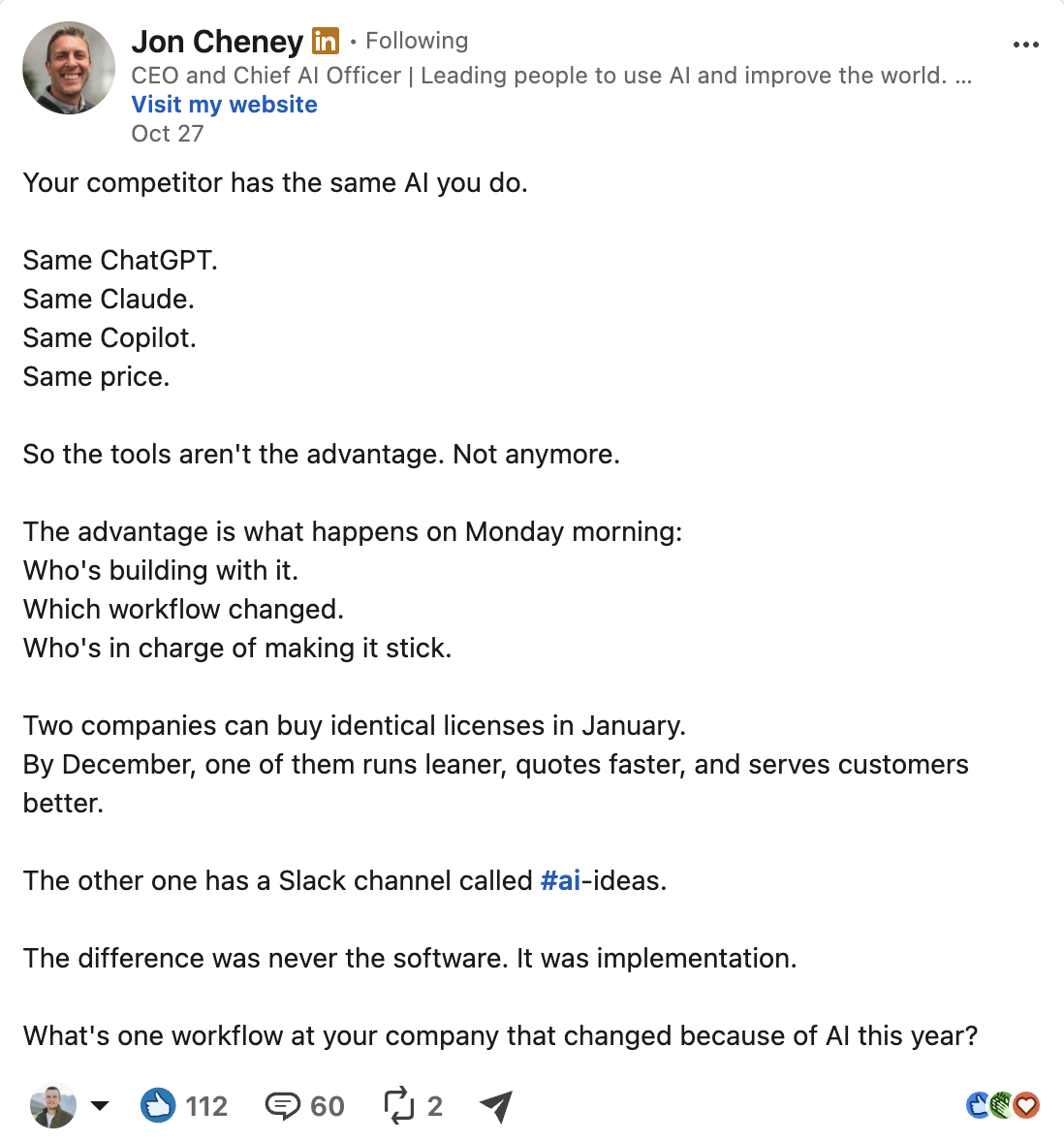
Your competitor has the same AI you do. Same ChatGPT. Same Claude. Same Copilot. Same price.
Two companies can buy identical licenses in January. By December, one of them runs leaner, quotes faster, and serves customers better.
The difference was never the software. It was implementation.
Jon was writing about how companies adopt AI internally. But when I read it, I thought, customer success has known this for 25 years. Here's what I wrote in the comments:
This has been true in Customer Success for the past 25 years. Your competitors have always had around 90%+ feature parity. What was the difference in the customer succeeding? Not the software, it was your expertise and ability to get the customer to change how they work. And those things were true regardless of the vendor. The advantage was being the vendor that actually helped the customer change.
And his post lands at a strange moment. Spend ten minutes on LinkedIn and you'll hear that SaaS is dead. Anyone can copy your product in a weekend. A new AI startup clones your best feature every week. AI can do everything now.
If you work in customer success, there's a quieter fear underneath all of it. If the software can do everything, what's my job?
I understand the fear. But it comes from a complete misunderstanding of what it has ever taken to make a customer successful.
Technology was never the reason anyone won
The mistake everybody makes is believing technology was what made customers successful in the first place.
Jim Collins found this 25 years ago in Good to Great: "Technology by itself is never a primary root cause of either greatness or decline." Technology has never been the source of success. Only the catalyst.
Business is hard. Change is hard. Making a change and sticking to it long enough to get the win is hard. That was true before AI, and it will always be true.
If you want different results, you must change. Something must change. That's true for us, and it's still true for our customers.
The turn-it-on test
Here's the simplest test I know.
Let's say a customer buys your software. You turn it on. And they don't change a single thing about how they work. Same process, same people, same habits, and they don't do anything different with what the software tells them.
Are they any better off?
The answer is no. Every time.
Now you might say, "Jeff, AI changes that. It's amazing what it can do now. It can automate things on your behalf."
Even that's not true. Let's say it connects to all your apps, pulls all the information, and comes up with things it could do. Somebody still has to tell it what to look for in all those connected apps. Somebody still has to take those recommendations and do something about them, in a way that actually makes your processes better and gets your company better outcomes.
AI raised the ceiling on what software can do. It never removed the requirement that we change how we work.
Three things that were true before AI, and still are
1. Your competitors have always had 90% of your features
Yes, you can copy features faster than ever now. Yes, new products are popping up every moment.
But admit it: in SaaS, we've had 90% feature parity for the last 25 years. We love to build those feature comparison charts for our websites. Twenty categories, and guess what? We have five more dots than our two competitors.
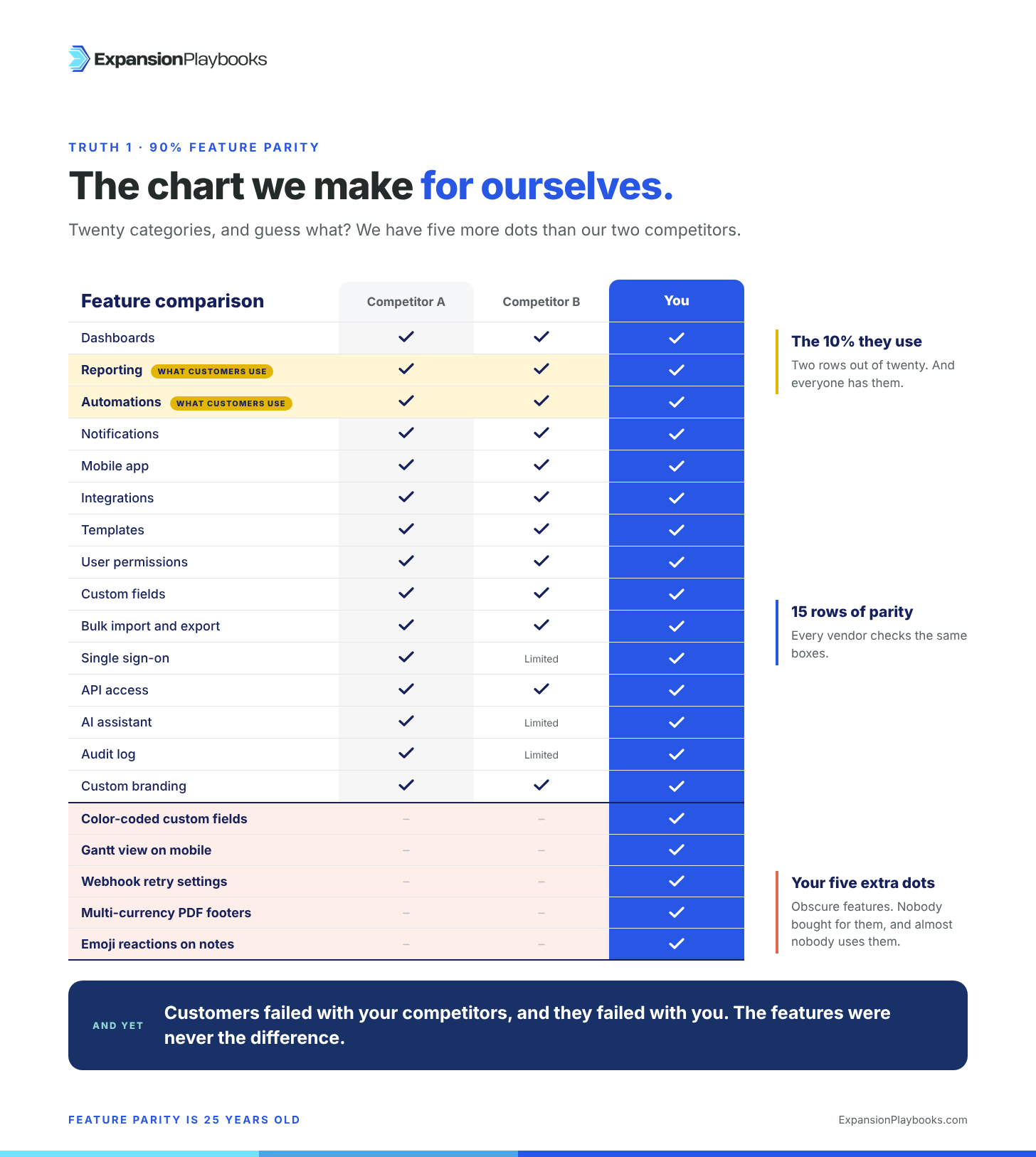
That chart was for us. Our customers use maybe 10% of our product, or 10% of our competitors' product. And the 10% they use was never the five dots of obscure features we have over our competitors, if you frame them a certain way.
And yet customers failed with our competitors, and they failed with us. If the features were the difference, that wouldn't happen. AI just sped up something that was already true.
2. Customers are buying your expertise, not your technology
Years ago, I worked with a company that sold customer experience survey software. They had a churn problem, so I went through interviews with a bunch of customers who had left.
The same reason came up every single time. The customers would ask, "How do we build the best survey, the one that gets us what we want?" And the company kept answering, "We can build whatever survey you want. Our product is completely customizable. The technology can do anything."
That wasn't the problem.
The customers were hoping that, because this company had worked with much bigger brands, it would share that expertise. Exactly which questions to ask. Which questions would give them the insights to dramatically improve their customer experience and increase sales.
They thought they were buying expertise. The technology was the bonus.
3. No technology makes a customer successful without expertise
No matter how advanced technology gets, it still requires expertise to make the customer successful.
Run the turn-it-on test on the most powerful AI product you can think of. If you didn't change how you work, and you didn't change what you do with the outputs, you're not any better off.
That's still true, and it will always be true.
Stop watching your competitors
So we need to stop panicking. Stop staring at our competitors and the next new technology, and get focused on the only thing that doesn't change.
You have a customer, and that customer is trying to win. They're trying to drive specific outcomes, and those outcomes exist regardless of your existence and regardless of your competitor's existence.
Your product can help them get there. But only when it's paired with real expertise. What is the customer trying to win? Which wins matter most? How does their business actually make money? And what has to change in how they work to get there?
Answer those, and you can put it into a defined map of your customer's results. Then you can sit down with a customer and say with confidence, "Here's what success looks like for you, and here's exactly how we get you there."
A competitor can't copy that by shipping a feature.
Four steps to make customers successful, whatever the technology
Let me show you with a real example. One of my first consulting engagements was with Solutionreach. Their customers are dental practices, and the products are what you'd expect: appointment reminders, two-way texting, confirmation messaging, recall messaging, and review requests.
Here's how to build the model of how their customers win, in four steps. Each step is a different view of the same customer, and each one speaks to different people inside it. Notice that the product doesn't show up until the last one.
Step 1: Define your customer's economics
Your customer's economics is the math of how their business makes money. Revenue on the left, cost on the right, and every term that drives each side.
It's purely mathematical, and it's what leadership cares about: the CEO, the CFO, the owner. They'll rarely lay it out for you, but every decision they make about you gets judged against it.
And it's true for every customer in the segment, whether or not your product exists. When you can show which term of the equation you move, you stop being a line item and start being a lever on their profit.
Applied to Solutionreach
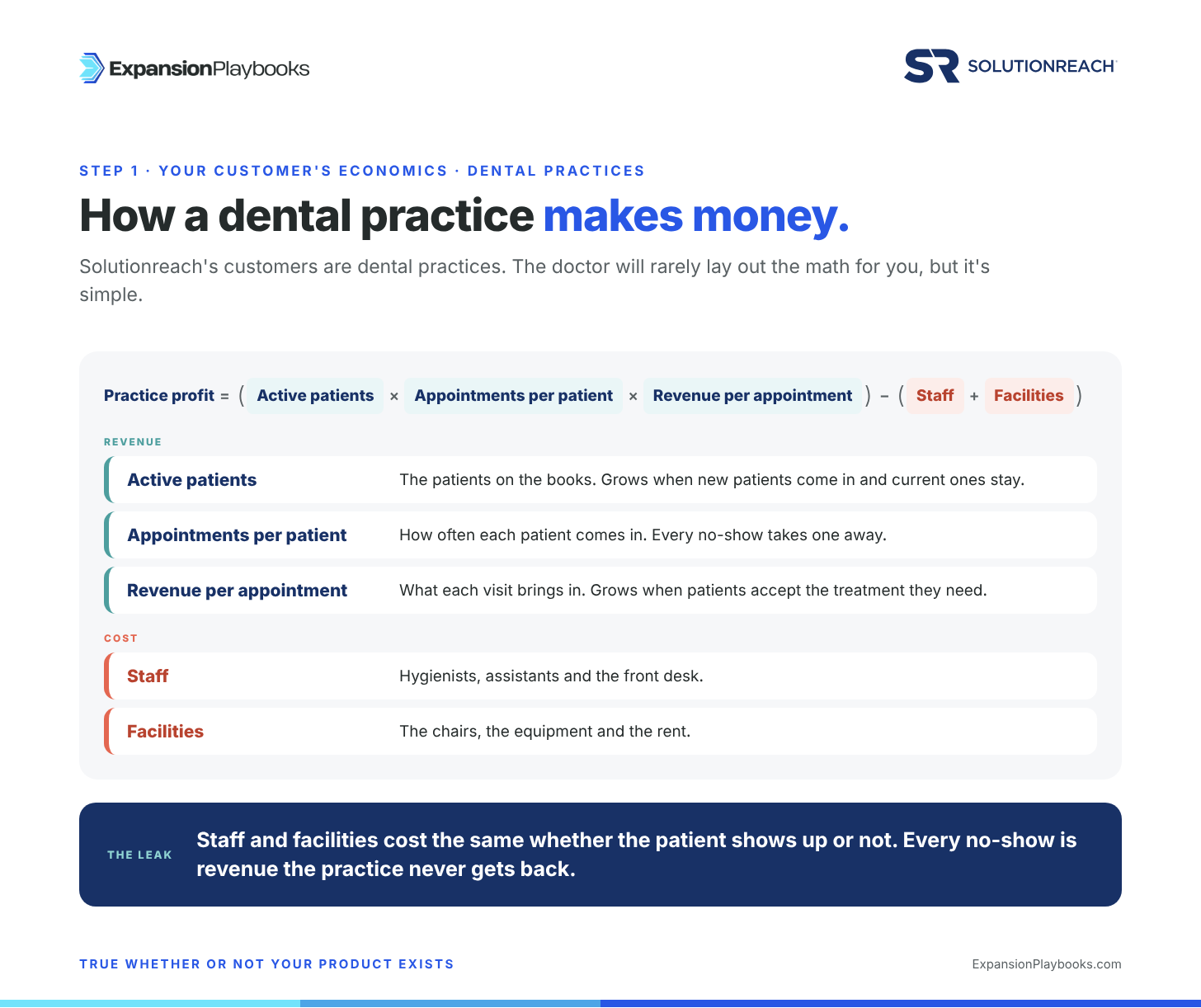
For a dental practice, the equation has five elements:
Practice profit = (active patients × appointments per patient × revenue per appointment) − (staff + facilities)
On the revenue side:
- Active patients. The patients on the books. It grows when new patients come in and current patients stay.
- Appointments per patient. How often each patient comes in. It grows when patients book their next visit and show up for it. Every no-show takes one away.
- Revenue per appointment. What each visit brings in. It grows when patients accept the treatment they need.
On the cost side:
- Staff. The hygienists, the assistants, and the front desk.
- Facilities. The chairs, the equipment, and the rent.
Here's the part that matters. Both costs are paid whether the patient shows up or not. And so an empty chair is never neutral. It's revenue the practice never gets back, against a cost it already paid. No-shows are the single biggest leak in a practice's revenue model.
Step 2: Define your customer's wins
A win is the value your customer describes in their own words. It's usually what they told your sales rep when they decided to buy: "We need to cut our no-shows." "We want more new patients."
Wins are the accessible version of the economics. Nobody walks into a demo and says, "I need to raise my appointments-per-patient term." They say, "I need my schedule full." But every real win moves a term in the equation, and that's how you know it's real.
Wins are what the VPs care about, and the people who typically buy your product. In a dental practice, that's the office manager, and the doctor when they're wearing the buyer's hat.
Applied to Solutionreach
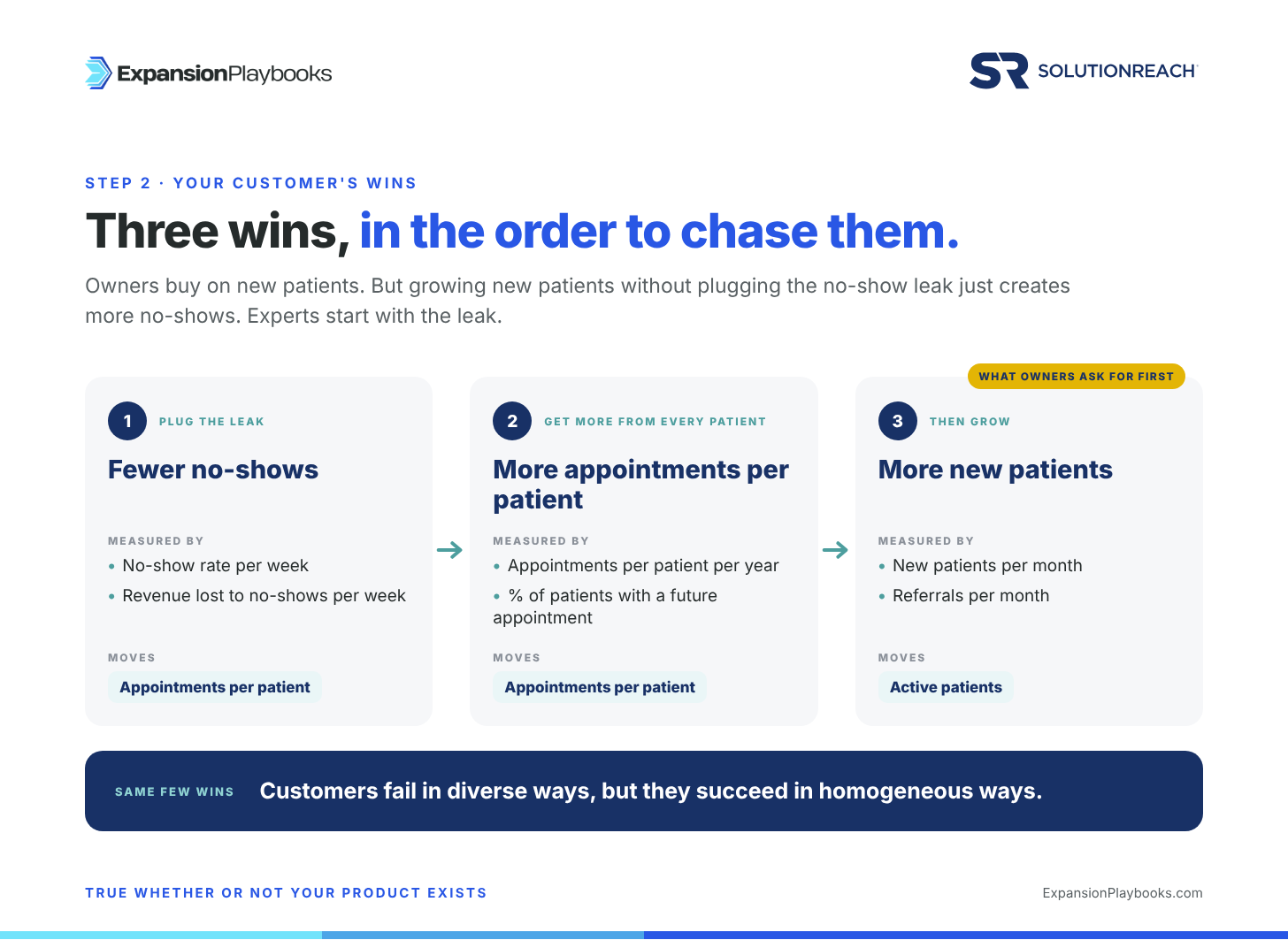
There are three wins that matter to almost every practice:
- Fewer no-shows. Measured by the weekly no-show rate, and the revenue lost to no-shows each week.
- More appointments per patient. Measured by appointments per patient over twelve months, and the share of patients who have their next appointment on the books.
- More new patients. Measured by new patients per month, and how many of them came from referrals.
Each one moves a term in the equation. Fewer no-shows and more appointments drive appointments per patient. New patients grow active patients.
And the order matters. Every practice owner wants new patients first. That's the headline they buy on. But most practices learn the hard way that growing new patients without first plugging the leak just creates more no-shows. So the expert sequence is the reverse: stop losing the patients you have, get more out of every patient, and then go grow.
Customers fail in diverse ways, but they succeed in homogeneous ways. It's the same two or three outcomes nearly every time.
Step 3: Define your customer's workflows
Workflows are how the work actually gets done, day to day. The sequence of things your customer's people do, whether or not your product exists.
This is the world the end users live in: the people in your product every day. They don't think in profit, and they rarely think in outcomes. They think about tomorrow's schedule and the patients who haven't confirmed yet. If your product doesn't fit how their day actually runs, they won't use it, and the wins never show up.
And so you have three views of the same customer. Leadership sees the economics. The buyer sees the wins. The end user sees the workflows. You have to be able to speak all three.
Applied to Solutionreach
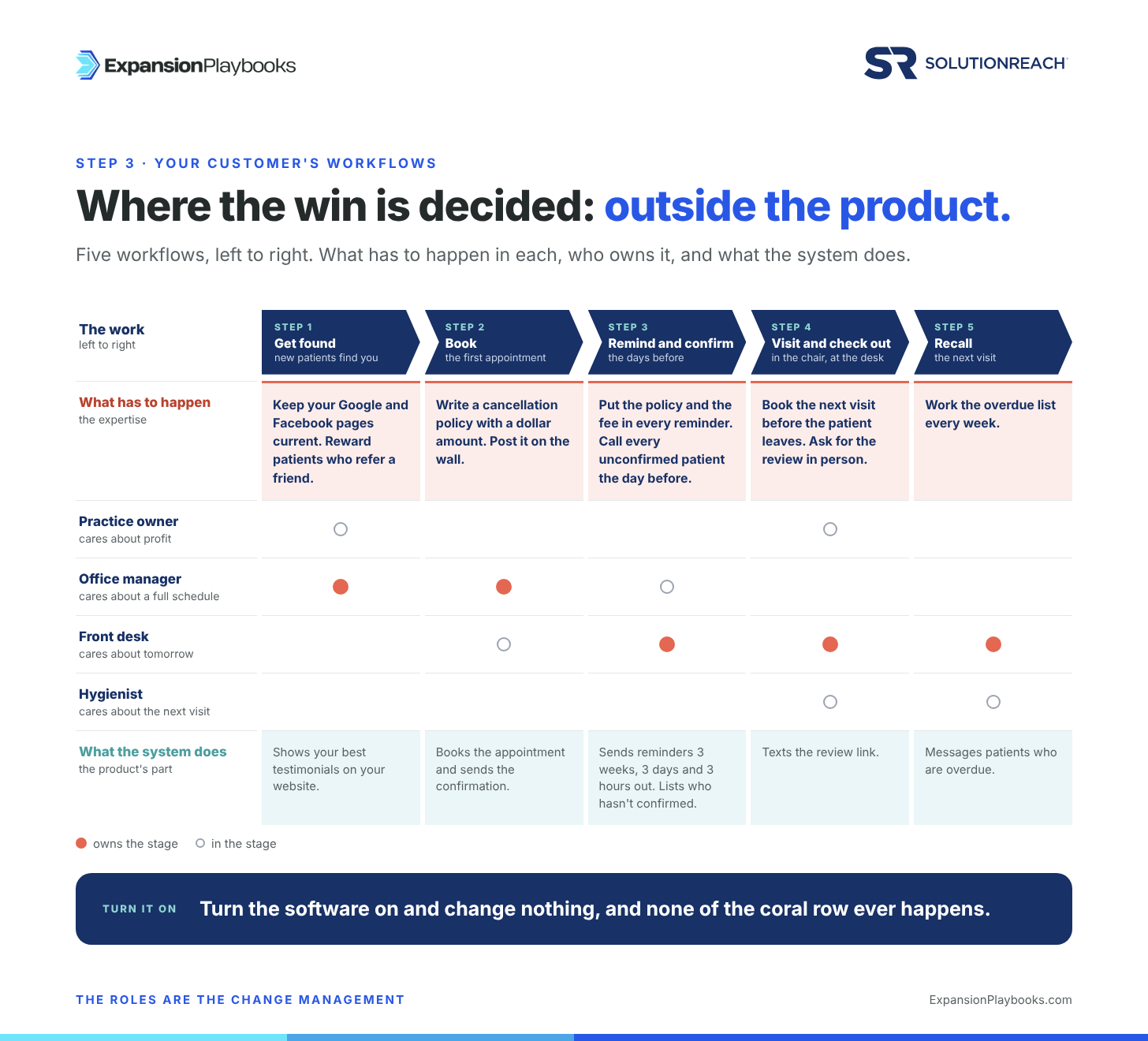
The doctor owns the wins, but the office manager, the front desk, and the hygienists do the work, and they live in five workflows: get found, book, remind and confirm, visit and check out, and recall.
Here's where the expertise lives. In every one of these workflows there's a behavior that decides whether the practice wins, and almost all of it happens outside the product.
The cancellation policy. The best way to cut no-shows is embarrassingly simple. Write a cancellation policy, put a dollar amount on it, and post it on the wall. Then put that same policy and that same dollar amount in every reminder you send. The reminder comes from the product. What makes the reminder work comes from expertise.
Confirming tomorrow's patients. The system can produce the list of patients who haven't confirmed tomorrow's appointment. It can't call them. Your staff still has to pick up the phone and confirm every one.
The next visit. The easiest time to book the next appointment is while the patient is still standing at the front desk. A recall message months later is the backup plan.
The review. Yes, you can get a review from a patient with nothing more than a link. But the in-person invitation, someone at checkout saying, "If you had a great visit today, we'd love a quick Google review. I'll text you the link now," dramatically increases the chance they'll leave one. The link just makes it easy to say yes.
And notice who has to change. The office manager writes the policy. The front desk makes the calls, books the next visit, and asks for the review. If you only ever trained the doctor, nothing changes.
That's Jon's "who's in charge of making it stick," and it's the part almost everyone skips.
Step 4: Build the Customer Results Map
The Customer Results Map is where the first three steps come together, and where your product finally shows up.
It starts from pure expertise on how the customer wins, then works back to exactly how your products help those outcomes and processes succeed. The wins become the outcomes. You decide how each one is measured. The workflows tell you the actions it takes to achieve them. And only then do you map the products that make those actions easier.
It's the one view that holds all three audiences at once. Leadership sees the economics behind every outcome. The buyer sees the wins they bought for. The end users see exactly what they need to do differently.
Applied to Solutionreach
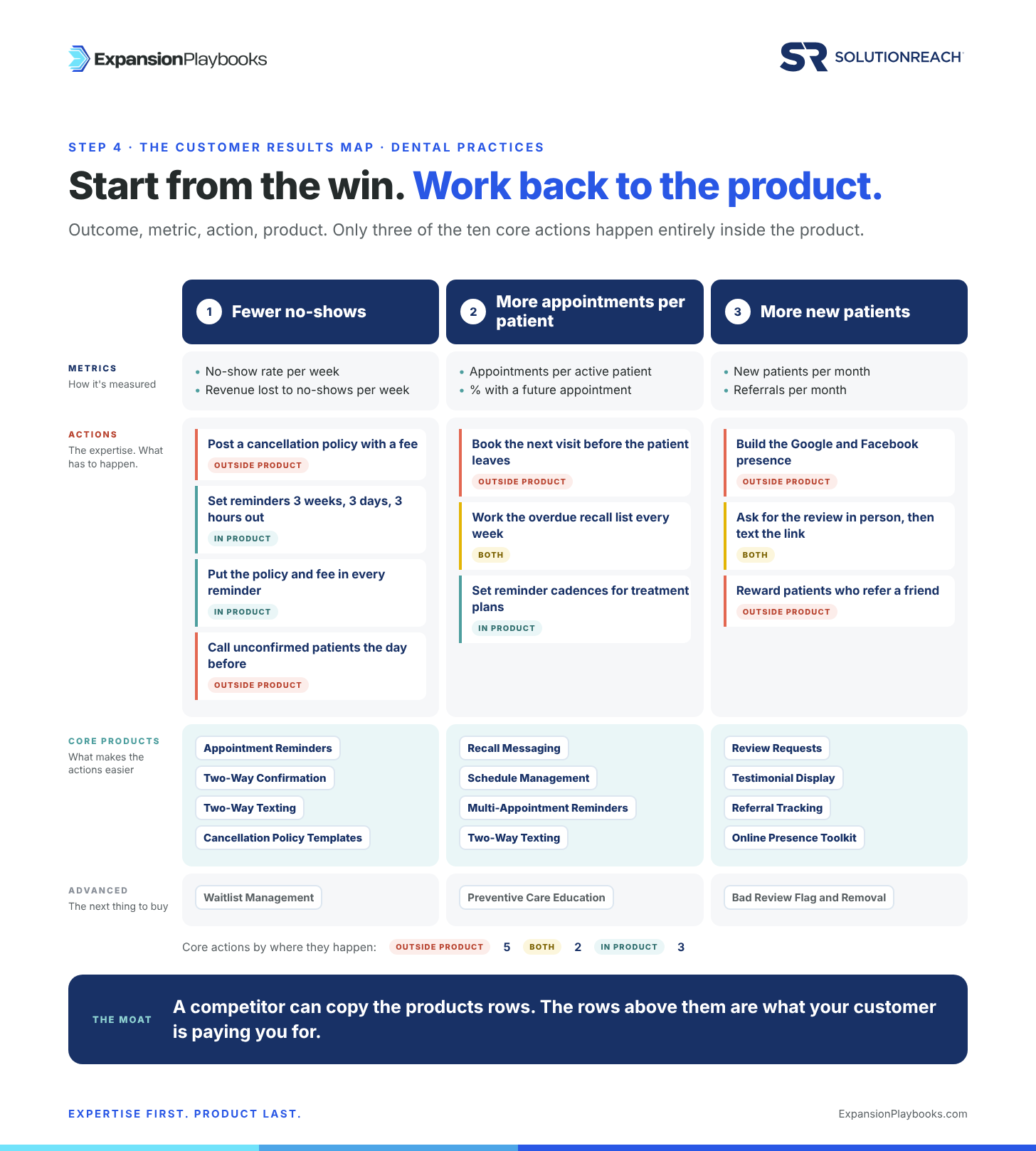
Read it top to bottom and something jumps out. Of the ten core actions, only three happen entirely inside the product. Five happen completely outside it. A competitor could have identical features, and a practice that skips those five would still fail.
That's the point. A competitor can copy the products row. The rows above it are what your customer is actually paying you for.
The map also tells you where to go next. A practice that has plugged its no-show leak is ready to work on appointments per patient, then new patients. That's your expansion path, and when you're expanding a customer, you're getting retention for free.
So is your job next?
If your job was to turn the software on and walk away, maybe.
But that was never the job that mattered. The job is getting the customer to change how they work, and making sure they win when they do.
At Expansion Playbooks, we've analyzed over a million customer records. When a customer gets a positive result, retention goes up two times. When they get a good result, six times. Results come from customers changing how they work, and somebody has to help them do it.
That somebody is you. AI can make you faster at it. It can't do it for you.
The advantage was never the software
Jon is right. Two companies can buy the same licenses in January, and by December one of them is better off.
The same has been true for your customers for 25 years. They could get the same features from you or from your competitors. The ones who won changed how they worked.
The advantage was being the vendor that actually helped the customer change.
Start with one customer
Pick one customer segment and run the four steps. Their economics. Their wins. Their workflows. Then the map back to your product.
If you want help, that's why I built Expansion Playbooks. It reads your own material (your website, your call transcripts, your decks) and drafts how your customers win. Then it makes you correct that model until it's yours, and turns it into the playbooks you run every week.
We're opening it to a small group of founding members first. Click here to apply to be a founding member when it goes live. You're not buying anything today. You're applying for a spot.
Jon asked what workflow changed at your company because of AI this year. Here's my version of his question: what's one thing your customers have to do outside your product to actually get the outcome they bought it for? Hit reply and tell me.