
As a kid playing basketball, I had a coach who taught me something that has helped me immensely in customer success. You have to know why you miss when you miss.
When I got to high school, I had high hopes of making the varsity team. I had started to become a pretty good shooter, but I was streaky. If I was on, I could make ten threes in a row. If I was off, I'd miss everything.
I had a neighbor who had played college basketball. He took some time to work with me one-on-one, and he asked me a question to help diagnose what was wrong. Why was it so streaky? He said, "Do you know why you miss the shot when you miss it?"
I had never thought about that. So he started asking me, every single time I missed, "Why did you miss it?"
You can't diagnose a miss until you know the fundamentals.
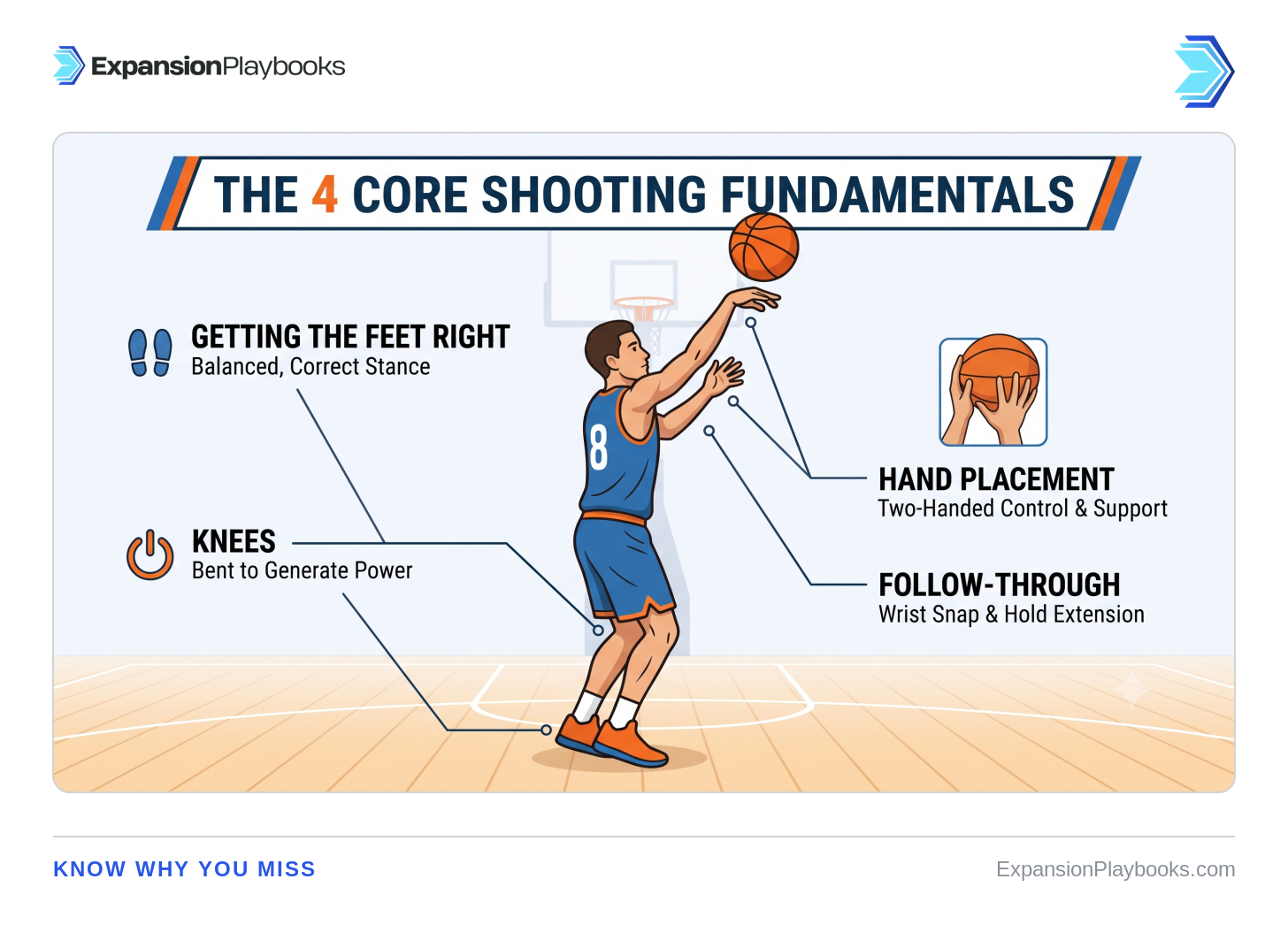
Before any of that could work, he broke down the core fundamentals of shooting effectively. Getting your feet right. Your legs right. Your hand position. Your follow through.
Once I understood the fundamentals, every time I missed a shot he would ask me the same thing. "Why did you miss it?" And I had to note what kind of miss it was. Did I shoot too far? Did it go off the back of the rim? Did I not shoot enough and hit the front of the rim? Did it go left? Did it go right? Did it go correctly to the hoop, but then bounce in and bounce back out?
Then I had to connect it to which of the fundamentals I failed at.
If it was off to the left, then it was my left hand hanging on the ball a little too long as I followed through, which dragged the ball left. If I was short on everything, I hadn't bent my knees and used my power. I was relying on my arms to shoot the ball, and so as I got more tired, I'd come up short on all my shots. If the ball was bouncing off the back of the rim, I wasn't creating enough backspin with my follow through. I was pushing the ball forward instead of shooting it.
And the proof that I was diagnosing it correctly was my next shot. If I corrected the issue, it would go in.
The streaky shooter chalks it up. The expert makes the correction.
Then my neighbor taught me the principle that actually mattered.
If you know why you missed when you missed, then in the middle of the game you can make corrections. When you're a streaky shooter and you're off, you just chalk it up to an off night. Nothing I can do about it. But if you know why you missed when you missed, then every single shot in the game teaches you something you can adjust, and you can stay on track and keep performing.
There are so many parallels to customer success.
We focus so much on cancellation reasons. We come up with some complex story about why a customer failed, and we become truly streaky shooters. We chalk it up. "Man, we had a great quarter of retention, then a bad quarter, and you know, nothing we can really do. It just depends sometimes." We treat the result like weather.
Instead, you can apply what I learned as a high school kid.
First, define the fundamentals of a make.
You can't ask "why did we miss" until you know what a make actually requires. In basketball it was feet, legs, hands, follow through. In customer success, here are the fundamentals I'd start with.
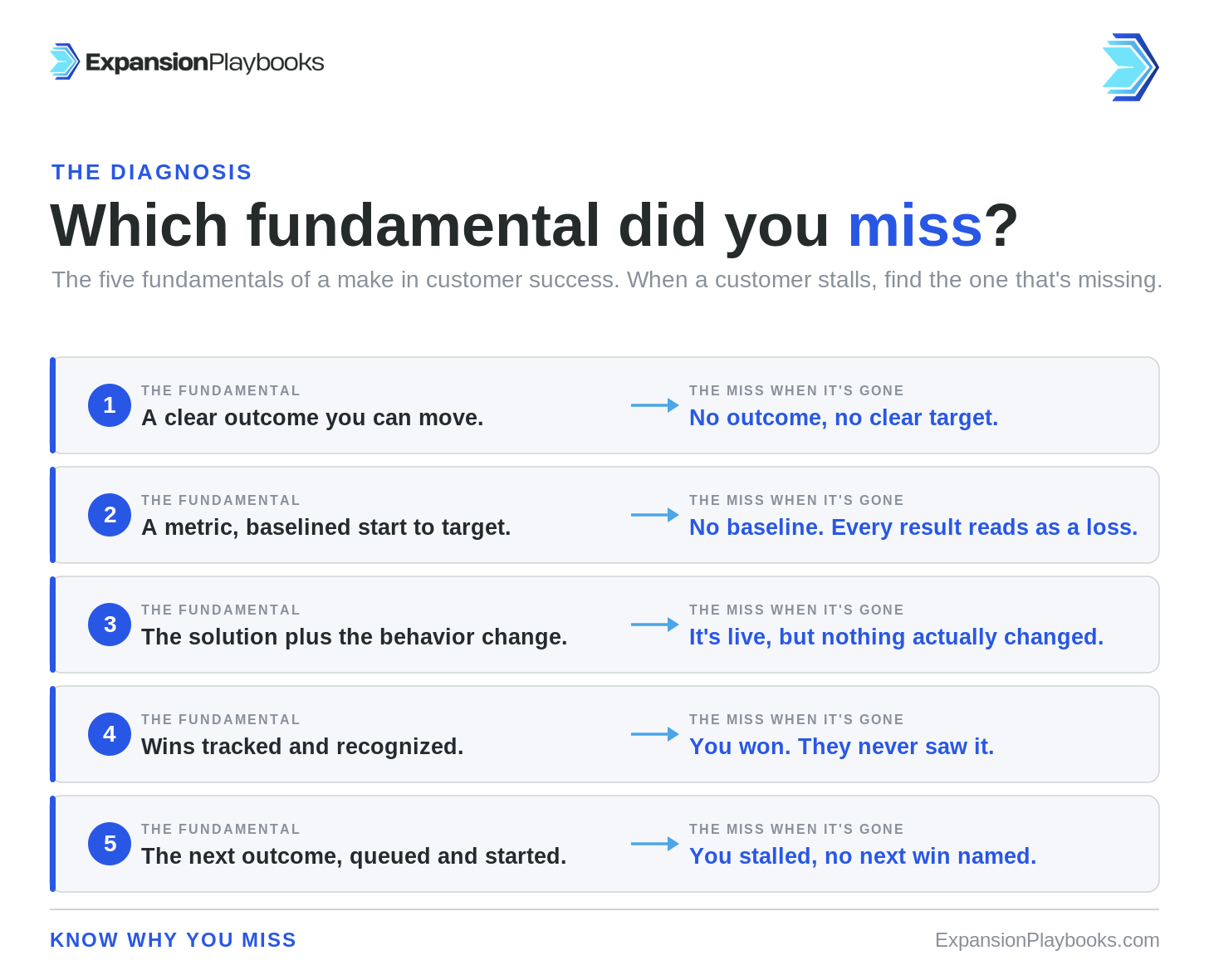
One. Does the customer have a clear outcome they want to achieve in their business that we are also able to help them achieve?
Two. Do we have a metric for how we'll know that outcome has been achieved, and have we baselined where they're at and where they're going?
Three. Have we assembled the correct technical solution and services they'd require to even be able to drive that outcome? And has the customer made the key action changes, both in the product and outside the product in their organization, to actually start improving their results?
Four. Have we tracked those wins, and has the customer recognized and seen those wins?
Five. Have we queued up the next outcome, started working on it, and repeated the whole thing?
If you have those fundamentals in place, then you can start to correct not just at the end of the game, "oh, we missed a bunch of shots, here's why," but mid-game, on the next shot.
There are two types of diagnosis, and you need both.
Remember, there were two parts to what my neighbor taught me.
The first is naming the miss that's happening right in front of your face. Is it long? Is it short? Is it left? Is it right? In customer success, that sounds like a cascade of questions. Do they not have results, or are they just not seeing them? Do we not even know what the outcome is they're going after? Do they have the right outcome, but we never actually set up the right solution? Do they have the right solution, but they never made the changes and took the actions necessary to drive it?
The second is connecting that miss back to the fundamental that failed, and then actually making the correction. Maybe we need to start over and lock in the right outcome. Maybe we need to go back and find the baseline, so we can use it to justify the improvement we've actually driven. Maybe we hit the outcome, but they're still frustrated because they never recognized it happened. We achieved it, and we just never promoted it properly. Or maybe we did all these good things and never said, "okay, that's great, here's what you should do next." There is always a what's next.
And the proof you diagnosed it correctly is the same as it was on the court. The next shot. You make the correction, and the customer starts moving again.
Every miss is information you paid for. Use it.
Here's what most teams get wrong. They think the job is to have more makes than misses, and when the misses pile up, to either come up with a complicated story or just give up and chalk it up to how things go sometimes.
The expert move is the opposite. Every single miss is a huge opportunity, because it's new information. You already paid for it. If you've oriented your work around the fundamentals, then that miss gives you the real signal you need to make the correction mid-game, the correction that can change the outcome of the next shot, the next win you drive for the customer.
That's the difference between being the adult in the room and being a streaky shooter. The streaky shooter is at the mercy of the night. The expert knows why every miss happened, and so the expert is never actually out of the game.
Know why you miss when you miss.
That's the whole thing in one line. Know why you miss when you miss.
If you only check your shooting at the end of the game, the best you can do is explain the loss. If you know why you miss in the moment, every miss becomes a correction, and you stay on track to perform. Do that consistently, and you don't just improve your customers' outcomes. You dramatically improve your own performance in your role, because you've stopped being streaky and started being someone who can be counted on to put it in.
So this week, take your most worrying customer, the one you'd be tempted to chalk up to an off quarter. Don't chalk it up. Run the diagnosis. Which fundamental are they missing? Is the outcome unclear, the baseline missing, the solution incomplete, the behavior change never made, the win never recognized, or the next outcome never queued? Name the miss, name the fundamental, and make one correction this week. Then watch the next shot.
I want to hear it. Hit reply and tell me the customer you've been chalking up to bad luck, and which of the five fundamentals you think is actually the miss. I read every response, and the patterns are going to shape the next piece.