Walk into any CS leadership meeting where retention or expansion is wobbling, and you'll hear the same prescription. "We need to get the customer's outcomes." "Let's make sure the CSMs are capturing business goals." "If we just knew what success looked like for the customer, we'd be fine."
It's not wrong. It's actually backed by the data. Customers with measurable results stay roughly twice as long. Customers with measurable and meaningful results stay roughly six times as long. If you knew exactly what your customer was trying to achieve, and you could prove you achieved it, and you knew what came next, and you could prove you could help with that too, retention and expansion would mostly take care of themselves.
So the playbook is obvious. Go get the goals. Achieve them. Get the next ones. Achieve those.
Then why doesn't anybody actually have the goals?
"Just get the customer's goals" is the most expensive piece of bad advice in customer success.
It sounds simple. Ask the customer what they're trying to do. Write it down. Hold yourself accountable to it. Done.
In practice, here's what happens. The CSM asks, "what are you trying to achieve?" The customer says something like, "we want to roll this out to the marketing team by Q2." The CSM writes it in the CRM. Six months later, the customer rolled it out to the marketing team by Q2, and they're still leaving at renewal.
Because rolling it out wasn't the goal. It was a task. And nobody renews a contract because they completed a task.
The mistake is treating goal-setting as a discovery exercise, when it's actually a coaching exercise. Customers rarely walk in with the goal you need. They walk in with project tasks, vague aspirations, and whatever language the sales team handed them on the way out the door. If you ask them point-blank, that's what you'll get back. And then you'll write it down and call it a win.
The goal isn't to ask for goals. The goal is to shape them.
Shape the Goal.
Shaping the goal is the act of using your expertise to move the customer from whatever they walked in with toward the business outcome that will actually keep them paying. You don't take what they say at face value. You don't smooth over the ambiguity. You bring the data, the patterns, and the recommendations, and you help the customer choose a goal worth chasing.
Note what that requires. It requires you to actually have an opinion about what your customer's goals should be. Not "it depends." Not "every customer is different." An opinion. Based on the hundreds or thousands of customers you've already worked with.
Most CS teams don't have that opinion. They've trained themselves out of it in the name of being customer-centric. The result is a team of professional note-takers, capturing whatever the customer says into a CRM field that nobody references again.
Here are the five moves that change that.
Move one: know the three tiers, and stop pretending they're all the same.
Not every goal is created equal. A "goal" your customer states could be any of three completely different things, and they don't drive the same behavior. They don't drive the same retention. And they sure don't drive the same expansion.
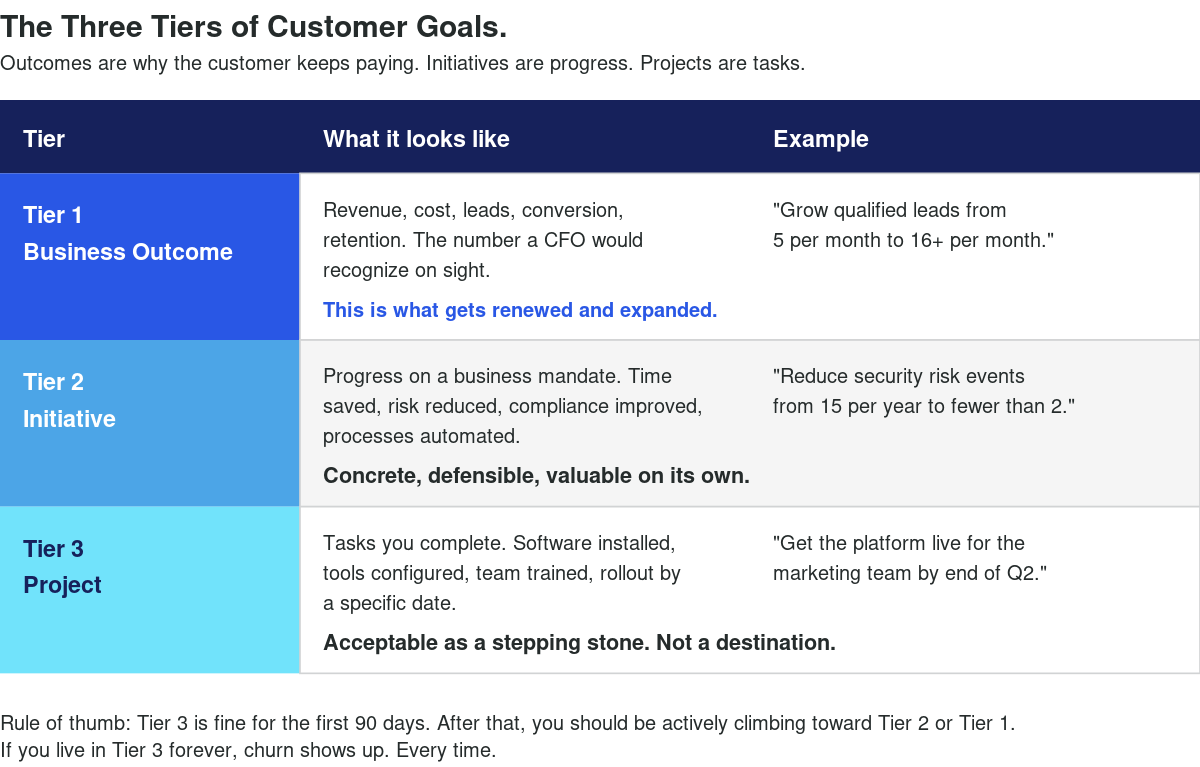
If you can tie your solution to Tier 1, do it. If you can't, Tier 2 is incredibly powerful on its own. "We reduced security incidents from 15 to under 2" is concrete, defensible, and worth paying for. Tier 3 is acceptable as a temporary state, but if you stay stuck in "we implemented the thing" forever, churn eventually shows up.
Most CSMs don't even know which tier they're operating in. They write down whatever the customer said and never ask the obvious next question, which is: is this a task, an initiative, or an outcome? If you can't answer that, you don't have a goal. You have a sentence.
Move two: accept the customer doesn't know their goals.
Most customers don't have a defined business outcome they're trying to drive with your product. They haven't sat down, baselined their current state, distilled the essence of what they're really trying to accomplish, and mapped it to the process and tool changes required. And it's not because they're not strategic. This initiative is new for them. There are multiple teams involved, competing priorities pulling in different directions, and a hundred other things on their plate. Goal definition for this specific project hasn't risen to the top.
You're in a completely different seat. You've onboarded hundreds, maybe thousands of customers in this exact use case. You know what success looks like. You know exactly where customers stall. You've watched the same patterns play out so many times you could sketch them on a napkin.
That's the opportunity. If you walk into every goal-setting conversation already assuming the customer hasn't fully thought this through, you stop trying to extract a clean answer that isn't there. You come in ready to teach. Ready to share what's already worked for customers like them. Ready to apply the expertise you've earned over years of repetition. The customer isn't expected to know what good looks like for them. You are.
That's the responsibility too. The customer signed up because they trusted you'd help them get somewhere meaningful. Helping them define where "somewhere" actually is, in business terms, is part of what you owe them. That's the job.
The mistake is to take whatever the customer says at face value. The other mistake is to let the ambiguity sit. Neither one is the work.
Move three: become the expert. Have a Results Map ready before the customer ever asks.
Your product is not doing an infinite number of things. Your customers are not chasing an infinite number of goals. You don't sell email marketing software to people who want to reduce their office catering budget.
You have a finite set of use cases. Within each use case, there's a finite set of outcomes that actually matter. And inside your customer base, you already have the data on which outcomes correlate with retention and expansion, and which ones don't. You're sitting on the answers.
Your job is to turn that into a Results Map. For every use case you support, you should be able to answer four questions on the spot:
- What are the Tier 1 and Tier 2 outcomes a customer in this use case should be driving?
- What's the best metric to track each one? The second-best? A proxy if the customer doesn't have the data for the first two?
- What does poor, good, and best performance actually look like for that metric? In numbers.
- Given where this specific customer is starting, what's the realistic first goal, and what's the next one after that?
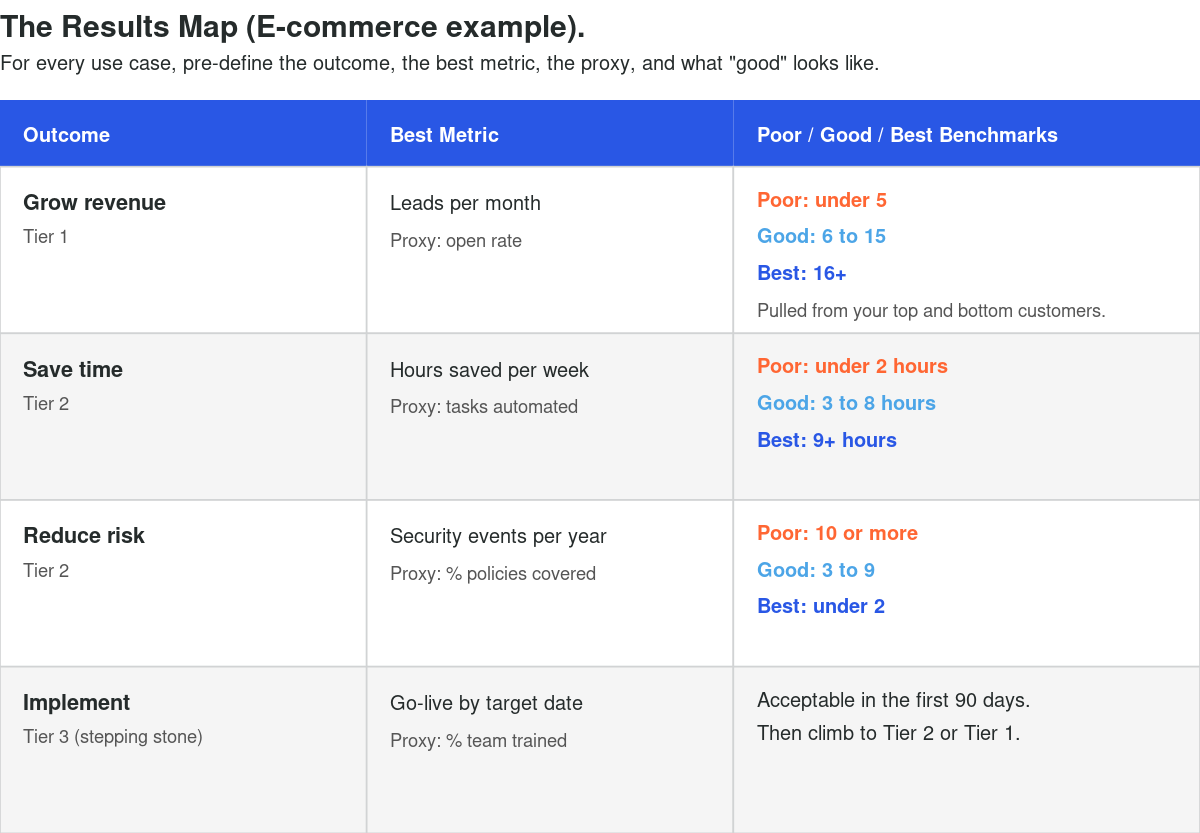
The poor/good/best benchmarks aren't abstract. They come from your own customer data. Your top performers and your churn risks already tell you what the ranges are. If you haven't pulled the numbers, that's the homework.
If a customer could walk into your office today and say, "you're the expert, tell me what my goal should be," and you don't have a confident answer for them, then it's already clear why you're not consistently capturing meaningful goals. Build the map.
Move four: master the surface-and-set method. Invite, Teach, Uplevel, Reframe.
Even with the Results Map ready, you can't just tell the customer their goal. Customers will always remember what they say better than what you say. Your job is to walk them down the path so they end up stating the goal themselves.
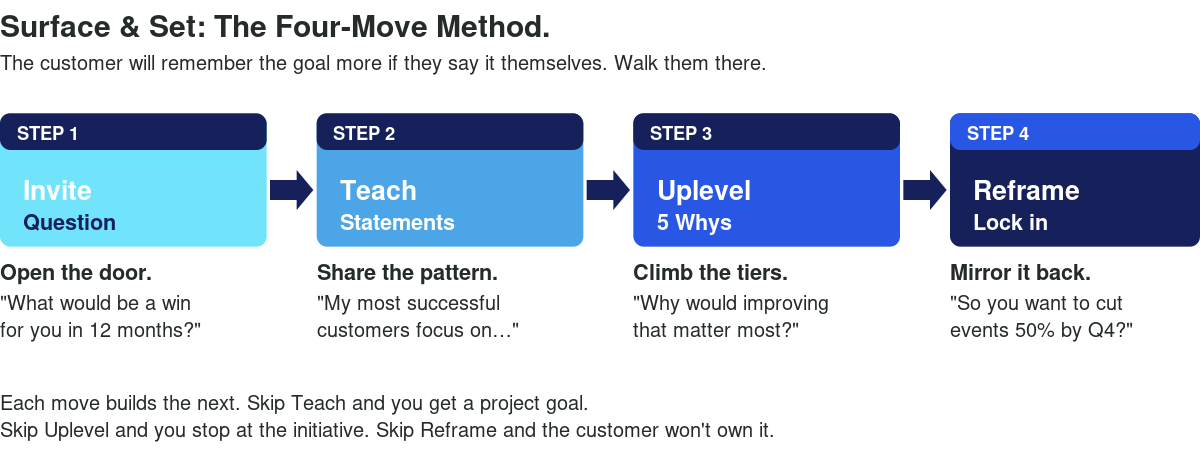
Here's how each move works.
Invite. Open the door with a question that surfaces where the customer's head is. "What are you trying to achieve? What would be a win for you in 12 months?" This reveals whether they have a Tier 1 outcome ready, a Tier 2 initiative, or, most often, a Tier 3 task. You're not done after this step. You've just gathered intel.
Teach. Now you share what your most successful customers in this use case focus on. Not to box them in, but to shift their thinking from tasks to outcomes. "My most successful customers with your use case of X are focused on either growing qualified leads or shortening their sales cycle. Typically they're aiming to get conversion above 25%." You're giving them a vocabulary they didn't have when they walked in.
Uplevel. Now you climb. Ask the why questions that move them from project to initiative, and from initiative to business outcome. "Tell me more about why getting this implemented matters. What's that for? Why would improving that be important to the business?" Keep asking why until you've landed on the Tier 1 or Tier 2 outcome that's the actual point.
Reframe. Lock it in. "If I'm understanding correctly, you're investing in this cybersecurity platform in order to decrease email security events by 50% in the next six months. Is that right?" Now the customer hears their own goal stated cleanly, and they confirm it. That confirmation is the moment the goal becomes theirs. Not yours. Theirs.
If you skip Teach, you'll get whatever they walked in with. If you skip Uplevel, you'll stop at the initiative. If you skip Reframe, the customer won't own it when things get hard.
Move five: use the goal. Don't just capture it.
The whole reason to shape the goal isn't to check a box or fill out a CRM field. It's because the goal gives you leverage. Without it, you're a vendor. With it, you're the adult in the room.
Business is hard. The customer signed up with you because they were struggling to achieve this outcome with previous vendors or previous processes. By definition, it's not going to be easy. There will be competing priorities. There will be people inside the customer's org who don't care about this goal. There will be quarters where the customer would rather coast than do the work.
Your job is to use the customer's goal to keep them accountable to the commitments, resources, time, and effort needed to actually get it. That looks like:
- Restating the goal at the top of every meeting. Not as a recap. As a recommitment.
- Tying every action you recommend back to the goal. "We're doing this because it gets you one step closer to under-2 events per year."
- Challenging the customer when they're not putting in the work the goal requires. Not asking permission. Telling them.
If you captured a goal and never use it, you didn't shape it. You just took notes.
The note-taker or the adult in the room.
Your customers don't need another note-taker. They have plenty of those already. Your CRM is full of them.
What your customers need is the adult in the room. The one who's seen this play out hundreds of times. The one who knows which outcomes actually keep companies paying. The one who's willing to push back when the customer says "let's just track open rates" and explain why open rates won't keep their boss happy at renewal.
The goal isn't to ask for goals. The goal is to shape them.
That's the work. That's where retention and expansion actually live.
One thing to try this week.
Pick one customer you have a meeting with this week. Before that meeting, pull out a piece of paper and answer these three questions.
- What Tier 1 or Tier 2 outcome should this customer be driving with your product, given their use case?
- What's the best metric to track it? What's a proxy if they don't have the data for the first one?
- What's a realistic first goal, given where they're starting today?
Then walk into the meeting and run the four moves. Invite. Teach. Uplevel. Reframe. See what happens.
If you want a starter kit, I built a free AI Prompt Pack for Shaping Customer Goals. It's a set of plug-and-play prompts you can drop into ChatGPT or Claude to walk through each of the four moves for your specific product and use case, pre-meeting. You answer a few questions about your customer, and it spits out the questions to ask, the benchmarks to anchor on, and the reframe sentence to close. Grab it free at expansionplaybooks.com/resources.
Which of the four moves do you skip most often? Invite, Teach, Uplevel, or Reframe? Hit reply and tell me where it breaks down for you. I read every response, and the patterns I'm seeing across teams are going to shape the next piece.