The renewal is 60 days out, and the customer is signaling they may not come back. They don't feel like they've been getting enough value from your solution.
So you do what every good team does. You dig into the account. You go over all the wins they've achieved and all the outcomes you've been impacting, and you come up with a pretty compelling narrative: you helped them generate $3 million in additional revenue. Your product only costs $100,000. On paper, this is a slam dunk. Obviously they should stay.
Then the pushback comes. "Well, at the same time we started using your system, we also changed our own sales process. And we hired some new reps who really helped us evolve."
I've watched this play out over and over, and there's a pattern: the bigger the number, the bigger the pushback. The bigger the win, the bigger the pushback.
The mistake everybody makes is treating this as a value problem. And sometimes it is. Plenty of vendors never actually produce value for the customer, and no renewal narrative can save you from that. But far more often the value was real, and the problem is something else entirely.
They never named the win. And they never called their shot beforehand.
An unobserved win cannot retain
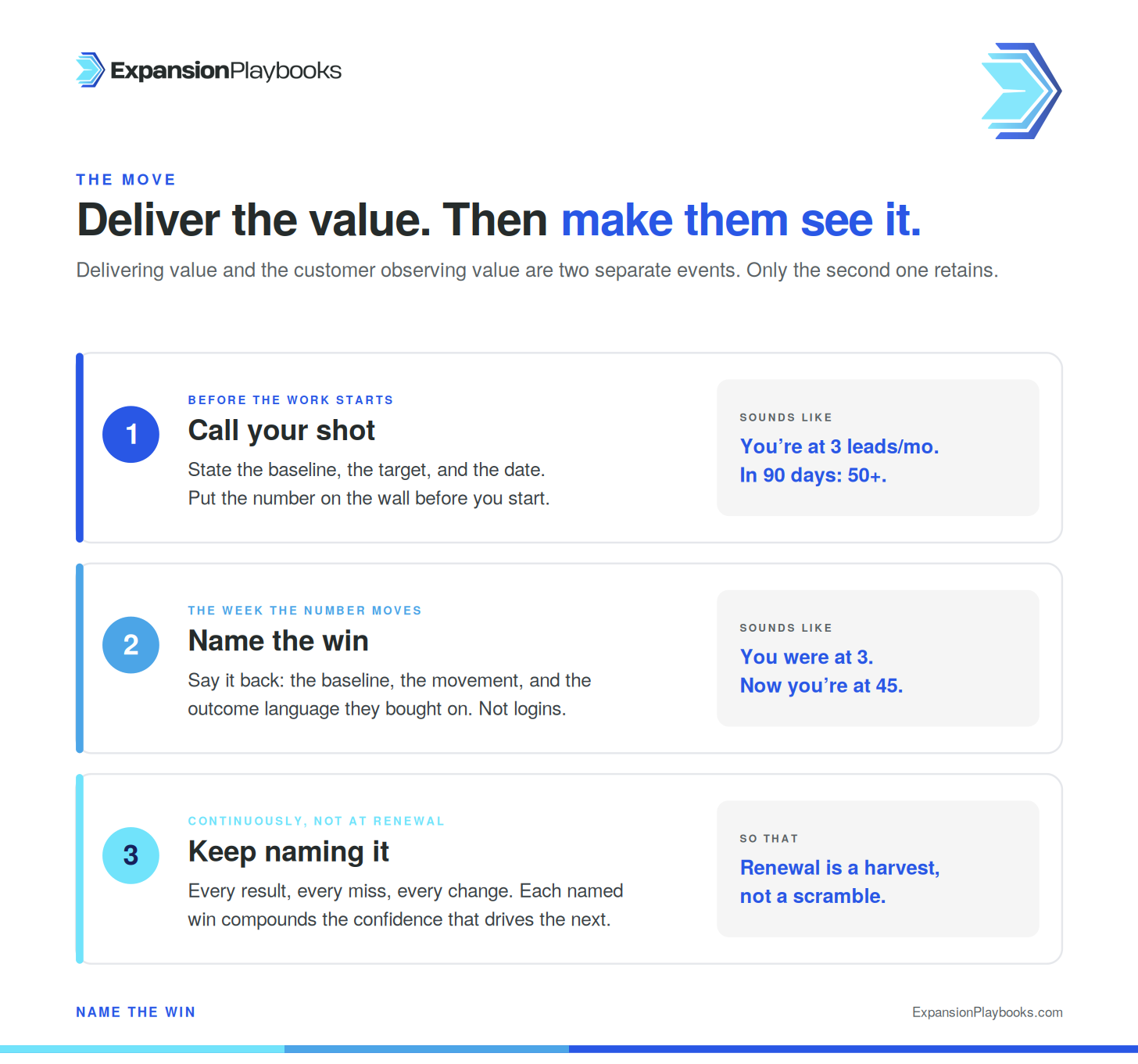
Everyone in SaaS is optimizing for delivering value. Time to first value, value realization, value engineering. All good things. But it's not enough to achieve the outcome. The customer has to recognize that success has been achieved. Delivering value and the customer observing value are two separate events, and only the second one drives retention.
I've analyzed millions of customer records, and the most highly correlated factor for retention is this: did the customer get a measurable outcome. A positive result, retention goes up two times. A good result, six times. And "measurable" is the load-bearing word. The outcome has to be measured, and the customer has to see the measurement.
So for retention purposes, a result the customer cannot see is a result that did not happen.
That's why I teach one move above almost everything else in customer-facing work: Name the Win. Before the work starts, you call your shot. Here's your baseline, here's where we're going to get you, here's when. And the moment the numbers actually move, you state the result back to the customer, with the baseline, in the outcome language they bought on. Then you keep doing it, continuously, not as a one-time reveal at renewal.
Why the customer gives your win away
Every outcome a customer achieves has multiple potential causes. New hires, new processes, a better quarter, a changed market. All of those variables are real, and all of them will be standing in line to take credit for your result at renewal time.
When you call your shot beforehand, something powerful happens: all those other variables receive almost no weighting from the customer. You said "you're getting three leads a month today, and in the next 90 days we're going to get you over 50." When the number moves, everyone already knows why it was supposed to move and who put the target on the wall. When you never call it, the credit gets spread across everything else that happened at the same time, and your $3 million narrative at renewal reads like a stretch.
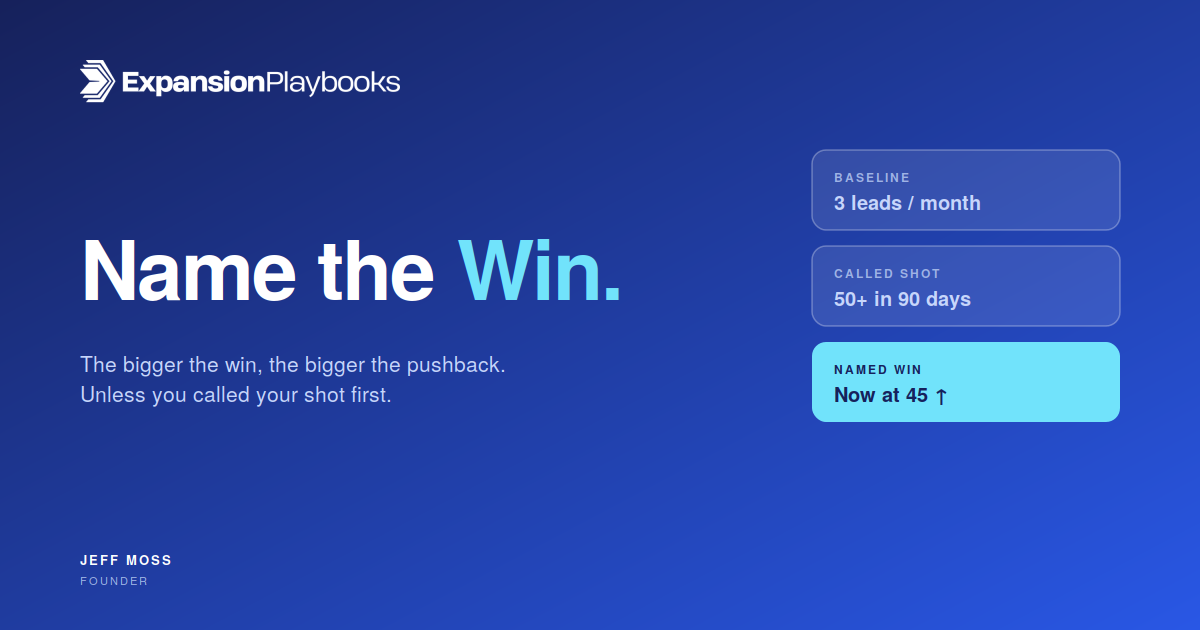
And the start of an engagement is actually the easiest time to do this, because the baseline is usually sitting right there. The customer was doing the process manually before, or with an inferior product, or with bad processes. Let's say you sell into food manufacturing: "For the last six months, you haven't even been labeling all of your food products correctly. Our goal is 100% compliance on your food safety labeling in the next six months." Or leads: "Currently you're only getting three leads a month. In the next 90 days, we're going to get you over 50."
That's calling your shot. Everything that comes after depends on it.
Name the win the week it happens
Then the number moves. And this is the step almost everyone skips: you name it, out loud, back to the customer.
"You used to be at 60% compliance. Now you're at 95, and we're on track for 100." "You used to get three leads a month. Now we're at 45." Whether you fully achieved the goal or just got close, you name it, and you tie it back to the shot you called. This is what closes the loop on the value you delivered.
Notice what those statements contain: the baseline, the movement, and the outcome language the customer bought on. Nothing about logins, adoption rates, or feature usage. Nobody bought your product to log in more.
The best example of this I ever experienced as a customer: when I was an early head of customer success and support, I installed Zendesk. They had a dashboard that showed me several metrics. But they also sent me something called a monthly snapshot, an emailed report at the end of every month showing my last month's performance. They picked one metric, first response time, and they would show me: "Hey Jeff, your first response time last month was 22 minutes. That was 6 minutes faster than the month prior, but it's 20 minutes slower than the benchmark of other companies in your industry at your size. Great job on the improvement. What did you do that caused it? And here are some suggestions on other things you can do to get in line with the benchmark."
There's so much power in that. They compared me against myself, and they compared me against a benchmark. I may not have been better than the benchmark of my competition, but I was better than myself. I was improving. And it even set up my next goal: okay, I improved by 6 minutes, but I want to get better even more. Let's get this from 22 minutes down to 4.
They only did one metric, and I actually recommend you do better than that: two or three core metrics, based on the customer's use cases. But the biggest mistake in almost everyone's reporting is that dashboards are just snapshots, a point in time. Everything should be compared to change over time, against yourself and against a benchmark. That combination is the ultimate win, and it should be there for every customer.
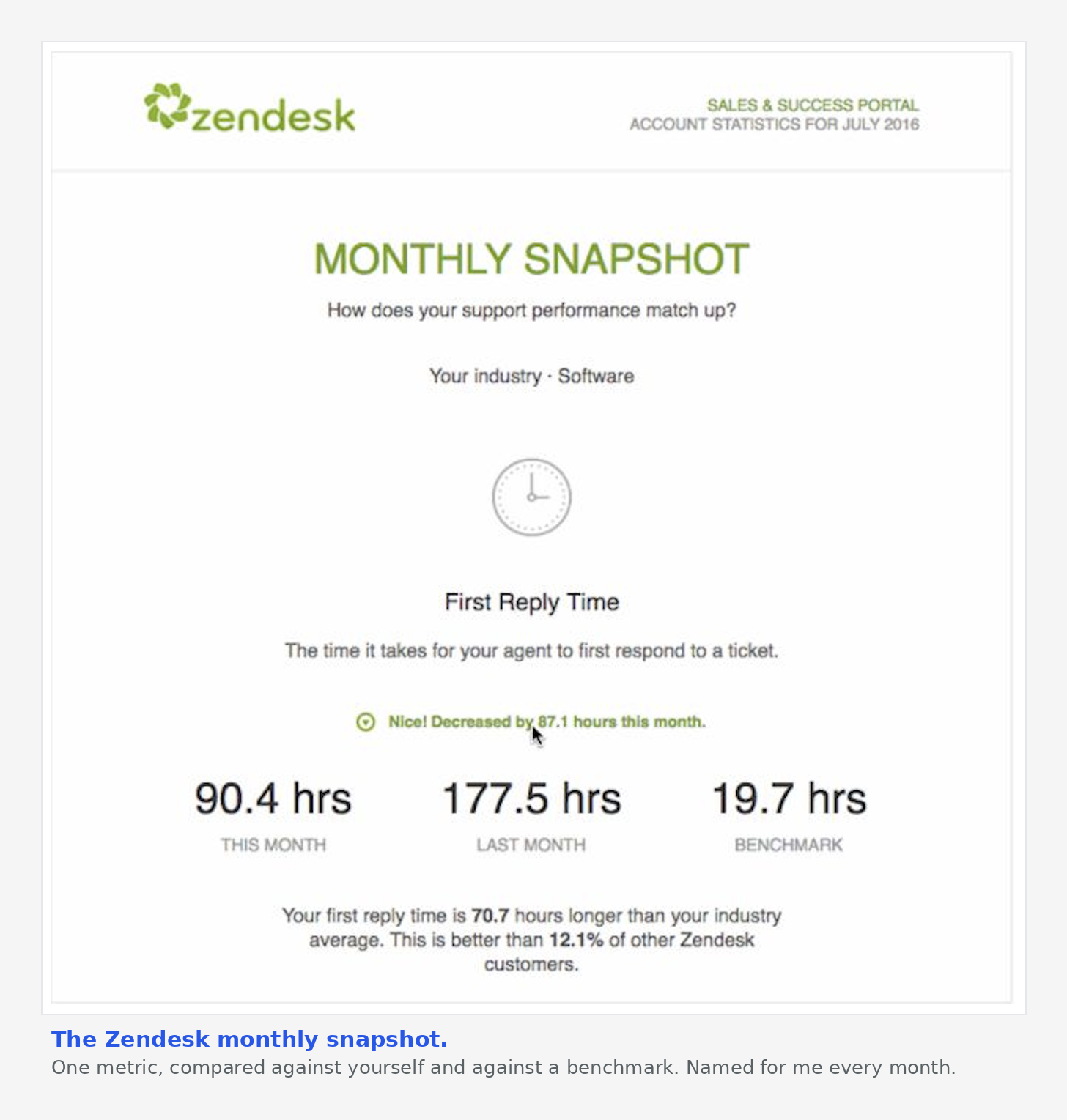
I knew whether I was succeeding or not, and they were helping me along the way, even though I never talked to a single account manager or CSM, because I was a small account to them. And that's the point about scale. If you have a human motion, naming the win looks like a CSM constantly showing the customer: "Okay, we've launched these things. Let's check our stats. Remember, our goal is to get here in the next three months." And when you get there: "Hey, we got there." If you're running a scaled motion, it looks like Zendesk's snapshot, pumped out monthly to every account. Either way, the move is the same.
Why everybody skips it
So why does this step get skipped? Why does a team deliver a real first result and never bring it to the customer's attention? Is it because there was never a baseline, so there's no way to show the movement? Is it because the result came in under the goal? Or is it because everyone assumes the customer can see the metrics in the system whenever they want?
The first one is the call-your-shot failure all over again. If you never captured where they started, you have nothing to name the win against.
The second one is fear. The goal was 50 leads a month and you only got them to 35, and so you don't want to show them less than the goal. Maybe they'll be mad. Maybe they'll react negatively to the result. But remember the baseline: they were at three. Naming it against the baseline is what makes 35 look like the progress it actually is, instead of the miss the customer will assume it was if they ever go looking on their own.
And the third one is the sneakiest. It goes like this: "We have an analytics section in our product. The customer can see their performance. Isn't that enough?" No. "Okay, we put insights right on the homepage. Is that enough?" It's better, but it's not enough. You have to put the result directly in front of the customer's face, framed against the baseline and the goal, or it does not exist for them.
One caution on what counts as a win: early enthusiasm doesn't qualify. The win is a materialized, measured result. Excitement in week two is nice, and it fades. A number that moved is what the customer remembers at renewal.
And when you do name it, it compounds. Each named win builds the customer's confidence, and so they engage more, and so the next result comes faster. If I know what the customer is trying to achieve, I can show them we've already achieved it, we're already on track, and I already know what we're going after next. The renewal becomes a foregone conclusion. Renewals are won at month two, not month eleven: the renewal is a harvest, not a scramble.
And you're buying a ticket to whatever else the customer needs, because they have plenty more problems, and you have plenty more solutions that deliver value for them. You're actually doing the customer a disservice if you're not pushing them toward the next outcome they could be getting. Naming the win is how you cash the check on the value you already delivered, and how you earn the right to sell the next one.
The three things this takes
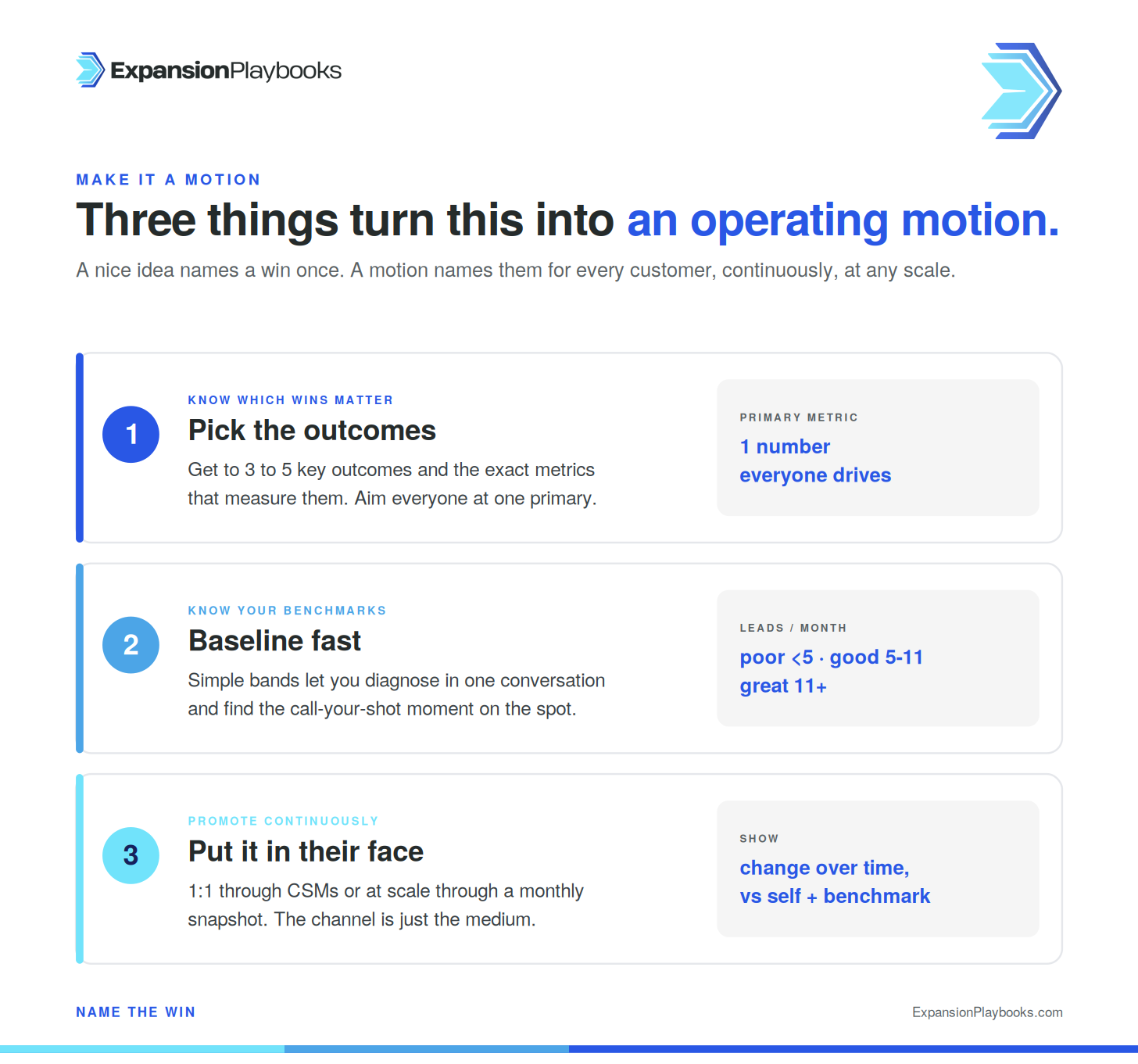
If you want to make Name the Win an operational motion instead of a nice idea, you need three things in place.
One: know exactly which wins matter for your customers. Get them down to a list of 3 to 5 key outcomes and the exact metrics that measure those outcomes, metrics you can actually do something about. And you should have at least one primary metric that you direct everybody towards.
Two: know your benchmarks. You need to be able to quickly determine a customer's baseline, and it often takes less effort than you think. As an example, if the metric is leads per month: poor is under 5, good is 5 to 11, great is 11 plus. If it's labeling compliance: poor is below 90%, good is 90 to 99, great is 100%. Now you can diagnose someone in a single conversation. "Just from talking to you and getting some basic information, you're performing in the poor category. Our goal is to get you to good in the next three months." That's your call-your-shot moment, and the benchmarks are what let you find it fast.
Three: promote the outcomes continuously. One-to-one through your CSMs, or at scale through something like the monthly snapshot. The channel is just the medium; the promotion is the thing. And continuously means all of it: the early results, the lack of results, and every change in between. You're not just showing numbers, you're teaching the customer what each one means, and connecting every result back to what caused it. "This moved because of what we just launched. It's working. We should do more of it." "You bought this additional product last quarter, and it's already starting to pay dividends." "This one hasn't moved yet, and here's what we're doing about it." Call out every win and every change, so the customer sees the progress and understands they are progressing. The customer should never have to wonder whether this is working.
"Isn't this just a QBR?"
No, and the two aren't in competition. They support each other. Naming the win is event-triggered: the trigger is the measured movement, whenever it happens. If the number moved in week 6 and you waited until the quarterly review in week 13 to mention it, the win went stale, and the customer already handed the credit to their new sales reps. The key is to not wait.
The QBR is where you assemble everything you've been naming along the way. What do all those wins mean in aggregate? What's the full value they add up to? And what do they set up next? So you capture and name each win the week it happens, you encourage the person you're working with to promote those wins internally at their company, and then you put a fine point on them at the QBR and use them to motivate the next elements of the strategy. The QBR stops being a scramble to prove value and becomes the place where value everyone already knows about gets aimed at what comes next.
The win only counts if they see it
You can deliver $3 million of value and still lose the renewal, because value that was never named gets absorbed into everything else that happened that year. And so the discipline is simple to describe and rare in practice: call your shot, name the win, keep naming it. A result the customer cannot see is a result that did not happen.
One account, this week
Find one account this week where a measurable first movement already happened. Maybe the number moved two weeks ago and nobody said anything. Name the win, with the baseline, in the language they bought on. Then watch what it does to the next conversation.
If you try this, I'd love to hear how it goes. Hit reply and tell me the win you named this week, or about the renewal where the customer pushed back on a number you knew was real. I read every reply.