I've handled angry customers on Zoom.
I wasn't prepared for the day they showed up in our lobby.
I was a first-time Director of Customer Success at SalesRabbit, and this was one of our largest accounts, a big satellite TV sales organization. They were about to launch a new wave of users. And instead of a calendar invite, I got a front-desk call telling me that four of their people were standing in reception, and they were fired up, and they had come to tell me everything that was wrong with our product.
Some of what they were about to say was true. Product stability, a couple of missing features, an integration that was not behaving. Other customers were hitting some of the same things. So I could not walk in there and argue with them.
But now they were here. In person. And I had about thirty seconds to decide what kind of meeting this was going to be.
The mistake everybody makes with an angry customer
Most of us treat this as an emotional problem. The customer is hot, so the goal becomes cooling them off. You lead with empathy, you apologize a lot, you promise to take it back to the team, and you try to get out of the room with the relationship intact.
And that fails, almost every time, because you never addressed the thing actually generating the heat.
What generates the heat is vagueness.
When a customer says "your product is broken" or "nothing is working" or "my whole team is dead in the water," they are not lying to you. They are describing something they have not measured. And an unmeasured problem has no edges. It expands to fill whatever space you give it. So in their head, the problem is not four issues that showed up in the last two weeks. The problem is the entire investment, the internal credibility they spent to buy your product, the launch they now believe is going to fail, and the sinking feeling that this was a mistake.
Ask them how big it is and they cannot tell you. Undefined customer problems have no edges, and that is exactly why they feel infinite.
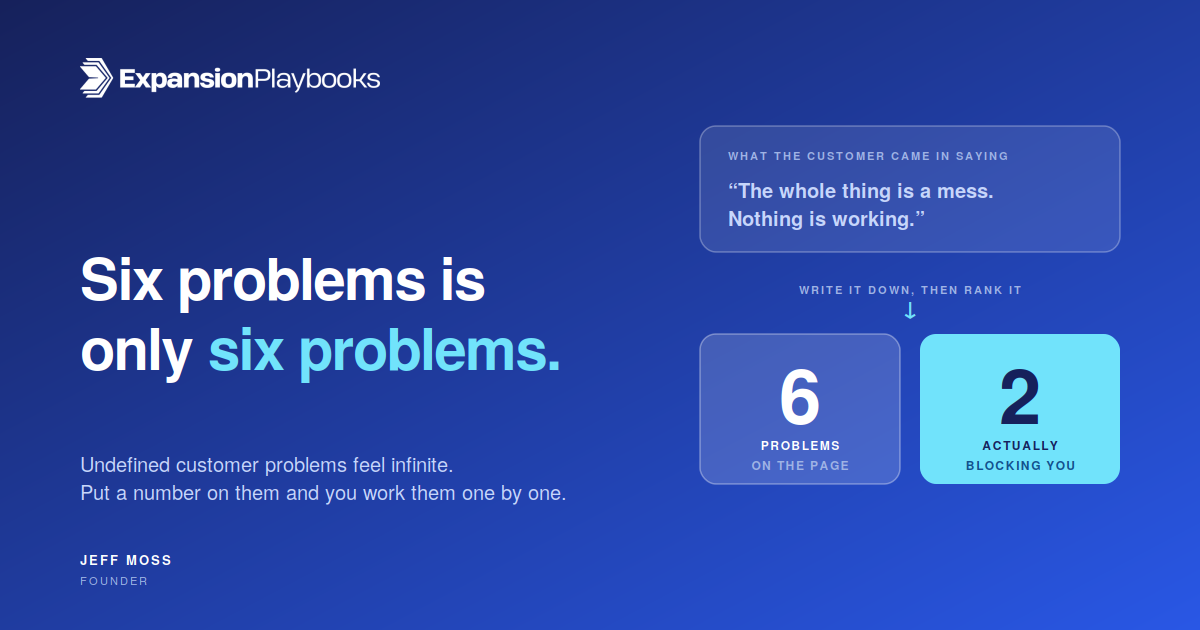
Now watch what happens the moment you put a number on it. Even a bad number. Let's say you write it all down and there are six distinct problems. Six is a lot. Six is worse than you hoped. But six is finite, and finite is a completely different emotional object than infinite. Six problems is only six problems. And not only that: those six are not equal. They are not equal in size, they are not equal in impact, and they are not equal in priority, even though they all felt equal thirty seconds ago when they were still a fog.
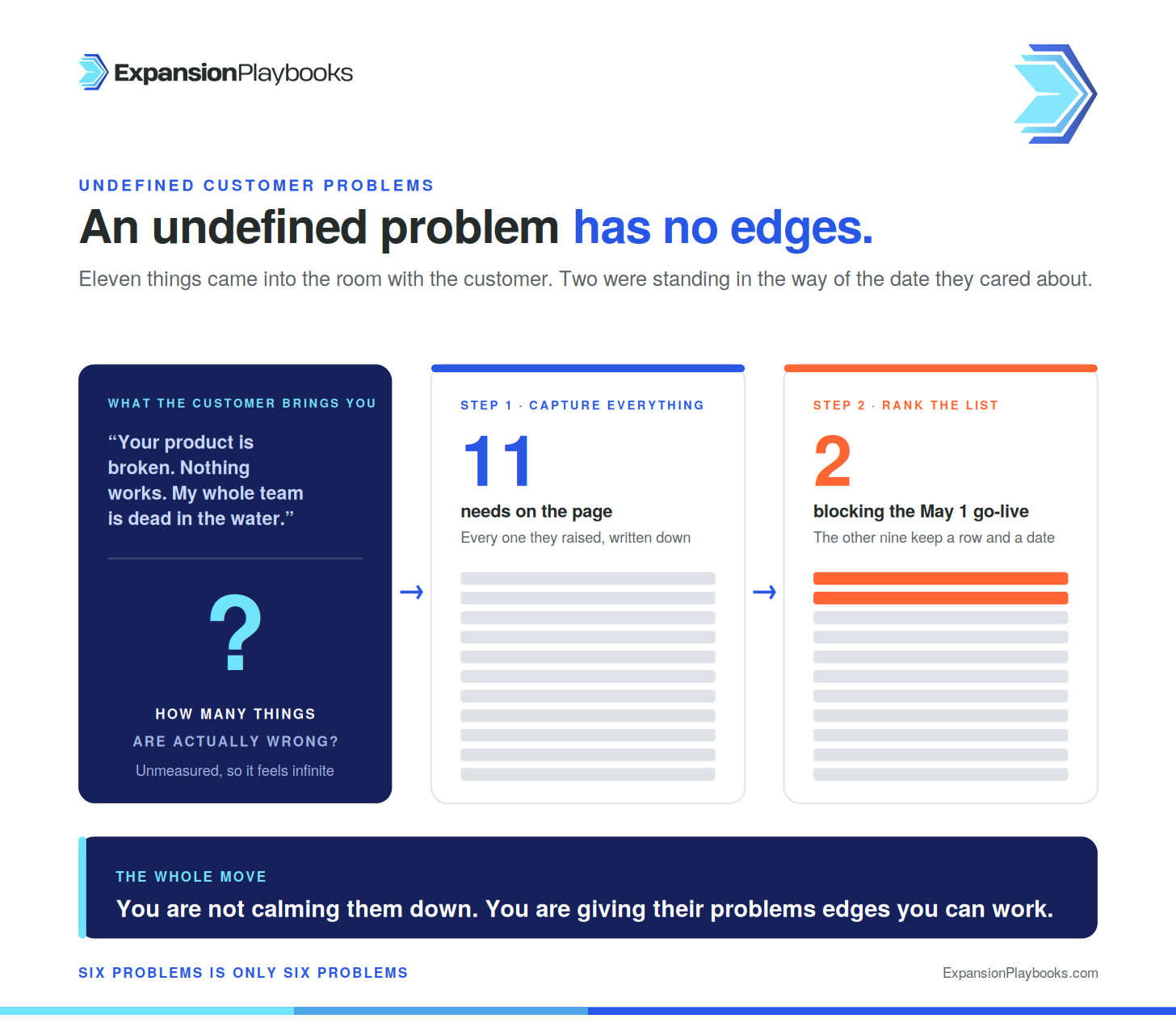
That is the whole move. You are not calming the customer down. You are giving their problems edges, so the two of you can work them one by one instead of staring at all of them at once.
I think of de-escalating as judo. You are not absorbing the customer's energy and you are not fighting it. You are taking that energy, which is already pointed at you at full speed, and you are redirecting it into defining and solving the actual list.
Here is what I did in that conference room
I put them in a room, sat down, and shared my screen.
Then I opened a spreadsheet. That was it. No deck, no prepared remarks, no defense of the product. One issue per row.
As they talked, I summarized what I heard, typed it out where they could watch me type it, and asked one question over and over.
"Is there anything else?"
We did not move on until it was all out on the table. Ten rows. Then fifteen. Some I already knew about, some were brand new to me. But complete.
That alone took the edge off, and it took the edge off before I had solved a single thing. People calm down when they feel heard, and they calm down faster when they can literally see their concerns captured in front of them in words they recognize.
So capture is step one, and it has a rule attached to it. You do not get to skip to solutions while there is still material in the customer's head. Every unspoken grievance is a live grenade in the next meeting. Get it out, write it down, read it back.
Define it down
Capture gets the list. Defining it down is what shrinks it.
The way you do that is by separating and labeling, continuously, while they talk. Every claim they make comes in at maximum scope, and your job is to walk it back to its real scope with questions, not with corrections.
Let's say a customer tells you the whole product is crap and everybody is dead in the water.
Okay. Tell me what's going on. Who's dead in the water? Is it all of your employees?
Well, no. It's our HR team.
Okay, is it all of the HR team, or a specific group inside it?
It's the HR generalists.
Okay. What's happening for them?
It's the new-hire workflow. When someone joins, we add them to the HRIS, and the document request is supposed to fire automatically, and it isn't.
Look at what just happened in four questions. We went from "the whole product is crap" to a specific workflow, for a specific role, inside a specific team. Same facts. Same customer. Nothing was minimized and nothing was argued. And now it is a thing with edges that a developer can actually be handed.
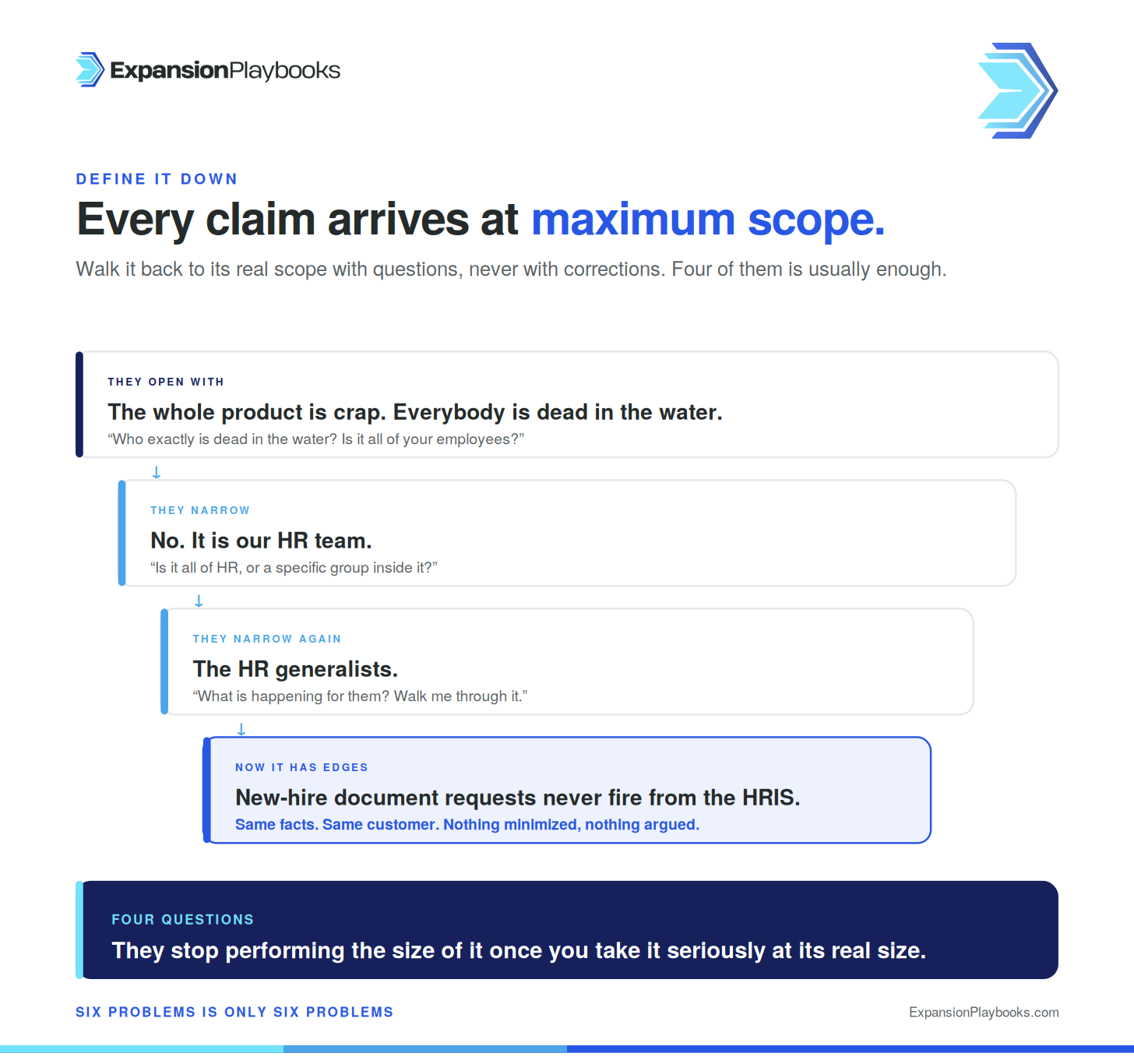
Do that for each item on the list and something powerful happens to the customer's body language. They stop performing the size of the problem, because they no longer need you to believe it is enormous. They can see you take it seriously at its real size.
And this is the moment to acknowledge it, once. Yeah, that's wrong. That's not what we want to be doing for our clients. Let's get after it.
Once, and then move. Because the apology is not the answer. Nobody drove to your office to collect an apology. They came to get the problems fixed as fast as possible, and to find out whether you are competent enough to be trusted with the fixing. Competence breeds confidence. So spend your minutes on the list, not on the sorry.
Rank it against the outcome, not against the annoyance
Here is the question that turned the SalesRabbit meeting.
Once everything was captured and defined, I asked them: "Which of these are impacting your ability, your team's ability, to launch with your target go-live date of May 1st?"
Not which ones are most annoying. Not which one their loudest internal stakeholder complained about. Not which one they had emailed us about the most times. Which ones stand between you and the outcome you bought this for.
Of the ten or eleven things they brought into that room, two were actually standing in the way of the May 1st launch. Two. Everything else was a nice-to-have, an irritation, or a thing that mattered but mattered in July, not in April.
And I want to be precise about what that does and does not mean. It does not mean the other nine go away. They stay on the list, they keep their row, they keep a target date. What changes is that the customer and I now agree on the order of operations, and we agree on it because we tied the order to their result rather than to their volume.
That is why this step has leverage. If a customer is just asking whether the product can do a thing, you are stuck in a binary, yes or no. When you anchor on the outcome instead, you get a much bigger set of ways to help: fix the bug, change the configuration, train the team on a process, or get them onto the package that actually covers the use case. As an example, a customer might want a feature you do not have, but what they are really chasing is a no-show rate under 5%, and there are four levers on that number besides the one feature they asked about.
So the question to keep in your pocket is not "how bad is this?" It is "is this impacting your ability to get the result?" Ask it about every row.
Assign it, date it, and give them a job
By this point the temperature in the room is different, and the risk shifts. The risk is now that they leave with a good feeling and no mechanism.
So the last thing you do in the room is turn the list into commitments in both directions.
Mine: I'm going to open tickets on the two blockers today. I'm going to pull the logs on the document-request failure myself this afternoon. I'll confirm the ticket numbers to you by end of day.
Theirs: I need a screenshot of the error from one of your HR generalists, and an export of your current workflow config. If you can get those to me in the next hour, I will attach them to the ticket the moment they land.
And then the clock: you'll hear from me at 4pm today with where we stand, and again tomorrow at 10am.
Giving the customer a job is not busywork and it is not deflection. The worst version of an escalation is the one where the customer hands you an enormous problem and then sits at their desk with nothing to do, wondering whether anybody on your side is actually working. When they send the screenshot at 3:10 and you confirm at 3:12 that it is attached to ticket 74805, the problem has visibly moved. They participated in the movement. That feels completely different from waiting.
And every single time something happens exactly the way you said it would, trust gets reinforced. The screenshot lands, you confirm. 4pm comes, you send the update. In that update you say you'll be back at 10am tomorrow, and at 10am you are back, and two of the three things are fixed. None of those are big gestures. Stacked up over 48 hours, they rebuild something that a single grand promise never could.
I did one more thing on their way out of the building, and it was deliberate. I walked them past the developer who was going to work their integration and introduced them. Not an ambush, and not a drive-by hello. Something like, "This is the developer working on the integration you mentioned. I'm briefing him this afternoon on the details you gave me, and I wanted you to have a face to go with the name while we work this out over the next few days." That humanized the fix for the customer, and it gave my developer a person to build it for instead of a ticket number.
You do not have to wait to be ambushed
Everything I just described works cold. Somebody shows up hot, you open a blank page, and you build the list with them in real time. You need that version in your pocket, because nobody gives you advance notice of a lobby.
The version that works better is the one where you did not start from blank.
Let's say a customer emails you six things they are unhappy about and you have a call with them Thursday. You already know about three of them. You have a ticket number on one. So do not walk into Thursday with an empty page and a plan to take notes. Pre-fill it. Put the ones you know about into rows, write down what you actually understand to be happening, take an honest swing at which one is blocking their result, and put in the dates you can already stand behind.
Then send it before the meeting. Here is what I understand so far. Look at it before Thursday and come ready to tell me what I got wrong and what I am missing.
And open the call with it on the screen: "From what I understand, there are at least these three outstanding needs, and this is the current priority order. The reason I wanted time today is to confirm that is right, and to find out whether there is anything else. I want us completely aligned on how many there are, on the ranking, and on which ones are actually blocking you, so we can knock through them efficiently."
Look at what that does to the meeting. The customer arrives to a list instead of a blank page, so some of the fog is gone before anybody speaks. They can see you were working on this before they asked you to. And their job in the room changes from "convince him this is bad" to "correct and complete the list," which is a much smaller job and a far more cooperative one.
You are still running the same play. You still ask what is missing until they say nothing. You still rank against the outcome. You just did the first draft yourself, and so the meeting starts three steps in.
The rule underneath this one is do not wait. If a customer is already frustrated and you have any read at all on what is going on, that read belongs on a page in front of them today, not in your head until Thursday.
The list is the asset, not the meeting
Most escalations get handled and then evaporate. The heroics happen, the customer calms down, and there is no artifact.
The list is the artifact. And it is worth more in the four weeks after the room than it was in the room.
We pulled that same list up in every subsequent meeting with the satellite TV account. Same rows, same order, updated status. Here's what's done. Here's what's in testing. Here's the one that slipped and why. And we got their team live on May 1st, the date they came in convinced they were going to miss.
Think about what that repetition does. The customer showed up believing our product was going to cost them their launch. Six weeks later they were looking at a document, in our shared history, that says they raised eleven concerns and every one of them was captured, ranked, and worked, and the launch happened on the day they wanted it. At that point the document has stopped being damage control and become proof of how you operate, which is the reason a renewal conversation nine months later is a formality instead of a fight.
So do not run this out of your own private notebook. Run it on a single page you build in front of the customer and share with them by name: the issue, what it actually is, what is being done about it, and the date. Bring the same page back every time. Never start over.
The whole thing in one line
De-escalation is a definition problem wearing an emotional disguise.
You are not there to make the customer feel better. You are there to take something they experience as infinite and give it a number, an order, and a date, so their problems become things you can work one at a time. The feeling better is a byproduct, and it arrives faster than any apology would have produced it.
When problems are undefined, they seem ever-expanding. Even six distinct issues is only six distinct issues. There is not more than that.
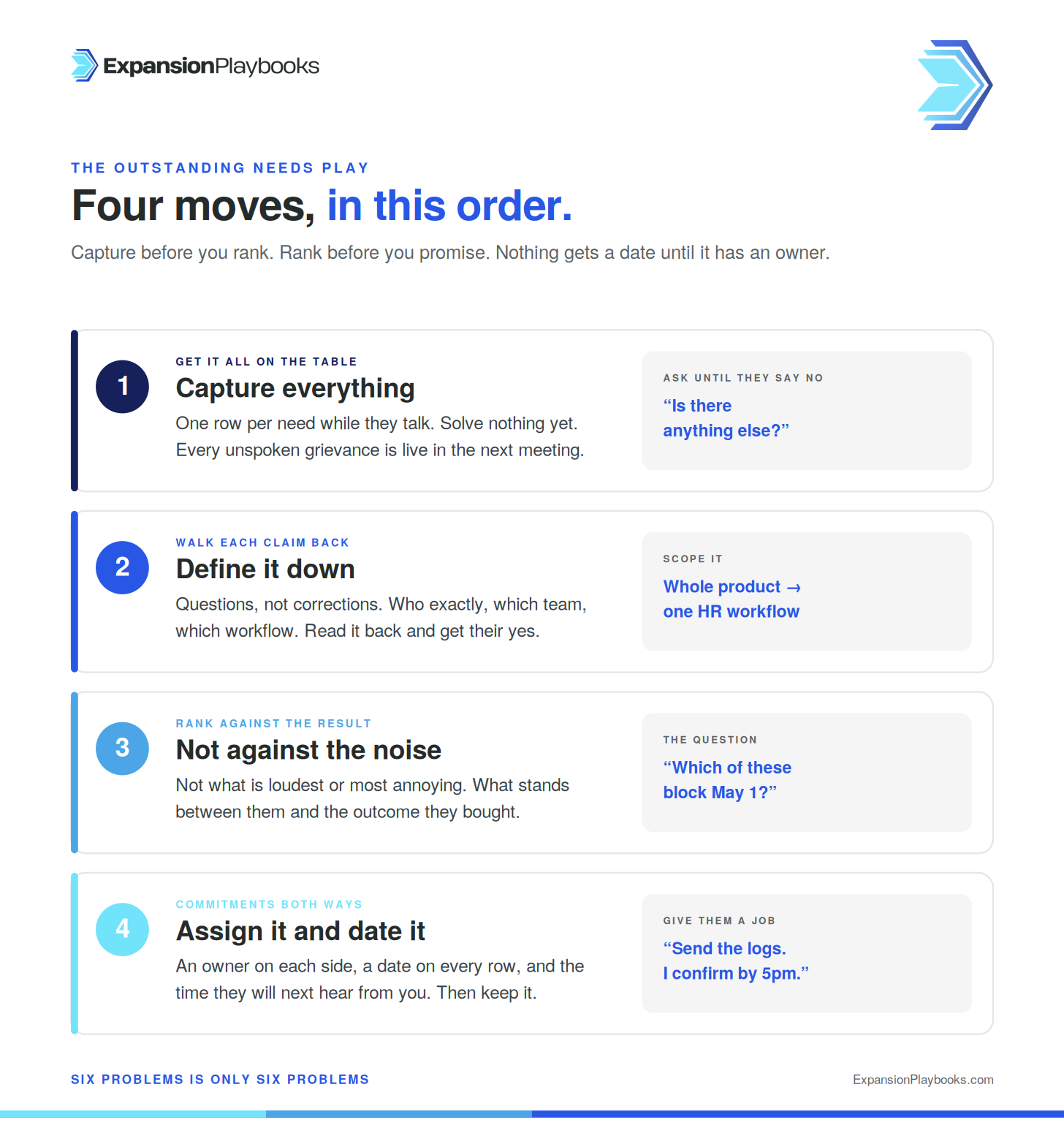
Capture everything. Define it down. Rank it against the result they bought. Then hand them the page with the dates on it.
Take the page
I run this on one slide now instead of a spreadsheet, and I have taught it to CS teams at several companies in exactly that form. It is called Outstanding Needs, and the word "needs" is deliberate. What a customer brings you is not always a bug. Sometimes it is a configuration problem you can fix in an afternoon. Sometimes it is a process their team was never trained on. Sometimes it is a commercial question about whether they bought the right package for the outcome they want. Naming which kind you are looking at is half the diagnosis, and it stops you from promising a development fix for something that was never a development problem.
The page has five columns: the need, what is actually happening, whether it blocks their target, the solution and who owns it on each side, and the date. Three counters run across the top: total needs captured, how many are blocking, how many are not. A companion page splits next steps into ours and yours, with the next update time on it.
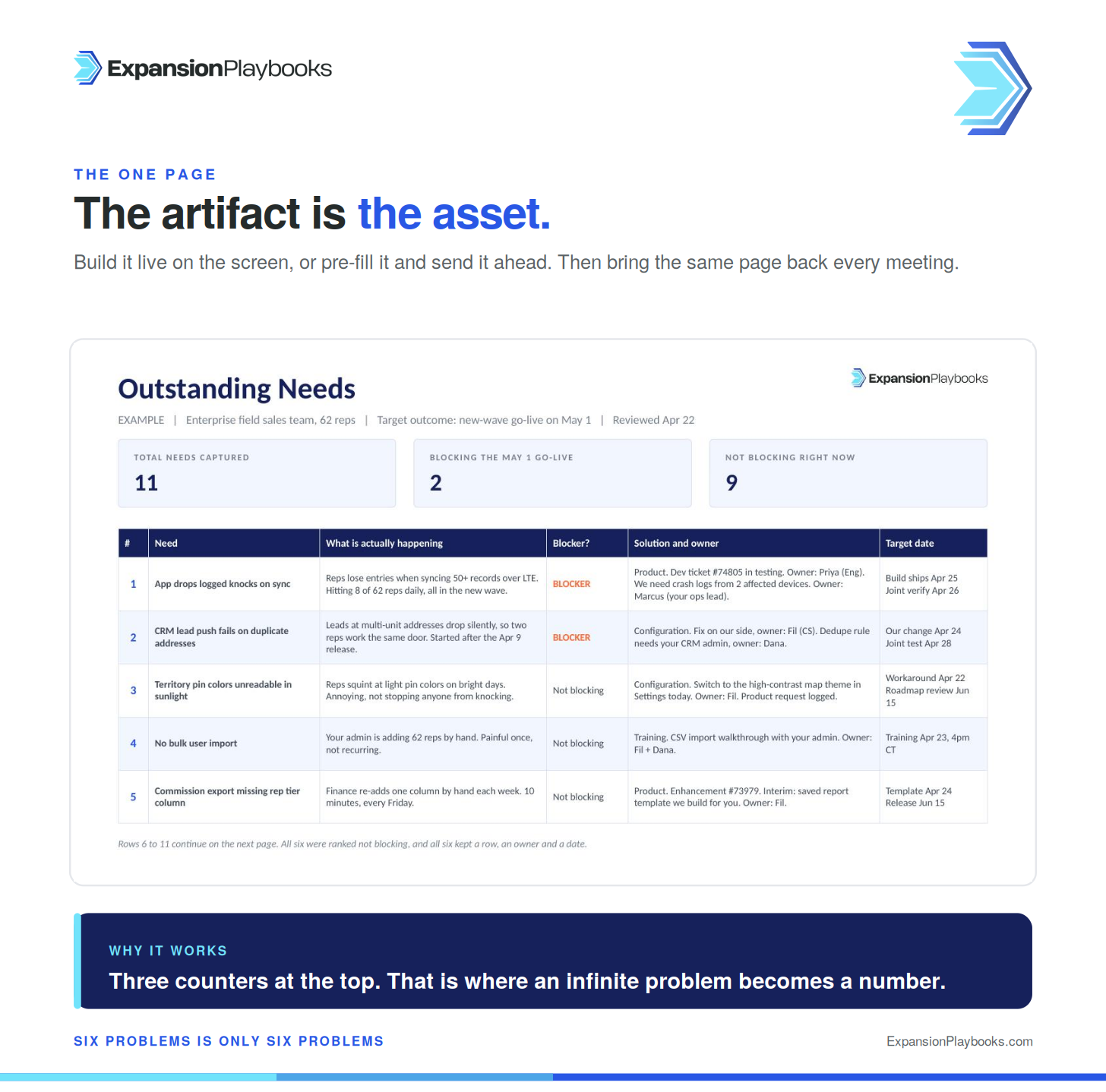
I put the whole thing together as a download you can use tomorrow. Blank template, a worked example, the exact questions to ask at each step, and instructions for dropping in your logo and swapping the colors in about two minutes, so it goes in front of your customer as your company's document rather than mine.
Grab it free on the resources page.
One question before you go
Think about the last customer who came at you hot.
How many distinct issues did they actually have? Not how it felt. The number.
Hit reply and tell me the number, and tell me how many of those were genuinely blocking the result they bought your product for. I read every reply, and my guess is the second number is a lot smaller than the first one.