I once worked with an onboarding specialist at a software company that provided software for doctors, and she thought exactly what almost everybody thinks the first time they hear this idea.
This customer has eight years more education than I do, she said. They have worked as a doctor for twenty years. Who am I to tell them how they should be running their business?
And I understood the feeling completely, and then I made it worse, because I handed her the line from The Challenger Sale that had been rattling around in my head for years:
"Challengers aren't so much world-class investigators as they are world-class teachers. They win not by understanding their customers' world as well as the customers know it themselves, but by actually knowing their customers' world better than their customers know it themselves, teaching them what they don't know but should."
And not only does that quote say I have to understand their world as well as they understand it themselves, it says I have to know it better than they know it, and then go teach them what they don't know but should. So how is that even possible when you have only been working the job a few months?
What do they mean by better? It does not mean having more knowledge. It means having expertise.
The mistake everybody makes
The mistake everybody makes is walking into the customer conversation as if it were a blank slate.
We treat discovery like an open field. What are you trying to achieve? What does success look like for you? Where do you want to be in twelve months? As though the answer could be anything under the sun and our job is to go find it. And when you open a conversation that way, what you are actually doing is asking the customer to go do your job for you.
But we already know what the goals are. We already know the outcomes this customer should be going after, because we do a specific thing for a specific kind of company, and we have done it hundreds of times now across dozens and dozens of customers. The goals do not vary from customer to customer nearly as much as we act like they do.
So the only real question on the table is which one of them matters most right now. Do they need to drive more leads? Do they need to bring their cost down? Do they need to get more efficient with what they already have? That is a far smaller question than "what are you trying to achieve," and unlike that one, it is answerable.
The scope of what your customer should be working on is already known, and wherever it is not known yet, it is knowable. Customers fail in diverse ways, and they succeed in homogeneous ways.
Which means the job in that first conversation is validation, and not discovery. You walk in holding a point of view, and you ask them to confirm it or correct it.
Knowledge is not the same as expertise
Now, the honest version of the objection is still sitting there. Will you ever have more knowledge about medicine than the doctor? No. Not in four months, not in four years, not ever.
But that is not what the Challenger line is asking for.
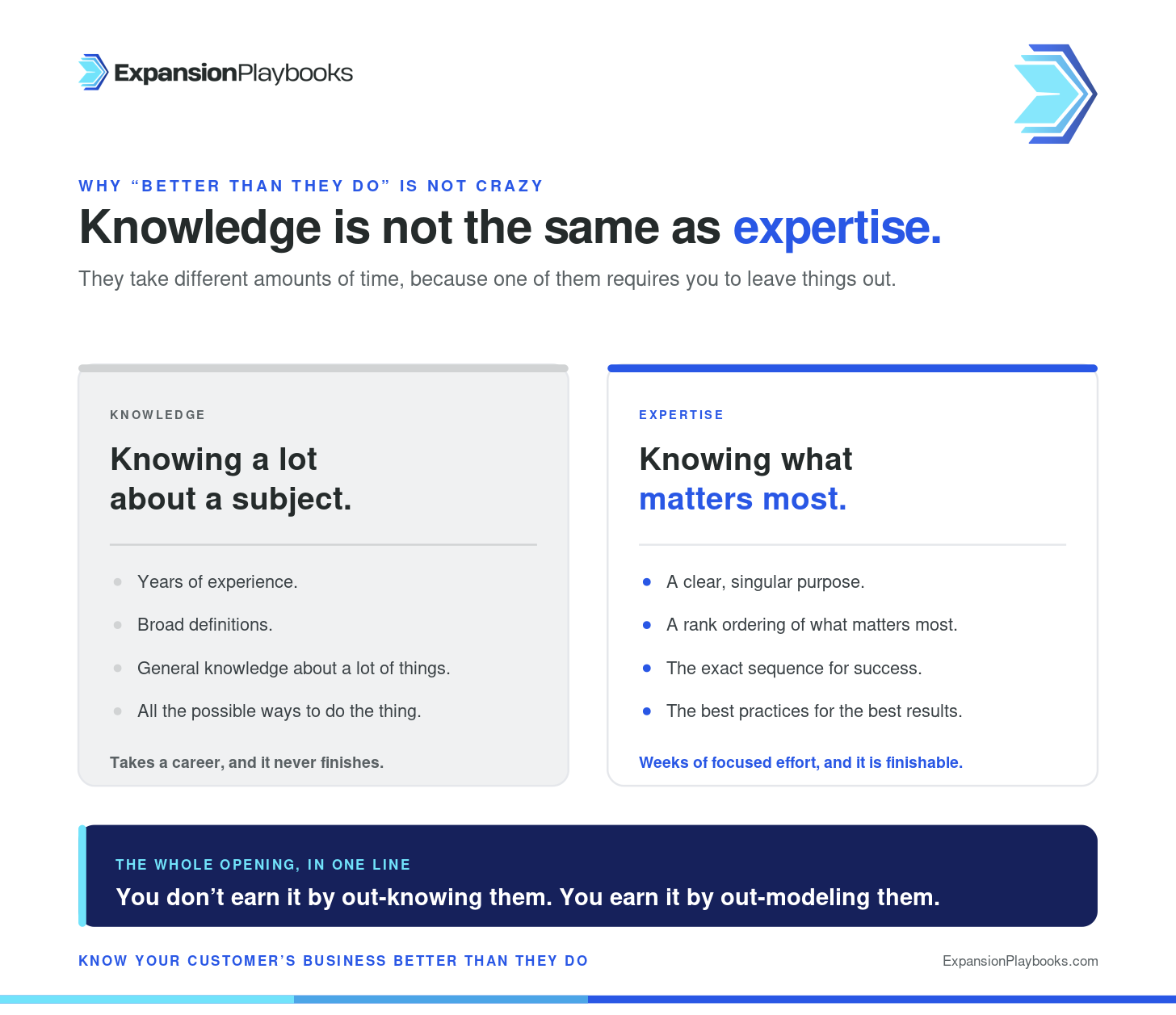
Knowledge is knowing a lot about a subject. Expertise is knowing what matters most. And those two things do not take the same amount of time to acquire, because knowledge is broad and expertise is narrow by definition. Expertise requires you to leave things out.
Can you develop more expertise than your customer in a very specific set of things they need to be better at? Yes. That you can do, and not in twenty years, in a few weeks of focused effort.
That gap between knowledge and expertise is the entire opening, and the reason most people never walk through it is that they are waiting to feel qualified in the broad sense before they will act in the narrow one.
The door is already open
There is a second version of the fear, which is what will the customer think of me for trying this.
So consider what is already true. The customer is talking to you about buying, or they already bought, and that by itself is proof they believe there is something they should be doing that they are not doing, and that they can get better results than they have gotten so far.
Nobody buys software because everything is going great.
They opened the door. The only question left is whether you walk through it with a point of view or with a list of questions.
The Customer Equation
So here is the object that makes all of this real, and it is the thing I want you to build.
The Customer Equation is the two-to-five variable model of how your customer actually makes money in the specific area your product touches. Not their whole business. The part you can move.
It is the answer to a simple question asked precisely: how does this customer make money, expressed as the handful of numbers that multiply and subtract into the result they care about?
Once you have that written down, you stop having opinions about your customer and start having judgment about them. Because now there is an objective truth on the table, and it exists whether you see it or not.
I had never done door-to-door selling
Early in my career I was at SalesRabbit, which makes an app for door-to-door sales teams.
I had never done door-to-door selling. I had never sold pest control or security or anything in that space. And I definitely did not think I knew more about my customers' business than they did.
But I was reading The Challenger Sale and I kept asking myself how a person actually gets to that level.
So what I did was interview our most successful customers. And I did not ask them the usual thing, which is hey, what are you doing, what is working for you. I asked them to teach me the business of door-to-door selling. I asked for their expertise so I could understand their economics and model the equation.
That sounds more intimidating than it is. On the most basic level it is just: how does this business make money? What are the revenue elements? What are the costs? And it does not have to be their whole company. Let's say they sell online, and they sell in stores, and they also run a door-to-door team. Fine. Then the question is narrower. What are the economics of how the door-to-door team contributes?
And they broke it down for me, and it turned out to be simple.
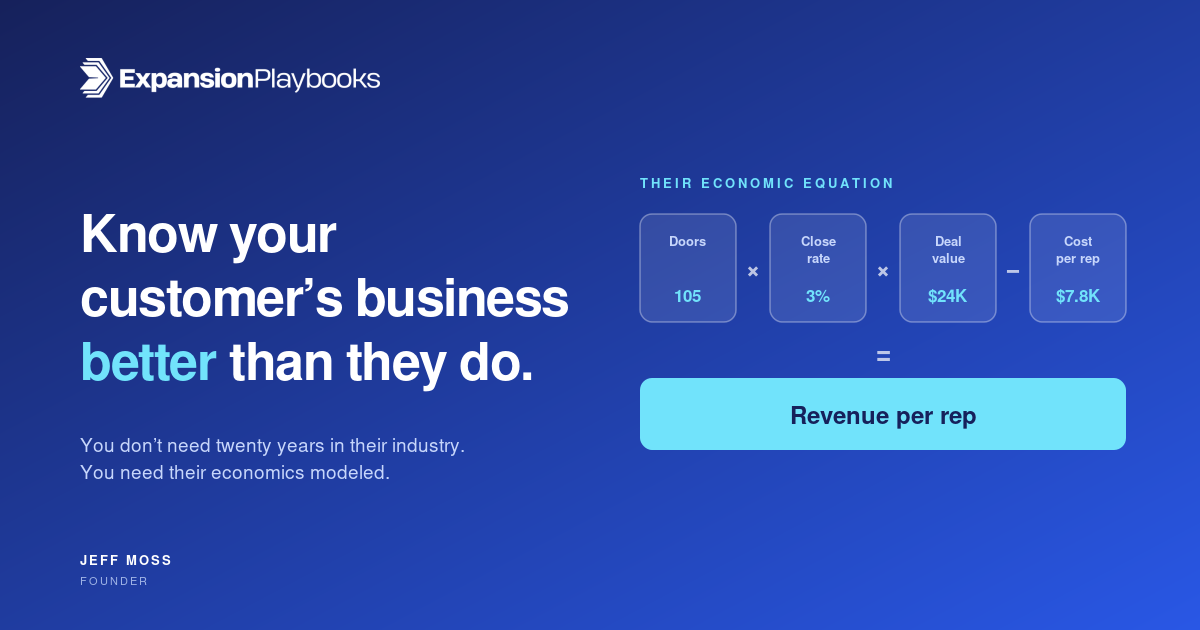
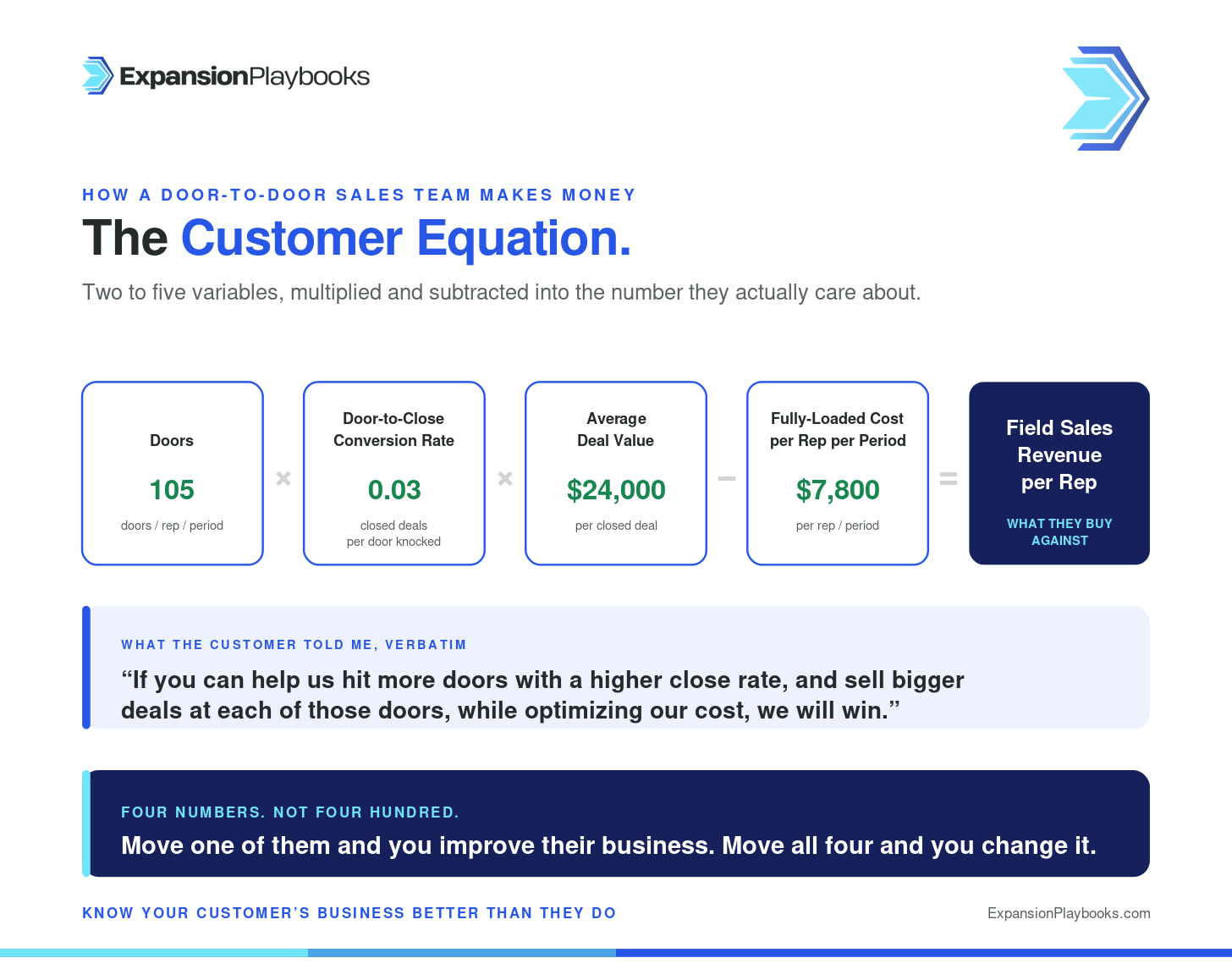
Doors knocked, times close rate, times average deal value, minus the fully loaded cost of each rep. Commission, training, ramp, all of it.
One of them put it about as plainly as it can be put. If you can help us hit more doors with a higher close rate, and sell bigger deals at each of those doors, while also optimizing our cost, we will win.
And so I modeled it. And all of a sudden it clicked.
What the equation actually gave me
The first thing it gave me was a judge.
If a customer knocks more doors, and increases their close rate, and increases their average deal size, while reducing cost, their revenue grows. That is arithmetic, and arithmetic does not care how the call feels. And so if I could move one of those four, I would improve their numbers. If I could move all four at once, I would dramatically improve their numbers.
The second thing it gave me was benchmarks, which I could not have built without the equation first.
Once you know the four variables that matter, you know exactly what to go find out. How many doors should an average rep be able to knock in a day? What is a strong close rate in this industry? What is a healthy average deal value? What does it actually cost to ramp and maintain a rep?
Four questions. Not four hundred. That is what I mean when I say expertise is narrow.
And once I had ranges for all four, I had something no individual customer had. They had their own numbers. I had everyone's.
Why your customer does not already know this
You might be thinking that the customer surely has all of this figured out already. It is their business.
Some do. Most do not, and the ones who do rarely have it written down in a form anyone else on their team can act on.
John Sterman at MIT has spent a career on this. His finding, after running these experiments on some of the most educated people in the world, is that "people are unable to accurately infer the behavior of even the simplest systems."
Let's say you have a bathtub. Water is running in at one rate and draining out at another, and I show you both rates over a few minutes and ask you one question: is the water in the tub going up or down, and by how much? That is it. That is the whole test. Only 36 percent of MIT graduate students got it right.
Running a business is not simpler than that. It is much harder. Your customer is inside the system, making decisions all day, with no time to step outside and draw the picture.
You are outside it. And you get to draw the picture across dozens of customers at once.
The four moves this unlocks
Here is what the equation let me actually do, and this is the part I want you to steal.
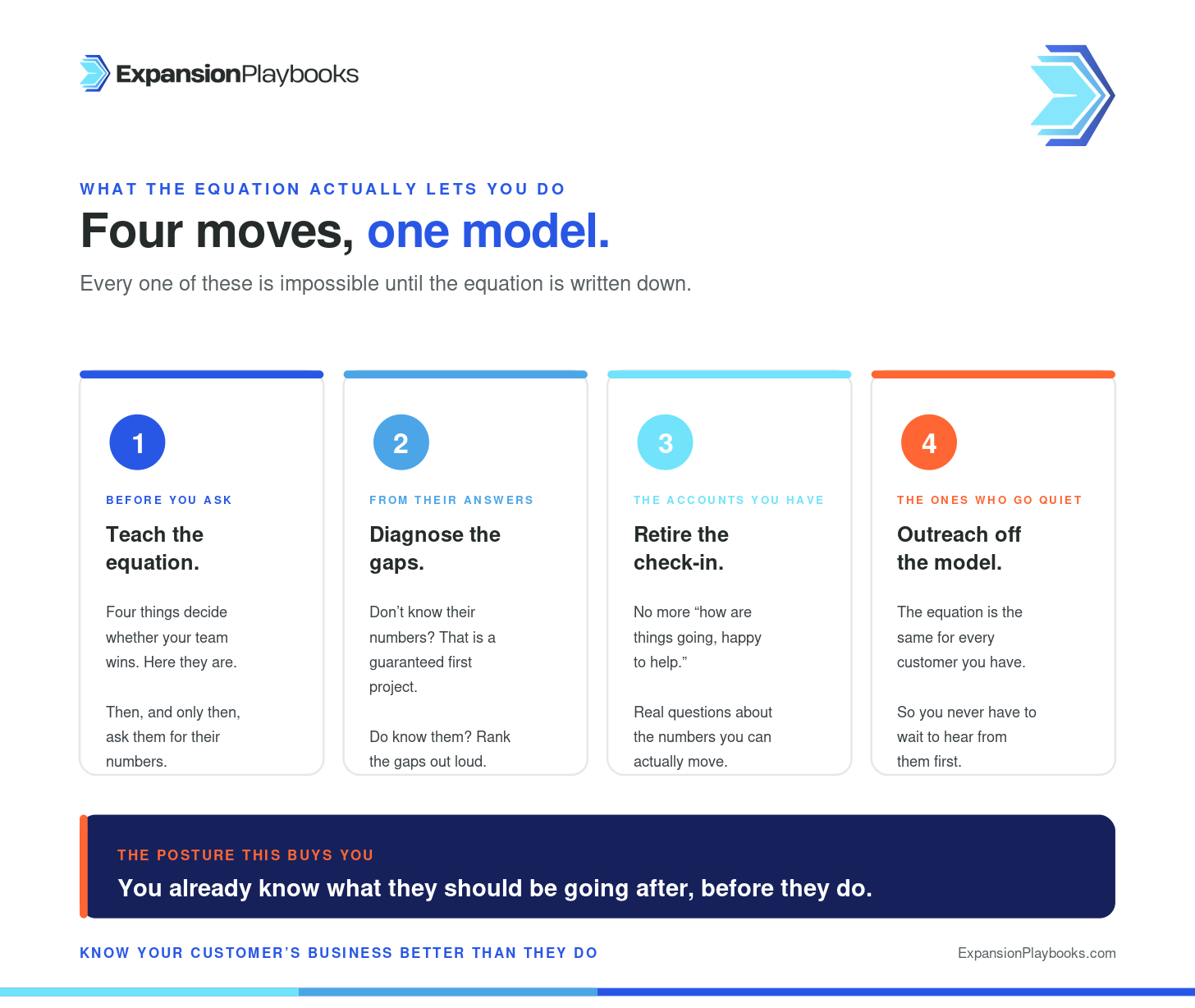
Teach first, then ask. When a new customer came my way, I did not open with "what are your goals?" I opened by laying out the equation. In this business, four things determine whether your team wins. Here they are. Then I asked: how many doors are your reps doing right now? What is your close rate? What is your average deal value?
Diagnose from the answers. If they did not know their numbers, that was a one hundred percent guaranteed opportunity, because you cannot improve what you are not counting, and getting them counting became the first project. If they did know their numbers, I could rank the gaps out loud. Sounds like your close rate is in good shape. The bigger opportunity right now is doors and deal size. Let's talk about what we can do about those two.
Bring the same model to the legacy accounts. This is where it changed the most for me. For the first time I was not checking in with "hey, how are things going, happy to help with anything." I was asking real questions about their business and how it was performing, and I was pointing at the specific areas I knew I could do something about.
Run outreach off the model instead of the calendar. The powerful part about the equation is that it is universal across every customer you have. All of them should be improving all four of those numbers all the time. So even for the account I could never get on the phone, I had a legitimate reason to reach out. Hey, I was looking at your numbers, your conversion rate is still below where it needs to be, here are two things I would like fifteen minutes to walk you through.
I was no longer waiting to hear from the customer before I could deliver value. I already knew what they should be going after, even when they had not decided it yet.
The version of this that is worth stealing
Now I want to be precise about one thing, because it is what makes all of this transferable.
I did not become an expert in door-to-door sales. I never knocked a door. What I became an expert in was the four numbers that decide whether a door-to-door team makes money, and that took me a handful of conversations and some homework, not a career change.
That is a repeatable, knowable process. It is not industry tenure. Which means the objection that stopped my onboarding specialist, the one about the doctor with all the education, was never really an objection. She was never going to out-doctor the doctor. She was going to out-model him on the four numbers that decide whether his practice fills its schedule, and then teach him what she saw.
You do not earn the right to advise your customer by out-knowing them. You earn it by out-modeling them on the small set of numbers that decide whether they win.
Go build one
So pick your best three customers this week. Not your happiest, your best performing. Ask them to teach you the business, not the product.
Then write down the equation. Two to five variables, multiplied and subtracted into the number they actually care about. Go find the benchmark for each one. Then take it into your very next call and teach it before you ask a single question.
And if you want the book that started this for me, The Challenger Sale has been one of the most important books in my career, and not only for selling. Its whole premise is that the people who win lead with expertise and help their customers think differently about what they are trying to accomplish. Get a copy here.
I am also building something that helps you do exactly this, for any company you work for or any company you are trying to work for. More on that in the coming weeks.
Now, tell me your equation. Hit reply with the two to five variables that decide whether your customers make money, even if you are not confident you have them right yet. And if you have no idea where to start, send me what your customers sell and I will take a swing at it with you. I read every reply.
Sources
Matthew Dixon and Brent Adamson, The Challenger Sale: Taking Control of the Customer Conversation (Portfolio/Penguin, 2011), p. 45.
John D. Sterman, "All models are wrong: reflections on becoming a systems scientist," System Dynamics Review 18(4), 2002, pp. 525 and 507.