

You have heard this pitch. If you have carried a number, you have probably given it.
"Our product is $100 per user per month. Your average deal size is $1,000. So if one rep closes one extra deal a year because they used us, the thing pays for itself. Essentially, you get everything else we do for free."
It lands. The math is deliberately conservative, the ask is small, and no reasonable person is going to argue that a rep with better tools closes zero additional deals in twelve months.
I ran that pitch for years before I understood what it was actually doing.
The mistake everybody makes
The mistake everybody makes is treating ROI as something you justify instead of something you set.
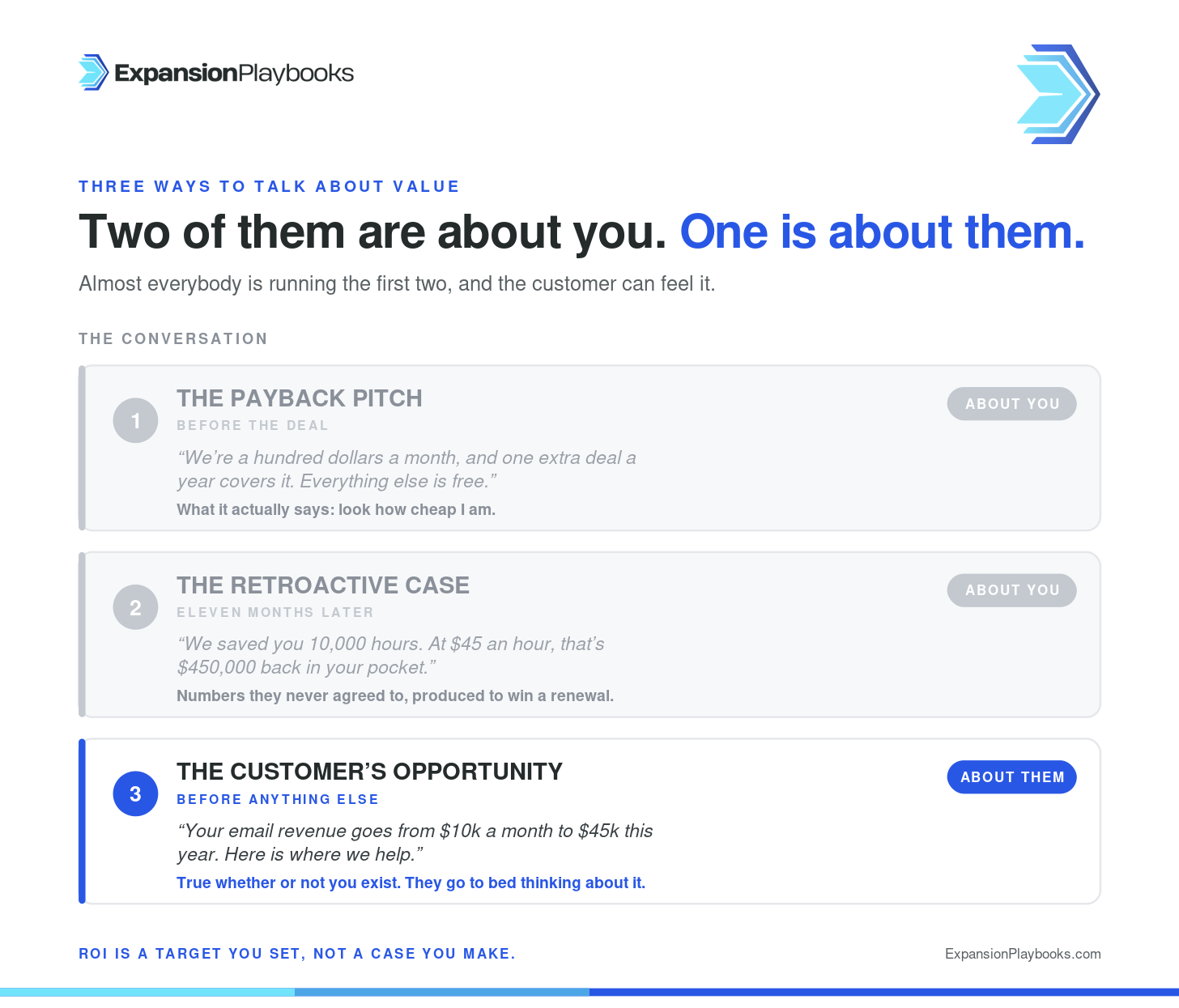
And once you see it that way, you notice there are really only three ROI conversations happening in this industry. Two of them are about you. One of them is about the customer. And almost all of us are running the first two.
The first one is the payback pitch. It happens before the deal. It is the $100 against the $1,000. What that conversation says out loud is "look how cheap I am relative to what you already do." What it says underneath is worse: it assumes the customer cannot see the value of your product on their own and needs help rationalizing why you are in their tech stack. You are not talking about their opportunity. You are defending your line item.
The second one is the retroactive case. It happens eleven months later. A renewal is coming, or the customer has started making noises about whether this is worth it, and so somebody pulls the account apart looking for wins to claim. Sales went up. We scored those leads. We saved time in onboarding.
And then comes the arithmetic. Let's say we saved every employee an hour a week. Across the team that is 10,000 hours. At $45 an hour, we have saved you $450,000.
That number is not real, and everybody in the room knows it. The customer never agreed that an hour of saved time was worth $45 to them. They never agreed the hour was saved by you. None of it was established at the beginning, so producing it at the end is a magic trick.
It is almost like you have been going along thinking things were not going well, and then someone walks up to you and says: no, no, you have got it all wrong. Things are great. You have been making money and saving money and getting more efficient this whole time. You are just looking at it wrong. That is your problem. You are actually killing it.
Nobody believes that. Not even the person saying it. And it falls flat for a reason that has nothing to do with the math being soft. The intent is transparent. That case exists to secure a renewal, and the customer can feel it coming.
The only one that starts with them
There is one, and only one, version of this conversation that starts from the customer.
It does not start from "what ROI case can I make for my product." It starts from a different question entirely: what are the outcomes this customer has to achieve, inside the part of their business I work in, that are true whether or not I exist?
That last clause is the whole thing.
Let's say I am Drip and I sell email marketing software to ecommerce brands. My customer needs sales from email to go up. They need their subscriber list to grow. They need better open rates and click-through and repeat purchase. Every one of those is true if you are an email marketing manager at an ecommerce brand, no matter whose software is on your screen.
It is also true that your performance across those things is uneven. Maybe you have a healthy list and a poor conversion rate. Maybe your sales are strong for the size of your list, but your list is tiny. Each one of those is an opportunity that can be measured objectively and pursued objectively, and it exists on its own.
So which one are you actually working on? Is it a number the customer is measured on? Or is it a number you invented so you would have something to report? Almost everybody, if they are honest, is working on the third thing, which is adoption of the features they happen to sell.
Here is the test, and it is a simple one. If the customer walked away from your product tomorrow, would they still have to go to bed at night thinking about this number?
If yes, you are working on something real. If no, you are working on your own line item.
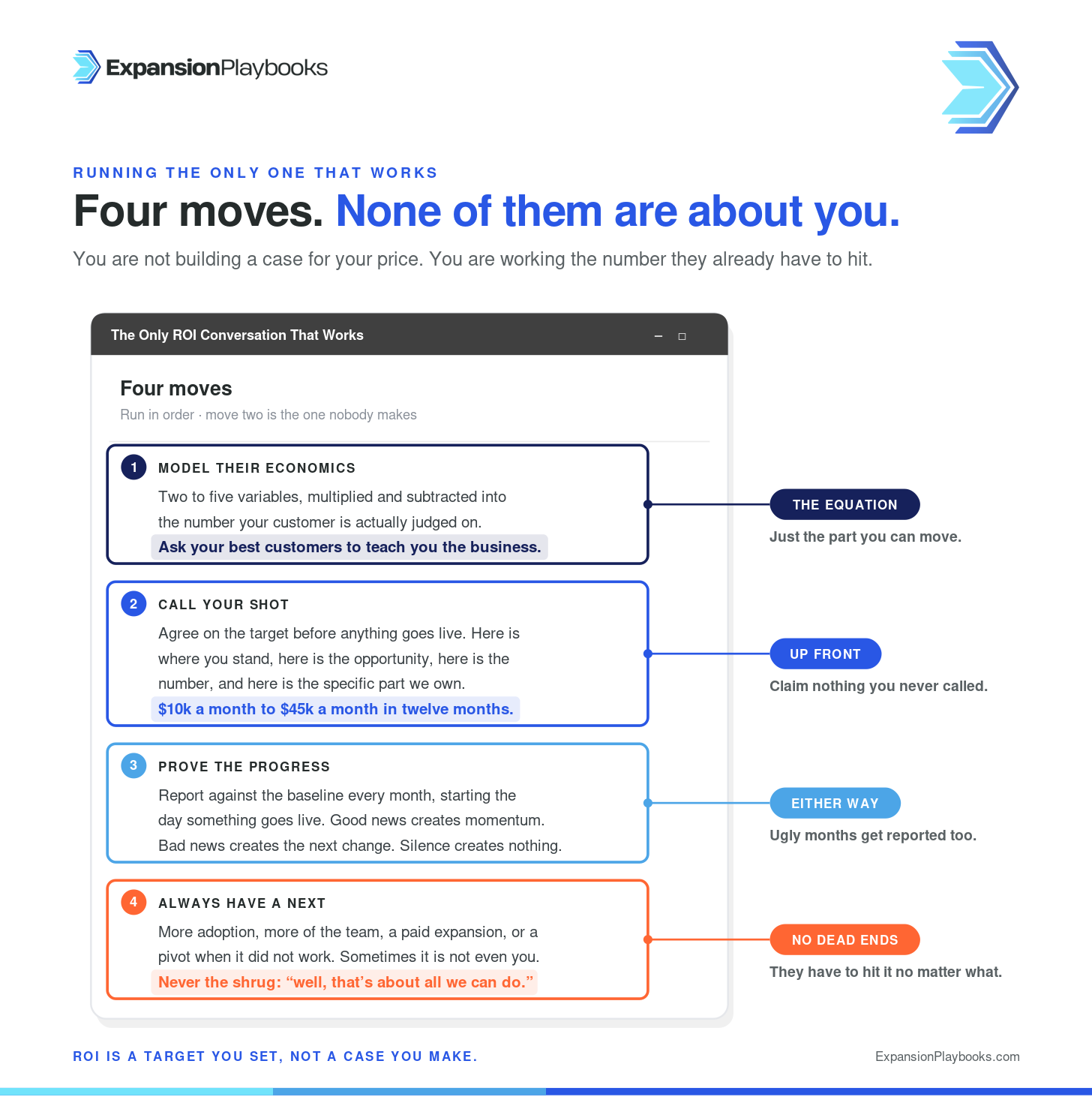
Four moves, and none of them are about you
Here is how you actually operate this way.
1. Model their economics before you do anything else
You cannot point at the right opportunity until you know how the customer makes money in the specific area you touch. I wrote about how to build that model a few issues back in The Customer Equation, so I will keep the how-to short here.
Two to five variables. Multiplied and subtracted into the number the customer actually cares about. Not their whole business, just the part you can move. You get it by interviewing your best-performing customers and asking them to teach you the business rather than tell you about the product.
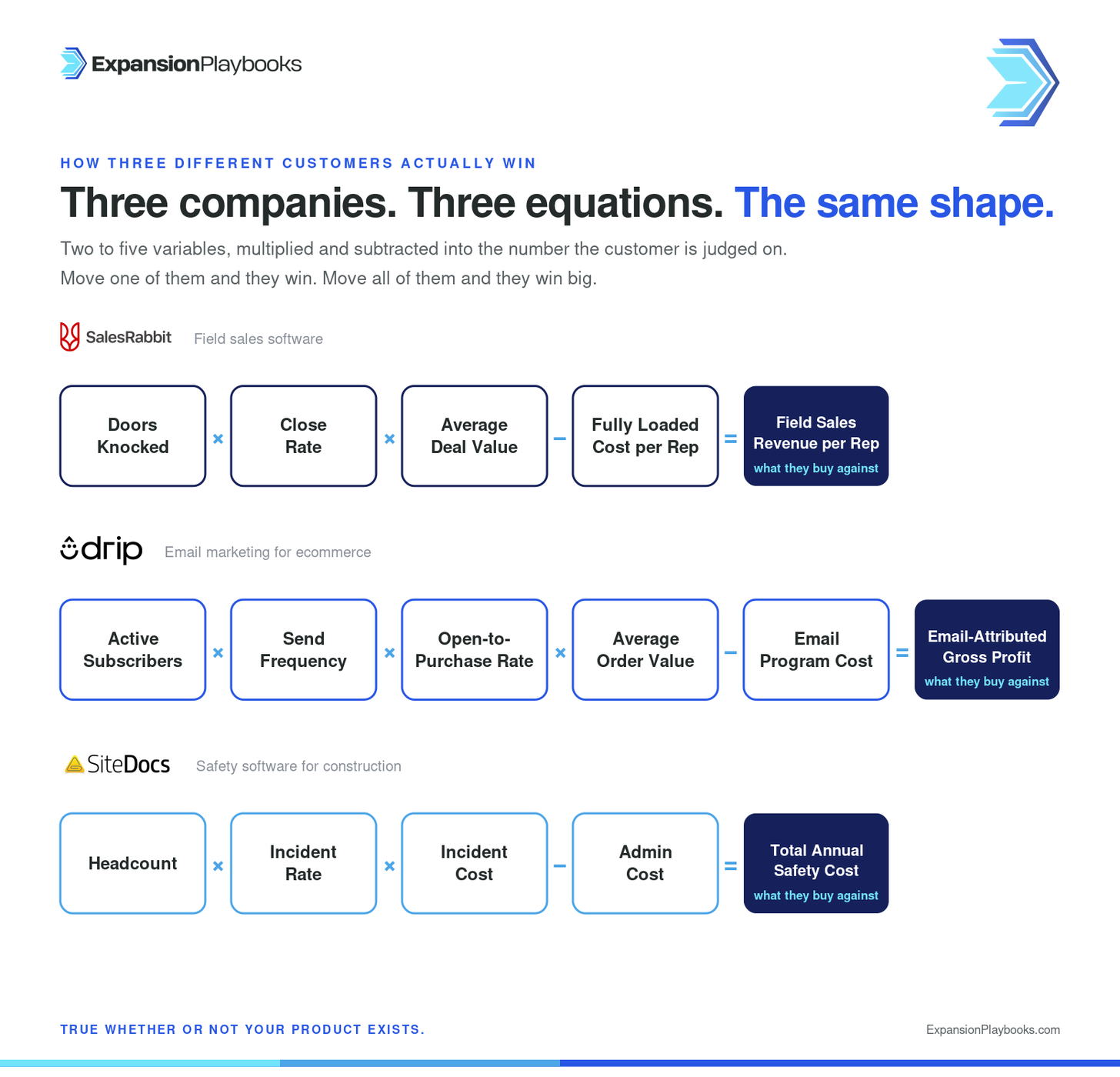
When I was at SalesRabbit, which makes an app for door-to-door sales teams, the equation came out like this: doors knocked, times close rate, times average deal value, minus the fully loaded cost of each rep. Four variables. If I moved one of them, their revenue went up. If I moved all four, it went up a lot. That is arithmetic, and arithmetic does not care how the call feels.
The email marketing version is the same shape with different terms. Active subscribers, times send frequency, times open-to-purchase rate, times average order value, minus the cost of running the program.
And this works for the businesses where the money is not obviously on the revenue side too. SiteDocs sells safety software to construction and industrial companies. Nobody buys it to grow revenue. So the equation runs on the other side: headcount, times incident rate, times cost per incident, against the administrative cost of all that paperwork. Fewer incidents, less severe incidents, cheaper incidents, less admin. That is how a safety team wins, and it is measurable, and it is true with or without the software.
Once you have the equation, you can see things nobody else in the room can see. You know where they are weak and where they are strong. You know which variable has the most room in it. You know what should be worked first, second, and third. That is what I mean by expertise. It is narrow on purpose.
2. Call your shot at the beginning
This is the move nobody makes, and it is the one that makes the other three possible.
Once you understand their economics, you align with the customer on the numbers up front. Here is how you are performing across these four things today. Here is where we think the opportunity is. We think you should be able to double your subscriber growth rate. We think your conversion rate has this much room in it. And your target is going from $10,000 a month in email revenue to $45,000 over the next twelve months.
They said that was the win. You are now participating in a goal they own.
And this is also why the retroactive case never works. When you show up at month eleven with a number, the customer will say: sure, sales went up, but we also restructured the team and increased ad spend, so how much of that is really you? They are right to say it. You never called it.
Calling your shot does not mean claiming you are 100 percent responsible for their success. It means saying these are the goals, this is how we are going to help, and here is the specific part we own. And if you did not do it at kickoff, you can do it today. Reset the conversation, find out where they actually need to go, and call it there. You can do that with four months left in the contract. What you cannot do is skip it and make the case later.
3. Prove the progress, whether the news is good or bad
Then you report against the baseline continuously, starting the moment something goes live.
All right, the integration is up, so we should start seeing subscriber growth move. One month in, that number is up 42 percent. This other one has not moved at all. Here is what we do next.
Most people only want to promote progress when the progress is good. That instinct is exactly backwards, because both directions do useful work. Good results create the motivation to do more of what is working. Bad results create the motivation to change something. Either one moves the customer. Silence moves nothing.
Proving progress when the numbers are not there yet is still the most important thing you can do, because it is what drives the next action.
4. Always have a next
If results are good, you need to know the next thing that makes them better. Sometimes that is another feature. Sometimes it is rolling out to more of the team. Sometimes it is a paid expansion that gets them an outcome they are not going after yet.
If results are bad, you need the pivot. We are going to change how your team runs this part of the process. We are going to reimplement this piece so adoption is easier. We are going to try the thing we have not tried.
The worst thing you can possibly say is the shrug. "Well, that is about all we can do. Your conversion rate did not really move, but at least we got you more subscribers."
There is always something to try. It does not mean you hit a home run every time, and plenty of things will fail. The only thing that matters is that you never run out of a next move, because that is exactly the position the customer is in. They have to hit those targets no matter what. Sometimes the next move is in your product. Sometimes it is a change they need to make outside of it. Sometimes it is a third-party vendor you point them to. Have one anyway.
But what if they miss the number?
The obvious objection: you just told me to anchor everything on going from $10,000 a month to $45,000. What happens when they land at $22,000?
Yes, we do everything we can to hit it. And yes, customers pick lofty targets that are hard to hit. I am not pretending otherwise.
But go back to the worry sitting underneath that question, because it is really a worry about the renewal.
So think about what the customer has experienced across those twelve months. Somebody who understood their economics well enough to name the four numbers that decide whether they win. Somebody who called the shot in advance instead of grading their own homework at the end. Somebody who showed them where they stood every single month, including the months it was ugly. And somebody who always had the next thing to try.
They are going to renew. Not because you built a case, but because nobody else is treating them like that. The whole reason they engaged with you is that they did not know how to get from $10,000 to $45,000. They were not doing it before with the last vendor, and they were not doing it on their own.
What they want, underneath everything, is a partner who is constantly working the problem with them. That is it. That is the whole ask.
Nobody asks you to justify a number that is already moving
The premise of ROI is wrong. When people say "what am I getting for my $10,000," I do not think they mean what it sounds like they mean.
Because watch what happens when this is working. The customer does not say "justify the spend." They say something completely different: our email provider got our subscriber growth rate from 2 percent to 10 percent a month, which is the highest it has ever been, and they have a new thing coming that should move our conversion. I need more budget so we can buy it.
Nothing was justified in that sentence. There was a target, there was visible movement against it, and so the next purchase never needs an ROI case of its own. It is just the obvious next step.
ROI is a target you set at the beginning and report against until nobody has to ask, never a case you assemble at the end.
Start these four steps this week
1. Map your customer's economics. Pick your best-performing account and write down the two or three things that decide whether they win in the area you touch. Multiply and subtract them into the number they get judged on. Any variable you cannot fill in is your first question for them.
2. Rank the variables. One of them has more room in it than the others. That is the opportunity, and you can see it because you have the model and they do not.
3. Call your shot. Take it to them. Here is where you stand today, here is where we think you can get to, here is the part we own. Get them to say out loud that hitting it would be the win.
4. Book the first readout. Pick the date you will show them movement against the baseline, and put it on the calendar before you leave the call.
I am building the tool that does this with you. It maps your customer's economics and then builds out your complete customer model, so you are not only helping customers pick the right opportunity, you have the tooling to help them make the changes that hit it consistently.
That is the Expansion Playbooks app, and it opens in the next couple of weeks. Get on the Founders Club list here. You are on this newsletter, so you get the early pricing.
Now tell me your version. Hit reply with the number your best customer has to hit whether you exist or not, and whether anybody at your company has ever said it out loud to them. If you are not sure what that number is, send me what your customers sell and I will take a swing at it with you. I read every reply.