
A good friend of mine was telling me about raising his teenagers, and how one small shift changed everything.
His kids were bringing home some poor grades. They were bracing for the conversation. They figured he was going to sit them down and tell them how disappointed he was, and walk them through how to do better.
That is not what he said. He said this instead:
"You're not getting good grades for me. This is about you. These are your grades. This is your future. I already got good grades in school. I already went to college. I already have a career. These are a part of your goals, what you want to achieve in life."
And once each of his kids realized that, their grades improved immediately. They took ownership of it.
I have thought about that conversation a lot, because it is the exact thing we get wrong with customers every single day.
The mistake everybody makes is framing the ask around your own job
You need the customer to do something. So you ask. And almost without exception, you frame the ask in terms of you, your company, or your role.
"Hey, I really need you to complete this onboarding. We have two more sessions left."
An onboarder says that sentence a dozen times a week. And it is framed entirely around their job, not the customer's business. The customer does not care about completing onboarding for the sake of completing onboarding. You care about it, because your metrics are built on onboarding completion rates.
Now you might push back on me here. You might say the sessions genuinely are valuable, that you packed them full of product, that you teach a lot in them, and so obviously the customer should want to be there.
Fair. But look at what you named them.
Admin training 1, admin training 2, admin training 3
Take your average company and look at how the onboarding sessions are titled. Admin training one. Admin training two. User training one. User training two.
Those sound like they are for the customer. You are training their admins. You are training their users. What could be more customer-facing than that?
But those titles are not built around the customer's business at all. They are built around what you decided you need to complete in order to get this customer off your list. If I can just train them on the admin stuff, and just train their users, then I can wipe my hands of them and move on.
And this is not only an onboarding problem. It runs through everything.
"I need to get a QBR scheduled with this customer, because I'm supposed to hit a certain percentage of accounts met with." That is a number about you.
"I need to get a set of customers to give us success stories." That one is sneaky, because it sounds like it is about the customer. So ask the diagnostic question. Are you doing that to satisfy your personal role metric? Or are you doing it to actually make more of your customers successful enough that they could generate a success story? Those are two different jobs.
"This customer has all these product issues and I have to resolve this at-risk account so I can get them off my plate." Are you trying to make them successful with the product, or are you trying to close out the problem ticket you are dealing with?
Almost every metric we operate to is about our company. And so almost every ask we make comes out of our mouth in the language of our company. The customer hears it, and correctly concludes that it is our problem, not theirs.
Customer leverage is what you get when the ask belongs to them
Customer leverage is the ability to get a customer to act, and to change, because the action is tied to something they already told you they have to achieve.
You are not creating the motivation. It already exists. Their goals exist whether you are in the room or not. The deadlines they are trying to hit, the performance they are trying to improve, the number they have to present to their manager next quarter. None of that came from you and none of it goes away if you disappear.
They are not doing us a favor. They are not trying to get good grades to make us happy. They are not showing up to the third onboarding session so we can tell our boss we completed another onboarding.
These are their grades.
Here are the four moves that turn that into leverage you can actually use.
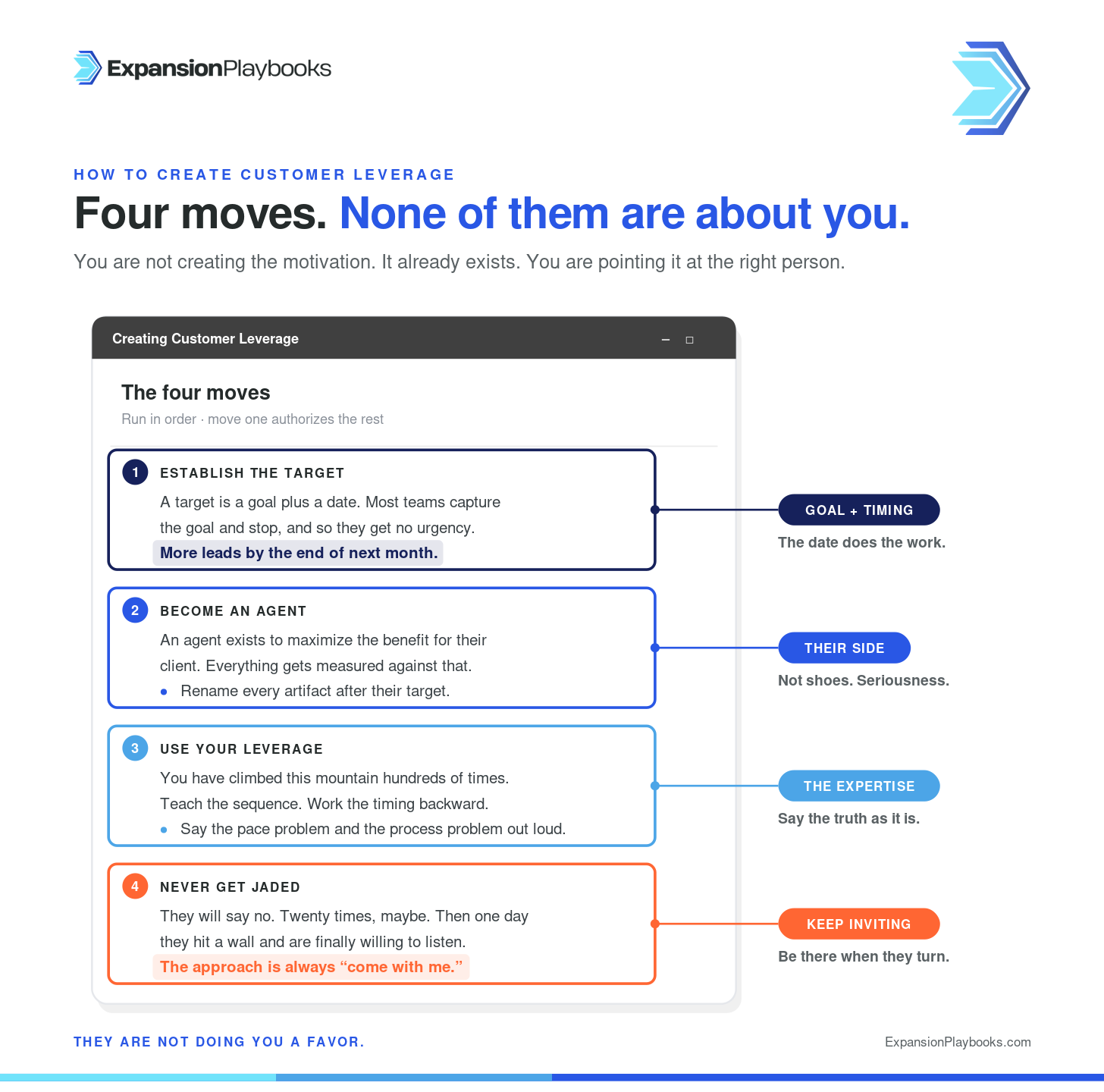
One: establish the target, and a target is a goal plus a date
I say target on purpose, because it combines two things.
The first is the performance goal. It is one thing to understand that the customer needs to get more leads, and that your solution helps them get more leads. Most teams stop there and think they have done discovery.
The second is timing. They want to see that increase in leads by the end of next month. That is the part almost nobody captures, and it is the part that does all the work.
When you combine the goal and the timing, you have the most important ingredient for creating urgency. Because now the pressure is not coming from your completion rate. It is coming from their calendar.
Watch what that does to the outreach. The weak version sounds like this: "You haven't adopted these two features yet and you really need to do that." The version with a target sounds like this:
"Hey, you missed our third onboarding session, where we actually set up your lead workflows, which are key to helping you increase your leads per month. In order to start producing more leads by the end of next month, we have to get those automations and your integration launched no later than the fifteenth of this month. Here are some times I'm available this week for us to get those built and launched with your team."
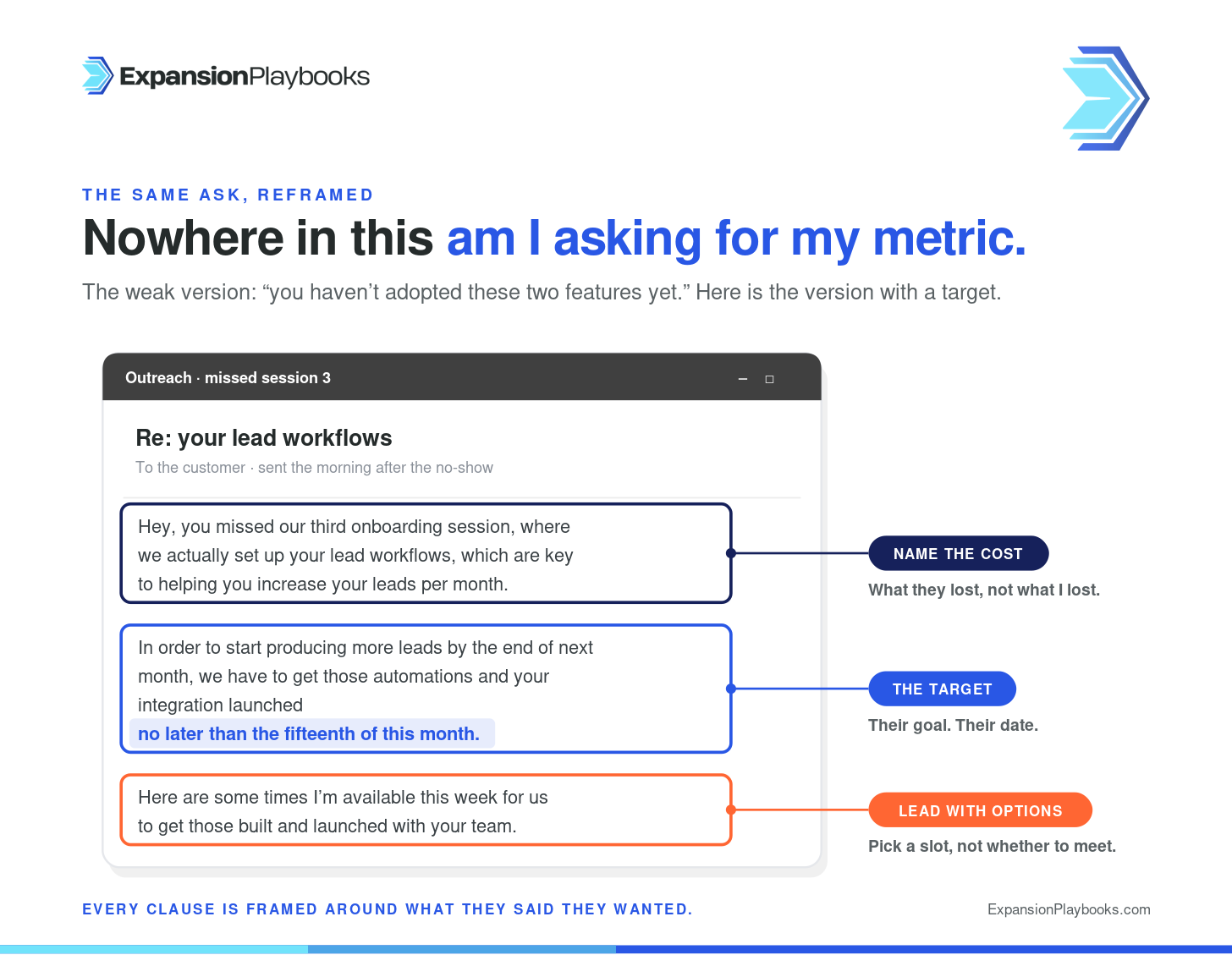
Read that again. Nowhere in it am I asking them to help me finish admin training three. Every clause is framed around what they said they wanted.
I am not the one who has to see a bump in leads by the end of next month. That is what the customer said they have to achieve. They are the ones who have to go to bed with that goal. They are the ones who have to sit in front of their manager and say whether they are getting closer to it or not.
Two: become an agent
I do not mean an AI agent. I mean an agent the way a professional athlete has an agent.
An agent has their client's best interest at heart. They exist to maximize the benefit for that person and for that person's targets. Everything they do is measured against what their client is trying to get.
And I do not mean this in the cheap way of "put yourself in your customer's shoes." I mean being so serious about what your customer is trying to achieve that it reshapes the artifacts you build.
Because when you operate as an agent, your onboarding stops looking like admin training 1, 2, and 3, and starts looking like this:
- We have to get you set up with your key integration so you can start driving your lead flow.
- We have to set up these automations. Once those are live, that is when you actually start getting the sorting and filtering to find your best leads.
- We have to set up your processes so that when the leads come in, your team can call them within a short period of time, increase your close rate, and drive more dollars for your company.
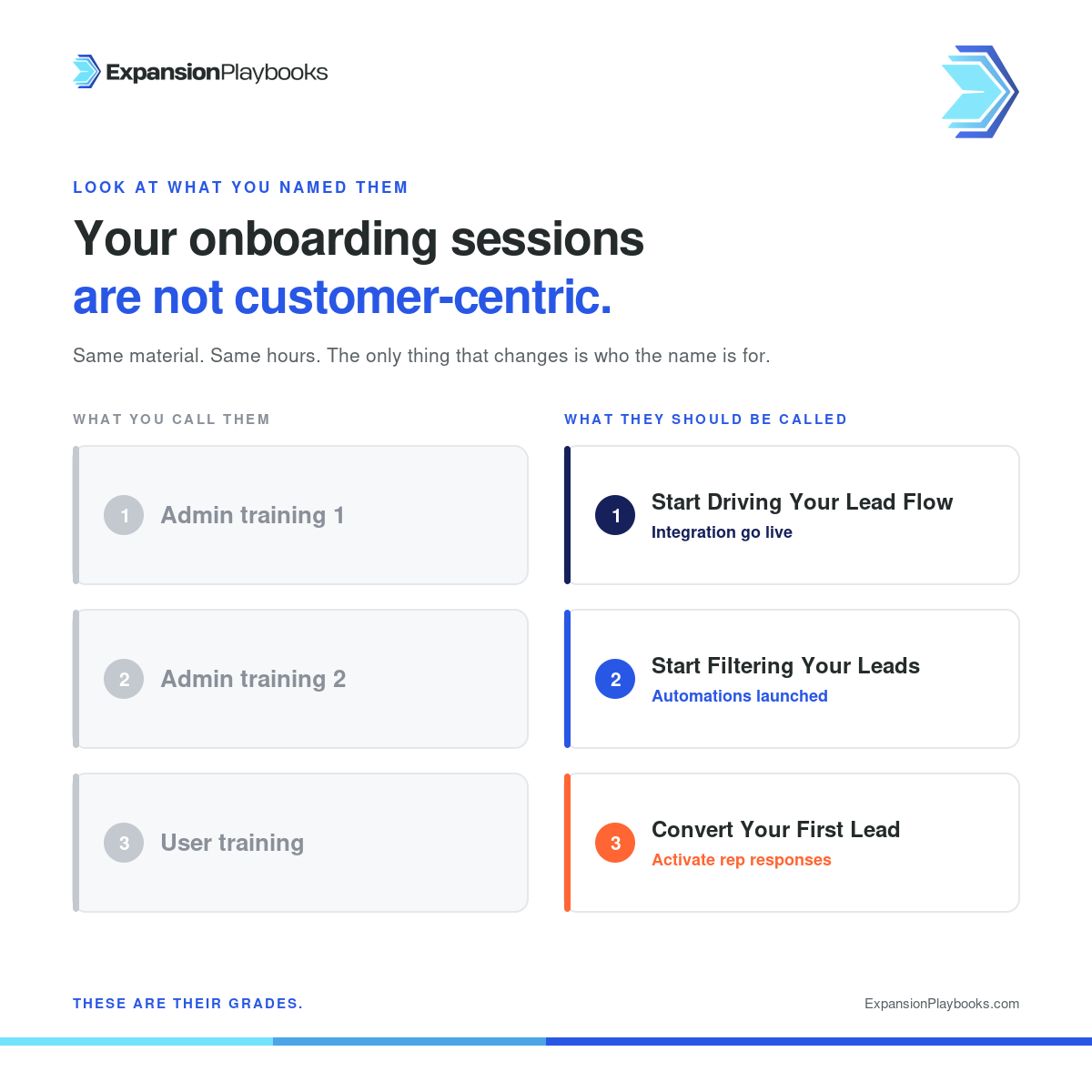
It may be that admin training 1 through 3 covers that same exact material. Same content, same hours, same slides. But it is so much more powerful when it is framed in terms of how it moves the customer toward their target.
What you do is not what you are for. The session is what you do. The lead flow is what you are for.
Three: use your leverage
You have expertise. Use it.
You know what your most successful customers have done in order to succeed. You have done this multiple times, and your company has done it hundreds, if not thousands, of times across hundreds, if not thousands, of customers. You have climbed the mountain your customer is trying to climb.
So do every single element of what it takes to get them there. Teach them the sequence of what to do and in what order. Work backward with them on timing. And say the hard part out loud.
Sometimes that means calling out the pace:
"This thing got pushed. If you really have to see results by no later than the 31st of next month, then we have to move faster here and here."
And sometimes it means calling out the process itself:
"You are going to have to change your process in this area, because the way you are doing it right now is not going to perform the way you need it to."
That is not being rude and it is not being belligerent. It is operating as an agent. Say the truth as it is, because it is your responsibility to articulate the pathway. Nobody else in that room has run this play a thousand times.
And notice that the target is what authorizes both of those. Without the goal and the date, they are just your opinions about how they run their business. With the target, they are a straight line from where they are to what they told you they need.
Four: never get jaded, and the approach is always "come with me"
Customers do not always do what we want them to do. They have a mind of their own. They make different decisions than we would make. They push back on changes we know they need and are not willing to make.
The easiest thing in the world is to get jaded. To throw your arms in the air and say, what am I supposed to do here? They told me this is what they want to achieve, and now they are doing everything they can to not achieve it.
You are right. And it does not matter.
A true partner never loses sight of the north star, and constantly invites the customer back onto the path. It sounds like this:
"I know you weren't willing to do that integration. But we just ran into this problem, and the only way to solve it is to get that integration live. Here are the exact instructions. Let's jump on a call and get it going, then I'll train your team, and I think we can have leads flowing by the end of the week if we commit to it."
You may have made that suggestion 20 times. They said no, no, no.
And then one day they hit enough of a wall that they are finally willing to listen. That is when the whole relationship changes, and the only way to be there for it is to have never stopped inviting.
When you are always ready, always inviting them to recommit and do whatever is next, even after failing at it a dozen times, that is what builds the real relationship. That is what makes you the person they actually listen to.
These are their grades
Every ask you make is either about your job or about their business. There is no third category, and the customer can tell the difference instantly.
Establish the target. Operate as their agent. Use your expertise as leverage. Never get jaded.
Do that consistently and the performance numbers follow on their own. I have analyzed millions of customer records, and the most highly correlated factor for retention is whether the customer got a measurable outcome. A positive result, retention goes up two times. A good result, six times. Retention, expansion, completion rates, all of it falls right out of helping the customer win.
But it only works in that order. You do not get their action by explaining your metric. You get it by handing them back their own goal, with a date on it, and showing them the fastest path there.
Go look at your own agenda
Pull up your onboarding plan, or your QBR deck, or the last three outreach emails you sent. Read the subject lines and the section titles.
Then ask the question honestly: is this framed around what I need to complete, or around what the customer said they have to achieve by a specific date?
If it is the first one, rewrite it. Not the content. Just the framing. Same sessions, same material, same meeting, renamed around their target. You will be surprised how much faster people move when the thing you are asking for is obviously theirs.
Which one of your customer-facing artifacts is most obviously named after your job instead of their business? Hit reply and tell me what it is called today and what you would rename it. I read every reply.