For the past year I've had a question I couldn't let go of.
A contact of mine works in customer success at a company that was acquired by OpenAI. And so for a year now, he's been inside one of the premier AI companies on the planet. The tip of the spear. The company everyone assumes is operating years ahead of the rest of us.
I was curious. Surely OpenAI had shown his team all the amazing cutting-edge things they were doing on the customer success side. Things he obviously wasn't doing before the acquisition. Surely all of that got passed down to his team, and this was my chance at a peek into what one of the premier AI companies in the world does with AI in customer success.
So I asked him.
The answer was surprising. Or maybe it wasn't.
No insight. No guidance. No unlock of amazing AI-powered customer success machinery. In fact, most of what his team was doing before the acquisition was maybe more advanced than what OpenAI had set up on the customer success side.
Sit with that for a second.
But here's what almost nobody in customer success is asking: what if that's not the exception? What if that's the pattern?
The second company made it a pattern
I've been working with another company recently. A newly started AI company that raised lots of money. Real momentum, real funding, the exact kind of company everybody in SaaS looks at and thinks, "they've figured out something we haven't."
And they have all the same problems we've been working on in customer success for the last 20 years.
They're still trying to figure out exactly what outcomes their customers are trying to achieve, and exactly how those outcomes are measured. They're still trying to figure out how to build an onboarding that gets customers to first value. They're still trying to figure out how to stand up forward-deployed engineers who can build out and tailor the solution for their enterprise customers.
Sound familiar? It should. That's been every CS team's roadmap since 2005.
Meanwhile, everyone in customer success, especially in the SaaS world, is panicked. AI is coming for our jobs. Everybody else is doing all these cool things with AI and we're barely doing anything. We're behind.
I've now looked under the hood at several of these companies. You're not behind. Nobody is ahead.
Everything has changed. And nothing has changed.
Here's the frame I keep coming back to: though everything's changed, almost nothing's changed. We still have to make customers successful.
Everything has changed in the sense that we have more capability than we've ever had. The heavens are opening. There is so much more we have the potential of doing, and I'm excited about it.
And nothing has changed, because we still have the exact same problems. And the way they get solved, or don't, is still the same: bring in technology and pray that it works.
It has never worked.
Jim Collins wrote this 25 years ago, before any of us had ever heard of a health score:
"Technology-driven change is virtually never a root cause of either greatness or decline. [...] Technology is an accelerator of momentum, not a creator of it."
Jim Collins, Good to Great
An accelerator of momentum, not a creator of it. The real question is: what creates momentum?
We've already run this experiment
We've had tons of innovation over the last 20 years. It may not have been as exciting as AI, but think about what we were promised.
We introduced machine learning that let us build health scores. We connected into our usage data so it could send us alerts. Every wave came with the same promise: load up your data, and the system will tell you who's going to churn and what to do about it.
And every single time, it produced minimal, if not zero, uplift in our ability to help our customers.
And if you think this wave is different, MIT already measured it. Their 2025 State of AI in Business report found that 95% of enterprise AI pilots delivered zero return. Thirty to forty billion dollars invested, and the same result we got from the health scores and the alerts.
Why? Why didn't the health score save anybody? Why did the alerts fire and the churn happen anyway? Why does every new tool demo like magic and land like a rounding error?
Because the answers don't come from your data. They never did. You can't get around the fundamentals. There are core questions that have to be answered, and no technology answers them for you:
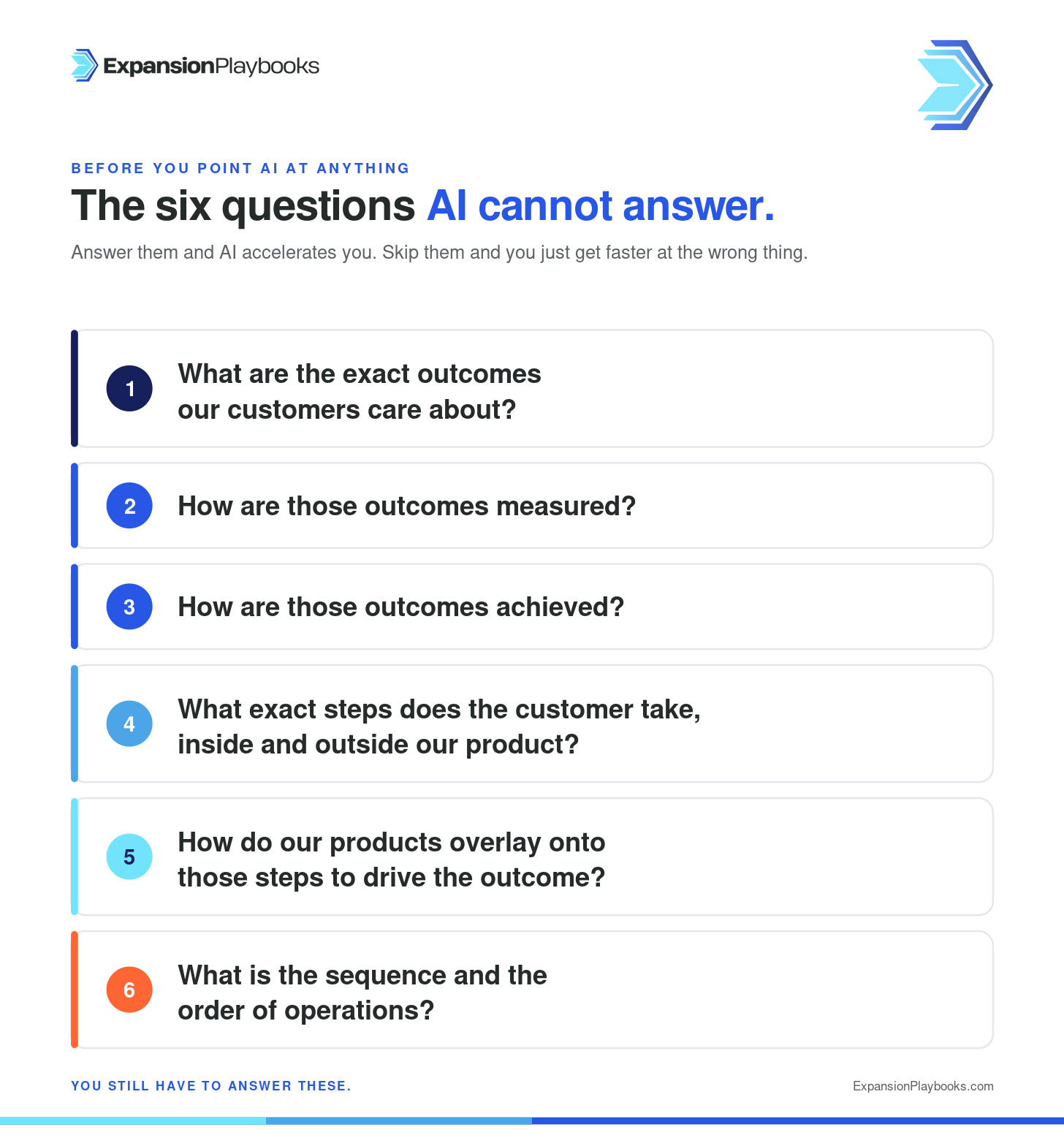
You still have to answer those questions. AI cannot answer them for you.
And if you apply AI to any of your processes without having answered them, all you will do is get faster and more efficient at doing the wrong thing you've always been doing.
How you design the ultimate customer success playbook
So how does one design the ultimate customer success playbook in the AI era? By addressing the fundamental things that haven't changed. Here's how.
Step one: build the customer model. This is non-negotiable, and it's the one everybody skips.
Lay out exactly what outcomes your customers care about. Not thirty outcomes. The three or four that matter, because all emphasis is no emphasis. Figure out the economics that drive their business: how they make money, how they save money, what they get judged on. Map the results that roll up to those outcomes: the metrics that measure them, the actions that produce them, and how your products overlay onto each one. And understand the personas involved, because a specific person has to take every one of those actions.
I call this artifact the Customer Results Map, and the reason it exists is simple: what you do is not what you are for. Ask a CSM what their job is and they'll tell you what they do. Run QBRs. Check on accounts. Fix problems. Those are proxies. What you are for is making the customer measurably more successful at their own business.
And that's not opinion. I've analyzed millions of customer records across dozens of companies, and the most highly correlated factor for retention is whether the customer got a measurable outcome. A positive result, retention goes up two times. A significant result, six times.
Almost nobody sits down and makes this model explicit. Of the few who do, far fewer live by it. That's the whole opportunity.
Step two: build the five key processes.
Once the model exists, you build the processes that run it. And there are five, because there are only five things you can be trying to accomplish with a customer if your job is their success: get aligned on what success means in their numbers, make the solution real and in use, prove to them where they stand, remove what's blocking them, and go after the next outcome.
Map those against the lifecycle and you get the five core processes:
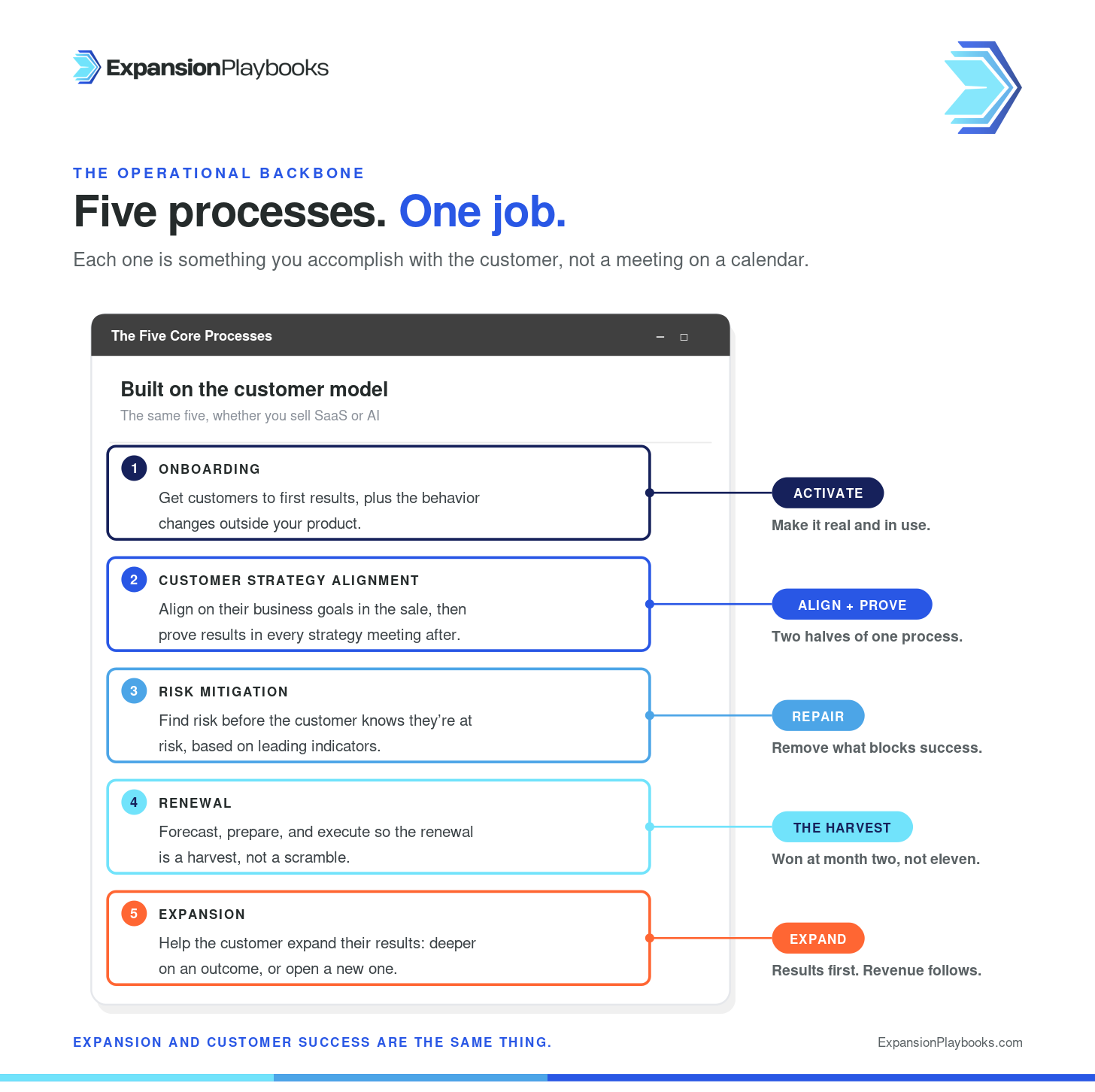
- Onboarding. Getting customers to first results. The technical setup, plus the behavior and process changes the customer has to make outside your product. This is how you activate the customer, and activation is what makes everything after it possible.
- Customer strategy alignment. Aligning on the customer's business goals, starting in the sale, and then proving results against those goals in every strategy meeting after it. Alignment and proof are the two halves of one process.
- Risk mitigation. Identifying risk before the customer knows they're at risk, based on leading indicators, and repairing what's blocking their success.
- Renewal. Forecasting, preparing, and executing the renewal so it's a harvest, not a scramble.
- Expansion. Primarily helping the customer expand their results: deeper on an outcome they already have, or opening one they don't. Do that consistently and more revenue for your business follows, because expansion and making the customer successful are the same thing.
A quick shout-out here to the forward-deployed engineers, since the FDE is the hottest new role in AI right now. Look at what an FDE actually does: embeds with the customer, configures the solution to their world, drives the workflow changes on the customer's side, and gets them to a real operational outcome. That is onboarding and strategy alignment. The role is new. The fundamentals it exists to deliver are the same ones we've been chasing for 20 years. And so the AI companies inventing this role ended up rediscovering the fundamentals, with a new title and a bigger salary band.
Step three: now point AI at it. And start small.
When you have the model and the processes, you have the unlock. You're finally in a position to make your customer successful and to use AI to its fullest: executing against a model you have validated and know to be true.
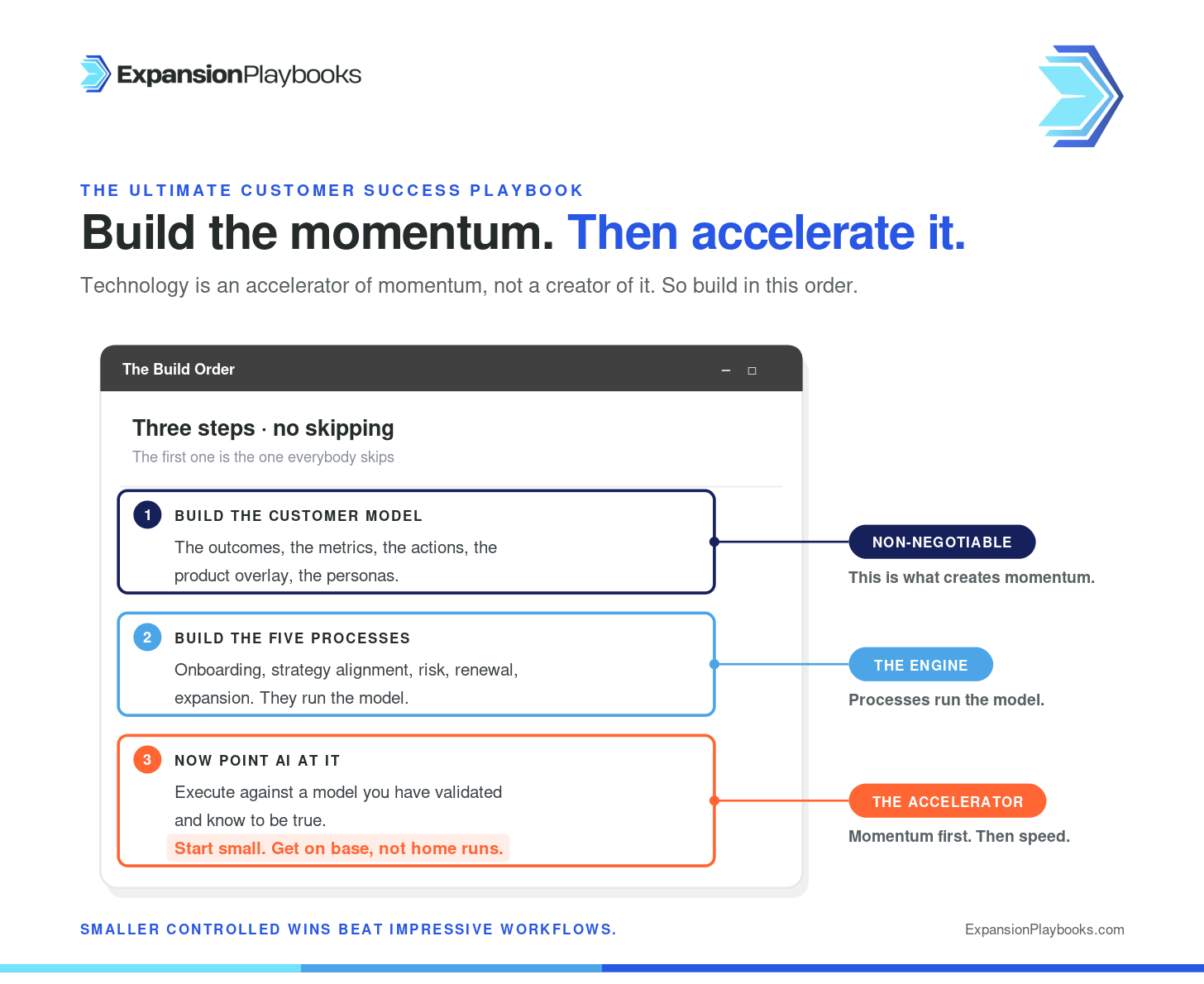
But stop trying to hit home runs. Start by just getting on base.
Once you've answered the core questions, you can use AI to surface the risk signals you've identified, the ones you know are actually meaningful. You can use AI to identify customer goals from your call recordings, so you can capture them and act on them.
That's where the real impact is. If you want AI to make you better at your job and make your customer successful, it will come from smaller, controlled wins, not from the hyper-complex, multi-stage workflows that sound impressive on paper but don't make anyone more successful.
Same tools as everyone else. The difference is whether the model underneath them is true.
The playbook was never the technology
OpenAI didn't hand my contact's team a magic customer success machine, because there isn't one. The best AI company in the world still has to figure out what their customers' outcomes are, how they're measured, and what it takes to achieve them. Just like you.
AI doesn't change what makes customers successful. It changes how fast you can execute on it if you know what actually works. And if you don't know, it changes how fast you fail.
Though everything's changed, almost nothing's changed. We still have to make customers successful.
If you want help going after this
If you want my help coaching you or your team on how to go after this, don't hesitate to reach out. I'm always happy to share what I've found that works. Hit reply, or reach me at expansionplaybooks.com/contact.
Of the six questions above, how many could your team answer today without looking anything up? Hit reply and tell me your number. I read every reply.
Sources: MIT Project NANDA, "The GenAI Divide: State of AI in Business 2025." Jim Collins, "Good to Great" (2001).