
I got an alert that one of our customers had gone from 200 active users down to one. A number on a dashboard flipped red and the system pinged the CSM: "this account is at risk." That's how I found out. After the fact.
And that's the whole problem with a number like that. It doesn't tick down from 200 to 199 to 198 over three months while you watch and quietly step in. It sits there looking fine, and then one day it's at one and you get the alert. By the time you can see it, it's already done. You only ever learn it reactively, when there's nothing left to do.
I've watched a version of this play out at company after company. The customer success team is watching one dashboard for risk, and the expansion team is running a totally separate motion to find the next sale. Same customer, two screens, and neither one can answer the only question that matters. Is this customer winning right now? And are they ready for what comes next?
So here's the one idea that changes how you see all of it. There's really no such thing as retention.
There's no such thing as retention. Even a renewal is the customer buying next year's value.
Now hold on, because I track retention like everyone else. It's a useful number. But as a concept, from the customer's side, retention isn't a real thing. Think about it. Even when a customer renews, they're not paying you for what you already did. They're paying for the value they're going to get next year. So a renewal is really just another expansion. They're buying the next chapter.
And this matters because of what it does to your head. The second you focus on retention, you're playing defense. You're reacting. You're scrambling around looking for reasons someone might leave. But focus on expansion, on growth, on the next bit of value you can create, and you're playing offense. When you play offense, you're always finding new value for the customer.
So really there's just one question for any customer: are they succeeding, and are they ready for what's next? When they're ready and you move them forward, we call that expansion. When they should be ready and they're not, we call that risk. Same customer. Same motion. You're just looking at which side they're on.
Risk and expansion share one core.
Here's what most companies do. They build a health score to catch risk, and a separate playbook to chase the next sale. Two teams. Two dashboards. Two sets of meetings. Like they're solving two different problems.
But it's one problem. Is the customer succeeding and ready for the next step? When the answer is yes, that's expansion. When the answer should be yes and it isn't, that's risk.
And so when a customer is doing the things that lead to success, they're ready to grow. When that same customer stops doing them, they're at risk. You didn't change what you're measuring. You read the same gauge, and it just pointed a different way.
That's why you don't need two systems. You need one good measure of success that both sides can read.
It's four parts, not one score.
Most health scores are useless because they blend a dozen things into one number that means nothing. What's the difference between an account at 58% and an account at 64%? Either there's risk or there isn't. A blended score can't tell you which, and it definitely can't tell you what to do about it.
A real signal isn't a score. It's a simple, four-part definition of what success looks like for one outcome the customer actually cares about. I call the whole thing the Dual Signal, because the same four parts tell you both stories at once.
Here are the four.
Technical. The system is set up to make the outcome possible. The automation is built, the integration is on, the thing is configured. This is the part teams are already good at, because it lives inside your product where you can see it.
Behavioral. The customer's team is actually doing the things that make the outcome happen. This is the one everyone forgets, so slow down here. Behaviors come in two flavors. Some happen inside your product, like printing a label or sending a campaign. Some happen outside it, like writing a cancellation policy or training the front desk to mention it. The inside ones are easy to see. The outside ones are the ones almost everybody misses, and they're usually the ones that matter most. Either way, the test is the same: is a real person actually doing the thing, not just is the software switched on.
Outcome. A real number moved. Not "they logged in," not "the feature is on." Something changed in their business that they actually care about.
Time. All of that, inside a window. Without a deadline, every behavior turns into "they'll get to it eventually," and "eventually" is not something you can manage. The clock is what turns a someday into a signal. Let's say a good customer would have this done by day 21. A customer sitting at day 21 with nothing done is telling you something right now.
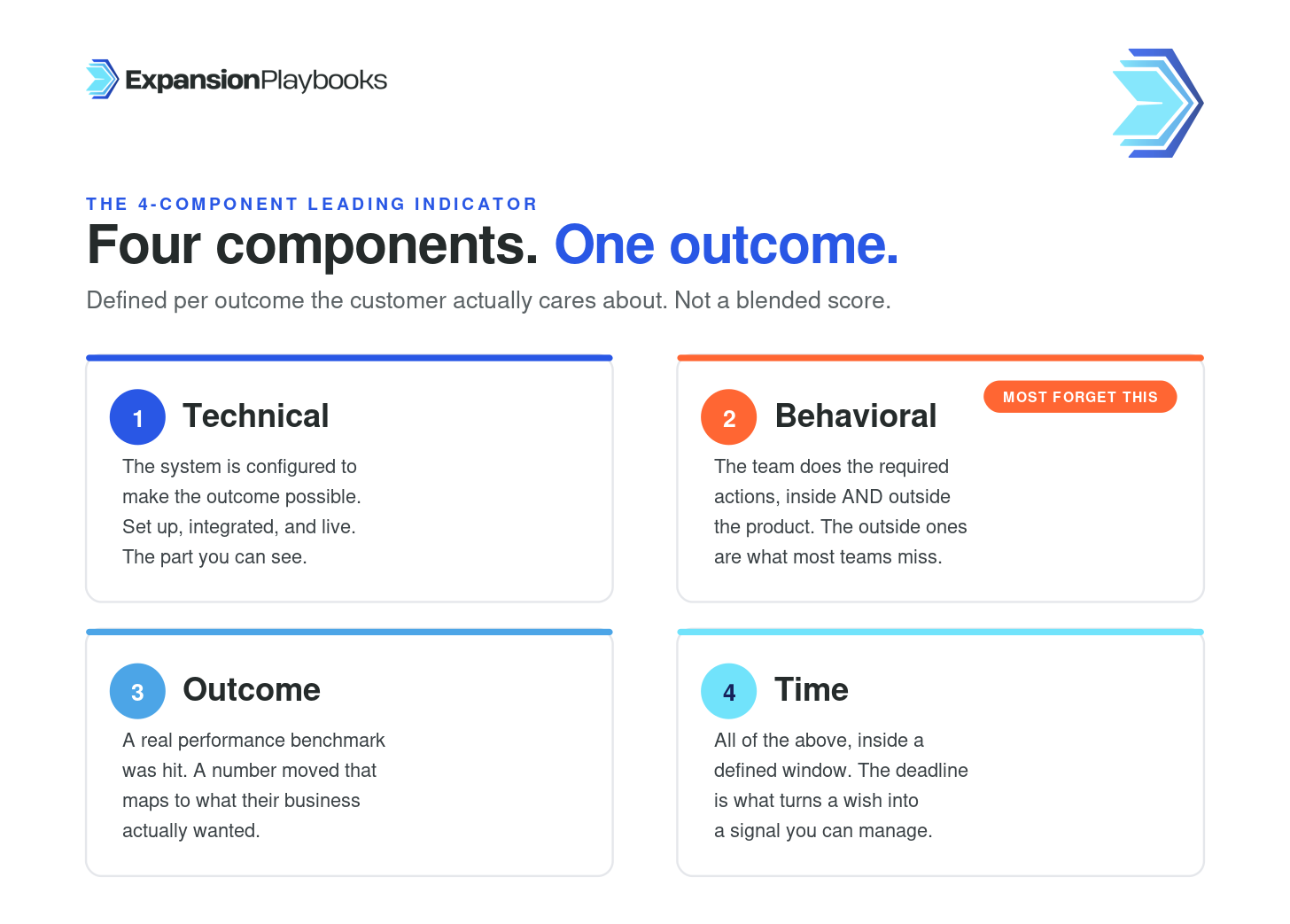
And these aren't four separate boxes to check. They build on each other. Miss the technical part, and you're not even in a position to do the right behaviors. Miss the behavioral part, the real change in how the team works, and you're never going to hit the outcome, or at least not an outcome big enough to justify the solution. Miss the time window, and the results come in too late, or never come at all, before anyone can call the whole thing a success. You need all four, for one specific outcome, or you don't really have a leading indicator.
Let's fill it in: growing an email list at Drip.
A framework does nothing until you fill it in. So let's fill it in.
I worked with Drip, an email marketing platform. Drip's own customers are e-commerce brands and creators who are trying to grow their business through email. So take one of those customers, and pick one outcome they're actually trying to hit: grow their email subscriber list. Now define the four parts for that one outcome.
Technical. The web pop-up is installed on their site and the auto-opt-in is configured. You can check that yourself, right inside the product, without calling anyone.
Behavioral. The customer set up an incentive to make signing up worth it, like "15% off your first purchase for joining." That's a decision they make and set up in their own store, outside Drip. The pop-up is the technical part. The offer behind it is the behavior.
Outcome. The list grew by 100 or more new subscribers, or the growth rate climbed by three percent. A real number, tied to the thing they wanted.
Time. All of it inside 30 days.
Now you've got something you can actually act on. One of Drip's customers who has the pop-up live but never set up an incentive isn't "78% healthy." They're missing the behavior for list growth, and you know exactly what to go do. You call them and you figure out why the incentive never went on. That's the power of writing it down this way.

The same four parts tell you both stories.
Here's where it earns the name. Define the four parts for an outcome, and you get both stories for free.
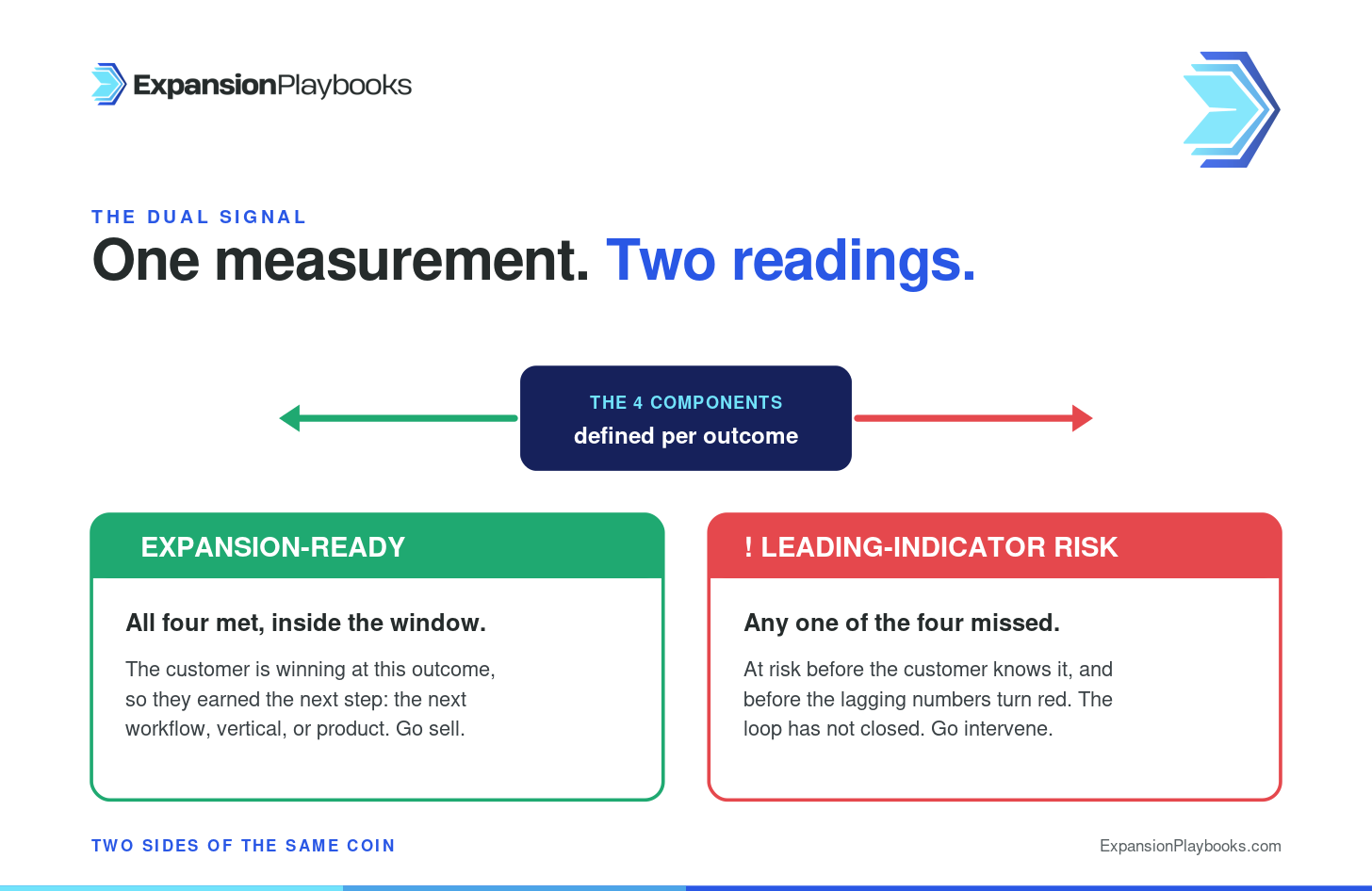
All four met, inside the window? That customer is Expansion-Ready. They're winning at this outcome, so they've earned a shot at the next one: the next workflow, the next use case, the next product. Expansion is what you offer a customer who already won the last thing. And when you're expanding a customer, you're getting retention for free.
Any one of the four missing? That's Leading-Indicator Risk. Because risk is the absence of success factors. That's all it ever is. The customer is at risk before they even know it, and before the lagging numbers show it. Nobody's removed users yet. Logins still look fine. But the loop isn't closed, you can see it, and there's still time to do something while the customer still cares enough to try.
So it's the same four parts. One read says go help them grow. The other says go fix something now. You never needed two teams and two dashboards. You needed one honest definition of success.
A second one: food safety at Jolt.
Drip is one shape of this. Here's another, from Jolt, another company I worked with. Jolt is operations software for quick-service restaurants, so Jolt's customers are the restaurants themselves. And Jolt drove three kinds of outcomes for one of those restaurants. Checklist accountability, making sure the cleaning checklist and the dinner-service line setup actually got done. Food safety, the labeling and the temperature checks. And employee operations, the scheduling and the clock-in, clock-out.
Now, which of those three told you whether a restaurant would stick? It was food safety. And inside food safety, the sharpest signal was labeling. When a restaurant makes food in-house, it's supposed to put a label on it with a date, so nobody serves something that's expired.
So watch how useless the lagging version is. The lagging read says, "the customer stopped using the labeler, so they're going to churn." Thanks. That just tells you the patient already died. There's nothing you can do with it.
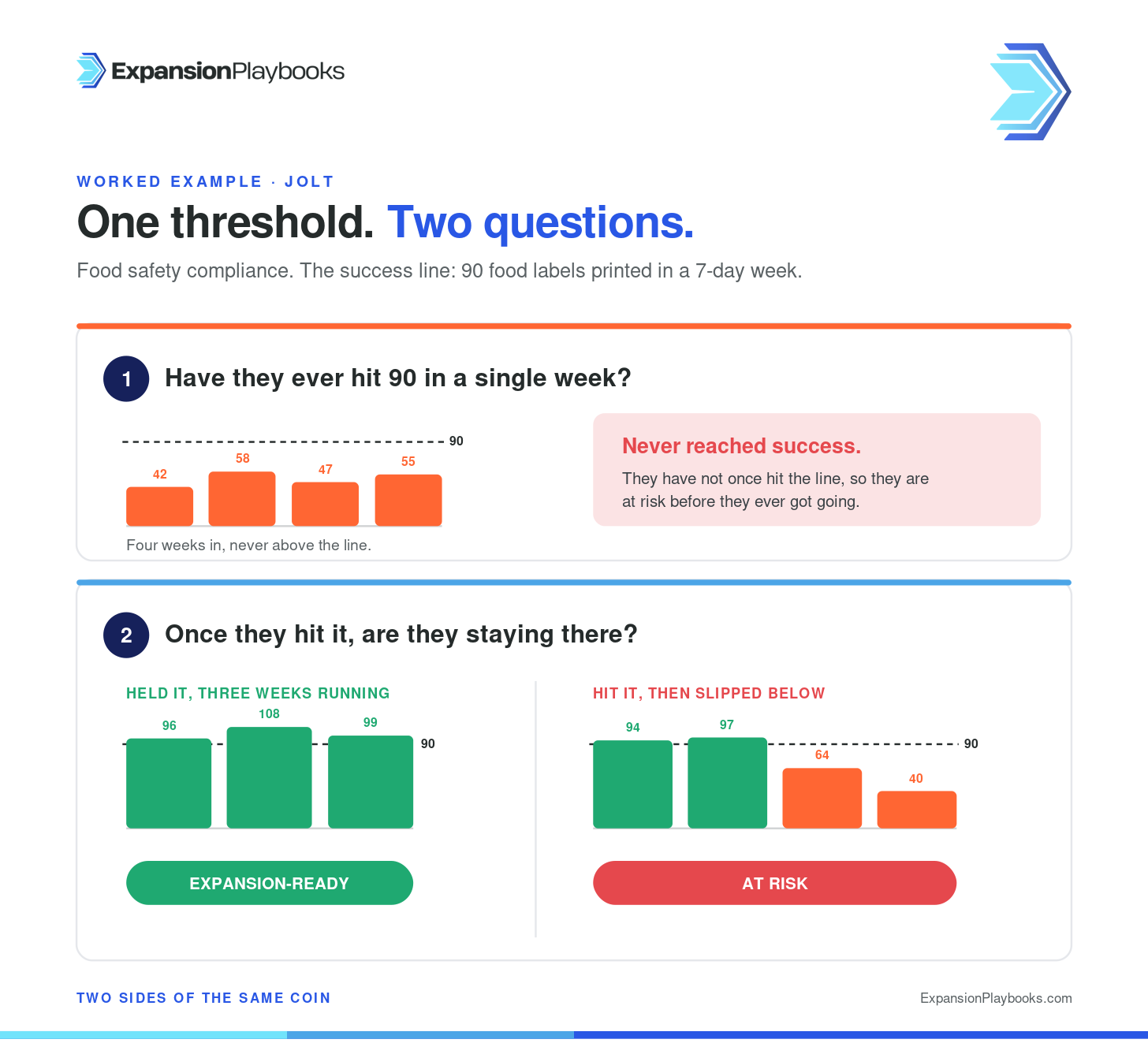
Now watch the leading version. Jolt knew that an average quick-service restaurant makes about 90 food items a week that need a label. Some make 150. Some make 200. But on average, around 90. So we set the threshold there, because we know you should at least be hitting that.
And here's the thing: printing those labels is a behavior, and it happens inside the system. Every time someone makes the ranch dressing or preps the vegetables and tags it with a date. So if a restaurant is printing 90 or more labels in a week, their food is getting labeled and they're getting the actual benefit, which is nothing expired going out to a customer. Drop below 90 and something is off. Either they stopped doing it right, or someone new never got trained. And now there's a real food safety risk, which is the one thing that restaurant genuinely cannot afford.
And there are actually two questions hiding inside that one threshold. First: has this restaurant ever hit 90 labels in a seven-day week? If they never have, that's a risk, because they've never once reached the success line. Second: if they have hit it, are they staying there? Maybe they ran 90 or more for three weeks straight. That's a customer proving it, and a customer who's ready for the next thing. Or maybe they hit it for two weeks and then fell off for two. That's a customer who reached success and slipped back below the line, and now they're at risk. Same number, two different stories, depending on which question you're asking.
That's the part that gets lost. This was never about using the tool for the sake of using it. The label count is a stand-in for whether the restaurant is succeeding at the outcome that actually matters to them. Above the line, you've got an expansion conversation. Below it, you've got a problem to go fix. Same number, read two ways.
This blows up the renewal calendar.
Here's something this quietly destroys: the idea that risk and expansion run on a calendar. We tell ourselves a customer should expand around month 12, and that retention is something you start worrying about right before the renewal. That's backwards.
If a customer is missing success factors, they can be at risk in week two of onboarding. And if a customer is flying through those same factors, they can be ready to expand in week two of onboarding. It has nothing to do with the renewal date.
It comes down to one thing: has the customer progressed to the stage where they're ready for the next thing? If yes, you introduce it now. You don't sit on it and wait for a renewal to have the expansion conversation. And if they're failing on success factors earlier than they should be, you raise the alarm now. Not at the next QBR. Not at renewal. Now.
Why lagging indicators waste your time.
Here's the mistake almost every CS team makes with risk. They track lagging indicators. The customer stopped logging in. They removed users. Usage is trailing off. These feel responsible, and they do predict churn, so a dashboard built on them looks smart.
True, and also useless.
Useless because by the time you can see them, there's nothing left to do. When a customer goes from 200 users down to one, they already failed. That number is right, and it's also a headstone. You can't save a customer who's already gone. And these signals are only loosely tied to success anyway. Sure, a customer needs users on the platform to use it, and if they pull everyone off, they can't win. But that's the floor, not the signal. Knowing a house needs a foundation doesn't tell you if the house is being built well.
What's always easier to track is whether the customer is doing the things that lead to winning. The pop-up incentive. The 90 labels. The behavior that closes the loop. Those move first, and those you can still do something about. So look lower, and look earlier, and you catch the signal while it's still a signal.
Building this is the expertise. The score is what you reach for without it.
Now, you might say this is a lot of work. Defining four parts per outcome, per use case, setting the thresholds, picking the windows. A blended health score is so much easier to stand up.
And it is easier. That's exactly why almost nobody does the real thing, and why the real thing is worth so much. A vanity health score is what a team reaches for when it doesn't have the expertise. The four-part signal is that expertise, written down, turned into something anyone on your team can read.
This is the adult-in-the-room move, pointed at your own metrics. Everybody's happy to ship a dashboard that turns green and call it customer health. Almost nobody is willing to do the work of saying, out loud and in writing: here are the four things that define success for this outcome, here's the threshold, here's the window, and here's exactly what we do when a customer falls short. That's the work. And that's the powerful part, because you only have to define success once, and then you get to cash that check twice: once on the expansion side, once on the retention side.
So here's the whole thing in one breath.
Risk and expansion aren't two jobs. They're the same job, looked at from two directions.
You pick one outcome the customer actually wants. You define what success looks like in four parts: the system is set up (technical), the team is doing the actions inside and outside the product (behavioral), a real number moved (outcome), and all of it inside a window (time). Then you just read where the customer is.
All four, on time? They're ready for more. Go help them get it. And when you're expanding a customer, you're getting retention for free.
Missing one? That's your risk, and risk is the absence of success factors. That's all it ever is. Real risk always has a name: either they never hit the outcome, or they hit it and slipped below the line. Go fix that one thing, while the customer still has the energy to care.
There's no such thing as retention. There's only a customer who's winning and ready for what's next, or one who should be and isn't. Customers renew for what you're going to do for them next, not for what you already did. So stop playing defense. Build the one definition of success, and play offense with it.
Try this this week.
Pick one outcome your best customers actually want. Just one. Now write down the four parts for it. What has to be true in your system. What the team has to do, inside and outside your product. What number has to move. And by when. If you can't fill in all four, good. That's probably the most useful hour you'll spend this quarter, because it shows you exactly where your current health score has been bluffing.
And I'd love to see what you come up with. Hit reply and send me the four parts for one of your outcomes, or tell me which of the four is hardest to pin down. My guess is it's the behavioral one. It almost always is. I read every reply.