
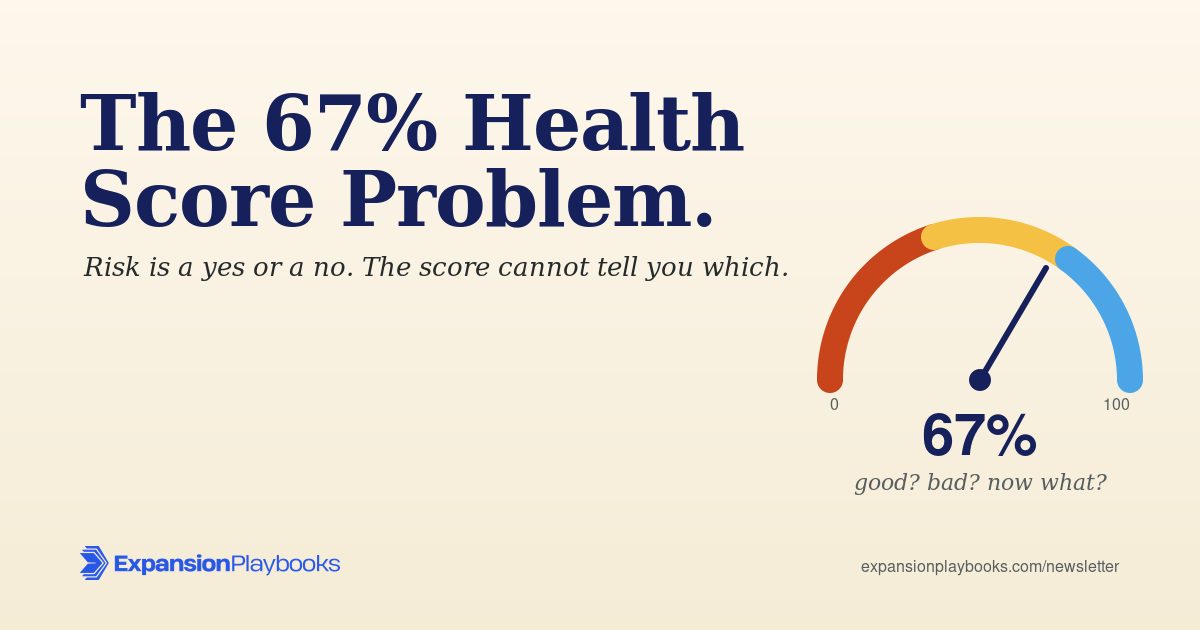
A company I worked with rolled out a customer health score. They had built it over a few months in their CRM. They pulled in everything they could track: login counts, the number of times a customer exported a report, how many features they had touched, how recently someone had signed in. They weighted each factor, blended it all together, and out the other side came a single number between 0 and 100 for every account.
The rollout was exciting. Now every customer had a score. You could sort the whole book of business. You could put a number on a slide. The dashboard lit up green and yellow and red.
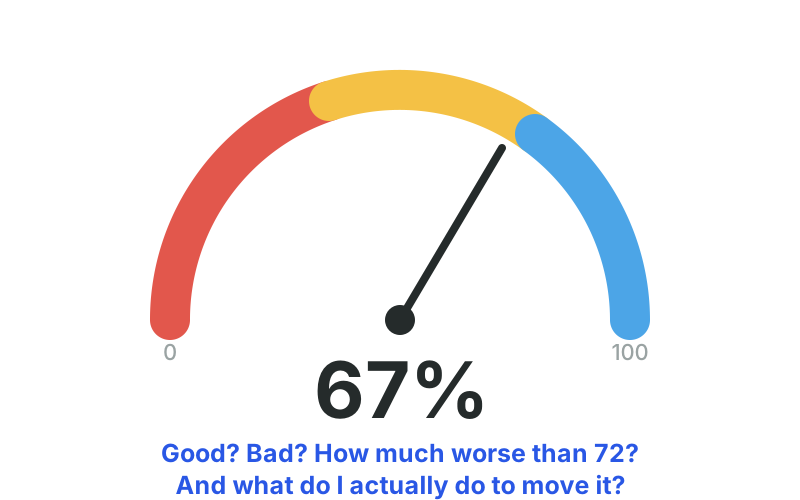
Then the first real account came up in the meeting. The customer was at 67%.
And the room went quiet, because nobody could actually answer the question that mattered. Is 67 good? Is it bad? How much worse is it than 72? Better than 61? What does it even mean for a customer to be 67% at risk? You are either at risk or you are not. And the question that mattered most: what do I actually do to move that number? Nobody knew. With that many factors and that many weightings, the score had stopped telling a story. It was just a number that went up and down for reasons no one could name.
Risk is a yes or a no, not a percentage.
I am not a fan of customer health scores, and the 0-to-100 continuum is the main reason. It puts every customer on a sliding scale, and then you are stuck trying to explain the difference between a customer at 58% and a customer at 64%. There is no real difference. There is no action attached to closing that six-point gap. Either there is a specific risk to that customer succeeding, or there is not.
When you bundle thirty factors into one number, you trade something you can act on for something you can report. The score looks sophisticated. It sorts nicely. But it cannot tell a CSM what to do on Monday morning, and that is the only thing a risk system exists to do.
The score says the customer is at 62%. Okay. What gets them to 80? Which of the thirty inputs do I touch, and in what order, and will it even matter? The number cannot answer, because it was never built to. It was built to summarize. Summarizing is not the job.
Most teams are watching the wrong half of the movie.
Here is the deeper problem underneath the score, and it has nothing to do with the math.
The mistake almost everybody makes with customer risk is they watch lagging indicators. The customer's usage dropped. They removed users. Logins fell off a cliff. So the health score craters, the account flips to red, and everyone scrambles.
I am not going to pretend those signals do not predict churn. They do. They are actually quite accurate. If a customer goes from 20 users down to 1 and stops logging in, yes, they are probably leaving. Technically true. Practically useless. By the time you see it, there is nothing left to do.
Because that customer did not fail when they dropped from 20 users to 1. They failed earlier, for some other reason, and removing the users was just them packing up on the way out the door. The usage drop was the symptom showing up at the very end. Staring at it is like waiting for the patient to flatline before you check the vitals. You were watching the wrong half of the movie the whole time.
This is exactly why loading those signals into a health score is wasted effort. A lagging indicator turns red only after the customer has already decided to leave, already evaluated your competitor, and in a lot of cases already signed with them. The decision is behind them. The customer is already gone. You are not looking at someone you can still save, you are looking at the wreckage of a failure that happened weeks ago. Putting that on a dashboard does not buy you a save. It just gives you a more colorful record of the loss.
Leading indicators are the inverse of success.
A leading indicator is not just a better lagging indicator. It is a different thing entirely.
A leading indicator is the absence of the behaviors and milestones a customer would need to actually succeed.
Think about what a successful customer does. They take certain actions. They set certain things up in your system. They hit certain results by certain points in time. Those are your success milestones. Flip every one of them over, and you have your real risk signals. The failure to do the thing that success requires is the risk.
This is why leading indicators are so valuable. They show up before the customer feels any pain. You can see the account is in trouble before the customer knows they are in trouble. That is the whole game. You still have their attention, their energy, and their willingness to change something. You have the relationship capital to go in and right the ship while there is still a ship to right.
And because each risk is tied to a specific missing behavior, the diagnosis comes with the prescription built in. If I know a customer should have set up their email signup form and a working incentive by week one, and it is day eight and that form is not live, I do not just know something is wrong. I know exactly what to go do. Call the customer, find out why the widget never went on the site, and get it done. The risk and the fix are the same sentence.
Replace the score with two lists.
So if the score goes, what replaces it? Two lists. Not thirty factors blended into a number. Two plain lists of the things that actually matter, tied to what the customer is trying to accomplish.
The first list is never achieved. These are the success milestones the customer should have hit by a certain point and has not. The key ingredient here is time. If a customer is three days in and has not hit a milestone, that is not risk, that is Tuesday. But if we know that by day 20 a successful customer would already have set up their core workflows and started to see initial results, then a customer sitting at day 20 with none of that done is at risk, for a specific and nameable reason: the absence of a milestone they should have reached by now.
At Drip, the email marketing platform, the milestone that mattered was getting a customer to at least one dollar of attributed revenue inside the first 21 days. A customer at day 19 with zero attributed revenue is on the never-achieved list. They have not hit the first win we know is essential, and we know to go intervene right now.
The second list is slipped below threshold. These are customers who did succeed, hit the benchmark, and have now fallen back below it. This is where performance thresholds come in, and they are worth the effort to define.
Take Jolt, an operations software for quick-service restaurants. One of the outcomes they drove was food safety compliance, and part of that was labeling prepped food with a printed expiration label. Jolt already knew a typical quick-service restaurant makes about 60 of those items a week. So the benchmark wrote itself. A customer should be printing at least 60 labels in any seven-day window. If they drop below 60, you already know something is off. Either they stopped using the system properly or someone new is not trained. You do not need a blended score to tell you. You need the threshold and the customer's number against it.
Notice what both lists have in common. They are binary. The milestone was hit or it was not. The customer is above the threshold or below it. There is no 67%. There is a specific thing, tied to a specific outcome, with a clear yes or no and a clear next move.
Pick the few that matter, then stop.
The other reason scores get bloated is that teams cannot resist adding factors. More inputs feels more rigorous. It is the opposite. Most of those factors are useless. They move the number without telling you anything you can use.
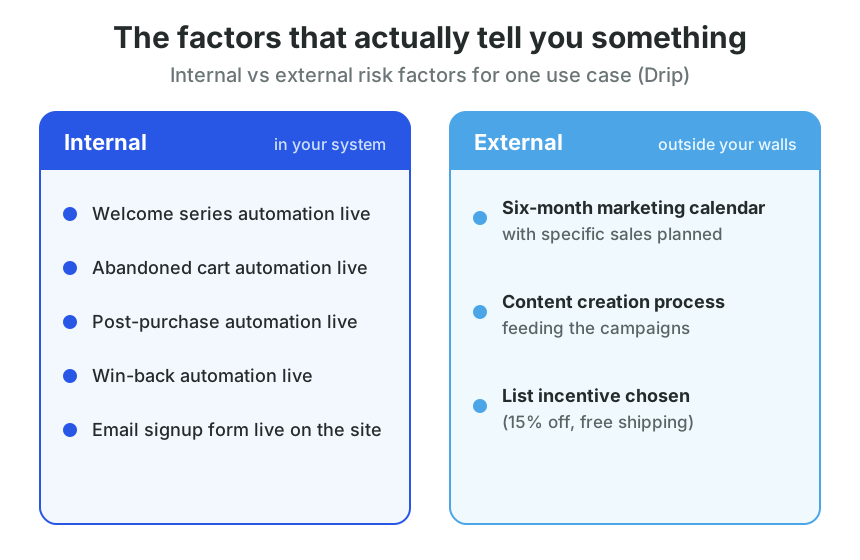
Less is more here. Aim for something like 5 to 10 internal factors, the things you can see in your own system, and 5 to 10 external ones, the things happening outside your walls that you have to ask about or observe. Weight them heavily toward the first phase of the customer's life, because if you get a customer to their early wins, most of the rest takes care of itself.
Take Drip again, because the difference between internal and external gets concrete fast. The internal factors are the things you can see right inside the product. Are the four core email automations live: welcome series, abandoned cart, post-purchase, and win-back? Is the email signup form actually on the customer's website? Those are yes-or-no, and you can check them yourself without ever calling the customer. The external factors are the things happening outside your walls that you have to ask about or go look for. Does the customer have a six-month marketing calendar with specific sales already planned out? Do they have a content creation process feeding the materials their campaigns need? Have they chosen a list incentive to drive signups, like 15% off a first purchase or free shipping? Same customer, two very different kinds of signal, and the picture is only honest when you have both.
Tie each factor to a specific use case, because the same product serves different customers who need different things. A construction company using a field service tool leans on job tracking. A home health agency using the same tool never touches jobs but lives in visit reports and geofencing. If you score them against the same generic checklist, you are off course for both. The construction customer should be using these four features to this level. The home health customer should be using those five to that level. Now you can say precisely why a customer is at risk: they are a construction account using two of the four features that construction success requires.
This is the part nobody else will do for the customer. Everybody is happy to sell rainbows and butterflies and a dashboard that turns green. Almost no one is willing to be the adult in the room who says, out loud, here are the eight things that actually determine whether you succeed, here is where you stand on each one, and here is the one we are fixing first. That is the work. That is also the expertise customers cannot get anywhere else.
You can only make a customer successful specifically.
You cannot make a customer successful in general. You can only do it one specific factor at a time.
That is the whole reason the two lists beat the score. The point of a risk factor is that it is specific enough that its absence tells you exactly what to do. Remove that exact risk factor. Accomplish that exact success milestone. Address that exact missing behavior. If you cannot be specific about a risk, there is no reason to flag it at all, because there is nothing you can actually do with it. You can only pinpoint risk when you know what has to happen for the customer to succeed. And the moment you know what has to happen, you have already answered what you must do about it. The diagnosis and the prescription turn out to be the same sentence.
A number tells you a customer is unwell. A list of essential, outcome-anchored, time-bound factors tells you which factor is missing, when it should have been there, and what to go do about it today. One closes the loop on the customer's outcome. The other just colors a cell red and hopes someone figures it out.
Risk is binary. Build the two lists, tie every factor to the outcome the customer is actually trying to reach, and you will see trouble while you still have time and standing to fix it.
What to do this week.
Three steps. You can start the first one this afternoon.
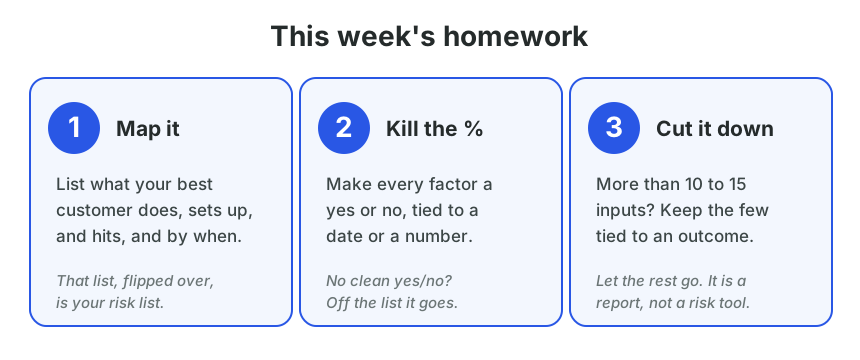
First, pick one use case in your book of business and write down what your best customer in that use case actually does. The actions they take, the things they set up, the results they hit, and roughly when. That is your success milestone list. Flip it over and you have your risk list.
Second, kill the percentage. For each factor on that list, define a binary. Did they hit the milestone by the deadline, yes or no. Are they above the performance threshold, yes or no. If you cannot state the factor as a yes or no tied to a date or a number, it is useless, and it comes off the list.
Third, take your current health score and count the factors. If it has more than 10 or 15 inputs blended together, you have a reporting tool, not a risk tool. Pull out the handful that map to a real outcome, attach an action to each one, and let the rest go.
If you run this on one use case this week, hit reply and tell me what you found. Which factor were you tracking inside a blended score that turned out to be the one that actually predicts whether the customer wins, and which ones turned out to be noise you can finally stop watching?