
I begged my CEO for two more CSMs for months.
This was SalesRabbit, my first job out of college. I was the first customer-facing hire the company ever made, so I was the first support rep, and then I built the first CSM role, and then I built out the customer success team under it. Everything was new. Nobody had done any of it before me, which meant there was no precedent to point at and no headcount ratio anybody could hold me to.
And I still ran into the same wall every customer success leader eventually runs into, which is that at some point the work outgrows the people doing it.
So I did what everybody does. I'd get off a hard call, a customer who'd been waiting four days on something that should've taken an hour, and I'd walk into my CEO's office full of the emotion of that one moment. My team is drowning. We're going to lose accounts over this. If we had more people, we could actually fix this.
Every one of those conversations was passionate. Every one had a real example in it. And every one was about the incident I'd just walked out of, never about the pattern underneath it.
And every one ended the same way.
"Not right now. Your team already has more people than our other team."
For a long time I told myself he just didn't understand what was happening out there. That wasn't it.
The mistake everybody makes
The mistake everybody makes is treating the resource conversation as a persuasion problem, when what it actually is is a preparation problem.
Here's what I was doing, and it took me a while to be honest about it. I was walking into that office with a need and handing my CEO the job of deciding whether the need was real. The math. The justification. The ROI. The tradeoff against every other place he could put that same dollar. I wasn't doing any of that work. I was describing what it felt like to be me and expecting him to convert the feeling into a business case on my behalf.
Which is lazy.
I know how that sounds. But look at what I was outsourcing and who I was outsourcing it to. I was handing the analysis to the one person in the building who was furthest from the problem, who had five other functions asking him for the same dollars, and who had none of the closeness to the work that I had. And then I was frustrated when he didn't land on my conclusion.
Nobody's going to build your case better than you can. And so if you don't build it, it doesn't get built.
Leaders are much better editors than they are creators
The second thing I didn't understand is a fact about leaders that would have saved me a year.
Ask a leader to create something from nothing and you'll get one of three answers. No. Let's wait. Or we need more information before we do anything. That's not obstruction, and it's not a lack of caring about your team. It's what any reasonable person does when someone hands them an open-ended problem in the middle of a day that already has forty other things in it. Creating from scratch is expensive. Reacting is cheap.
Give that same leader something concrete to react to and you get an entirely different person. Now they can say I agree with these four assumptions, I disagree with this one, change that one and let's see what it says.
I've been saying a version of this about customers for years. The customer is an editor, not a creator. You don't sit down with an account and ask them to articulate their goals cold, because they'll give you something vague and generic and you'll both waste the hour. You draft the strategy, you put it in front of them, and you let them correct it. People own what they help build, and so you leave the editing door open on purpose.
It turns out the person who signs off on your headcount is no different.
A working premise is a model with your assumptions showing, built specifically to be argued with. It's not a request and it's not a deck. It's a piece of reasoning that produces a number, with every input visible, so that the person across from you can change an input and watch the number move.
That's what I had never given my CEO. And so every conversation we had was a conversation about how I felt.
Start from the standard, not from the strain
When I finally built the thing, the shape of the argument changed completely, and the change had nothing to do with being more persuasive. It had to do with where I started.
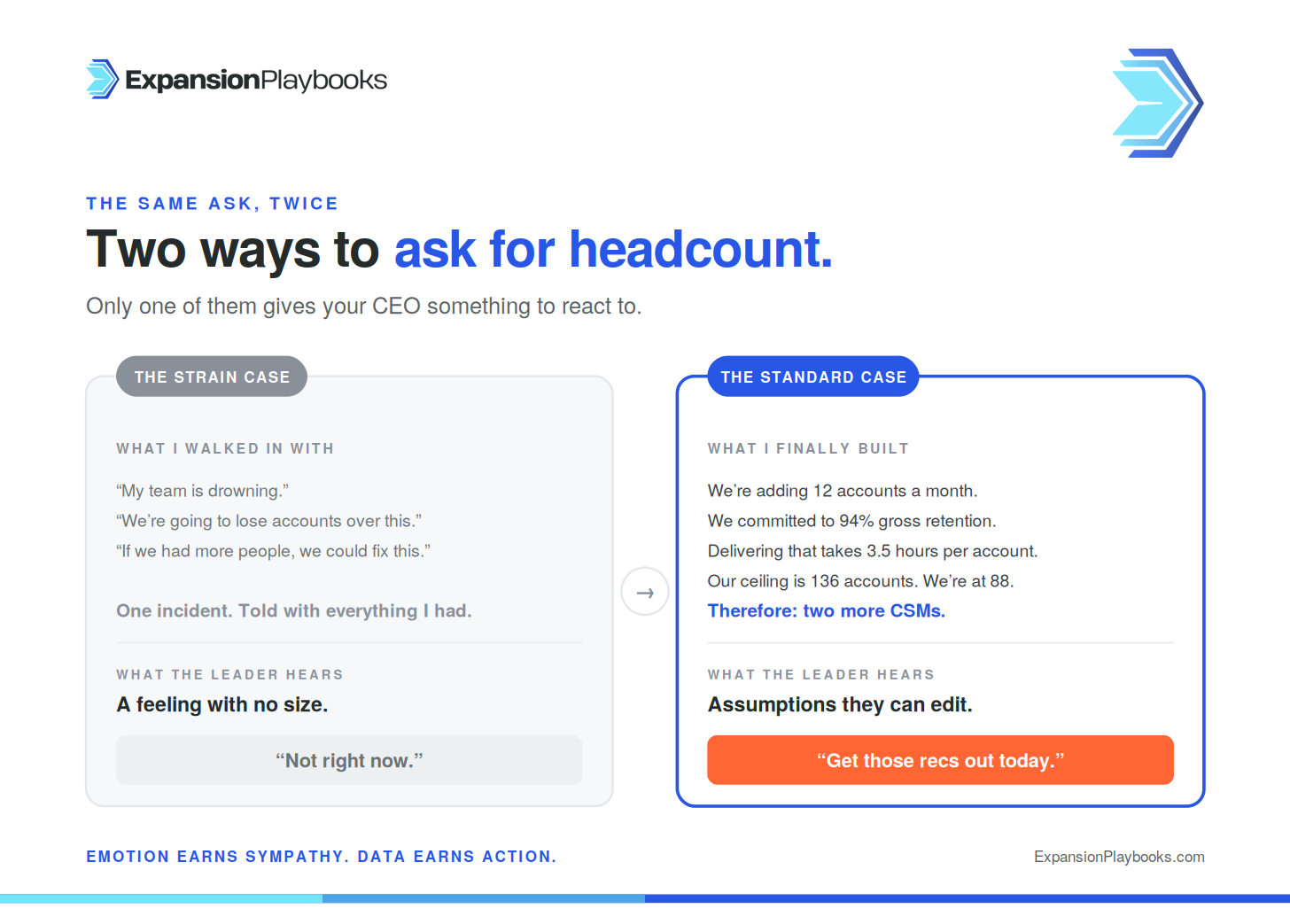
I stopped starting from the strain. My team is underwater, we can't keep up, people are working weekends. All of that was true and none of it was an argument, because "we're tired" has no obvious remedy and no obvious size. How many people fixes tired? Two? Four? And if he gives you two and the team is still tired in April, what does that prove? Nobody in the room can answer any of it, and so the answer is always let's wait.
I started from the standard instead.
Here's the pace we're growing at. Here are the retention and expansion numbers we've said we're going to hit. Here's what our team actually has to do for a customer in order to hit those numbers, activity by activity, and here's how long each of those activities takes. Multiply that across the accounts we have and the accounts we're about to add. That's the input required. And so, in order to deliver the standard we've already committed to, this is how many people it takes.
Notice that this version doesn't ask anybody to feel anything. It's arithmetic sitting on top of assumptions, and every one of the assumptions is out in the open where it can be challenged.
I built a rough capacity model. Nothing fancy. I laid out every activity it took to get a customer to success, I broke down how long those activities took by segment, and I calculated how many CSMs it would take to deliver that consistently instead of heroically.
Then I put it in front of my CEO.
He didn't argue. He didn't say not right now. He looked at it, pushed back on a couple of my assumptions, and we changed them together right there. And when we were done editing, the model still said I needed at least two more people.
He said, "get those recs out today."
I did almost no convincing in that meeting. All of the convincing had already happened inside the model. And the part I want you to sit with is that he didn't just approve it. He started pushing for it, because by then it was partly his. He'd edited it. He had authorship.
Build the capacity model
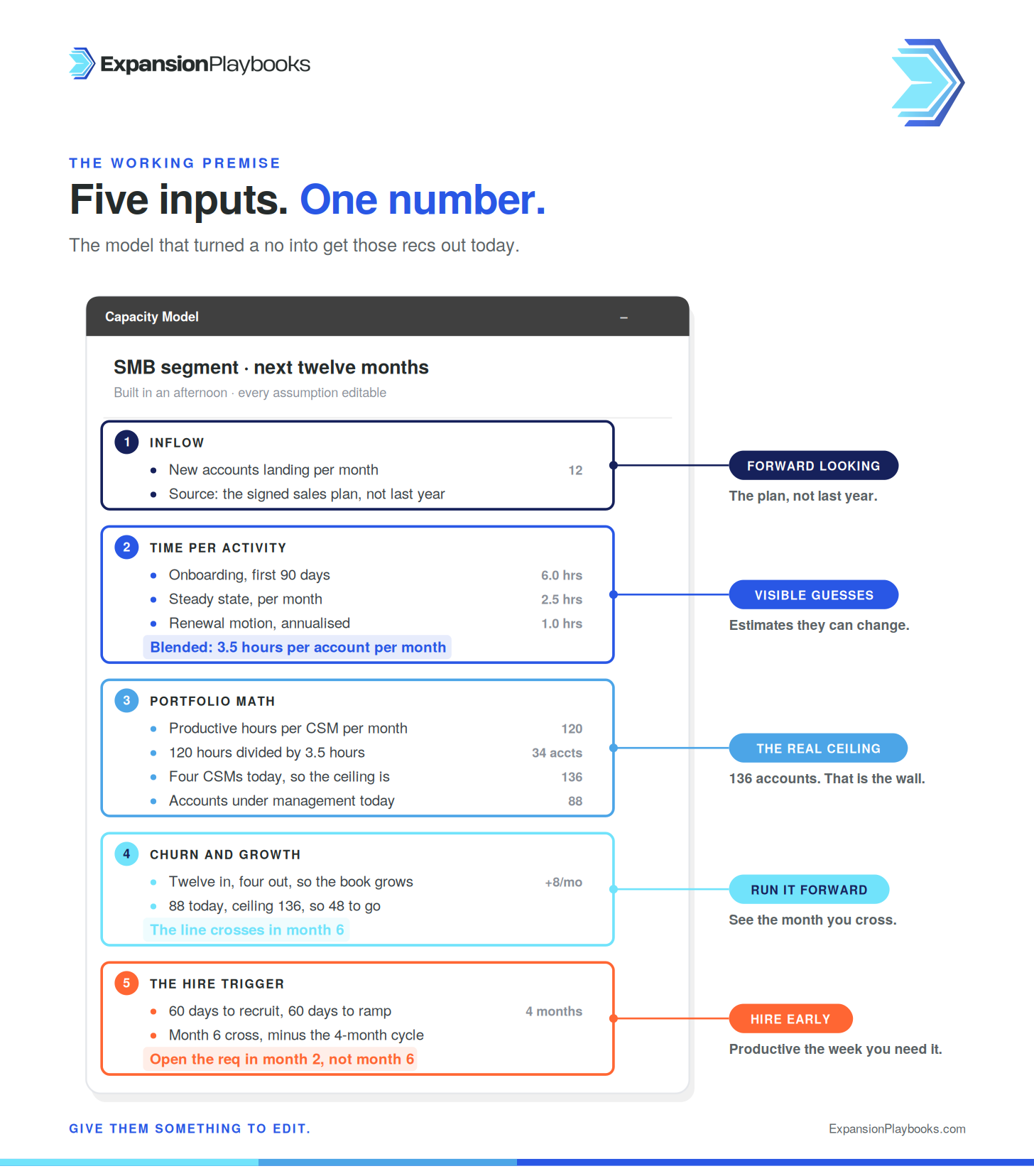
This is the part that used to take real work and doesn't anymore. Five inputs, and you can build the first version of this in an afternoon.
1. Inflow. How many new customers land in the team's lap per month, by segment? Not last year's average. The number your sales plan says is coming, because you're hiring against the future, not the present.
2. Time per activity. For each segment, list what your team actually has to do for a customer to get a result. Kickoff. Implementation touchpoints. The first result conversation. Business reviews. Escalations. The renewal motion. Then put minutes on each one. People resist this step because the numbers feel made up. They're estimates, and estimates are fine, because the whole point of a working premise is that the estimates are visible and your leader can change them.
3. Portfolio math. Multiply the per-customer time across the book each person carries. This is where most teams discover the real problem, which is that a CSM isn't over capacity because of the new customers. They're over capacity because last year's customers never left the portfolio and every one of them still needs something.
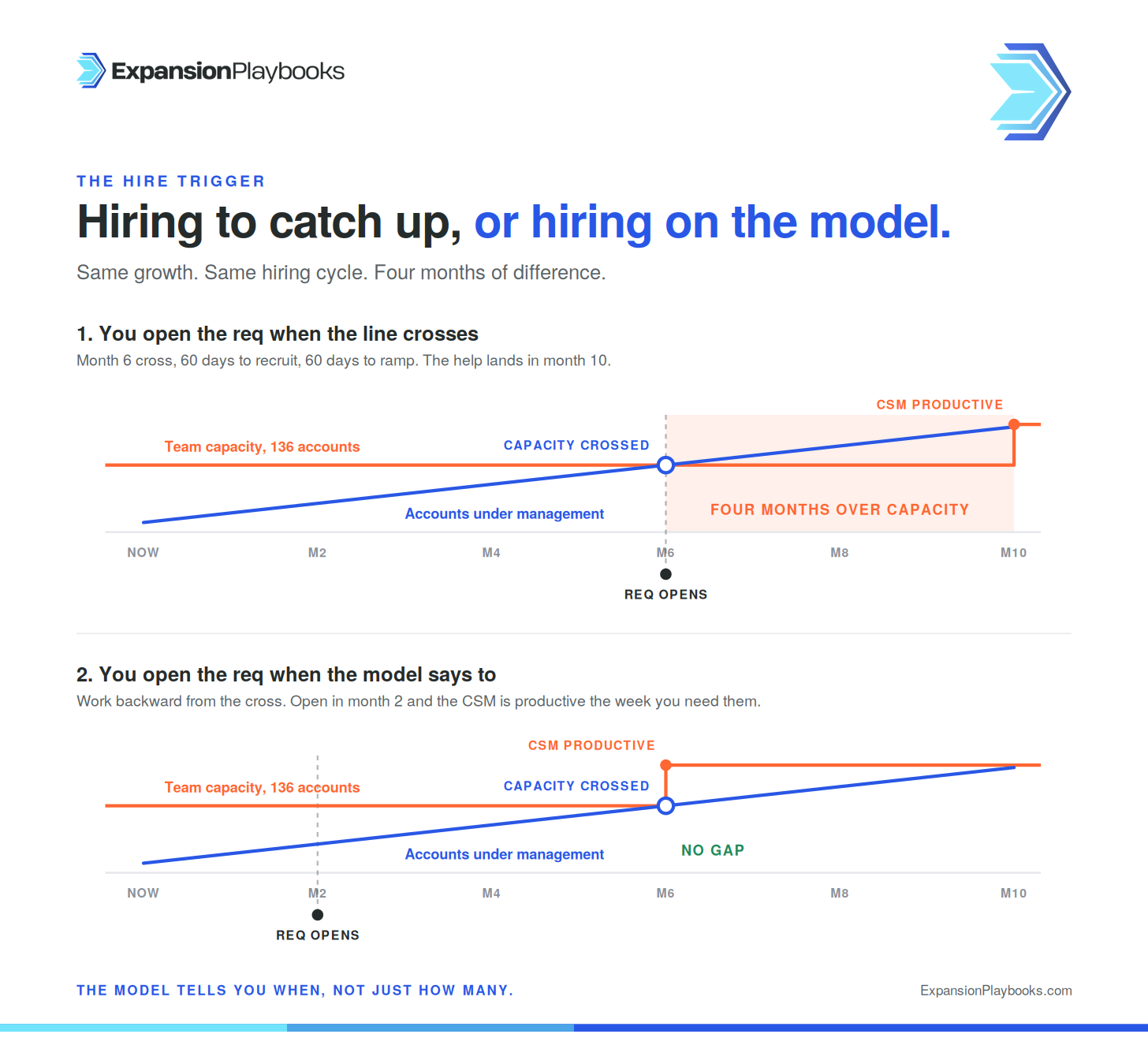
4. Churn and growth over time. Run it forward. Your inflow adds accounts, your churn rate removes some, and the portfolio compounds in between. Now you can see the month you go over capacity instead of finding out after you're already there.
5. The hire trigger. This one is the difference between a capacity model and a capacity complaint. Work backward from your hiring cycle. If it takes you sixty days to recruit and another sixty to ramp, then the model should tell you to open the req four months before the line crosses, so the person is productive the week you need them. That's how you stop hiring to catch up.
Then, once you have that, you get the other half for free. If you know what a CSM is worth in the model, you can run the return side of it. What does that person's capacity do to your retention rate? What does the time they get back do to your expansion pipeline? Let's say a fully loaded CSM costs $120,000 and carries $2 million in ARR. You don't need a big improvement for that math to be uncomfortable to say no to.
And I want to be clear about how much easier this is now than when I did it. I built mine by hand. You can now sit down with AI and have it help you think through the whole structure. Feed it your segments, your inflow, the activity list, your time estimates, your churn rate. Have it build the portfolio projection, have it argue with your assumptions before your CEO does, and have it produce the version where you hire early and the version where you don't, so you can show both.
The math was never the hard part. Sitting down to do the math was the hard part, and that excuse is mostly gone.
But my CEO would never go for it
Two versions of this objection, and they get different answers.
The first is "we don't have the money." Fine. The model is still the most useful thing you own, because now the conversation isn't about whether you get people. It's about what the company is choosing not to deliver. If the standard requires seven people and the budget allows four, then somebody has to decide which segment gets less, or which activity comes out of the motion, or which retention number moves. That's a real decision, made on purpose, in the open. That's a much better place to be than quietly failing at all of it and calling it a staffing shortage.
The second is "my leader isn't analytical, they won't read a model." Then make it one page and three assumptions. The working premise isn't about sophistication. It's about giving somebody something specific to disagree with. A napkin with four numbers on it beats a passionate speech every single time, because you can't edit a speech.
Nobody is withholding your headcount
Emotion earns sympathy. Data earns action.
I didn't lose those first conversations because my CEO didn't care about customers or about my team. I lost them because I brought him a feeling and asked him to turn it into a decision. That was my job, and I was giving it away.
Your leader isn't withholding the resources. Most of the time they're waiting for something to react to, and nobody has handed them anything yet.
Stop asking and start modeling
Pick the number you've been asking for and stop asking for it.
Instead, write down the standard you've committed to, the activities required to hit it, and the time those activities take. Build the roughest possible version of the model. Get it wrong on purpose in a few places, because the wrong assumptions are the invitation.
Then put it in front of the person who says yes or no, and let them edit it.
If the model still says you need the people after they've had their hands on it, you're not going to have to do much convincing. And if the model says you don't need them, you just learned something that was worth learning before you spent another six months asking.
So what's the thing you've been asking for and not getting? Hit reply and tell me what it is and what you'd have to put in a model to make the case for it. If you build one and it changes the conversation, I want to hear about that too. I read every reply.