

You've been assigned an account, and there's one person you cannot reach.
Maybe it's the CFO. Maybe it's the VP of Sales, or the head of HR. You can get the admin on a call any day of the week. But the executive who actually controls whether this renews, the one whose goals you're supposed to be driving, will not talk to you. So you do the thing everybody does. You email again. You call again. You send the note that says, "Hey, is there any way I can grab some time on your calendar? I'd love to chat and talk shop, understand your goals, figure out your strategy."
Nothing comes back.
And you keep going, because at least you can tell your boss you're trying. "I've reached out a million times. I told them I need their input to build the strategy. I keep asking for their goals and they won't give them to me." You've built a paper trail of effort. You dropped in, you called, you emailed fifty times.
Then the contract ends, or the renewal comes due, and you get one email. "Hey, we've decided to switch to a different platform. Thanks for everything." And you sit there and think: what else could I have done? I did everything. I called, I emailed, I asked and asked. They just wouldn't engage.
So before you file that one under "unreachable customer," let me ask you the question I ask every CSM who brings me this exact problem.
Would you want to meet with you?
Put yourself in that executive's chair for a second. You're the CFO. Or you're the VP of Sales, or the CHRO, and you've got 99 things on your plate that all matter more than any single vendor. Now someone who represents a product your team uses 15% of the time, or that only 15% of your team touches at all, sends you a message. "I'd love to take 30 minutes to talk about your goals."
Would you take that meeting? Would you schedule it, show up to it, and walk away feeling like you got something out of it? Or would you let it sit in your inbox with the other 40 things that want a piece of your day?
Be honest. You wouldn't take it either.
The mistake everybody makes is treating this as a persistence problem. If I just reach out enough times, eventually they'll cave and give me the meeting. So you pepper them, and you log the attempts, and you tell yourself effort is the same as progress. It isn't. An executive doesn't give their calendar to the person who wants their time the most. They give it to the person who's obviously worth it.
And here's what most people miss about that word "goals." When you email a busy executive asking them to hand you their goals, you're asking them to do work, for you, so that you can then figure out how to help them. That's backwards. You're the one who's supposed to be the expert here. Asking for their goals cold is an admission that you don't already know what someone in their seat cares about. And they can smell that.
Earn their time
So here's the move I want you to build everything around. You don't chase the meeting. You earn their time.
Earning their time means you prove, before the meeting ever gets booked, that sitting down with you is worth it. You do that by showing up already knowing what they care about, already having done work on their behalf, and already having something valuable to hand them. You reveal your expertise first. The meeting becomes the obvious next step, not the thing you're begging for.
You're post-sale. You have something a salesperson chasing a first meeting never has: their account, their data, and a track record you can point to. The proof is already sitting there. Your job is to go get it and put it in front of them.
Three steps.
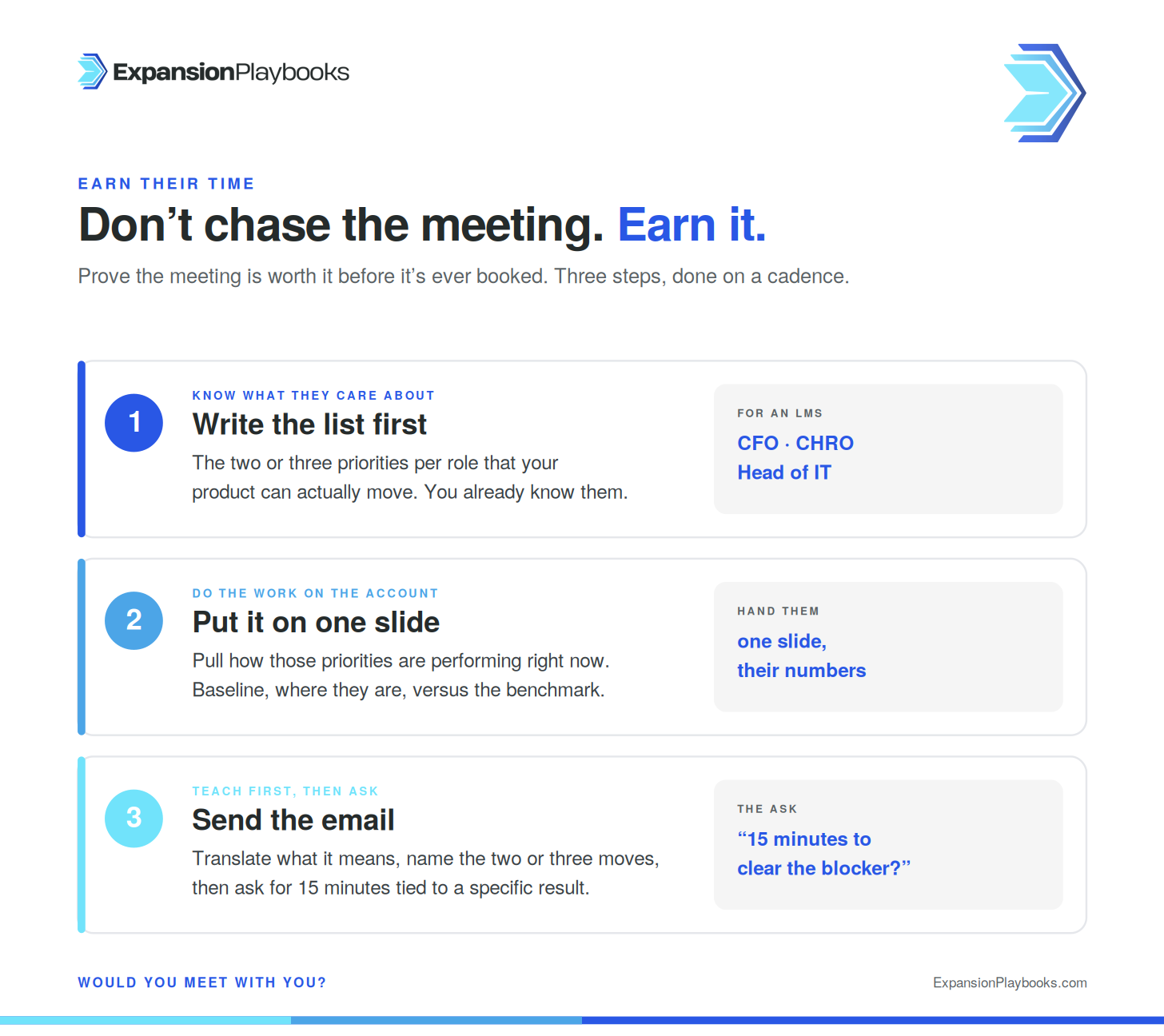
Step 1: You already know what they care about
Start here, because this is the part almost nobody does.
Your company has been serving the same use case for years, across hundreds of customers. What you do is not infinite. And so every executive role intersects with your product in just two or three places. Customers fail in all kinds of different ways, but they succeed in the same handful of ways. Which means you can write down what each executive cares about before the meeting is ever on the calendar.
Let's say you sell learning management software. You work mostly with the HR team, and you help them improve retention, promotion rates, and compliance. At almost every one of your customers, the same roles are in the picture: a CFO, a CHRO, and a head of IT.
What do they care about? You already know.
The CFO cares about the L&D budget actually paying off, about reducing churn through better onboarding and training, and about growing revenue by enabling partners to sell more effectively. The CHRO cares about employee retention, promotion rates, and staying compliant. The head of IT cares about integrations, security, and getting more value out of fewer tools.
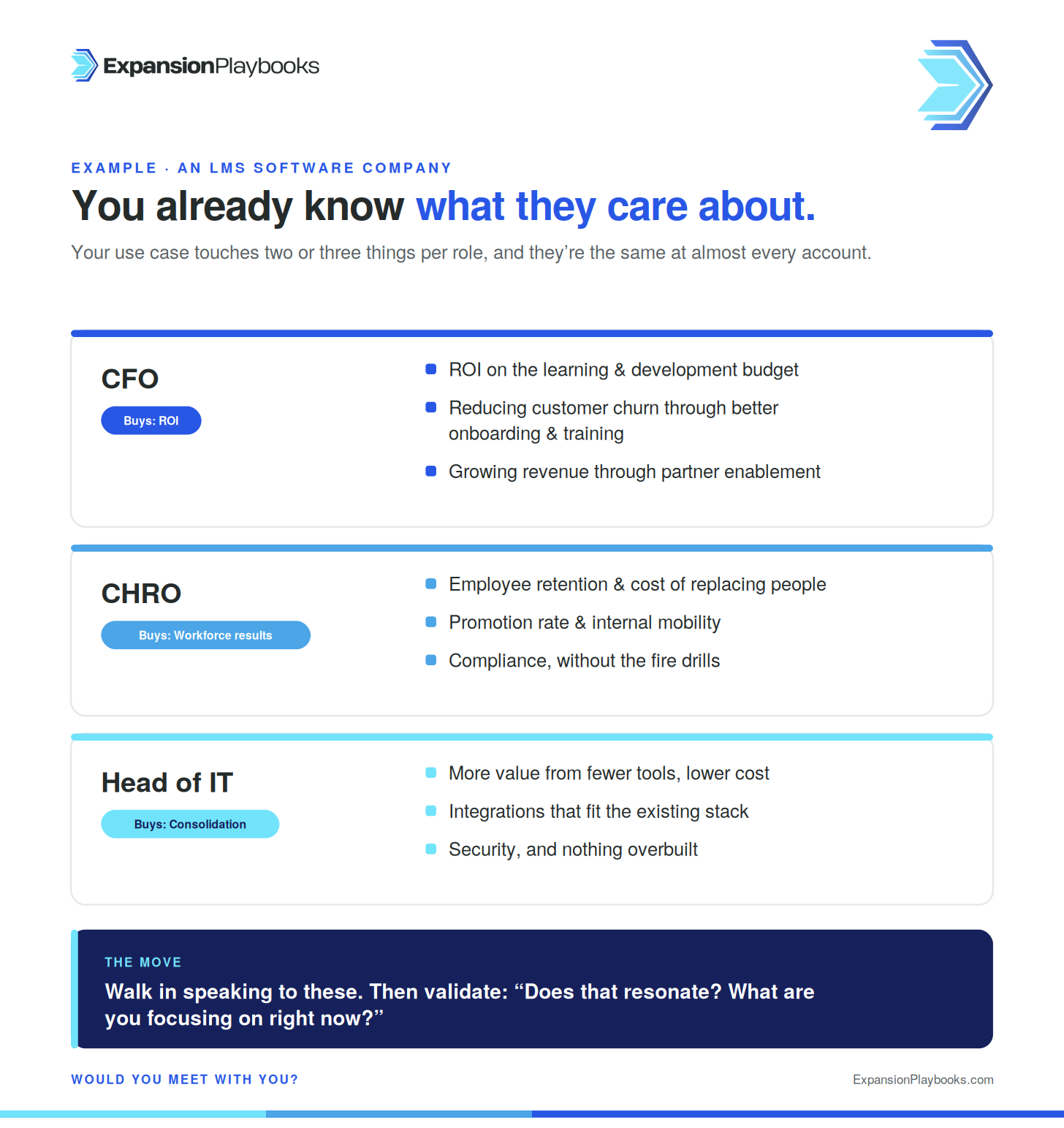
You could write that list before you ever get in the room. Now, you can't impact everything a CFO cares about, and they don't expect you to. What you need is the overlap: the two or three things that matter to them in their role and that you can actually move. That's the Venn diagram you operate inside. So do it objectively, for each role you work with. What are the two or three priorities that intersect what your product does?
Stuck? Give an AI the roles you work with, what your product does, and your use case, and ask it where those paths converge. And look at your own book. Which of your accounts already gives you time with a CFO or a head of HR? Flag those. They're your model. They show you what it looks like when an executive decides you're worth meeting with.
Step 2: Do the work on the actual account
Knowing what the role cares about in general is step one. Step two is doing the work on this specific account.
Take that CFO, or that head of HR, and take the two or three things you just identified. Then go into the account and answer the questions honestly. How are we doing on each one? What's going really well? What could be better? What's flat-out going badly? Pull the data. It's already in there.
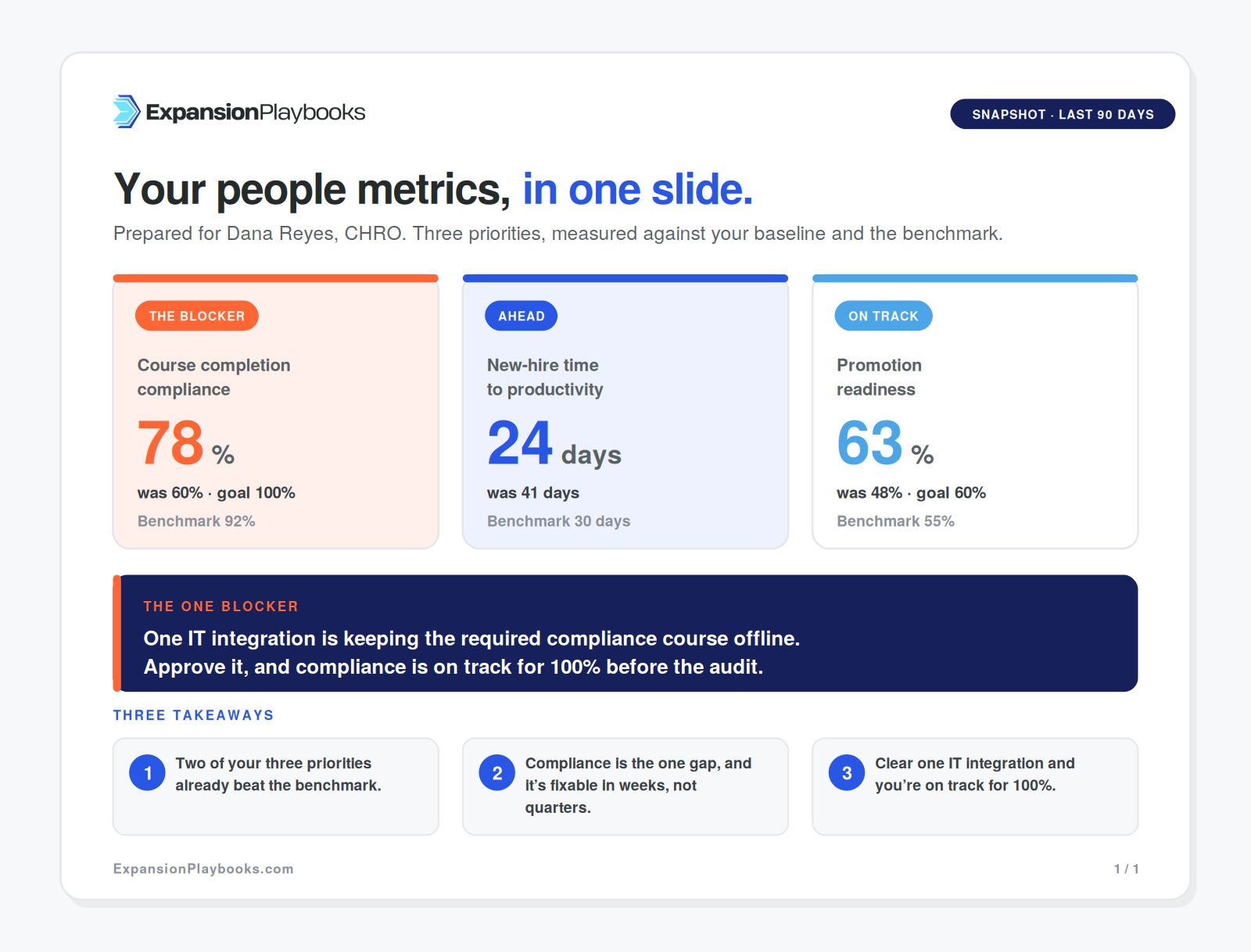
Then put it on a single slide. One graphic. Here's how these things are performing, right now, for you.
The best version of this I ever experienced as a customer was at Zendesk, back when I was an early head of support. They sent me a monthly snapshot. One metric, first response time: "Jeff, you were at 22 minutes last month. That's 6 minutes faster than the month before, but 20 minutes slower than the benchmark for companies your size. Here's what we think you did right, and here's what to try next." They compared me against myself, and they compared me against a benchmark, over time. I knew exactly where I stood without ever talking to a soul.
That's the standard for your one slide. Not a dashboard the customer has to go dig through. A clear picture of their two or three priorities: where they started, where they are, and how that stacks up against what good looks like. You're not asking them to interpret anything yet. You're showing them you've already done the interpreting.
Step 3: Teach first, then land the ask
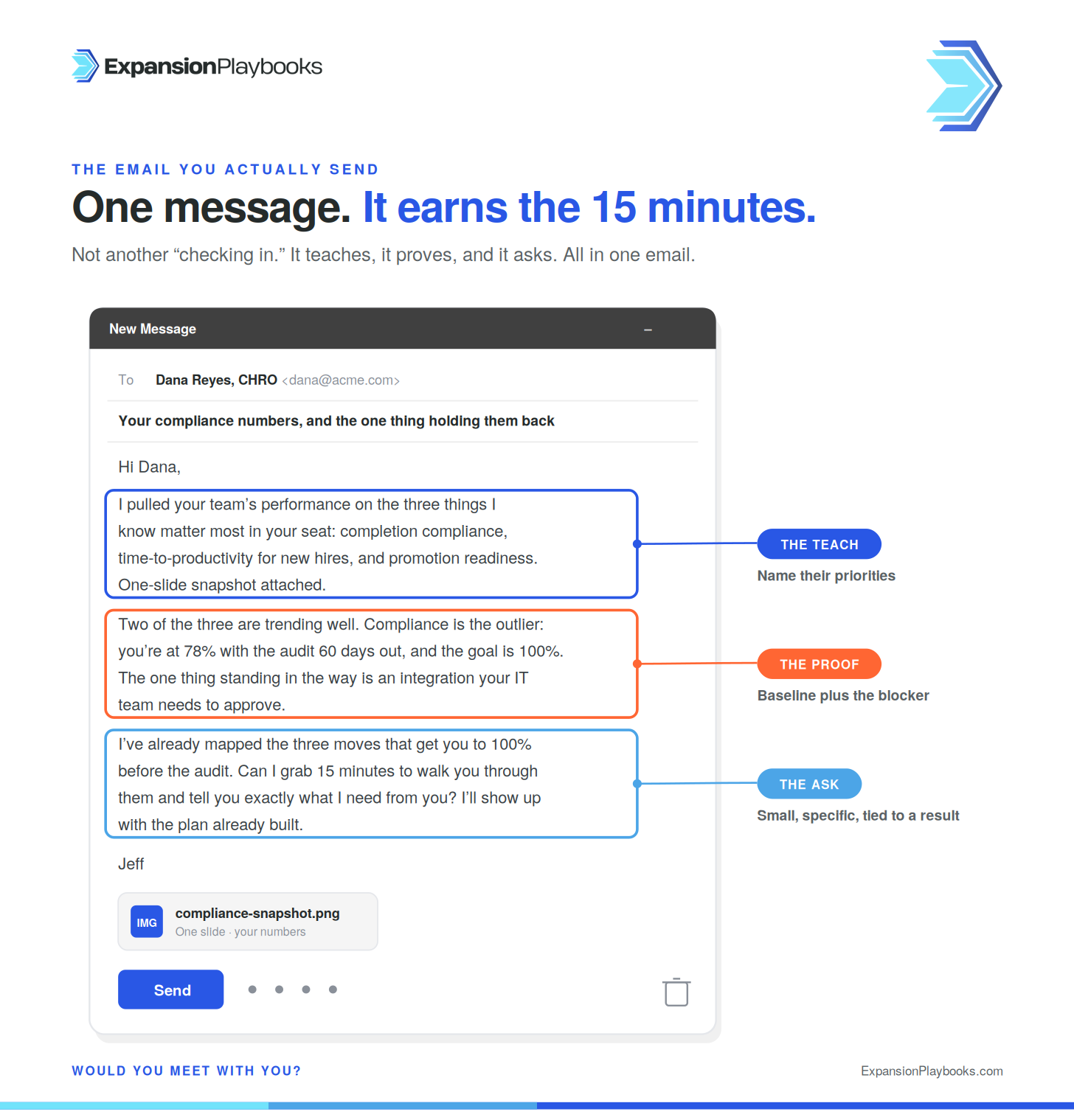
Here's the step that separates a report from a reason to meet. And to be clear about what this actually is: it's an email. You send them an email. Not another "checking in," an email that does work for them before they've given you a minute.
Don't just attach the slide and hope they get it. Translate it. Teach them what it means and what they need to do about it right now. You're doing the thinking for them, in their language, about the outcomes they actually bought. And then, and only then, you land the ask. Make it specific, make it short, and tie it to something that matters to them this month.
Here's the type of email you'd send:
Subject: Your compliance numbers, and the one thing holding them back
Hi Dana,
I pulled your team's performance on the three things I know matter most in your seat: course completion compliance, time-to-productivity for new hires, and promotion readiness. One-slide snapshot attached.
Two of the three are trending well. Compliance is the outlier. You're at 78% with the audit 60 days out, and the goal is 100%. The single thing standing in the way is one integration your IT team needs to approve so the required course can go live.
I've already mapped the three moves that get you to 100% before the audit. Can I grab 15 minutes to walk you through them and tell you exactly what I need from you? I'll show up with the plan already built.
Jeff
Notice what that email contains. Why this matters to them, in the outcome language of their role. Where they're winning and where they're stuck. Two or three specific things to do about it. And a small, concrete ask tied to a result and a deadline. That's an email an executive reads and thinks, "This person has already done work for me. I should probably talk to them."
The same shape works for any role. For a CFO worried about pipeline, it's their leads number and the two moves to grow it. For a head of IT, it's tool consolidation and the one integration that gets more value out of fewer systems. Swap the outcome, keep the structure: here's where you stand, here's what it means, here's the small ask to fix it. Compare any of those to "I'd love 30 minutes to hear about your goals."
What actually happens when you do this
Now, does everybody magically jump on the call the first time you send this? No.
But you don't send it once. You send it every couple of weeks. Here's where your numbers are. Here are the things I've been telling you we need to get done. If we did them, this would move, or this blocker would clear. You keep showing up with value, on a cadence, whether they answer or not.
And when you do that consistently, one of two things happens.
Either the executive eventually engages. "Sorry I've been buried and couldn't get back to you, but yeah, this has been a problem for us. I've seen your emails. Let's make it happen." You created enough visible value that they finally lean in.
Or they surface for a bad reason. They're frustrated, results haven't been where they want, and now they're talking about leaving. But even then, notice what they have to admit: "I know you've been trying to reach me. We've been frustrated about our numbers. I probably should have gotten time with you sooner."
That's the moment. And it should have been a nerve-wracking, back-on-your-heels conversation. Instead you're ready. "Like I've been telling you in all my updates, I know exactly how to improve these results. I hear that you're frustrated and thinking about leaving. But as I've been saying, there are three things we can do right now. If you're willing to recommit and work with me, I've already got them queued up. Let's go drive the result, and let's earn your business back." You flip the script, because you did the work out loud the whole time, and now the receipts are yours.
Good reason or bad reason, you're prepared, because you took ownership of their success and kept showing them why you were worth meeting with. The executive who won't talk to you today is just a person you haven't yet made an offer worth their time.
The whole thing in one line
You will keep losing the accounts where you can't reach the executive as long as you're trying to earn the meeting with effort. Effort is the paper trail you build to feel okay about the loss.
Would you meet with you? Answer that honestly, and it tells you exactly what to fix.
Executives don't give their time to the person asking for their goals. They give it to the person who already knows them, has done the work, and is holding the next result in their hand.
Earn the time first, and the meeting stops being something you chase and starts being something they want.
One account, this week
Pick the account where the executive won't talk to you. The one you've almost given up on.
Write down the role, and the two or three things someone in that seat cares about that you can actually impact. Go into the account and pull how those things are performing onto a single slide. Then write the outreach that teaches first, points at the two or three moves, and asks for 15 minutes tied to a specific result. Send that instead of the next "just checking in."
So here's my question for you. Which executive have you been chasing without any luck, and what are the two or three things you believe that role actually cares about? Hit reply and tell me the role and your guesses, and I'll tell you whether I think you'd meet with you. I read every reply.