
I was at Utah State (go Aggies!) and we got a new business law professor that almost the entire class revolted against. However, he instantly became the most impactful professor I ever had.
One of his first assignments was a question. That was the whole thing. One question, and we each had to answer it in the form of a paper, and we had to turn it around fast.
And so we did what successful students do. A hand went up almost immediately. Is there a rubric for this? Some sort of list of the things you want us to cover?
"Answer the question," he said.
Okay, but how many pages does it need to be?
"Enough to answer the question," he responded.
Well, do we need to do interviews? Is there outside research you want us to pull?
"Whatever it takes," he said, "to answer the question."
Now at this point students were getting genuinely frustrated, and honestly, I was right there with them, because we always get all of this up front. Page count, sources, format, the rubric. And so somebody finally pushed him on it. We need something here. Just give us a number.
"I stop reading after six pages," he said.
What happened when the rubric went away
So here is the part I did not expect.
I did more work on that paper than I had ever done on anything. I interviewed people who actually worked in the industry. I did my own research. And I chased the answer until I had one I believed in, and then I wrote it down.
Nobody made me do any of that, and there was no requirement to point at. And so for the first time, instead of managing a checklist that somebody else had built for me, I was actually trying to answer the question that had been put in front of me.
That is when it clicked. All of those arbitrary requirements I had been waiting for my whole academic life were never the work, they were the packaging around the work, and once he took them away the only thing left standing was the actual thing I was supposed to accomplish.
And that is the whole job, in school, in business, in your career. Answer the question. Solve the problem. Get the result.
The mistake everybody makes
But the mistake everybody makes is treating the boundaries of their role as facts about the world.
We put up these arbitrary barriers and then we go live inside them. Well, that's not my job. I can only go so far on this one. You really expect me to go hunt the customer down? Don't I need permission to do that?
And every one of those is a rubric you wrote for yourself. The reason it feels so safe is that a rubric gives you something to point at later. I hit the page count. I made the calls. I logged the outreach. I did what was asked. So what you end up with is a paper trail of effort, and effort is not what anybody is actually measuring.
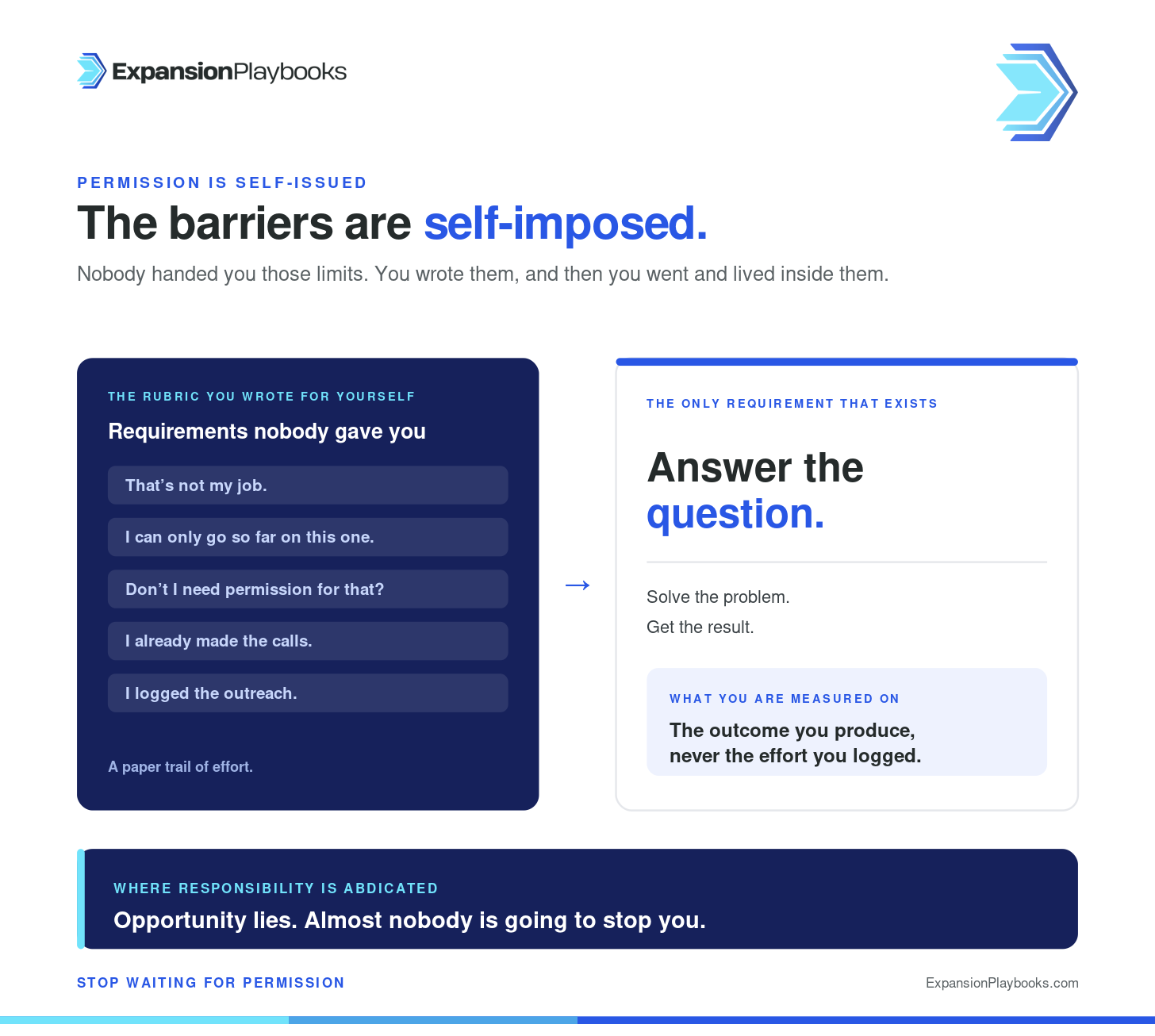
Now, where responsibility is abdicated, opportunity lies. Every place your company has quietly decided that something is nobody's job is a place where you can go be the person who handles it, and almost nobody is going to stop you.
And so once I relieved myself of all that, I realized I do not need permission. I need to answer the question.
Answer the question
So that is the frame I want you carrying into your accounts this week. Answer the question.
What I mean by that is you pick the actual result you are responsible for, you name the real problem standing in front of it, and then you do whatever it genuinely takes to resolve that problem, regardless of whose org chart box it happens to live in. You are going after the version of the work that gets the customer to the outcome, rather than the version that fits neatly inside your scope.
And you already know what it looks like when somebody operates this way, because every single problem is an opportunity to fix something and they do not sit around waiting. So here are two of them.
He found the customer on Facebook
I had a CSM who was going after the highest retention number he had ever achieved in his portfolio. He wanted 98%. He set that goal, and part of getting there was that he had to engage every account he was assigned and make sure they were actually expanding and achieving the value they came for.
And he had one customer who would not respond to anything.
Emails, nothing. Calls, nothing. LinkedIn, nothing. So he went looking, and he found the guy on Facebook, connected with him, and sent him a message.
The customer could not believe it. But then he wrote back, essentially: hey, I respect the persistence. Let's chat. Let's get a call scheduled.
Now look at what actually happened there. The CSM knew LinkedIn was not working. He knew his emails were not working. He knew his calls were not working. And nobody handed him a fourth channel and nobody told him it was allowed, and so he went and found a way, because the account was his responsibility and unreachable was not an acceptable place to leave it.
I wrote 20 help center articles inside somebody else's product
And here is my own version of the same thing.
When I was at SalesRabbit, a door-to-door selling app, we integrated with a third-party CRM. And I had a customer whose reps were hitting errors in our product, which was the front-end tool they were in all day long, and so naturally they were blaming us. But I knew it was the CRM causing the problem.
So the obvious move was to get my contacts at that company on the phone. However, after three emails and two phone calls, I could not reach anybody.
And so I called their public support line. The same line any random user calls. And I sat there and worked it until I understood exactly what was happening and exactly how to fix it for that one customer.
Then I kept going, because fixing one customer does not close the loop. Once I had it solved, I went back to that customer and asked whether I could use their account to take some screenshots and put together some articles that would solve this for all my other customers. They said yes. And I ended up creating 20 different help center articles, hosted in my own system, covering every one of the things that could go wrong in that integration.
Did I ask my boss for permission? Did I ask that company for permission?
I just did it, because that was what was necessary to make sure my customers were consistently successful, and that was the retention number I was on the hook for.
Step 1: Name exactly what you are solving
So how do you start operating this way on purpose?
First, you get clear on exactly what you are trying to solve. What is the question you are actually trying to answer? What is the real issue this customer is going through, or that your team is going through?
Not "the account is at risk." Not "they're unhappy." The actual thing.
Because once it has a name, it becomes so much easier to see what has to be done about it. As an example, mine was not "customer is frustrated with errors." Mine was "the CRM's field mapping is throwing errors into my product and my customers have no documentation to prevent it." And one of those you can go do something about today, while the other one you can only sit around and worry about.
Step 2: Stop asking whose job it is
Second, stop thinking in terms of what you control and whose job it is, and go answer a different question instead.
What would it take to resolve this issue?
Not what can I do about it. Not what am I allowed to do about it. What would it actually take, from anybody, to make this go away permanently?
And then say it out loud. Say the whole thing, including the parts that are not yours.
For example, in my case that sentence was: I need to not only correct this customer's CRM integration problem, I need to build a solution and probably some help center articles that will prevent any other customer from ever running into these same issues.
And when you say it out loud, you will notice that most of the things that have to be done are things you could actually go do yourself. The reason these things feel impossible so often is that you never clearly stated what needed to be done in the first place.
Step 3: Don't wait. Act.
Third, do not wait. And this is the step where almost everybody gives up, because this is the hard one. This is where you start feeling like you need to go ask somebody for permission.
Maybe I know exactly what the problem is. Maybe I am clear on exactly what could be done about it, and I know I am capable of doing it. But what if I get in trouble? Should I really be sitting on another company's help line on behalf of my customer? Is that a waste of my time? Should I be spending those hours somewhere else? Am I really going to go create help center articles for a completely different system that isn't even mine?

That is the wall. And the answer on the other side of it is that if what needs to happen for this to truly be resolved is that you sit on some third-party vendor's help line for an hour and a half until you get to the bottom of it, then go sit on the help line. And if you did a quick search and found the person on Facebook, it is worth a shot. Send the request.
Ask for forgiveness later.
Because ultimately you are judged on the outcome you produce and not on the effort. So if you can get there faster, if you can get there more directly, if you can get there the right way the first time, then go do that. There are no bonus points for reporting how many hours you spent on something for the sake of looking busy. There are only bonus points for doing good work that produced a result.
And this is also the honest answer to that objection, the "what if I get in trouble for this" one. Maybe you will. But I have never once seen somebody get in trouble for doing what it took to help a customer succeed. I have seen plenty of people get in trouble for quietly sitting by and allowing a customer to fail and churn.
When to start
The great thing about operating this way is that you can start immediately. You do not have to wait around for some dramatic opportunity to show up. Take responsibility for the customer's outcome, get clear on what the issue actually is and what it would take to do something about it, and then start acting. Some of the most common places to find one:
Broken processes. Is there a process that keeps plaguing your work or your team's work and slowing everybody down? Do not wait for permission to see whether you can solve it. Start drafting a new one, and then go talk to the specific teammates who would have to agree to those changes and find out what it would actually take to make it real.
Customers you cannot reach. If you cannot get a customer on the phone number you have, try to find them on LinkedIn. Try Instagram. Call the other users at the account and work your way up. Because there is almost always another door.
A bug your product team is slow on. Go do some additional QA yourself. Reproduce it, capture the steps, get the screenshots. And then build your own bug submission template that gives them even more information up front, so that they are not only more likely to fix it, they are more likely to fix it faster.
None of those require anybody's approval, and all three of them are sitting there right now.
That one assignment from a professor almost the whole class wanted gone changed the way I think about work entirely. It put me on a completely different trajectory, and I have been operating off of it ever since. And I am confident that the day you stop waiting for permission is the day a whole lot of good things start happening in your career too.
So what is the one thing you have been waiting for permission to go fix? Hit reply and tell me, and tell me what you think it would actually take to resolve it. I read every one.