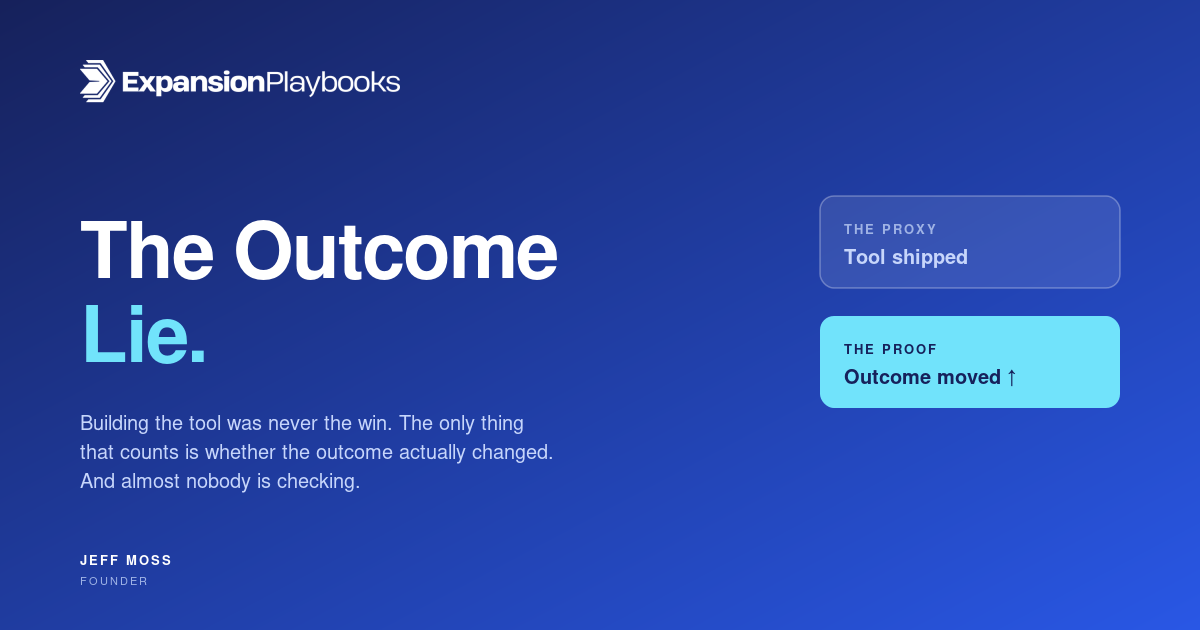
Last month I watched someone announce they had replaced their entire SDR team with three AI agents. Big post. Lots of applause. So I asked the obvious question. How many deals have the agents closed?
Silence.
Around the same time I talked to someone whose company had built an outreach bot. It messaged people on LinkedIn a couple times a day, very natural, very human-sounding. It ran perfectly. It never missed. And it had not generated a single lead or converted a single customer. They built the bot. It technically produced messages that could be sent to people. That was the whole accomplishment. The bot was a success, and in every way that actually matters, it was nothing.
Here's what most people miss.
Whenever somebody confuses the implementation of something with the outcome, you have a problem.
"I launched an AI SDR that closed a million dollars of business" is a win. "I don't need my SDR team anymore, I have three agents" is a sleight of hand. One of those sentences is an outcome. The other one is a press release for something that hasn't worked yet.
The most expensive lie in business is calling a proxy a win.
It sounds harmless. You shipped the thing. The thing is running. Everyone nods, because the thing existing feels like progress, and progress feels like success.
But the tool was never the achievement. The dashboard was never the achievement. The agent, the automation, the health score, the rollout, none of those were ever the point. They are the cost of admission. The outcome is the thing you were actually hired to produce, and the outcome is almost always the part everyone skips.
I call this the Outcome Lie. The Outcome Lie is accepting a proxy as proof: pointing at the thing you built, or the activity you generated, and treating it as evidence that the result you promised actually happened.
And the reason it's so seductive is that it's mutual. Both sides want to believe it. The person who built the thing wants the credit. The person who paid for the thing wants the relief. Real outcomes are hard and slow and uncomfortable to measure, and so everyone in the room quietly agrees to grade the easy thing instead. Nobody's lying on purpose. That's what makes it so common.
It shows up in two places that cost you the most. The first, and by far the most important, is with your customer. The second is inside your own company. Let's take them in order.
Where it costs you most: your customer.
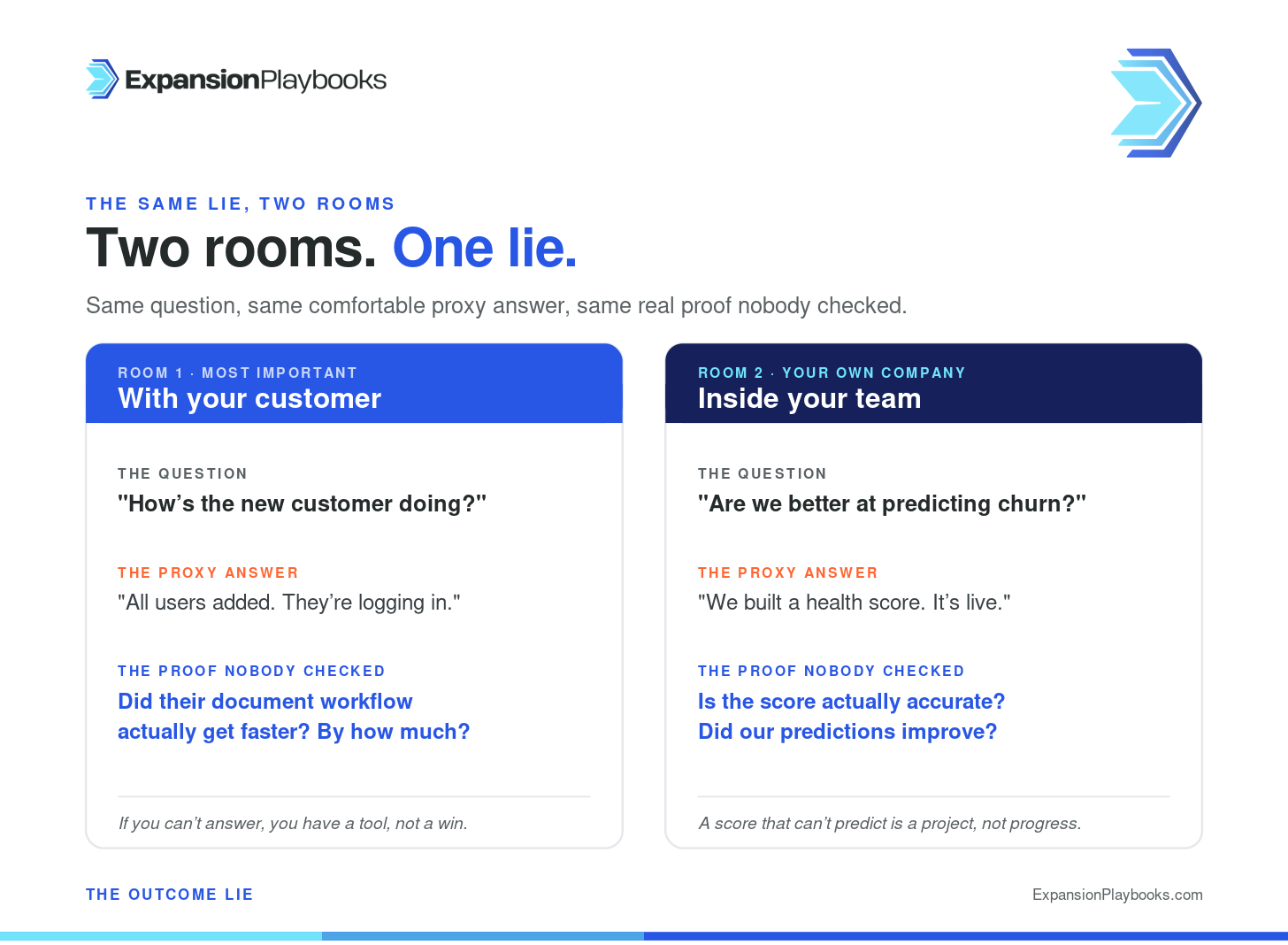
You know this scene. Your CEO or your CRO pulls you aside. "How's that big customer we just signed? They've been live a couple weeks now. How's everything going?"
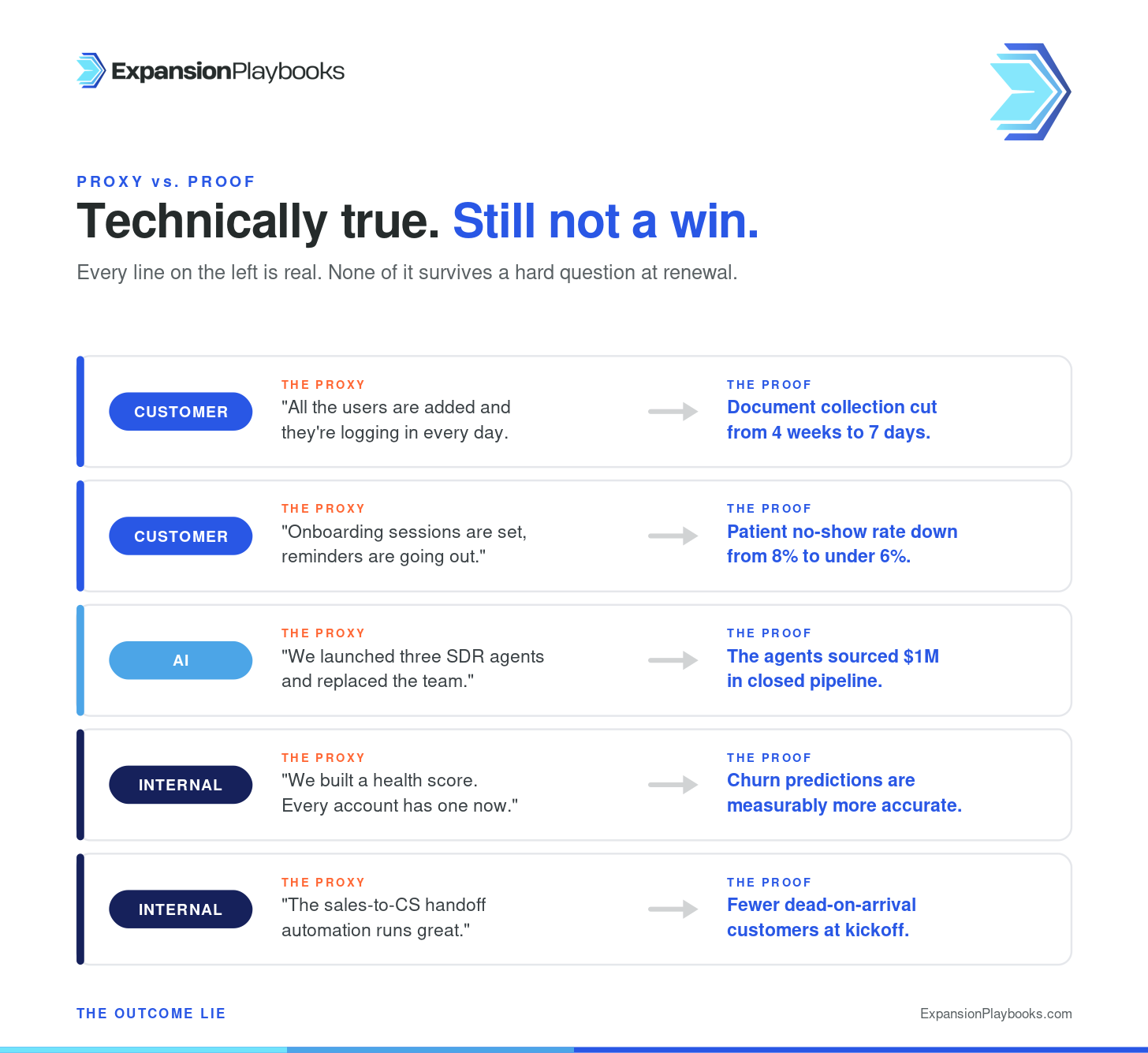
And you say, "Really well. We got all the users added, and they're logging in pretty consistently."
In the moment, that sounds like a great answer. It sounds like you responded appropriately. If you heard a teammate give that answer, you'd probably accept it yourself. Yeah, sounds like things are going well, they're logging in, that's good.
But logging in is a proxy. Users added is a proxy. These are substitutes for the outcome, and even among proxies there are wildly varying degrees of how close they actually sit to the customer progressing toward their result.
A few weeks ago I wrote about the three tiers of customer goals (you can find Shape the Goal here). Tier 1 goals are the true business outcomes: make money, save money, prove compliance, do things faster, reduce risk. The mistake everyone makes is treating a basic output as if it were a Tier 1 outcome. And the temptation to do that is enormous, because the outputs are so easy to hit. People are logging in. All the users are added. The data migrated. Things are moving.
The hard version sounds completely different. "Your three core document management workflows used to take four weeks on average to collect new-employee documents. You're now down to seven days." Or, "Your patient no-show rate was 8% last month, and this month it's already trending below 6%."
That's the difference between a proxy and proof. One of those is a reason for the customer to keep paying you. It's a reason to go after the next hill, to push for the next improvement, to expand into the other things you offer. The other one is a line item in a status update that nobody remembers at renewal.
And the customer is in on it too. When you hand them a proxy, they're tempted to accept it, because they know how hard the real thing is. It's easier for everyone in the moment. "Glad we got all those sessions scheduled. Glad the reminders are going out. Great." Everybody feels productive. Nobody is lying.
But eventually the time runs out. The payment comes due. The renewal conversation arrives, and now you have to prove you actually made a difference. And here's the problem with the Outcome Lie: you cannot manufacture that proof in the moment.
There are two reasons. The first is that real improvement takes real effort, and if you weren't actively working toward that specific outcome the whole time, odds are you didn't move it. You can't intervene on a number you were never watching. The second is more painful. Let's say you actually did make a difference, but you never tracked it, never operated to it, never said it out loud along the way. So at renewal you try to make the case after the fact. "No, no, we made you way more productive. We probably contributed millions to your business." It sounds like exactly what it is. A retroactive argument. It doesn't land, because you're assembling the evidence the day you need it instead of building it the whole time. You can't cash a check you never wrote.
And that's the real cost of the Outcome Lie. If you can't show real progress on a real outcome, the customer is far more likely to leave, because nobody renews a proxy. When they go, they lose too. They still haven't solved the problem they hired you for, so now they have to go find another provider and start the entire search over again. And you lose a customer you already fought to win and had every chance to keep. The proxy felt safe in the moment, and it quietly cost both of you the thing you actually wanted.
The same lie, inside your own company.
Now turn the camera around, because the exact same thing happens to your own team. And internally it's even easier to get away with, because the person asking the question knows how hard the real work is, so they're relieved to accept the proxy too.
Say your leadership decides, "We need to get better at predicting which customers are at risk." Good goal. Three months later someone asks how it's going. "Well, we built a health score. It's been implemented. Every customer has a score now."
Okay. Are we actually better at predicting risk?
"It's not super accurate yet. But we have a score."
That's the Outcome Lie in its purest form. The score is the implementation. Predicting risk is the outcome. Having a score on every account tells you nothing about whether you can see churn coming, which was the entire point. You built the dashboard and declared victory on the disease.
Or take the one every company has fought: the sales-to-CS handoff. "How are we doing on fixing that handoff?" "Great, actually. We used to send notes back and forth, and now the automation runs clean every time." "Awesome, keep it up." And both sides walk away thinking, good, we solved that one.
But did you? The automation running is a proxy. The real measure of whether the handoff is fixed is the outcome it was supposed to produce. So ask the diagnostic questions. Do we still have dead-on-arrival customers showing up to kickoff? Are we still drowning in change orders and revisions during onboarding because the customer thought they bought something different from what they actually bought? Are we still dragging the sales rep back in to re-sell a customer because there was never an aligned solution in the first place? Those are the proof points. The automation is just the tool you hoped would move them.
The outcome doesn't have to be enormous. It has to be real.
Now, I'm not saying the proof has to be staggering. You don't have to generate ten million dollars to escape the Outcome Lie. That's its own kind of mistake, where the bar gets set so high that everyone gives up and retreats to the comfortable proxy.
You just need the right metric. One metric you've actually chosen to represent the outcome, and the ability to show movement in the right direction. Eight percent to under six percent is plenty. Four weeks to seven days is plenty. A health score that predicts churn correctly seven times out of ten when it used to be a coin flip is plenty. A step in the right direction, measured and named while it's happening, beats a giant claim assembled retroactively every single time.
That's actually the good news buried inside all of this. The standard isn't perfection. The standard is whether you picked a real outcome, watched it, and can point to honest progress. Most people aren't failing that test because the bar is too high. They're failing it because they never set the bar at all.
The tool was never the achievement.
So here's the whole thing in one line. The tool was never the achievement, the proxy was never the proof, and the outcome is the entire game. The Outcome Lie is what happens when we grade the easy thing because the real thing is hard, and everyone in the room is quietly relieved to let us.
The work is refusing to do that. Being the adult in the room who, when everyone is celebrating that the agent launched or the score went live or the users are logging in, asks the uncomfortable question. Great. Did the outcome move? And if not, then what we have isn't a win. We have a tool that hasn't earned its keep yet.
One thing to try this week.
Pick the one initiative you're most proud of right now. It can be a customer you'd brag about, or something you shipped inside your own company. Then answer three questions on a piece of paper.
- What was the actual outcome this was supposed to move? Not the thing you built. The result you promised. In business terms.
- What's the one metric that represents that outcome, and where did it start?
- Can you show a step in the right direction since you launched, with a real number?
If you can answer all three, you have proof, and you should be saying it out loud constantly. If you can only answer the first one, you've been living inside the Outcome Lie, and the good news is you found it before renewal did.
The invitation.
But I want to leave you with something bigger than an exercise. I want to leave you with a challenge. Commit to doing the hard thing. Rise above the temptation to settle for the proxy, because I know exactly how strong that temptation is. I've given in to it myself. It is always easier in the moment to point at the thing you built and call it good.
So pick one or two outcomes, inside your company or out with your customers, that you know in your gut you should be driving. And then don't stop. Don't stop until you can at least baseline it. Don't stop until you can measure it and start actually working against it. Don't stop until you have something real to show, even if it's just one honest step in the right direction.
And I promise you this. If you commit to operating to real outcomes instead of proxies, everything starts to change. You'll have more successful customers. You'll earn better retention and more expansion, because you're finally giving people a real reason to stay and to grow with you. And you'll grow too, in your impact, your responsibility, and your role. That's what's waiting on the other side of the hard thing. The proxy never gets you there. The outcome always does.
Which one are you most guilty of, the customer version or the internal version? Hit reply and tell me the proxy you've been quietly accepting as a win. I read every response, and the patterns are going to shape the next piece.