
Jeff Breunsbach, who's building customer success at Junction, posted this on LinkedIn earlier this week:
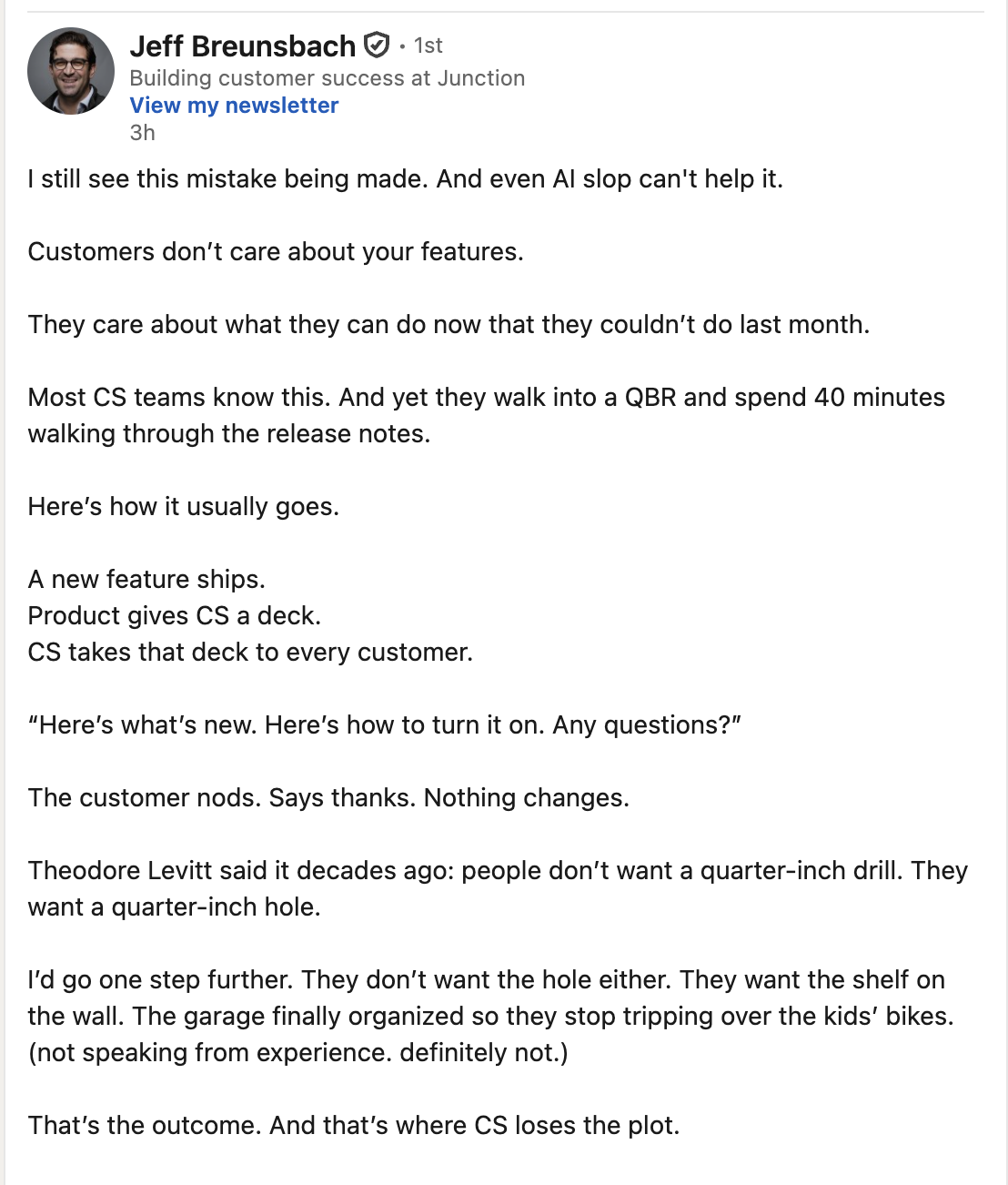
Most CS teams know this. And yet they walk into a QBR and spend 40 minutes walking through the release notes.
A new feature ships. Product gives CS a deck. CS takes that deck to every customer.
"Here's what's new. Here's how to turn it on. Any questions?"
The customer nods. Says thanks. Nothing changes.
Jeff closes by saying that connecting a feature to what the customer is trying to get done isn't a tooling problem. It's communication, it's positioning, it's knowing your customer well enough to say "this matters to you because..." And his line is, "That part is still on us."
I agree with all of it. But I'd push on one part. If the why depends on every CSM finding the right sentence on every call, you'll get it from your best CSM, and you'll get the release notes from everyone else.
It doesn't have to work that way. When you start with your customer's results and work back to your product, every single feature has a why built in before it ever reaches a customer. And the biggest payoff isn't a better release note. It's a value case for expansion that's built in before the customer ever hears about the feature.
That's a structural fix, and it's one your company can make. And if your company hasn't made it yet, you can still make it yourself, today, with the same steps.
The mistake everybody makes is adding the why after the feature ships
The mistake everybody makes is treating the why as something you attach once the feature exists. Product builds it, marketing writes the launch post, and CS gets the deck. And somewhere along that chain, somebody finally asks, "So why would a customer care about this?"
By then, the only thing everyone in the chain shares is the product. And so the deck is organized around the product, the training is organized around the deck, and the CSM walks into the QBR holding a good description of the drill and gets asked to improvise the shelf.
Jeff uses Theodore Levitt's line: people don't want a quarter-inch drill, they want a quarter-inch hole. Then he takes it one step further. They don't want the hole either. They want the shelf on the wall, and the garage they can finally walk through.
For a business customer, I'd take it one more step. The shelf matters because of what it does to the customer's economics. How does their business make money? Which part of that does this feature move? If you can't answer that, the customer can't either, and they won't pay to keep it.
The results throughline
Every feature should have a throughline to the customer's results.
It starts with how the customer's business makes money. One term in that equation is an outcome the customer is chasing. That outcome is proven by a metric. The metric moves when the customer's people take a specific action. And only then do you get to the product, which is whatever makes that action easier.
I call that the results throughline: the line from the customer's result all the way down to the feature that serves it, written down before the feature ever reaches a customer. If you can draw it, the why is already done, and any CSM on your team can say it. If you can't draw it, no amount of positioning on the call will save the feature.
You build it in that order, from the customer's economics down to your product. And you test it in the other direction. Start with any feature and walk it back up: which action does it make easier, which metric does that move, which outcome does that prove, and which term in the economics does that grow? If a feature can't make it all the way up, that tells you something.
Here's what it looks like for Solutionreach, one of my former clients, whose customers are dental practices. (I walked through their full Customer Results Map in an earlier article.)
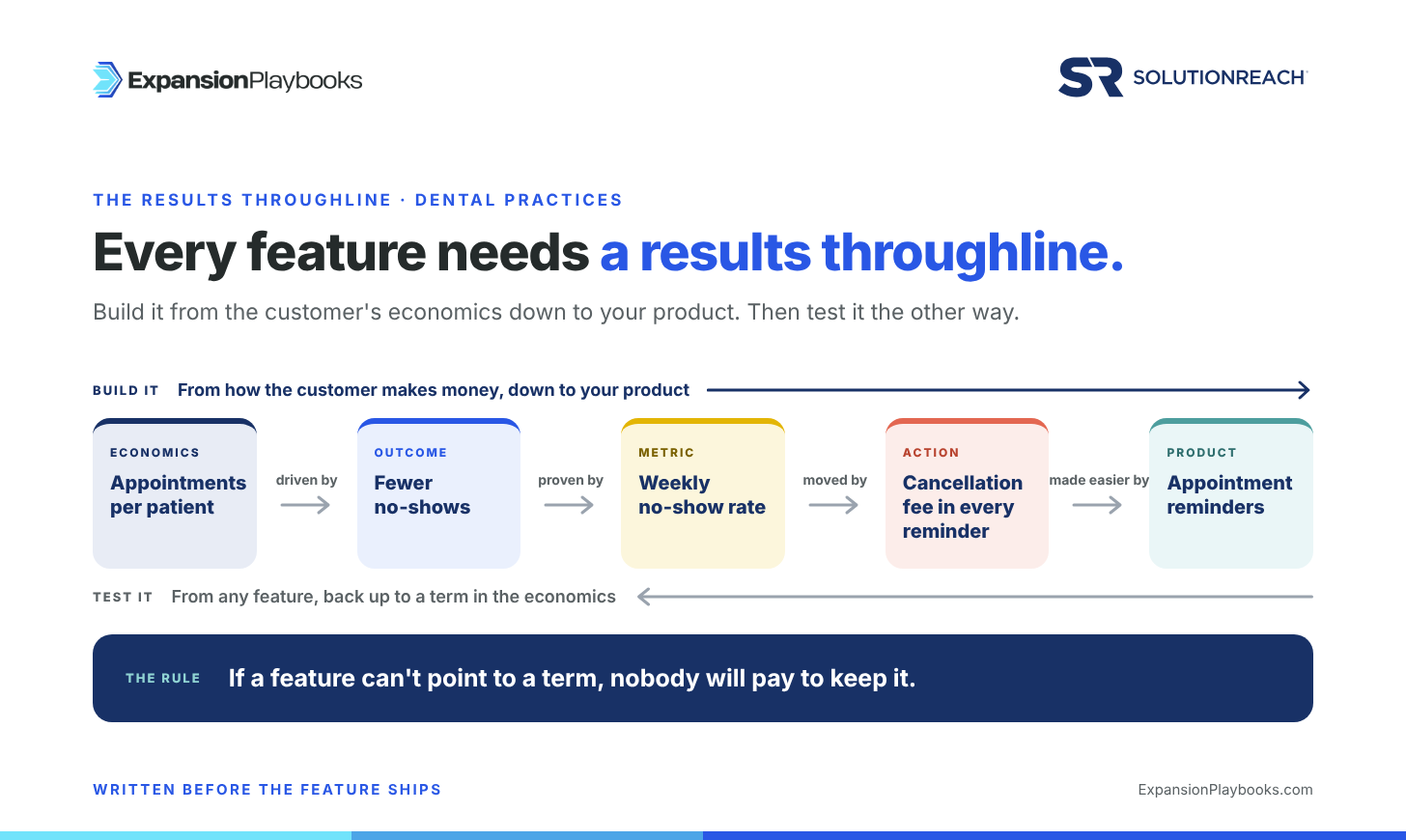
Start with the economics. A dental practice makes money from active patients, appointments per patient, and revenue per appointment. No-shows are the biggest leak in that revenue, because the staff and the chair cost the same whether the patient shows up or not. And so one of the outcomes every practice is chasing is fewer no-shows, proven by the weekly no-show rate. The action that moves that rate is putting the practice's cancellation policy and fee in front of every patient before every visit. And the product that makes that action easy is appointment reminders.
Now listen to the two ways a CSM can bring up reminders.
The feature version: "Reminders go out three weeks, three days, and three hours before each appointment. Here's how to set up the cadence."
The throughline version: "Every no-show is a chair you already paid for and didn't fill. The best way to cut no-shows is to put your cancellation fee in every reminder. Let's set that up today, and then let's look at your no-show rate in two weeks."
It's the same feature, but only one of those conversations changes what the practice does. The other one gets a nod.
When I walk through SalesRabbit's economics in my keynote, I put it this way: every product SalesRabbit sells should move one term of the customer's equation. If a feature can't point to a term, nobody will pay to keep it.
Why this is a structural fix
The results throughline comes from the Customer Results Map, not from a clever CSM on a good day.
You start with how the customer makes money, whether or not your product exists. Then the outcomes they bought for, and how each one is measured. Then the actions their people take to get there, inside your product and outside it. And only then do you map the products that make those actions easier. Outcome, metric, action, product.
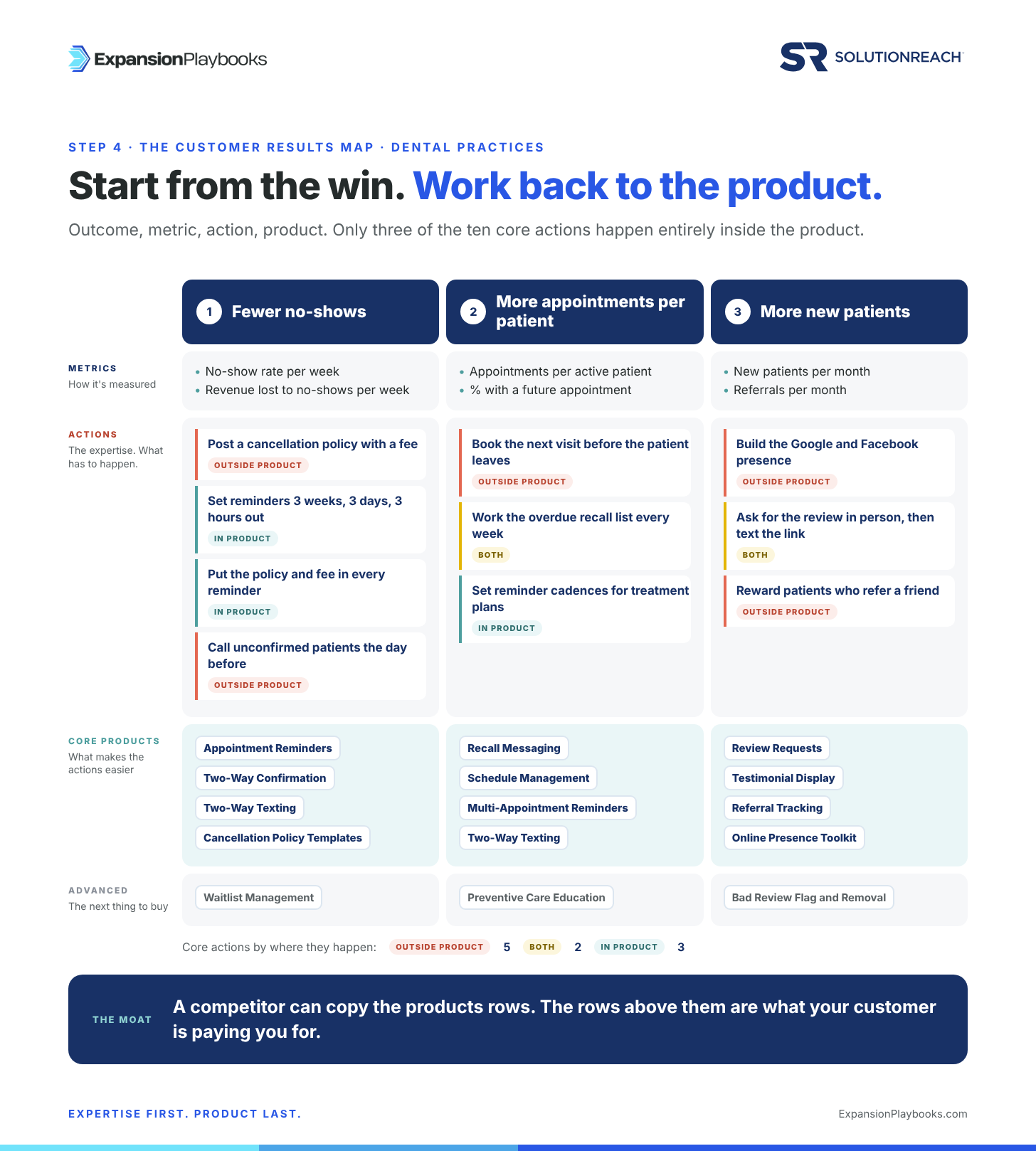
Once a company builds that map, every product on it already has its throughline. And three things change.
1. Product stops building features with no throughline
Solutionreach once spent months of time and money building an internal staff-chat feature. It was a genuinely cool piece of technology, with no line back to making dentists more money or filling more chairs. It wouldn't sell. They ended up giving it away for free.
Think about the deck CS would have gotten for that feature. It could only describe the drill, because there was no shelf. No CSM, however good, could have found the "this matters to you because..." sentence, because it didn't exist.
A Results Map would have caught that before any of that time and money was spent. When the outcomes and actions are written down first, the first question about any new feature becomes, "Which action does this make easier, and which metric will it move?" If nobody can answer it, the feature waits.
2. The release note writes itself
When a feature is built from the map, the release note is the throughline. Which outcome it serves. Which metric it moves. Which action it makes easier. And which customers it's for right now.
Let's say Solutionreach ships a waitlist that texts patients the moment a slot opens. Here's the release the way it usually reaches a customer, next to the release written from the map.
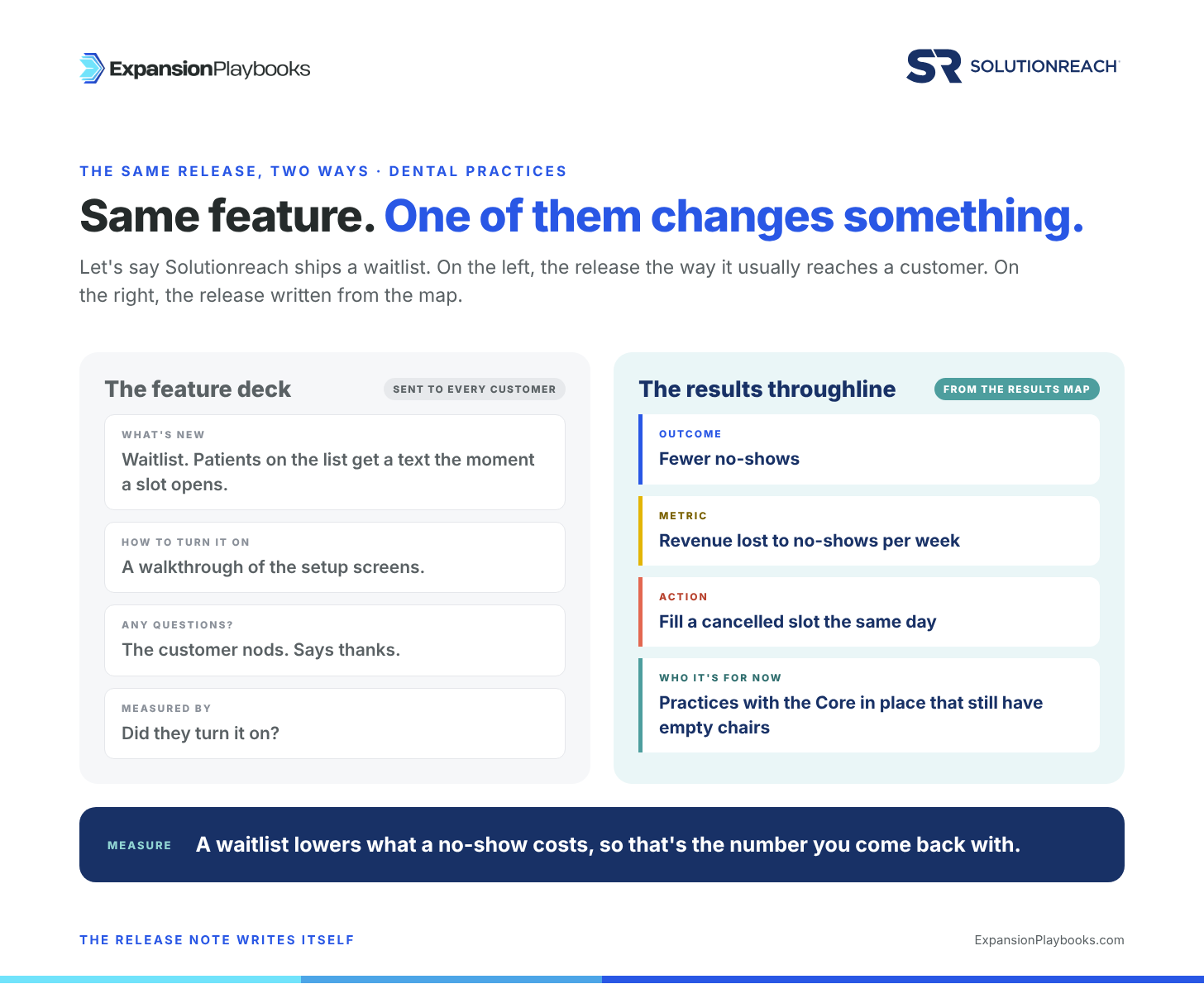
Notice what the throughline gets honest about. A waitlist doesn't lower the no-show rate. It lowers what a no-show costs, because the chair gets filled anyway. That's a different metric (revenue lost to no-shows each week), and it's the one to measure. Jeff's fourth tip was "measure the outcome, not the adoption." With the map, you don't have to work out which number. It's already written down.
3. You know who to tell, and when
Every product on the map sits somewhere in the customer's progression toward an outcome. Core products are foundational. They come first, and they're enough to get the first result. Advanced products build on the Core, and they only work once the Core is in place.
On Solutionreach's map, the waitlist is Advanced for fewer no-shows. Reminders, confirmations, and the cancellation policy are Core.
And so a practice that hasn't posted its cancellation policy, and isn't calling tomorrow's unconfirmed patients, shouldn't hear about the waitlist first. It would paper over a leak they haven't plugged, and when the no-show rate doesn't move, it'll look like the product failed. A practice that has the Core in place and still has empty chairs is exactly who the waitlist is for. For that practice, it's the next move.
That's what turns Jeff's "skip the features that don't connect to anything" from a judgment call into a filter. You're not guessing which customers care. The map tells you, and that's what sets up the biggest payoff of all.
The real payoff is a built-in value case for expansion
Make no mistake about what this is for. Explaining a new feature better is a benefit, and so is teaching the customer how to use it. But the main benefit of the results throughline is that every feature on your map comes with a built-in value case for expansion.
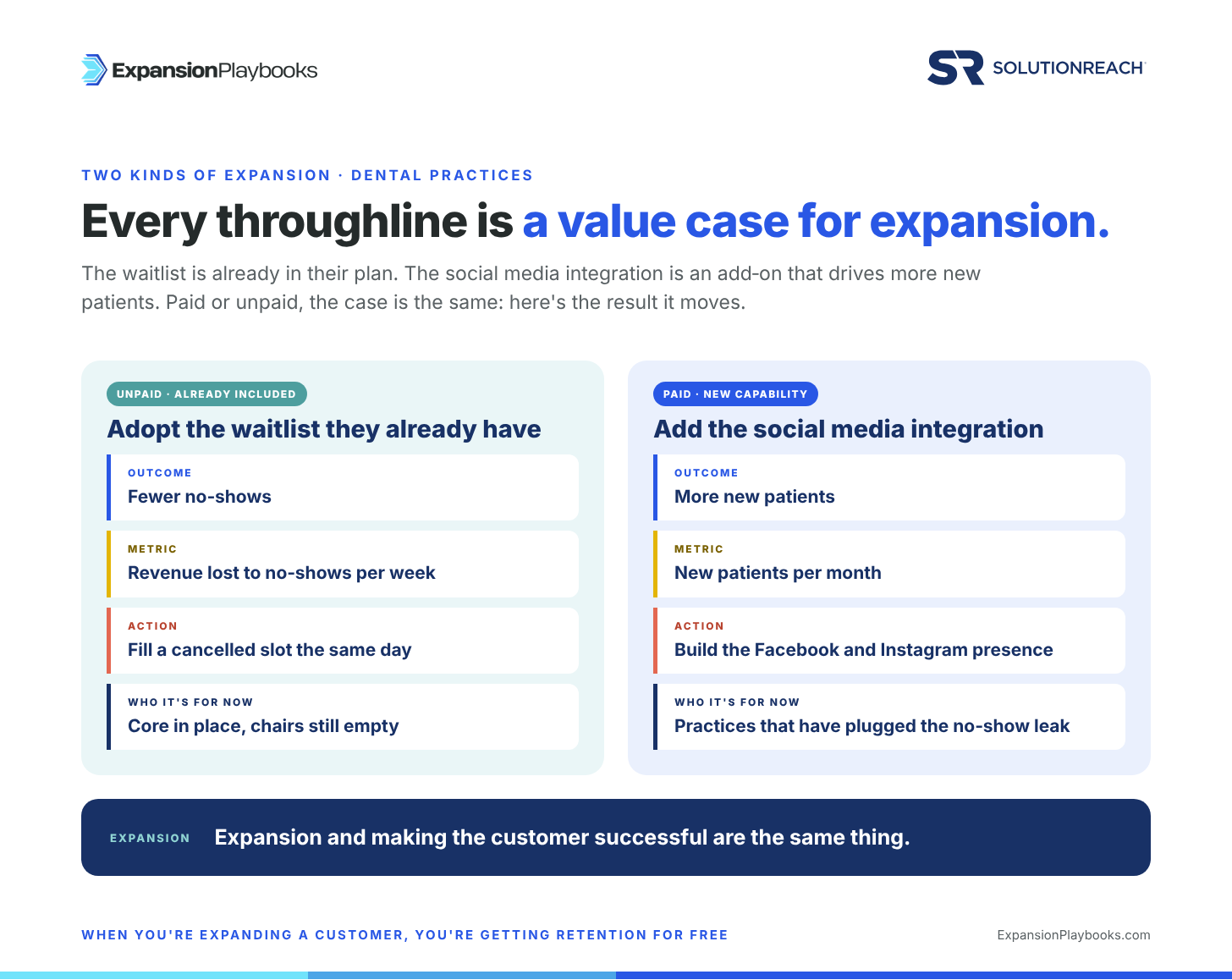
When I say expansion, I mean both kinds. Paid expansion is the customer adding a capability they don't have yet. Unpaid expansion is the customer adopting something that's already included in what they bought. When we help a customer take advantage of something they already own, we're expanding the value they receive, and that counts. The throughline makes the case for both.
Stay with the same dental practice.
Let's say the waitlist is already included in their plan. Nobody is buying anything. But a practice that starts filling cancelled slots the same day gets more out of the same subscription, and you can show them exactly which number moves: revenue lost to no-shows each week. That's unpaid expansion.
Now take the social media integration, an add-on that helps drive more new patients to the practice. Its throughline starts with active patients, the first term in the practice's economics. The outcome is the one every owner wants, more new patients, proven by new patients per month. The action that moves it is building the practice's presence on Facebook and Instagram, and the integration makes that action easier. That's paid expansion. And because more new patients comes after the no-show leak is plugged on the map, you already know which practices are ready for that conversation.
That's what we're actually trying to do every time something new ships. We're trying to help the customer do more, change how they work, and take advantage of the new value we can offer, so their business hits the goals it's going after.
And so the real difference isn't that your team gets better at presenting release notes. Your team is properly oriented to what your customers are trying to accomplish and what success looks like in their business. From there, you can help them expand that value right away, whether the next step is a feature they already have or a new capability worth adding.
Expansion and making the customer successful are the same thing. Customers renew because of what you're going to do for them next, not what you've done. And when you're expanding a customer, you're getting retention for free.
You don't have to wait for your company
Here's the part I care about most. The best fix is structural. Product, marketing, and CS all build from the same map, and every feature arrives with its throughline.
But most companies aren't there yet. If you're a CSM or an individual contributor, that doesn't mean you're stuck with the deck. You have access to everything you need: your customers, your call recordings, your sales notes, and your product. The steps are the same. You just run them on your own book.
Where responsibility is abdicated, opportunity lies. If nobody at your company owns the throughline, you can.
Step 1: Map how your best customers win
Pick your most common customer segment. Write their economics in one line: revenue on the left, cost on the right, and every term that drives each side. Then write the three or four outcomes that matter most, and how each one is measured.
Don't start with a blank page. Start with your best customers. What did they actually change? Which numbers moved? Customers fail in diverse ways, but they succeed in homogeneous ways. It's the same few outcomes nearly every time.
Step 2: Draw the throughline for every feature you bring up
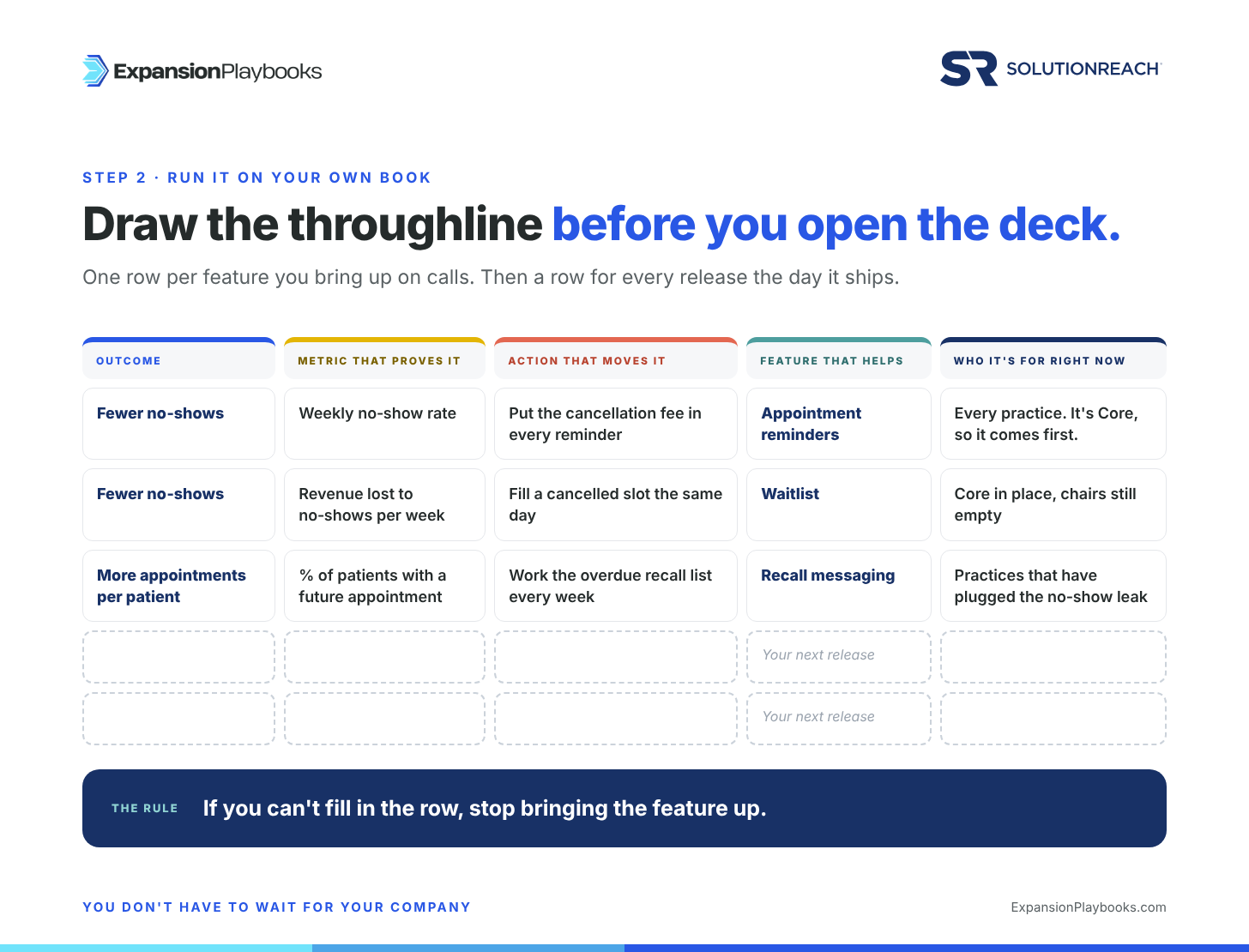
List the products you actually talk about on calls, and test each one against the map from Step 1. Walk it back up: which action does it make easier, which metric does that action move, and which outcome does that prove?
Where you can't draw the line, stop bringing that feature up. And when the next release ships, draw its throughline before you open the deck. Jeff's "this matters to you because..." sentence is just the throughline, said to a customer.
Step 3: Match each feature to where each customer is
For every account, ask three questions. Which outcome are they working on right now? Is the Core in place? And what's the number today?
Then bring a feature only to the customers it's next for. Open with their result, not your roadmap, and come back with the metric, not whether they turned it on.
That list of customers, and the next move for each one, is your expansion list. Some of it is paid and some of it is unpaid, and every item on it comes with its value case already written.
Do this for one segment, and you'll walk into your next QBR with something no release deck has ever given you: a reason this customer should care about this feature, this month.
"Can't AI just do this for me?"
Jeff made the point that AI will happily write a beautiful, polished email about the drill. He's right, and here's why. AI can only draw the throughline if you give it the map. Hand it the release deck, and it writes about the release deck. Hand it the map, and it'll draft the throughline for every feature in seconds.
AI cannot compensate for clarity you do not have about your customers. The map is the clarity. Once you have it, AI makes you faster at everything downstream of it.
The why was there before the feature
Jeff ended his post with, "Features are how you get there. The outcome is the whole point."
I'd add one thing. If you start with your customer's results and work back to your product, you never have to invent the why. Every feature already has one, and it was there before the feature shipped. And so every feature is also a ready-made case for helping your customer do more and win more, whether they already own it or they'd add it.
Want help doing this?
This is why I built Expansion Playbooks. It reads your own material (your website, your call transcripts, your decks) and drafts how your customers win: their economics, the outcomes that matter, the actions that drive them, and the results throughline to the products you sell. Then it makes you correct that model until it's yours, and turns it into the playbooks you run every week.
See the plans and sign up here, and start with your own customers.
Pick the last feature your company shipped. Can you draw its results throughline to something your customer cares about, in one sentence? Hit reply and send me the sentence. I read every reply.
Jeff