

When I first met Joe Brown, he was one of the best sales-first CEOs I had ever worked with. His team at DearDoc had the sales skills and the sales process to hit amazing new logo numbers, and they hit them. And so if you had asked him back then what the business ran on, he would have told you new sales.
But Joe wanted a fast-growing business, not just a fast-selling one, and at some point he realized that the fastest-growing businesses are built on what happens to the customer after the sale, not on the sale itself. So he jumped into the post-sales world with both feet, and what he came out with is one idea that now runs the entire company: it all comes down to customer results. The way DearDoc sells a new customer is about the results they'll get. The way they onboard is about getting to the first result fast. He has even put a guarantee into the sale, where they tell the customer, "we'll guarantee you get these results, and if you don't, you can opt out of the contract immediately."
That makes sense when you know where he came from. Joe's grandfather ran a medical practice, and when Joe bootstrapped DearDoc, he knew it had to make people like his grandfather successful.
Here's the business in plain terms. A dental or medical practice signs up with DearDoc to do three things: get more new patients in the door, get more and better reviews, and take work off the front desk, and every product they sell lives under one of those three.
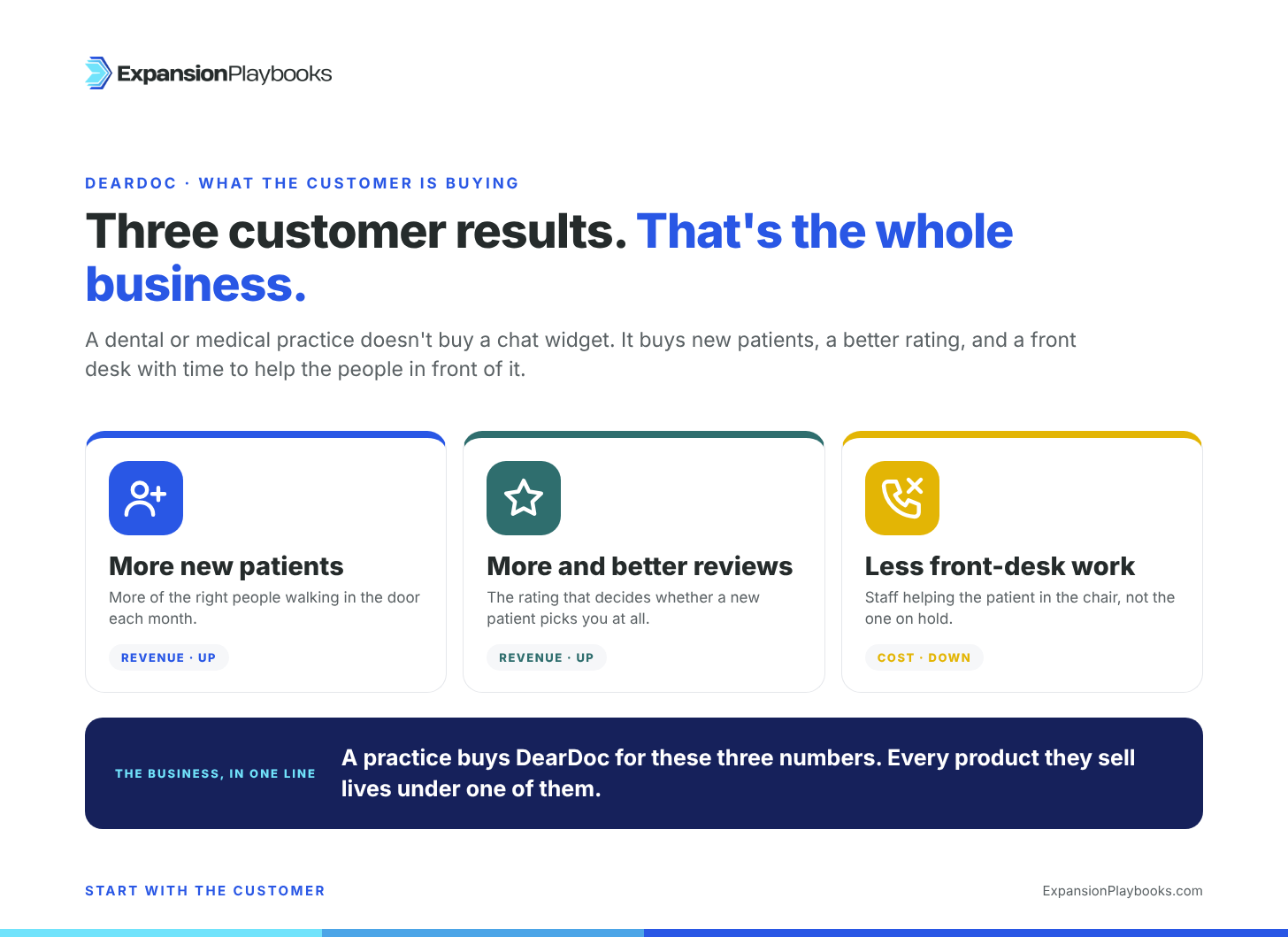
And every one of those three is a number the practice already cares about, because a practice makes money the same way every practice does. New patients, times appointments per patient, times revenue per appointment, minus what it costs to run the place. Two of those results push the revenue side up, and the third pulls the cost side down.
So a practice that buys DearDoc is buying new patients, not a chat widget, and that is how Joe sells it.
Today DearDoc's expansion revenue is 8 times what it was the year before, and that is what happens when one idea runs the whole company. Everything DearDoc sells gets pitched, and designed, to increase the customer's results.
What I mean by that is simple. If a practice is getting bad results, there is something they should be doing, or buying, that improves them. If they're getting good results and want better, there is something for that. If they're happy with the result they have but want a different one, say they're getting reviews now but they need new patients, there is something for that too. And if the practice is doing well but the front desk is spending its day calling patients instead of helping the ones in the chair, there is something for that as well.
And so expansion stopped being a quota somebody carried and became the answer to a question the practice was already asking: what should we do next?
That is my whole 101 lecture on expansion. Almost everybody gets it wrong, and they get it wrong in the same direction.
The mistake everybody makes is starting with themselves
Here's how expansion gets planned at most companies. We have a list of things we sell. We pull the list of customers who haven't bought them yet. And then we ask, what can I sell to this customer?
Done properly, expansion starts on the other side of the table. Where is the customer at? What should they do next that would drive more value for their business? And which of the things we offer is the answer to that?
Because the customer never bought for your product. They bought an outcome, they bought results, and that's just how the exchange occurs: you give them product, they give you money, but the outcome is the thing they're paying for.
So if they're not getting the outcome, ask what they are not doing that they should be doing, before you ever ask what else they could buy. Sometimes the answer is a behavior change on something they already own. Sometimes the answer is an additional solution, because they bought a result and what they've purchased so far isn't enough to produce it. Either way, you're selling the outcome, not the product.
When you understand that, you stop being hesitant about expansion. You're not nickel-and-diming anybody. You're saying, this is the result you told us you wanted, you're not getting it yet, and we have the tooling, the onboarding, and the expertise to get you there. That is what drives real expansion.
Every customer is either ready for the next expansion, or failing to be
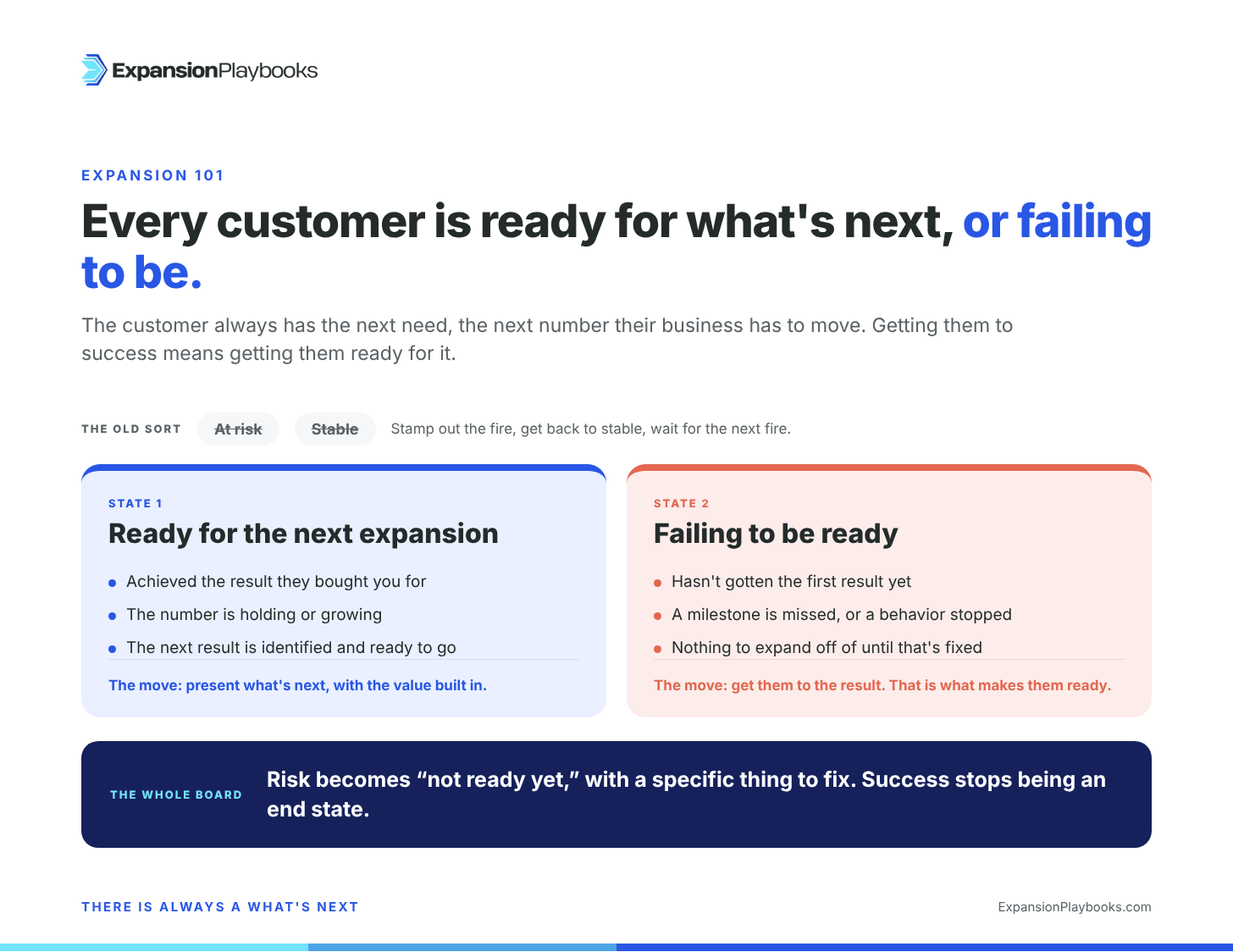
We sort customers into two buckets today: at risk, or stable.
I'd argue that's the wrong sort. Risk is a hamster wheel, because you stamp out the risk so you can get back to stable, and then you wait for the next fire. There's no forward motion in it.
The better frame is this. Every customer, at every moment, is either ready for the next expansion or failing to be ready for it.
A customer who is ready has achieved the result they bought you for, and the next result is already identified, validated against what they're trying to do, and ready to go. They bought for outcome A, and we know exactly where they go from here: either deeper into A with a solution that lifts that performance, or on to outcome B. A customer who is failing to be ready hasn't gotten the first result yet, and so the job is to get them there, because that is what makes them ready.
Notice what that does to risk. Risk doesn't disappear; it becomes "not ready yet," with a specific thing to go fix. And success stops being an end state. The customer always has more problems. They always have the next need, the next number their business has to move. Our job in getting a customer to success is getting them ready for what's next.
That frame only works if you can actually answer the what's-next question for every customer. Four things make that possible.
1. Map everything you sell to a customer result
Start with the customer's business, not your catalog.
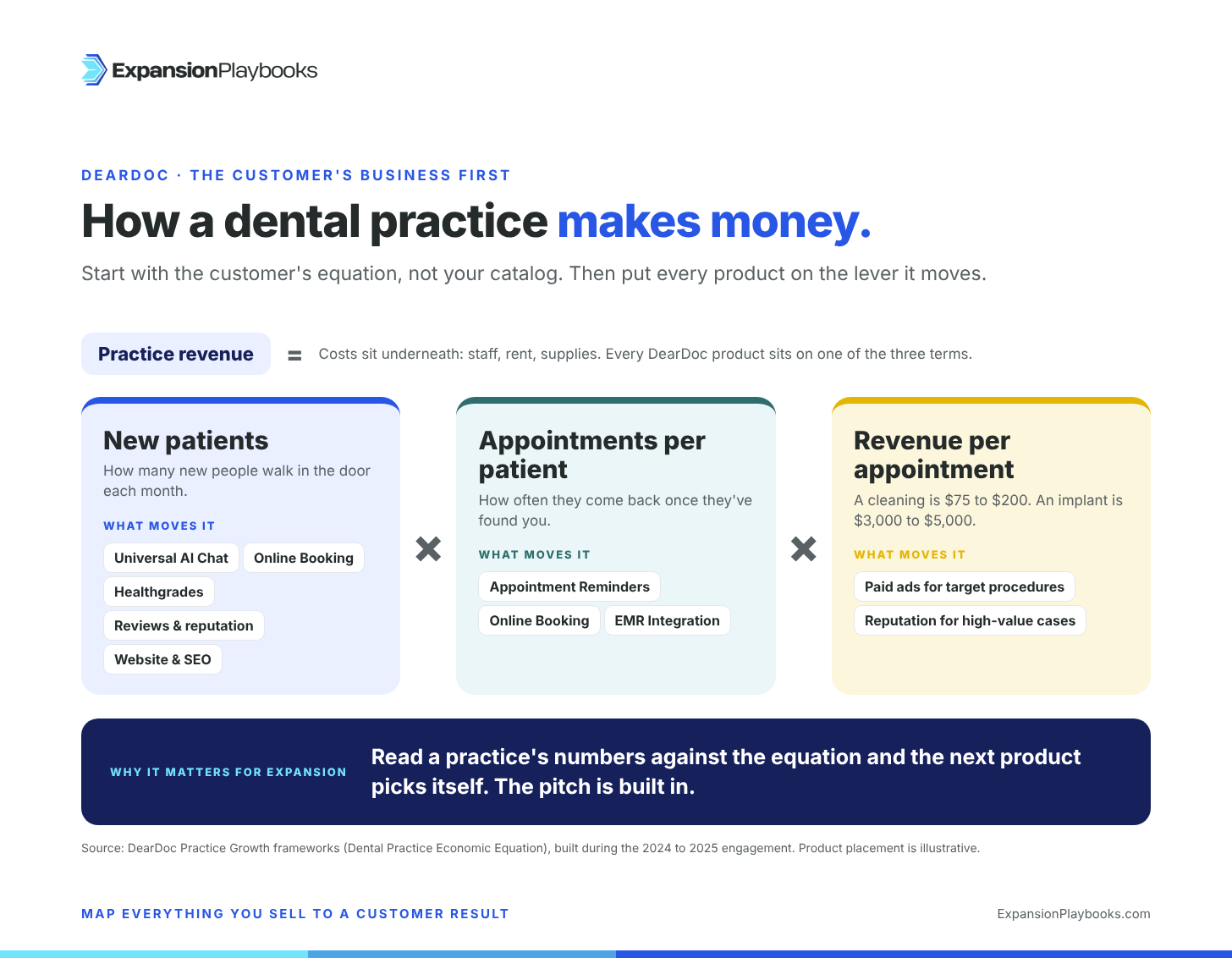
Go back to the practice equation: new patients, times appointments per patient, times revenue per appointment, with the cost of staff, rent and supplies underneath. Every product DearDoc sells sits on one of those levers, or on the cost under them. Universal AI Chat and online booking turn website traffic into new patients. Appointment reminders keep the appointments-per-patient number up. Reviews and reputation decide whether a new patient picks you at all. And paid ads aimed at target procedures, like implants, move revenue per appointment. Missed Call AI doesn't touch the top line at all; it takes the front desk off the phone, which is cost.
From there you build the Results Map. Three key results a practice is buying: more patient referrals, more and better reviews, less staff workload. Under each one, the metric that proves it, the core products that produce it, and the expansion products that take it further.
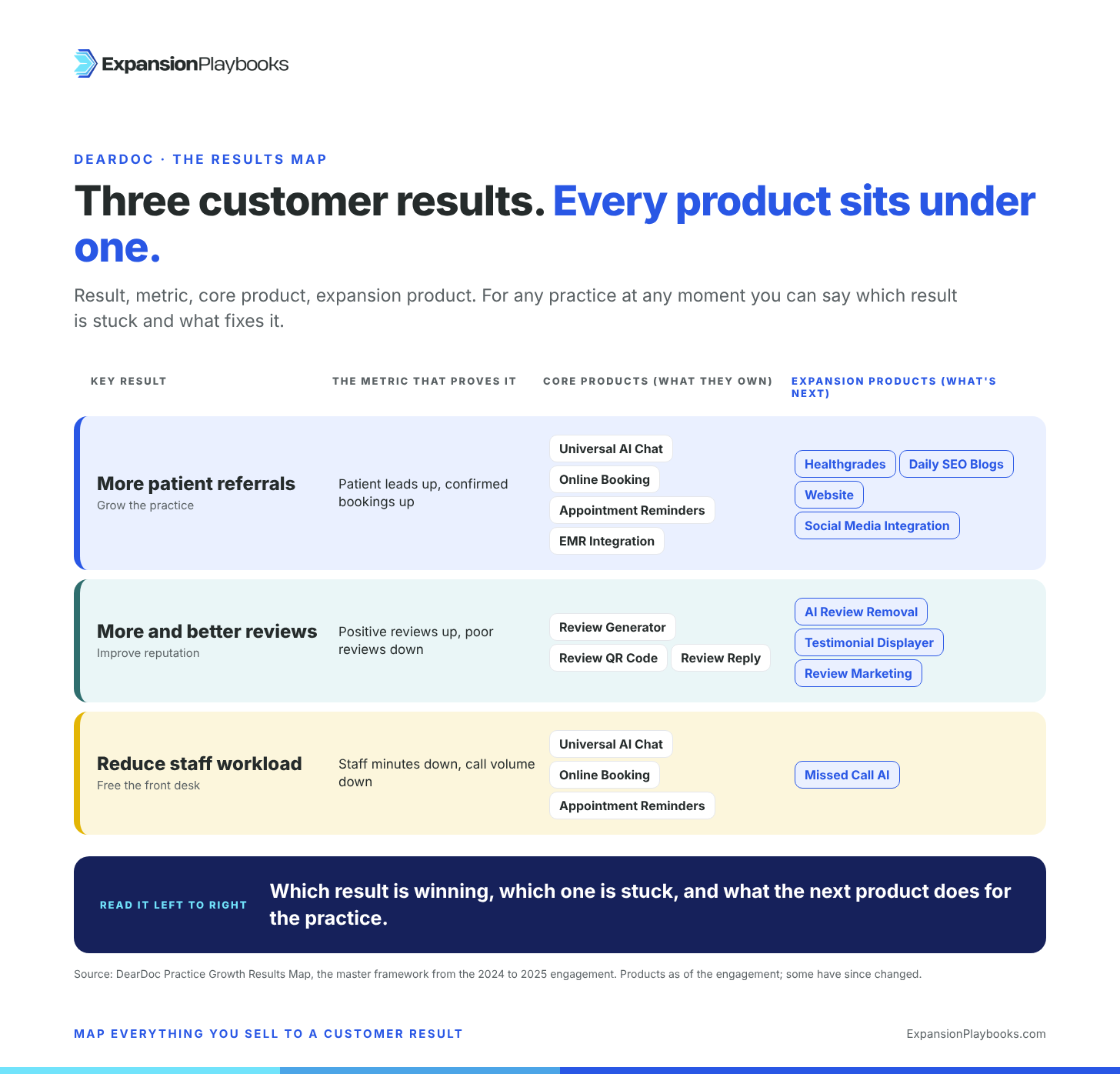
Look at what that map gives you. For any practice, at any moment, you can read their numbers against it and know which result is winning, which one is stuck, and what the next product does for them. The pitch is built in. You never have to ask a dentist, "would you like to see a demo of our review tool?" You get to say, "your new-patient number is up and your review count is flat. Here's what that's costing you, and here's what fixes it."
2. Expansion runs in two directions, and both start from the customer result
Once everything maps to a result, there are only two ways to expand a customer.
Vertical expansion is going deeper in the same result. The practice is getting more traffic because we listed them on Healthgrades. If they upgrade to a full custom website with us, they get even better traffic, which is the same result with a bigger number.
Horizontal expansion is moving to the next result. We're helping you get more traffic and more patients in the door. Now your star rating is holding you back, and so the next move is the review response tool that cuts down the bad reviews and lifts the five-star rating, which is a new result for the same practice.
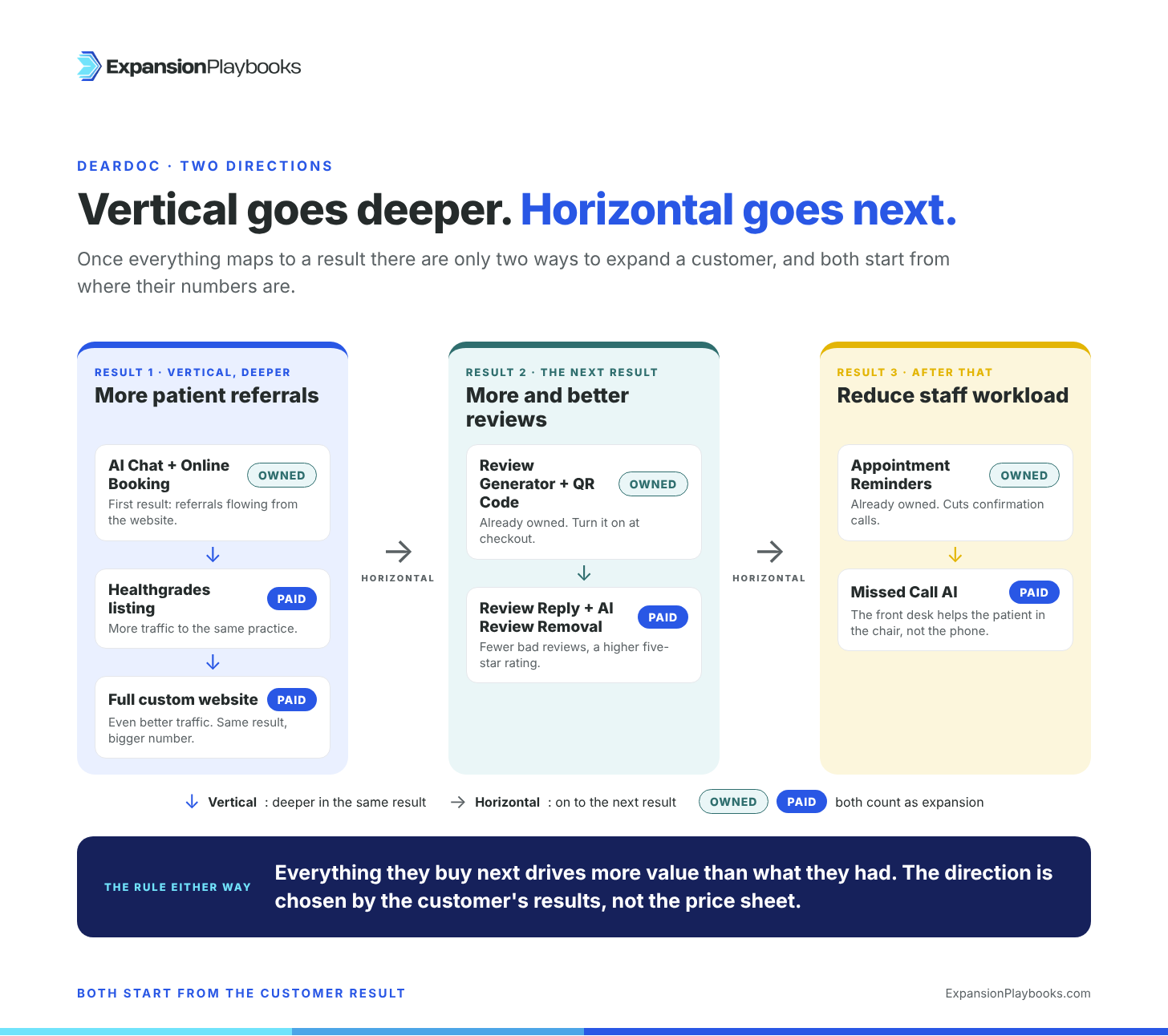
Either direction, the rule holds: everything they buy next drives more value than what they had. If you want the full breakdown of upsell versus cross-sell by use case, I wrote it up in Everyone Gets Expansion Backwards. Vertical or horizontal, the direction gets chosen by the customer's results, not by what's left on the price sheet.
3. Expansion does not happen at renewal
There's an unwritten rule in CS that expansion happens at renewal. We believe people magically have budget at renewal. That is just not the case.
Customers create budget when they understand a need. "This thing is going to give us a benefit, and we need it right now." They make the money available. When you treat expansion as something you do every twelve months, it always becomes an afterthought, because push comes to shove, you'll say, "let's at least get the renewal, then we'll focus on expansion." And when you do that you will never get the expansion.
You'll also struggle to get the renewal. Renewals are about what you're going to do for the customer, not what you did last year. They already paid you for last year. The renewal is about what we're going to do together next. Expansion pitched properly, aligned to the customer's results, builds that in. "We did great this year. Here's what we're going after next." Renewals are won at month two, not month eleven.
The data says the same thing. Kyle Poyar and ChartMogul looked at 10.5 million purchases across 4,029 software companies and tracked what customers did in the year after they bought. Seat upgrades peak in month one, then drop by more than half in month two. By month four, plan upgrades are about a fifth of what they were in month one. Customers are up to 10x more persuadable in their first 30 days than they are in months four through eleven. And 40% of first-year plan upgrades land in month twelve, at renewal, because that's the one moment the customer is forced to decide.
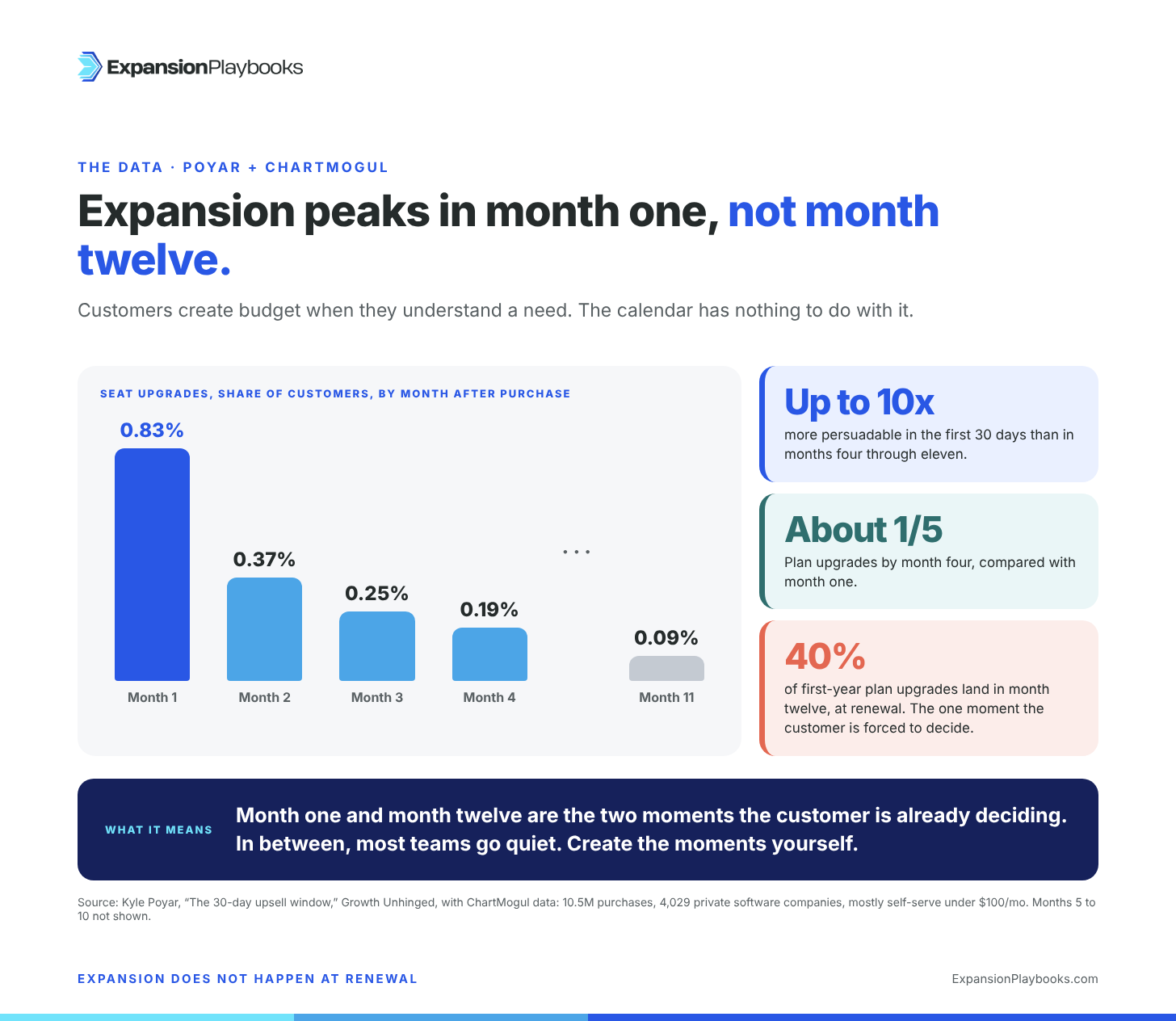
Some of that is consumer-style, self-serve data. I've found it true in my own experience with CS-led teams. Onboarding is the single best place to show a customer, "this is working, you're already seeing results, and you're actually in position for the next thing." They should have bought the additional feature, and now they can see why.
Joe took that further than anybody I've worked with. His onboarding team drives expansion, at a high rate. They get the practice to first value, and then they queue up the next thing right there in onboarding, while the practice is watching the first result land. Nobody waits for a renewal date to have that conversation.
Month one and month twelve are the two moments the customer is already making a buying decision. In between, most teams go quiet. The job is to create those moments yourself, every time a result lands.
4. Nobody owns it, so build the system that does
Here's the other reason everyone is bad at expansion. Nobody owns it.
Sales owns it for a while, then starves it, because new logo is always the path of least resistance. The CS team struggles to own it, because they think renewal first, expansion second, which makes it second fiddle forever. An expansion team can work, but then you fight the drift toward pushing product instead of making the customer successful.
I actually don't care who technically owns it. It's a responsibility, and whoever carries it, the way you do it is the same. You build expansion triggers, and you build expansion pathways.
An expansion pathway is the answer to a question most teams can't answer about their own product: if a customer comes to us with use case A versus B versus C, what is the sequence? What's the first outcome they should achieve? Once they've achieved it, what's the next thing they should buy that increases that outcome? And if they have that outcome but want the outcome from use case B, what's the next thing that gets them an added benefit they aren't getting today?
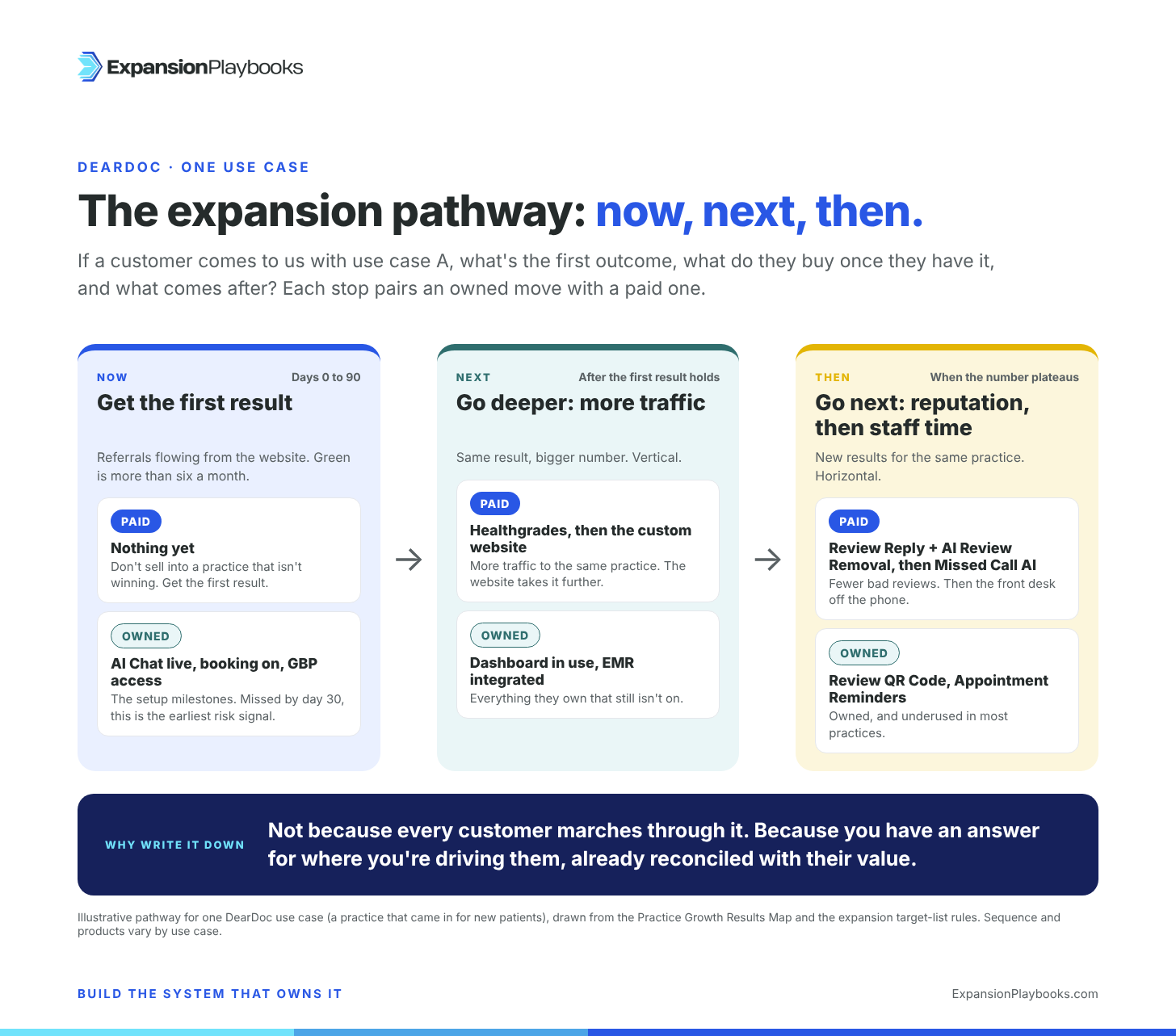
You map that out not because every customer has to rigidly go through it, but because you have to have an answer for where you're driving the customer, already reconciled with the customer's value. That's what makes you the expert. If they're underperforming, you know what to do to get the number up. If they've succeeded and are ready for the next challenge, you know which one to recommend.
An expansion trigger is the condition that fires the next move. For each result and its metric: what are the action milestones that have to be done, what does poor, good, and best look like on the number, and when they cross a line, what's the next offering? Each trigger carries a paired move, one they already own and one they'd buy, so there's always a way to keep the customer progressing even if the budget isn't there this quarter.
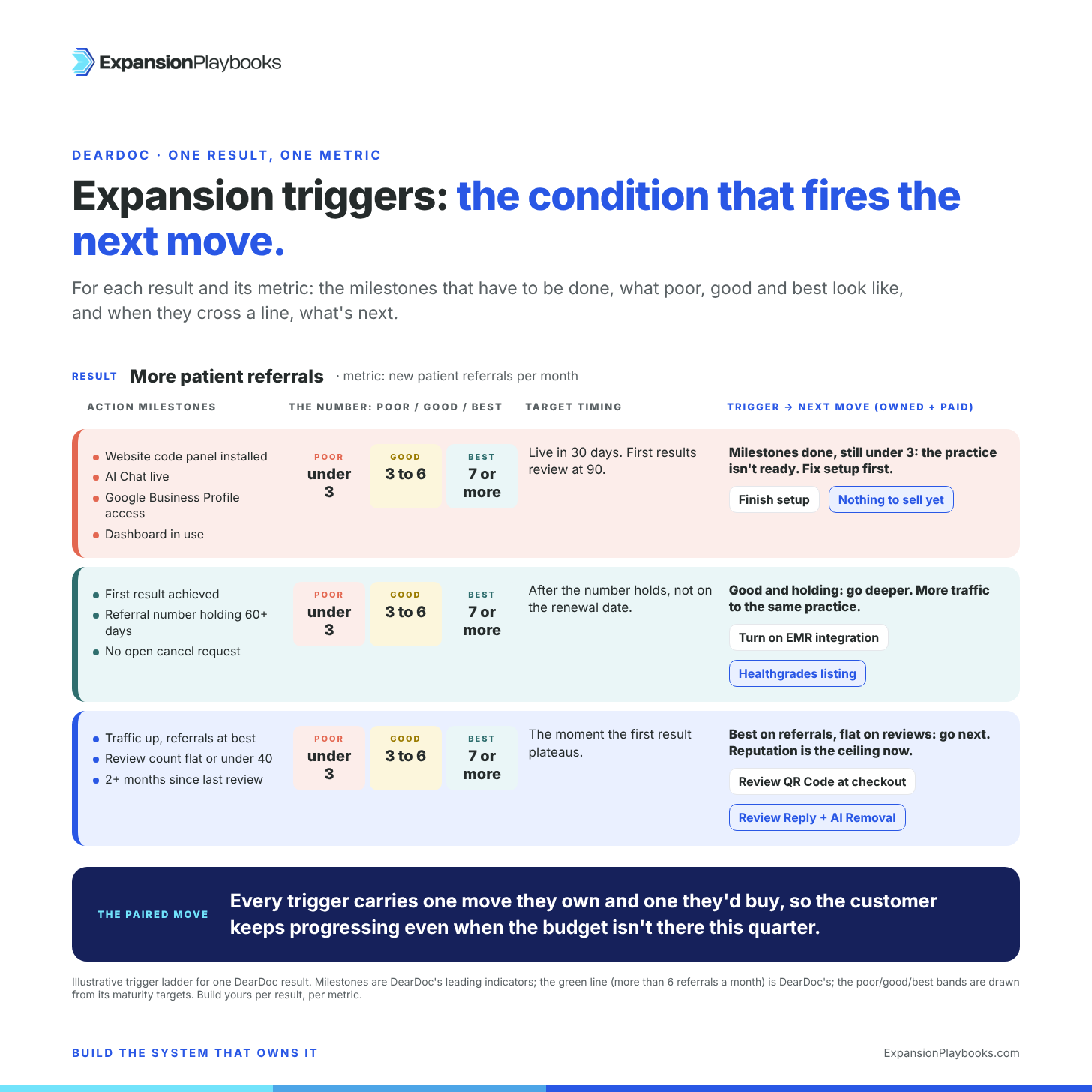
That's how the division of responsibility works, too. Whoever has the customer focuses on getting them to success at each stage of the pathway and cues up the next thing at the right time, with the justification already built in. The conversation stops being, "would you like to see a demo of this other feature?" It becomes, "you've hit this milestone, you're getting this value, and what we need to do next is go over here to get this additional value, because that's what takes your business to the next level. Let's talk about how we get that set up for you."
Look at how DearDoc staffed it. They don't have a traditional customer success manager role at all. When a practice finishes onboarding, a growth manager picks them up to make sure they're getting results and to queue the next thing. If a practice starts failing, a performance engineer goes in, fixes what's wrong, makes the key changes to get them back on the pathway to what's next, and hands them back to the growth manager to keep them moving.
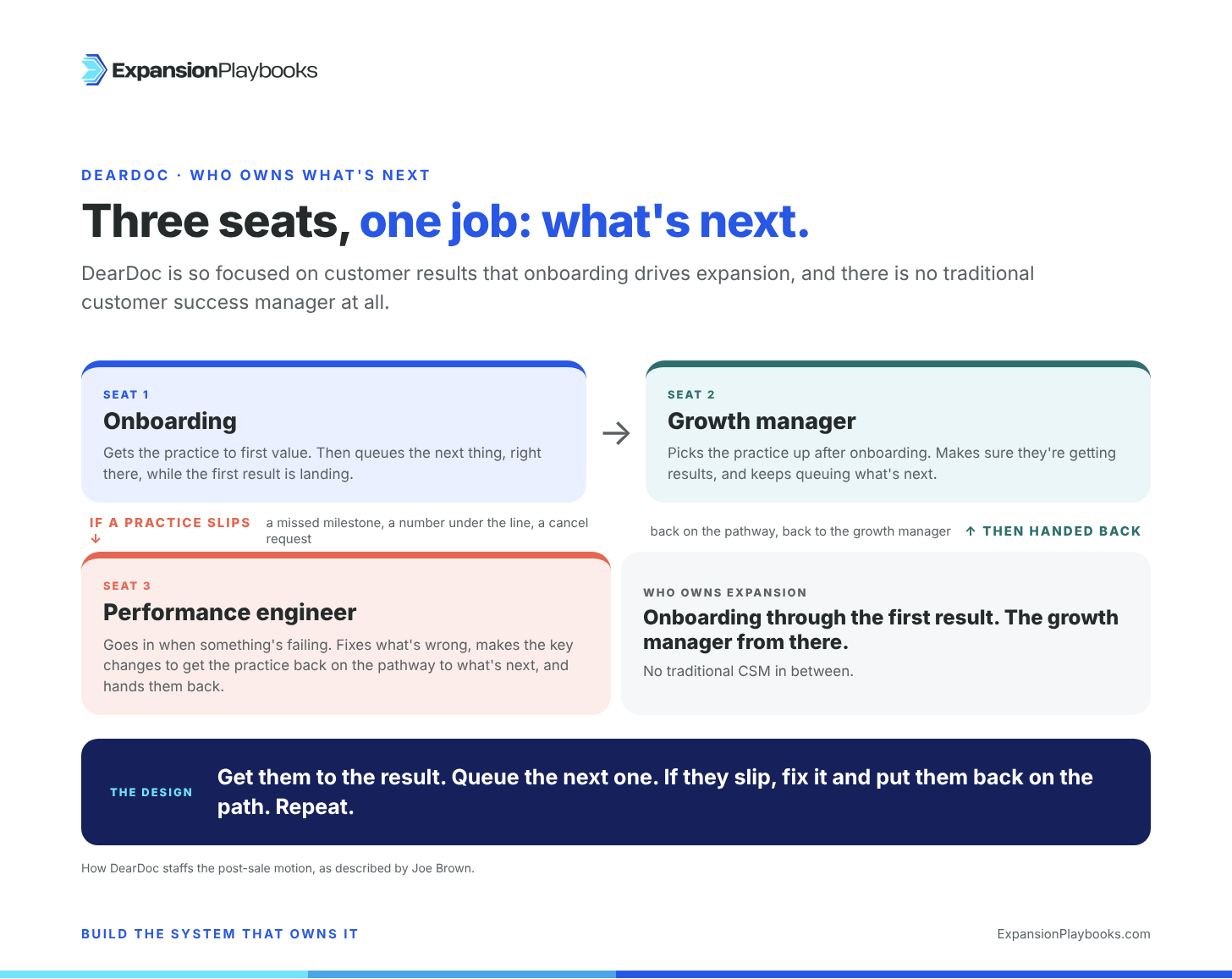
Notice who owns expansion in that picture. Onboarding owns it through the first result, the growth manager owns it from there, and there is no traditional CSM in between.
Measure the percent of customers who expanded, not the NRR headline
One more reason everyone thinks they're fine at expansion. We never break it out by customer.
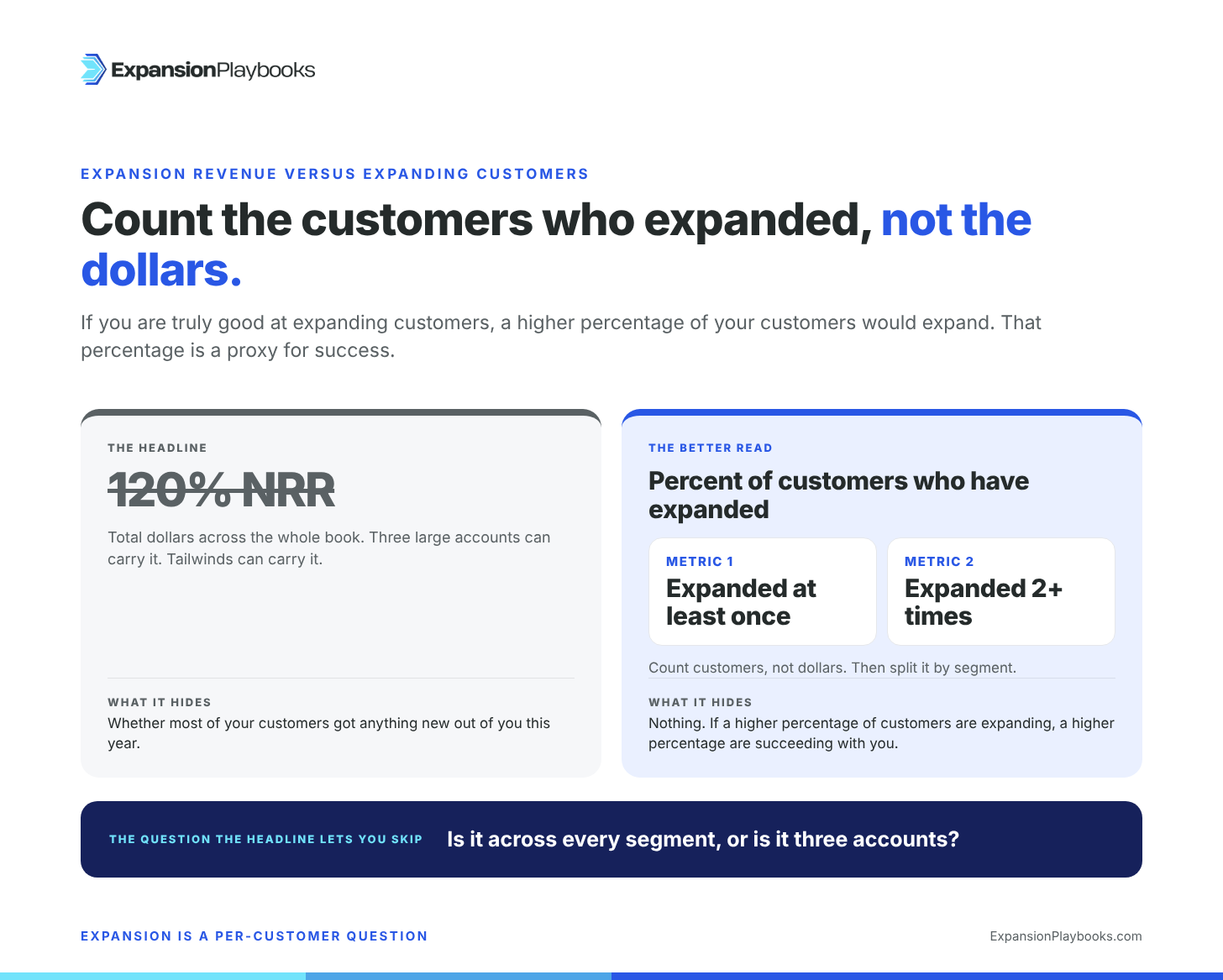
Either you're a company with amazing tailwinds, and NRR is happening in spite of your efforts, or you have a few customers making up all of your expansion. "We're at 120% NRR" tells you nothing about either.
Look at the percent of customers who have expanded instead, the percent who have expanded at least once and the percent who have expanded at least twice, because that's a proxy for whether the things you're building are helping customers keep growing the value they get. If a higher percentage of your customers are expanding, a higher percentage of your customers are succeeding with you.
Is it across every segment, or is it three accounts? That's the question the headline number lets you skip.
That's the number I'd want to see from DearDoc, and the design points straight at it. Onboarding is driving expansion from the first result, and the growth managers are driving it right after, and so a greater share of their practices expand, and not just once but multiple times, in their first year.
Expansion is how you keep the customer
One last thing on "just get the renewal." When you only go for the renewal, you're not being careful. You're being a protectionist, and protectionists lose what they have. We've analyzed over a million customer records, and customers with measurable results stay about six times longer than customers without them. A customer who stays can expand, and so retention and expansion start in the same place.
So the most important thing you can do for a customer's retention is get them ready for what's next, and then get them to act on it. Expansion and making the customer successful are the same thing, and when you're expanding a customer, you're getting retention for free.
Map one pathway this week
Pick your most common use case and write the pathway for it: the first result the customer should achieve, the next thing they should buy once they've achieved it and what it does to the number, and the next result after that. Then write the trigger for the first step: the milestones, the poor-good-best bands, and the paired move, one owned and one paid.
If you can do that for one use case, you have an answer for every customer in it. If you can't, that is where your expansion is actually stuck, and it has nothing to do with who owns the number.
If you want help with this, that's why I built Expansion Playbooks. It reads your own material (your website, your call transcripts, your decks) and drafts how your customers win. Then it makes you correct that model until it's yours, and turns it into the Expansion Pathway for your product: what's next for every customer, and the trigger that fires it.
We're opening it to a small group of founding members first. Click here to apply to be a founding member when it goes live. You're not buying anything today. You're applying for a spot.
I'd love to hear how this lands at your company. Hit reply and tell me who owns expansion today, and whether you could write the what's-next for your best customer right now. I read every reply.