
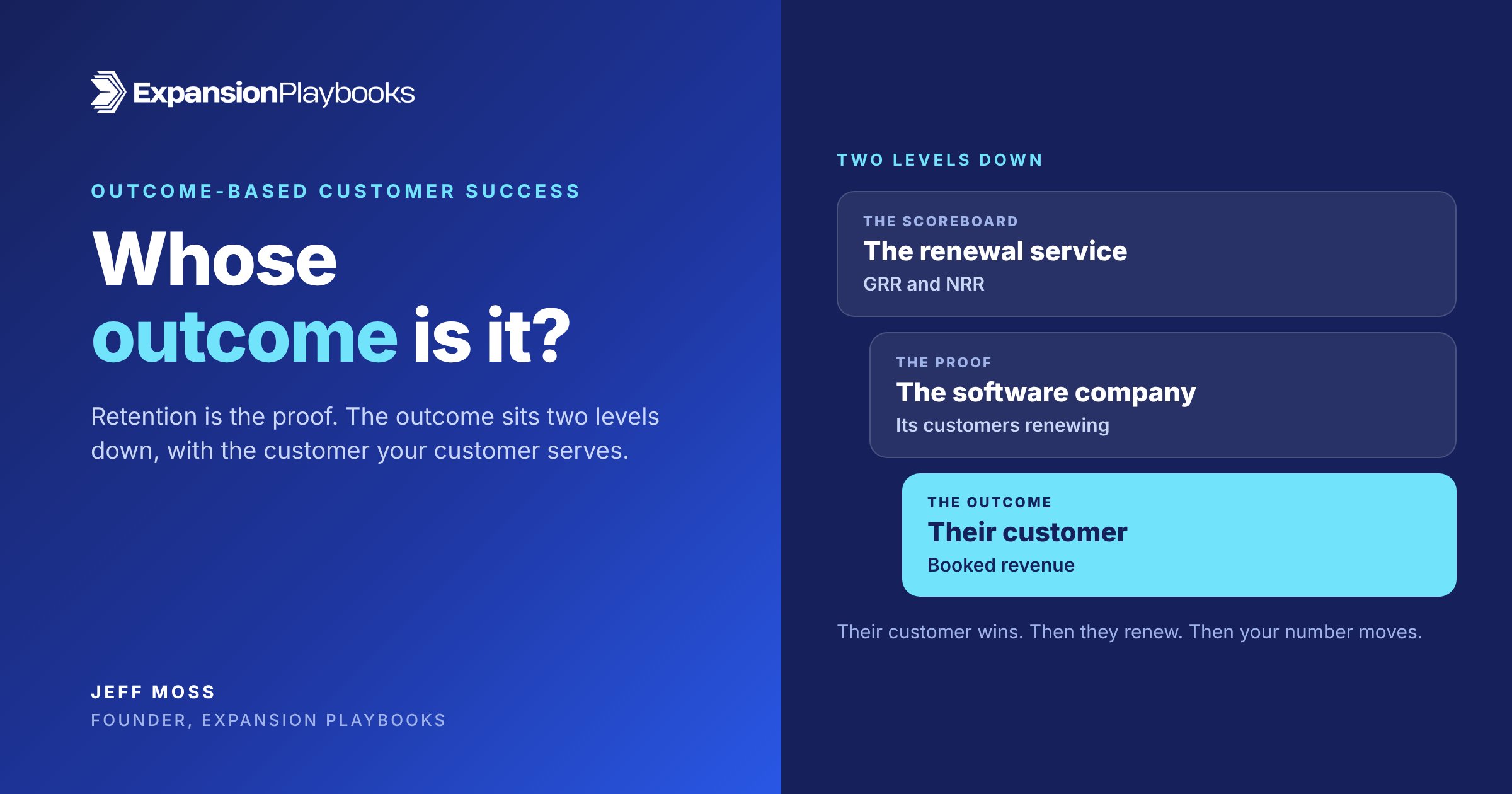
Gainsight published a piece last week that everybody in customer success should read.
Their CEO, Chuck Ganapathi, says software is moving from "shipping bits to delivering outcomes." For twenty years a vendor could ship the product, collect the subscription, and leave it to the customer to turn it into results, and so the revenue kept coming even when the value didn't. He says that era is ending. Gainsight is rebuilding itself around what comes next: pricing that moves from seats to value, one accountable owner for every customer's outcomes, and a new service called Atlas, where people and agents deliver retention for you, measured in gross and net revenue retention.
This is the company most responsible for making customer success a category, and it's saying the category has to change. I agree with more of it than I disagree with.
But I read it three times looking for the answer to one question, and I never found it. What is the outcome? And whose outcome? Yours, your customer's, or the customer your customer serves?
What Gainsight gets right
Start with the honest part, because it's the best part.
We've gone through a period in SaaS where you could focus on capturing market share and never deal with real feedback. You could cover up your sins by going up market. But eventually your churn catches up to you. Gainsight is saying that plainly about the industry it helped build, and about itself.
They say value a customer never realizes turns into revenue the vendor never earns. Yes. They want one owner accountable for the customer's outcomes instead of a chain of handoffs from sales to services to renewals. Yes, because every handoff loses information and diffuses responsibility. And they admit they don't have every answer yet, so they're going to run the change on themselves first and share what works and what doesn't. I respect that a lot.
So the direction is right. Here's where it stops short.
The mistake everybody makes
The mistake everybody makes is calling retention the outcome.
Read the piece again and look for an outcome with a name. You'll find two: GRR and NRR. Those are real numbers and they matter. But they're your numbers. No customer has ever renewed because your retention rate needed them to.
There's no such thing as retention. Even a renewal is the customer buying next year's value.
I've analyzed over a million customer records. The most highly correlated factor for retention is, did the customer get a measurable outcome. When a customer gets a positive result, retention goes up two times. A good result, six times.
And so retention is what shows up after the outcome. If you treat it as the goal, you can hit it for a year with discounts, multi-year contracts, and a well-timed save. And it's not a true save unless they stay the next cycle.
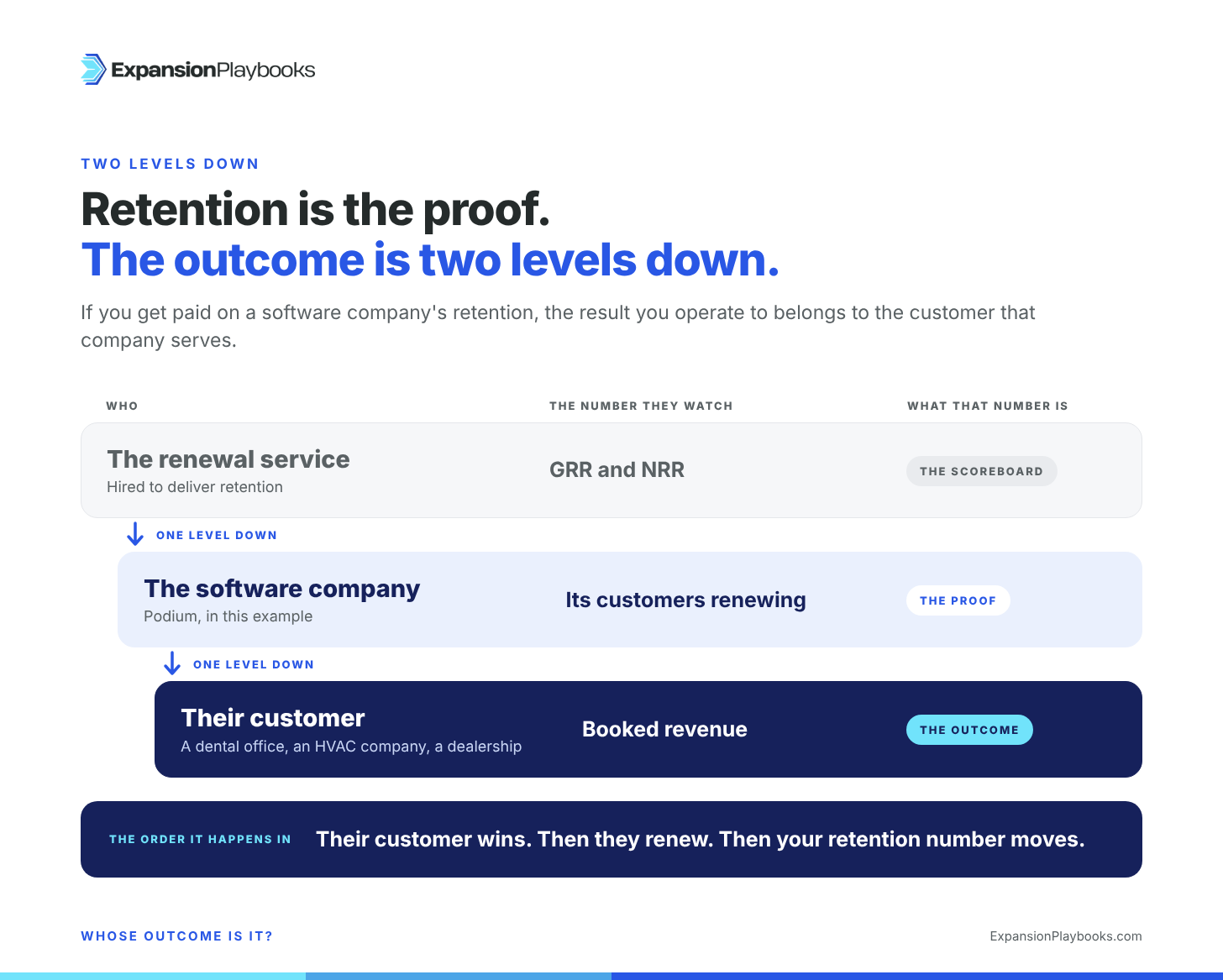
Now think about what that means for a renewal service. Let's say a software company hires you to run its renewals, and you get paid when its GRR goes up. What moves that company's GRR? Its customers getting a result. And so the outcome you have to operate to sits two levels down, with the customer your customer serves.
Two levels down: the result your customer's customer gets paid for. Their renewal, and then your retention number, is the proof that it happened.
It's easy to nod at that. So let's do it with a real company.
Start with how their customer makes money
Take Podium as an example. They make messaging and AI software for local businesses: the dental office, the HVAC company, the car dealership. And let's say Podium hired a service to deliver retention as the outcome.
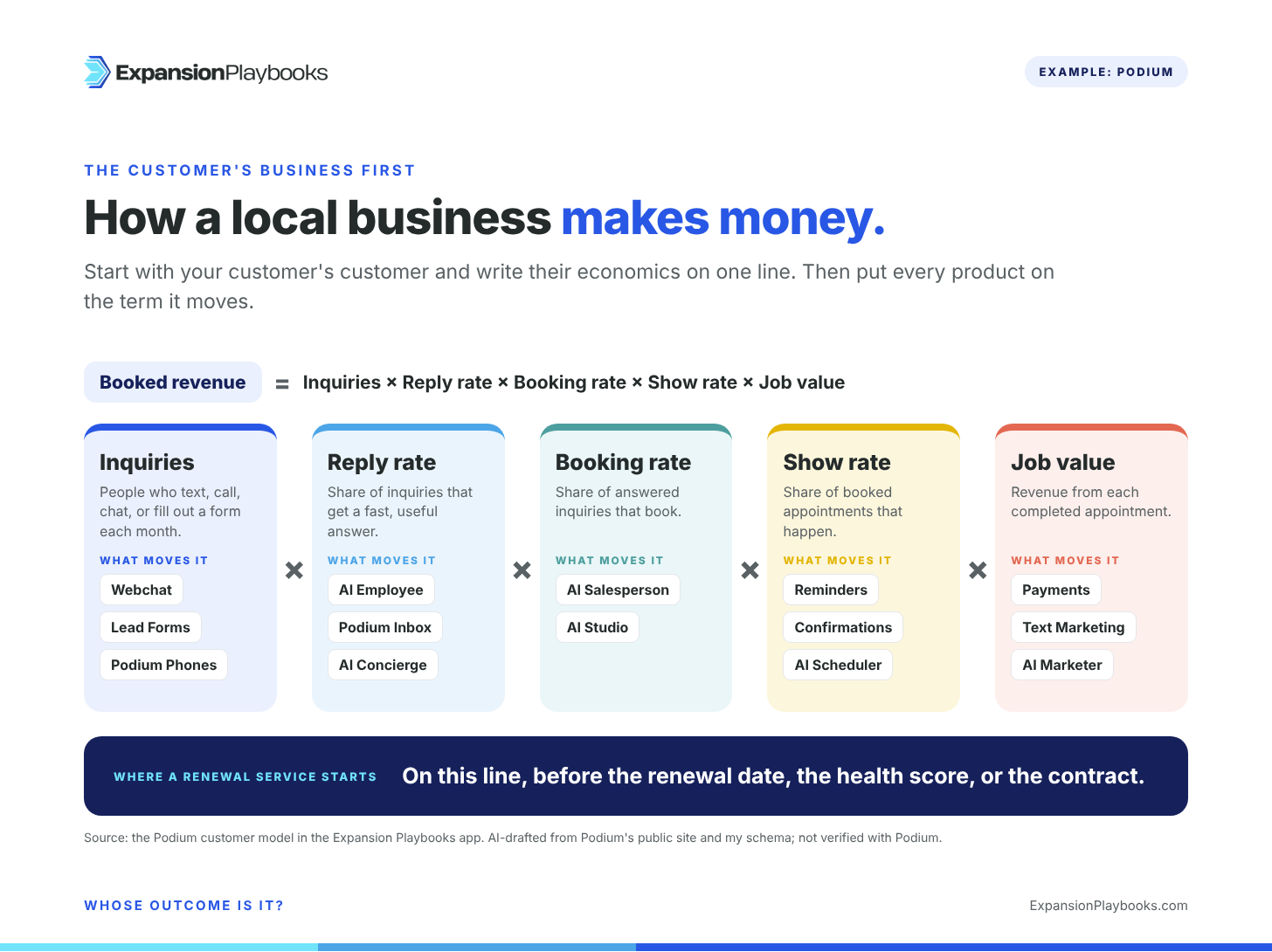
The first thing that service needs has nothing to do with Podium's renewal dates. It needs to know how a local business makes money. Written on one line, it looks like this:
Inquiries × reply rate × booking rate × show rate × job value = booked revenue.
Somebody texts, calls, or fills out a form. The business replies fast, or it doesn't. The reply turns into an appointment, or it doesn't. The person shows up, or they don't. And the job is worth what it's worth.
That line is the customer's economics, and every product Podium sells sits on one of those terms. If a product doesn't move one of them, the owner of that dental office has no reason to care about it.
Frame it by use case, not by industry
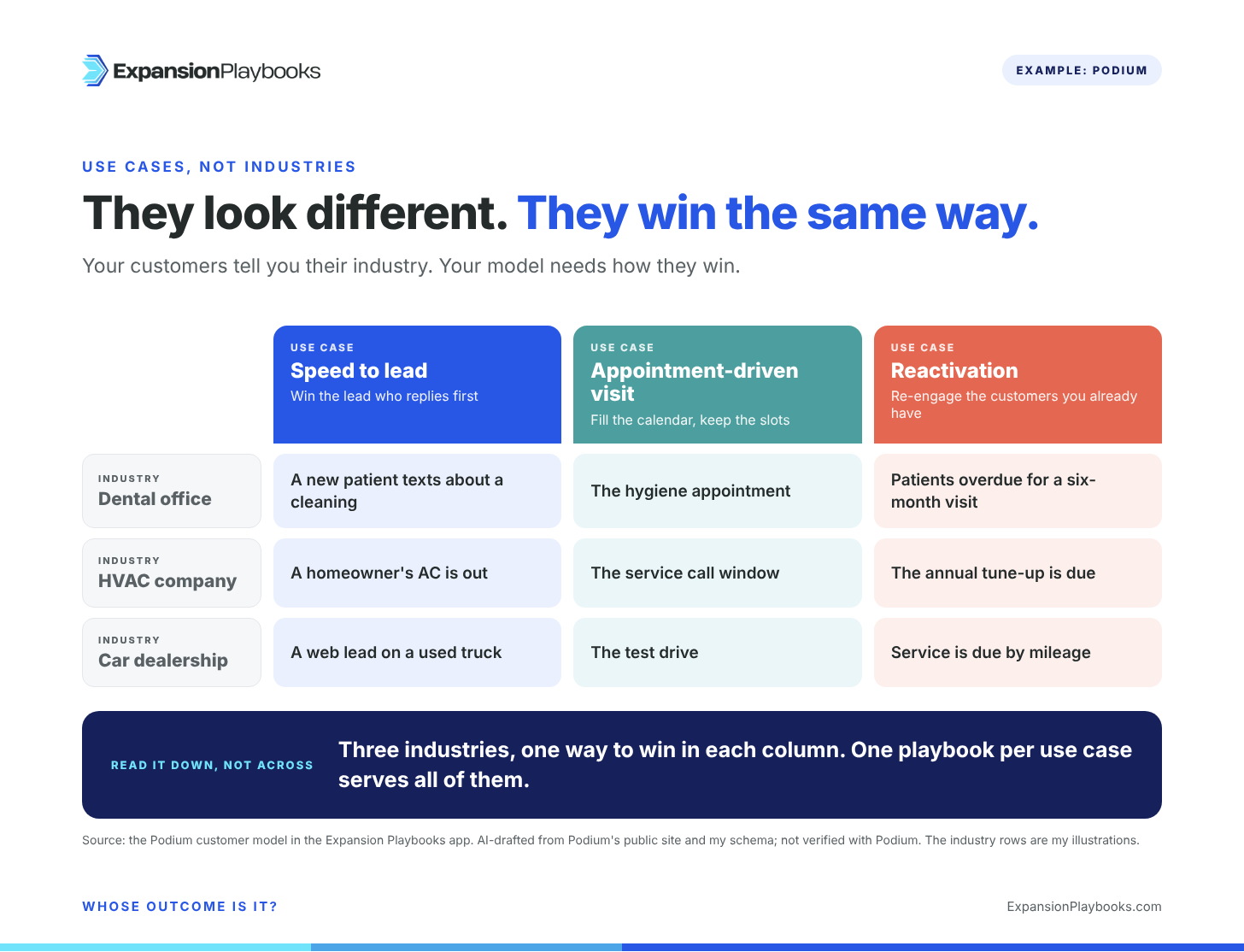
A dental office, an HVAC company, and a car dealership look like three different customers. And if you organize by industry, you build three of everything.
But look at how they win. All three win the lead by replying first. All three lose money on an empty slot they can never get back. And all three are sitting on a list of past customers nobody has contacted in a year.
Those are the use cases: speed to lead, the appointment-driven visit, and reactivation. Frame it that way and one playbook serves all three industries. That matters even more for a renewal service, because it has to do this for every software company it serves.
Name the outcomes, and the metric that proves each one
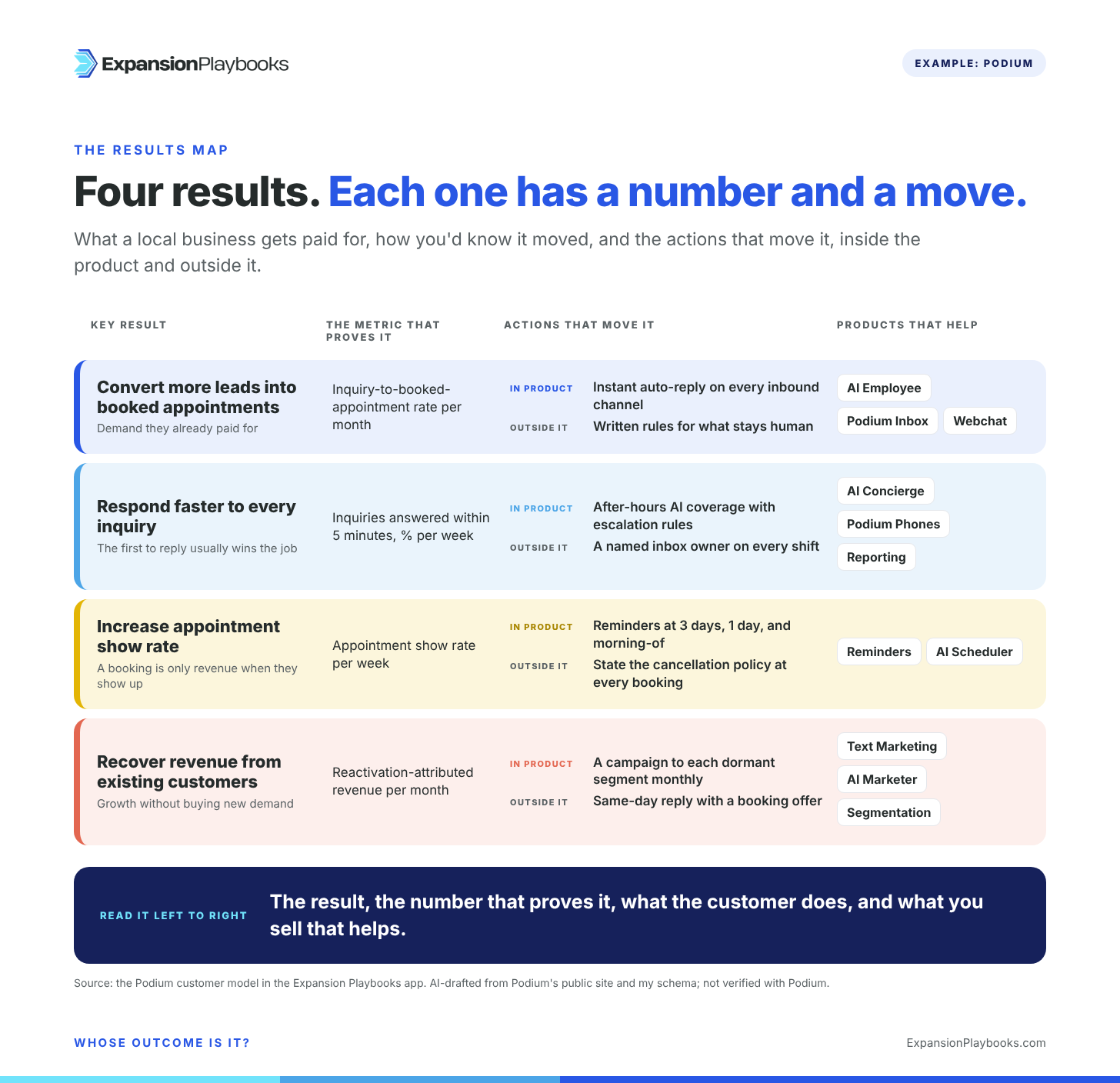
From those use cases you get four outcomes a local business gets paid for.
- Convert more leads into booked appointments. The metric is the inquiry-to-booked-appointment rate each month.
- Respond faster to every inquiry. The metric is the share of inquiries answered within five minutes.
- Get more booked appointments to actually happen. The metric is the appointment show rate each week.
- Recover revenue from the customers they already have. The metric is reactivation revenue each month.
Look at what isn't on that list. Logins, feature adoption, and the health score aren't there, because a metric only earns its place by proving an outcome moved.
And every outcome has actions, in the product and outside of it. As an example, show rate moves when reminders go out at three days, one day, and the morning of. It also moves when the front desk states the cancellation policy out loud at every booking, and no software does that part for them.
One of my first consulting engagements was with Solutionreach. They make patient communication software for dental and medical practices: appointment reminders, two-way texting, confirmations, and recall messages. What a practice is paying for is more kept appointments from the patients it already has, and so a no-show is money that practice never gets back.
I use them as the example for this all the time. Let's say a practice asks whether the reminder text can do a pop-up. If you think in features, the answer is a yes or a no, and in this case it's a no. But ask why, and you hear, "We've got our no-shows down from 15% to 8%, and we're trying to get to 5%." Now you have leverage. You can adjust the reminder cadence. You can ask if the poster with the cancellation fee is on the wall, and if the team is reinforcing the cancellation policy every time they schedule somebody.
The feature question has one answer. The outcome gives you three things to work on, and only one of them is in the software.
That's the level we worked at with Solutionreach, and we cut early churn by almost 80%.
Put them in order, then read the model backwards
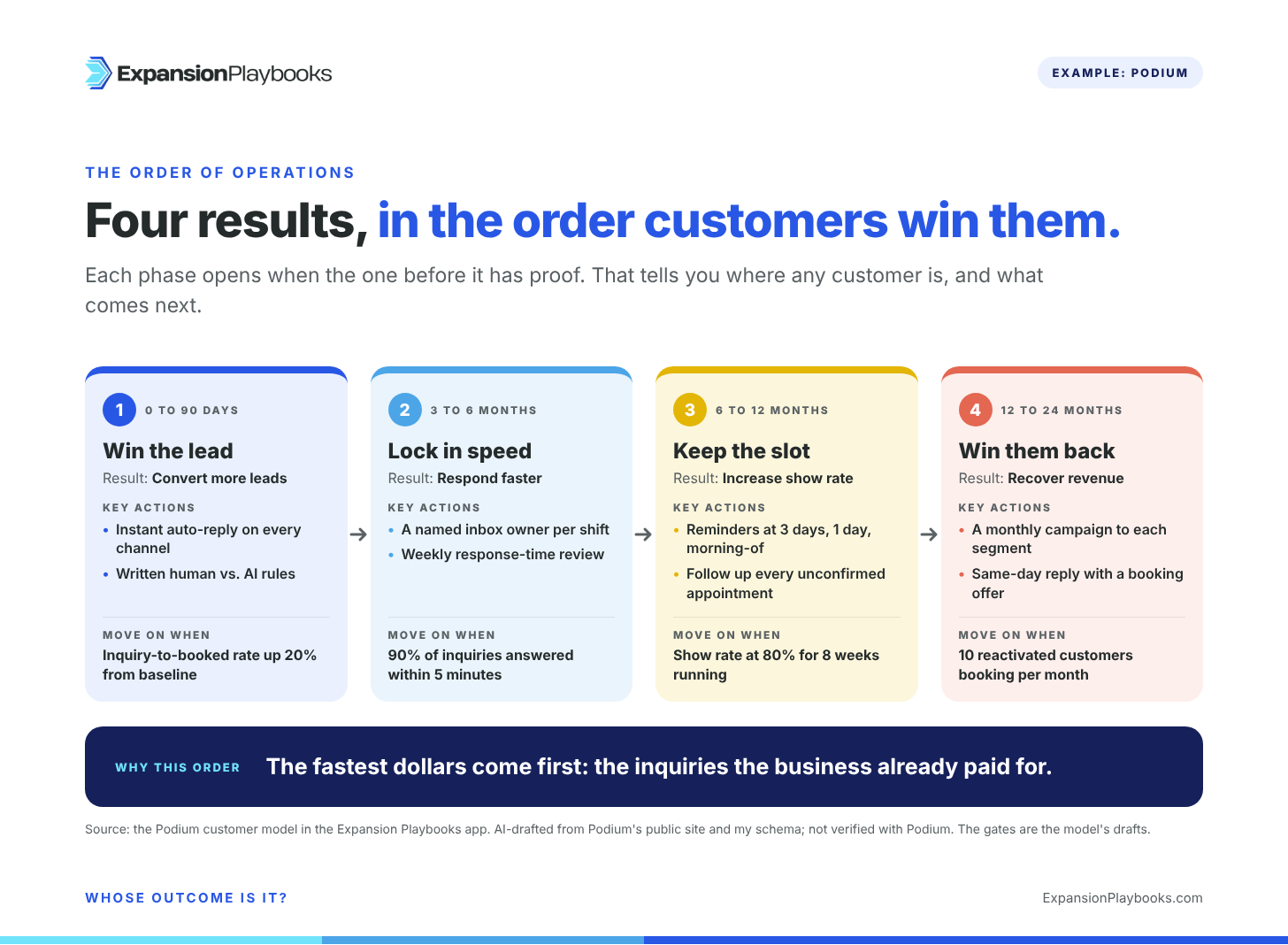
Customers don't go after all four outcomes at once.
Win the lead first, because that's the fastest dollar and the business already paid for that inquiry. Then make the speed a habit on every channel and every shift. Then protect the slot. Then win customers back. Each phase opens when the one before it has proof, like 90% of inquiries answered within five minutes, or a show rate at 80% for eight weeks running.
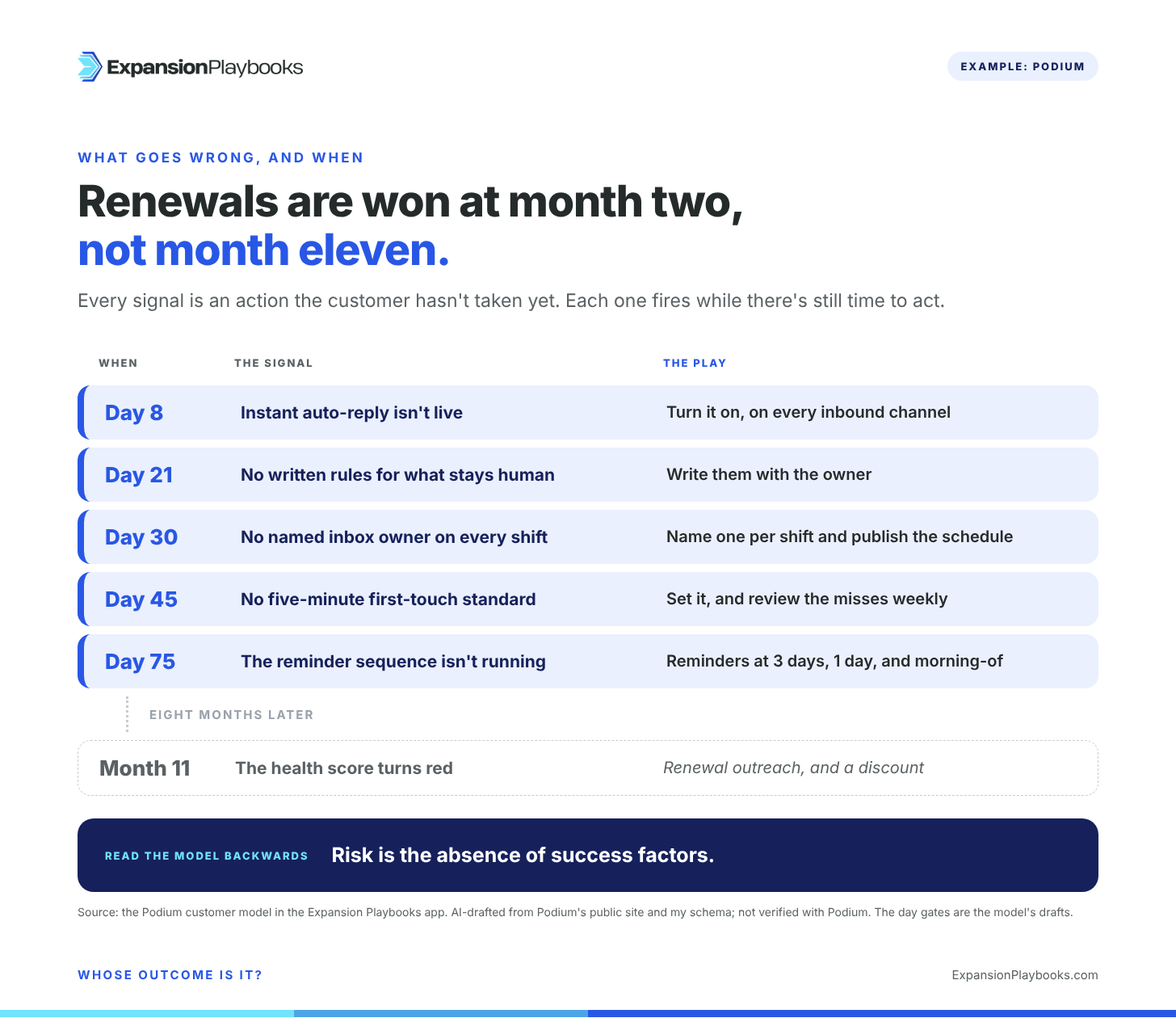
Now read the same model backwards. Risk is the absence of success factors.
If instant auto-reply isn't live by day 8, that's a risk. If there's no named inbox owner on every shift by day 30, that's a risk. If the reminder sequence isn't running by day 75, that's a risk. Not one of those is a usage score, and every one of them fires months before anybody opens the renewal.
Renewals are won at month two, not month eleven.
What the renewal service would have to do
So what would it take for a service like Atlas to deliver outcomes for Podium's customers, and not only a better number for Podium? Three things.
Number one, align on the outcome before you price it. Value-based pricing needs a value. Agree on which outcome, which metric, and what the baseline is before anything gets built. If the contract only says GRR, you'll get paid for things you didn't cause and blamed for customers who were never going to win.
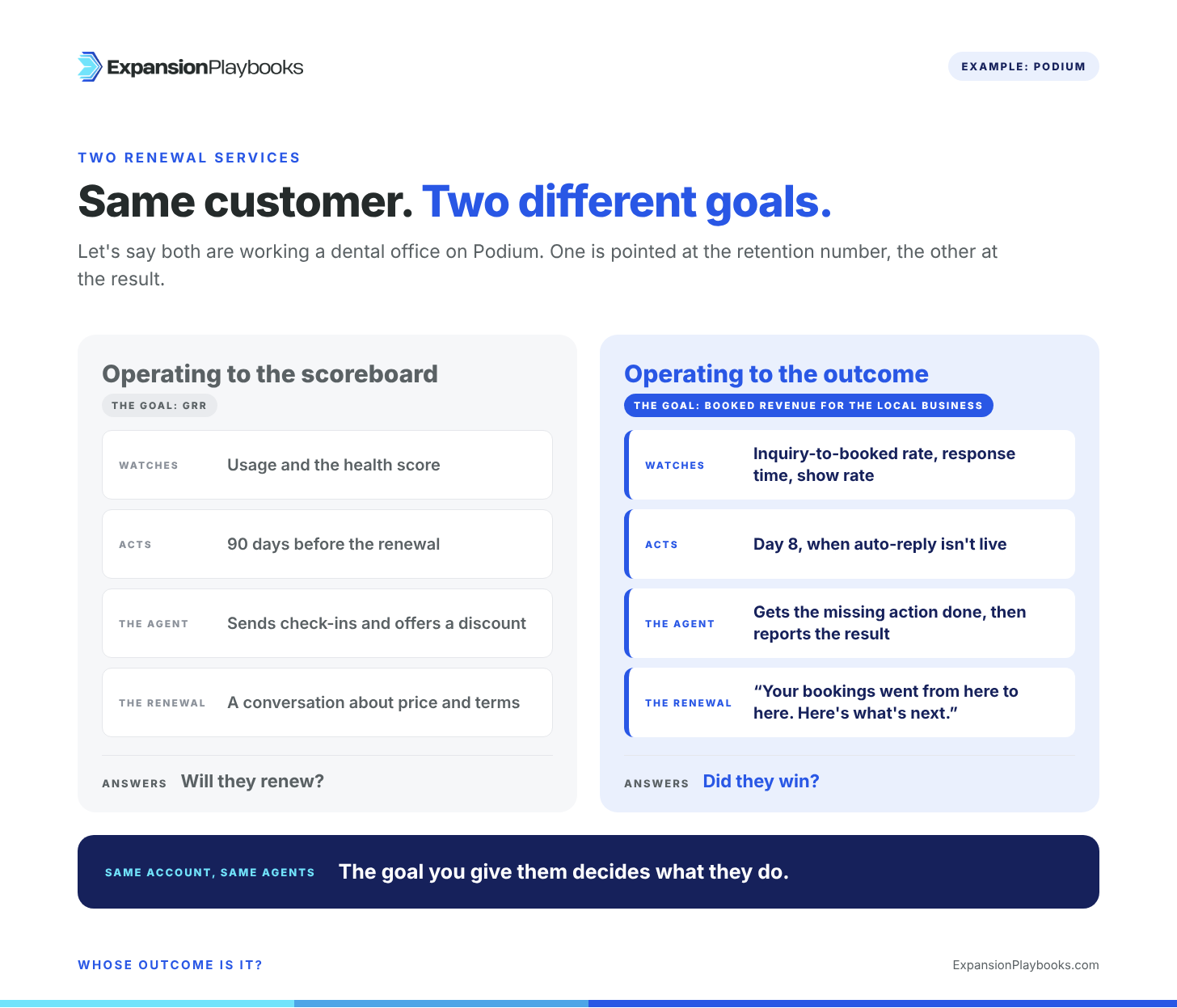
Number two, point the people and the agents at the customer's actions. Gainsight describes people and agents working in a loop: set the goal, act, observe, adapt. I love that loop. But it's only as good as the goal you give it. An agent told to protect a renewal will send check-in emails and offer a discount. An agent that knows auto-reply isn't live on day 8 knows exactly what to do next. AI cannot compensate for clarity you do not have about your customers.
Number three, make every renewal a proof. It's not enough to achieve the outcome; the customer has to recognize that success has been achieved. So the renewal conversation with the dental office sounds like this: "Your inquiry-to-booked rate went from here to here, and here's what we go after next." And the service's own renewal with Podium is the same story one level up: your customers won these results, that's why they renewed, and that's what you paid us for.
"Isn't GRR an outcome?"
You might be thinking that the revenue leader who buys a renewal service cares about GRR, so isn't GRR the customer's outcome?
It is. It's the number they defend in their own board meeting, and it belongs in the contract. But nobody on the team can wake up on Monday and do GRR. They can get a dental office replying to every inquiry within five minutes.
What I mean by that is the number at the top tells you whether it worked, and the number two levels down tells you what to do.
Ask whose outcome it is
Value-based pricing, one outcome owner, and agents working every account are the right pieces. Every one of them depends on knowing whose outcome it is, and it's almost never the one on your own dashboard.
Go two levels down, find the result your customer's customer gets paid for, and operate to that. The retention shows up after.
Try it on your own company
Write one line for how your customer makes money. Then pick your most common use case and name one outcome, the metric that proves it, and two actions that move it: one in your product and one outside of it.
If your customers have customers of their own, do it once more for the people they serve.
If you want help doing this, that's why I built Expansion Playbooks. It's software that maps how your customers win, from their economics down to your product, and turns that map into the playbooks you run every week.
For this piece, that means the outcome two levels down, written out for your customers: their economics, the use cases, the outcomes, the metric that proves each one, the actions that move them, and the early signals that tell you one is slipping. The Podium equation, outcomes, metrics, and signals above came straight out of the model Expansion Playbooks drafted from Podium's website.
Founding membership opens soon, and founding rates lock for as long as you stay. See the plans and founding rates
Hit reply and tell me: if your contract were priced on an outcome tomorrow, what number would go in it, and whose number is it? I read every reply.
Jeff