
When I was a missionary for my church in England, I did a lot of door-to-door work. I would knock sometimes around dinner time, because people were home after work.

Me as a missionary in Northern England.
I still remember one evening in Stoke-on-Trent, when a man opened the door and said to me, "Why are you bothering people right now? You should knock during the day, at like noon or something."
I said, "Sir, are you home right now?"
He said, "Yes."
I said, "Are you home at noon?"
He said, "No, I'm at work."
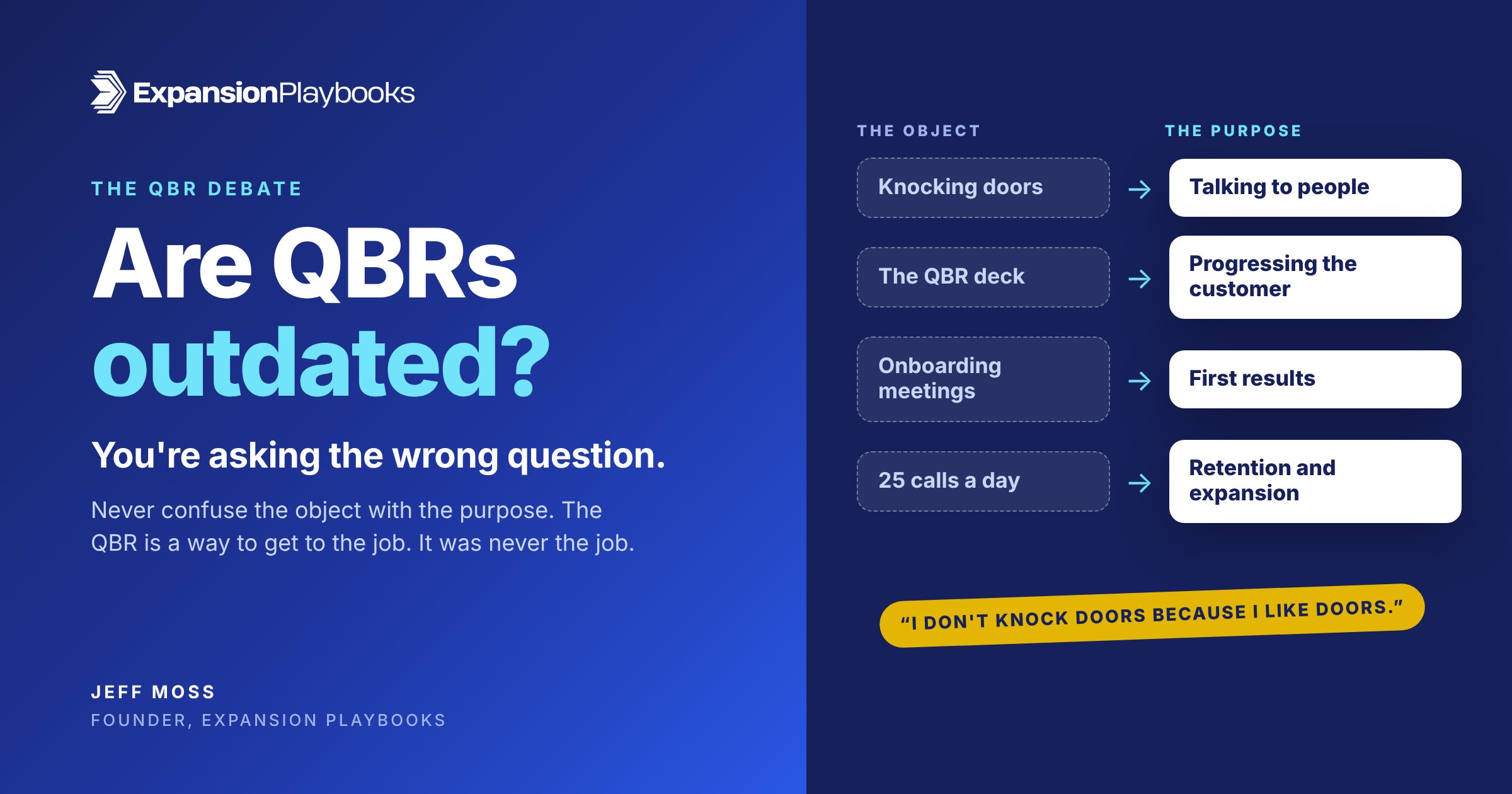
I said, "Well, then that's why I've knocked on your door right now. I'm trying to talk to people and share something that is of value to them, and my purpose is to actually talk to people, not to knock doors. I don't knock doors because I like doors. I try to talk to the people behind the doors, and the reason I'm potentially bothering you right now is because I hope I could speak to you."
We ended up laughing about it, but it taught me something valuable. I wasn't checking a box. I was trying to accomplish a purpose.
If all I'd cared about was doors knocked, noon would have been perfect. Lots of doors, nobody home, and a great number to report at the end of the week. And customer success is full of teams knocking doors at noon, and the QBR is where you see it most.
Are QBRs outdated?
Colin Foley asked that on LinkedIn recently, and my answer is that I don't care so much about QBRs versus no QBRs. The bigger issue is whether we're actually helping the customer move toward the outcomes they hired us for.
Colin described what a lot of us have lived. We spend hours building a 20-slide deck full of usage data, walk the customer through it, and forget to ask whether any of it is helping them achieve what they hired us to do.
There's a conversation that has to happen with the customer. You set the strategy once, at the start with a new customer. Then you go over performance, update the strategy, and execute to drive even more value, and then you go back to reviewing performance and do it again. That may be done in a QBR. It may be done with a combination of automated reports and agent engagements along with customer meetings.
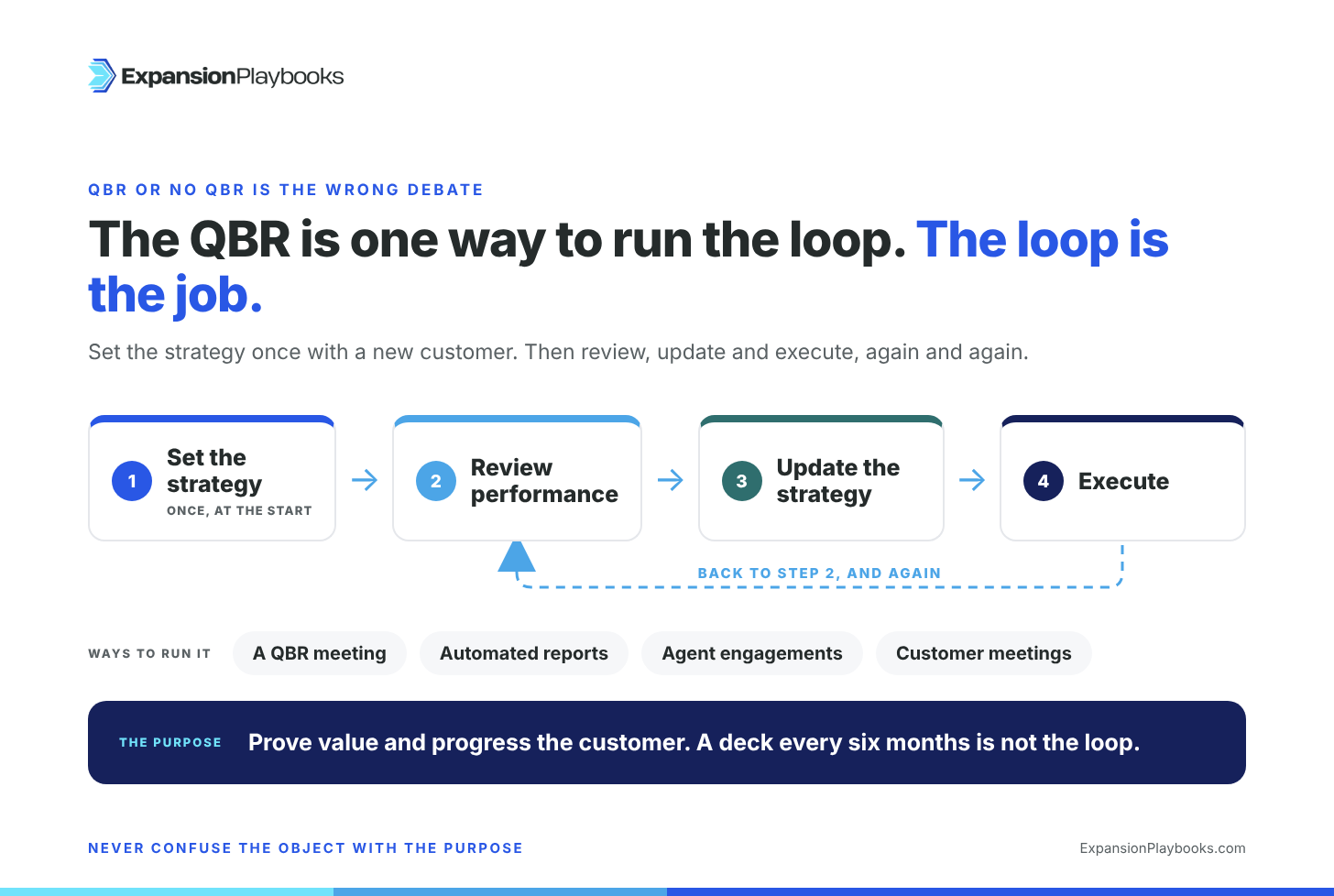
The big mistake was using the QBR as a proxy, when it was just a means of doing the real thing you were supposed to be doing. If you're checking the box on a QBR defined as "presented the deck, every six months," then yes, the QBR is outdated.
So you must never confuse the object with the purpose. We're trying to prove value and progress the customer, not deliver each slide of the deck in a meeting. If the QBR accomplishes that, great. If there's a completely different way to accomplish it, let's do that instead. But in many instances the QBR is still a great way to accomplish the purpose, if it's done right.
Every process has an object and a purpose
Here's what I mean by that. Every process in customer success has an object and a purpose. The object is the thing you can see and count: the meeting, the deck, the call, the email, the training session. The purpose is what that thing exists to accomplish for the customer.
The object is easy to track, because it either happened or it didn't. The purpose is harder, because you have to know what the customer is trying to achieve and whether they got there. And so, left alone, the object wins, because it's the one that fits in a report.
What you do is not what you are for.
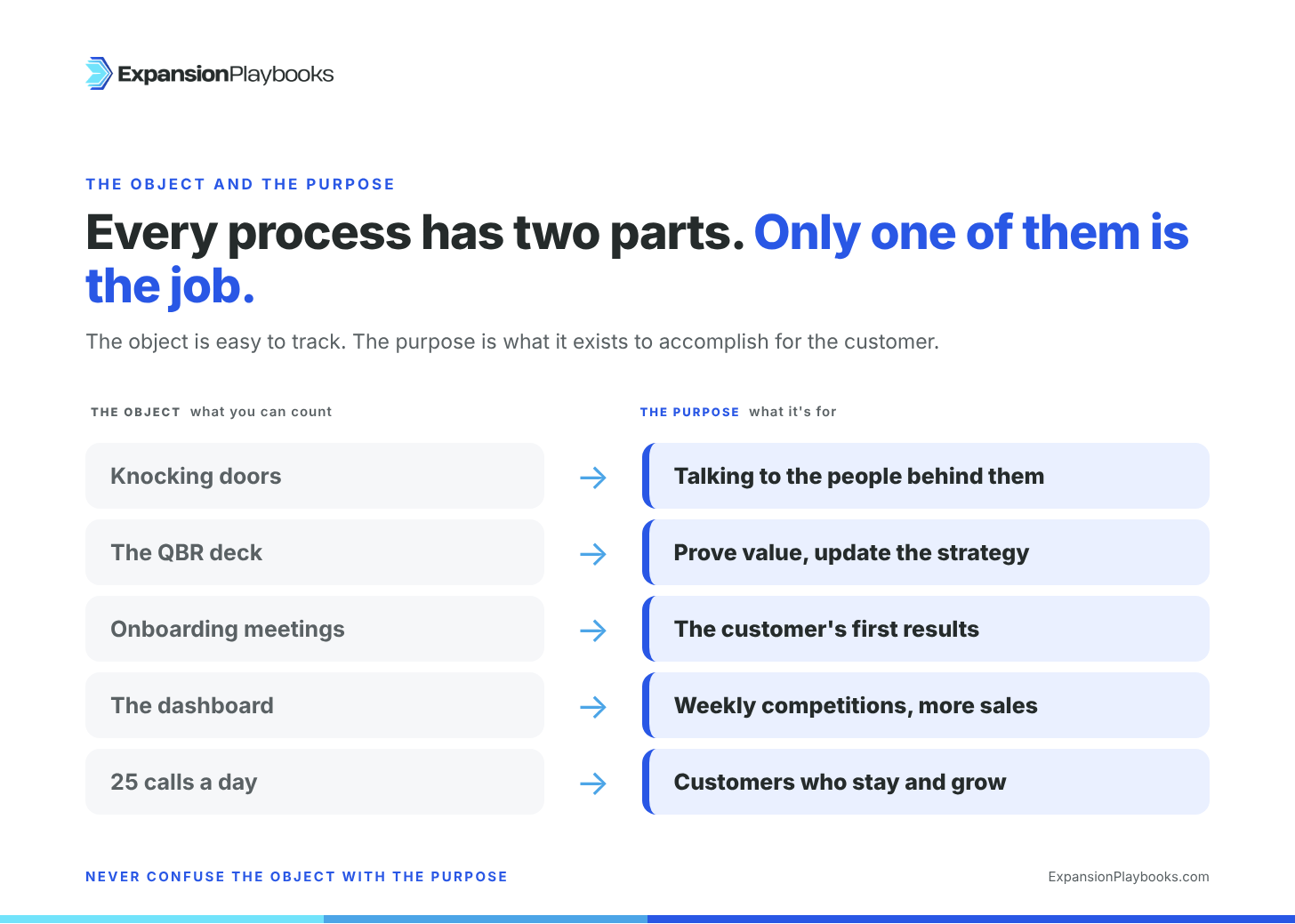
Once you see the difference, you start finding it everywhere. Here are two more.
Onboarding is done when the customer gets results
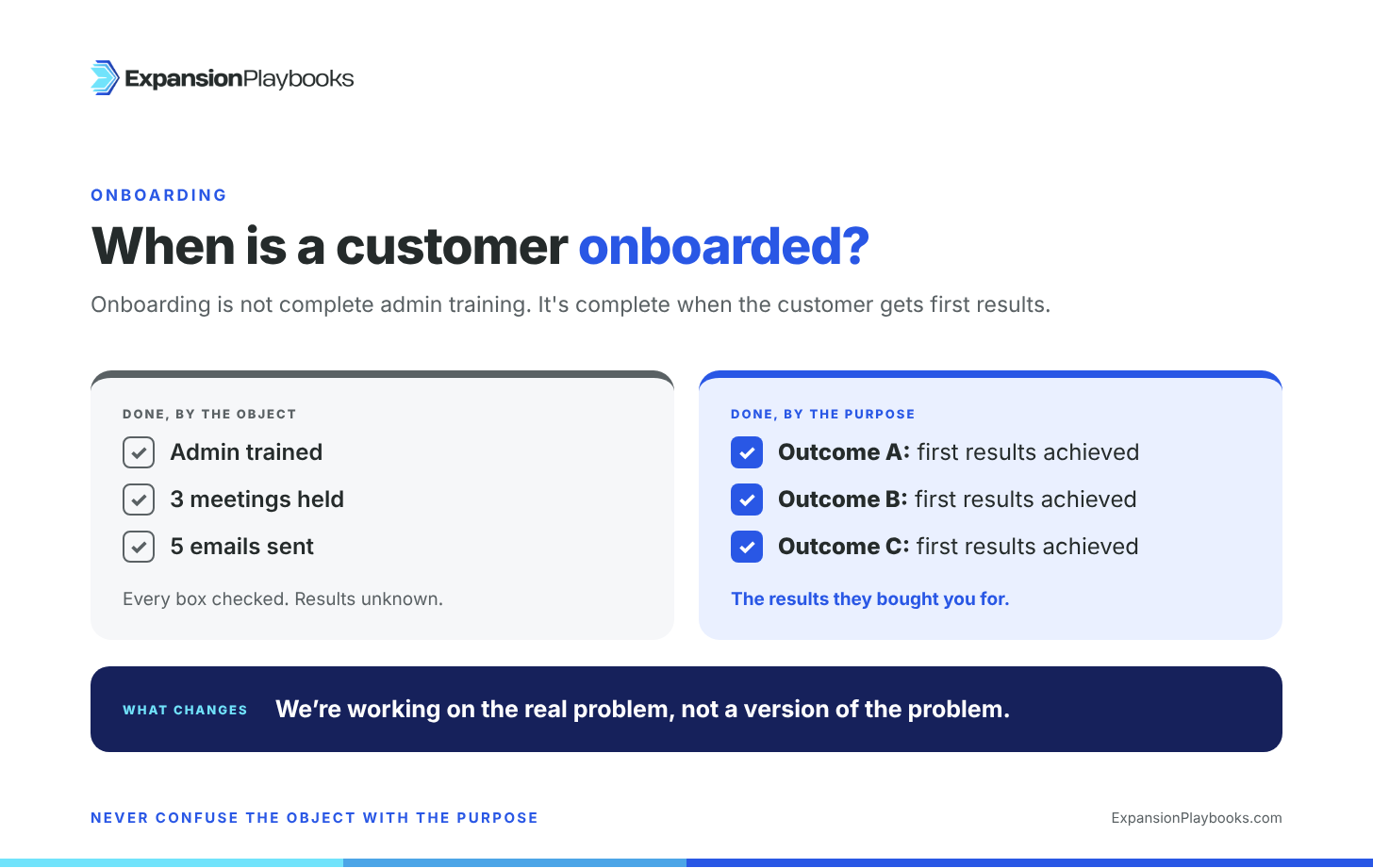
Onboarding is not complete admin training, where once training is completed, the customer is onboarded.
The purpose of onboarding is to get the customer to first results on whatever they purchased you for. Onboarding is only complete when the customer is successfully getting those first results, not when you've completed your three meetings or sent your required five emails.
When you understand that's your purpose, the whole thing changes: how you approach onboarding, what makes a session successful, how you know whether a customer is struggling, and whether that customer is likely not to succeed. All of that gets revealed once you understand your purpose and stop checking the box, because now you're working on the real problem, not a version of the problem.
The dashboard was never the point
I learned this one the hard way at SalesRabbit, when I was trying to figure out how to reduce churn. We noticed our most successful customers were using the dashboard, and so we said, "Okay, we'll train everybody on the dashboard." We trained everybody, and churn was still horrible. We were asking ourselves what was going on.
Then we asked what the successful customers were using the dashboard for. They were using it as the source material for running their weekly sales competitions, which drove more activity from their sales reps and typically increased the number of sales per rep. The dashboard was how the competition was run, how everybody stayed up to date on how everyone was doing, and how they gamified the whole thing.
Ultimately, its purpose was to drive more sales, to give managers the insight to go help the reps who were struggling, and to help reps see what they were up against and what was possible. Dashboard usage was the object, more sales was the purpose, and we had been training everybody on the object.
Proxies are fine, as long as you've earned them
Now the leader's side of this. Leaders as a whole have hurt themselves and their teams by settling for check-the-box proxies of performance.
I get why you do it. The temptation is there because you can always track them. Did we do the QBR call, yes or no? Did we make 10 calls today, yes or no?
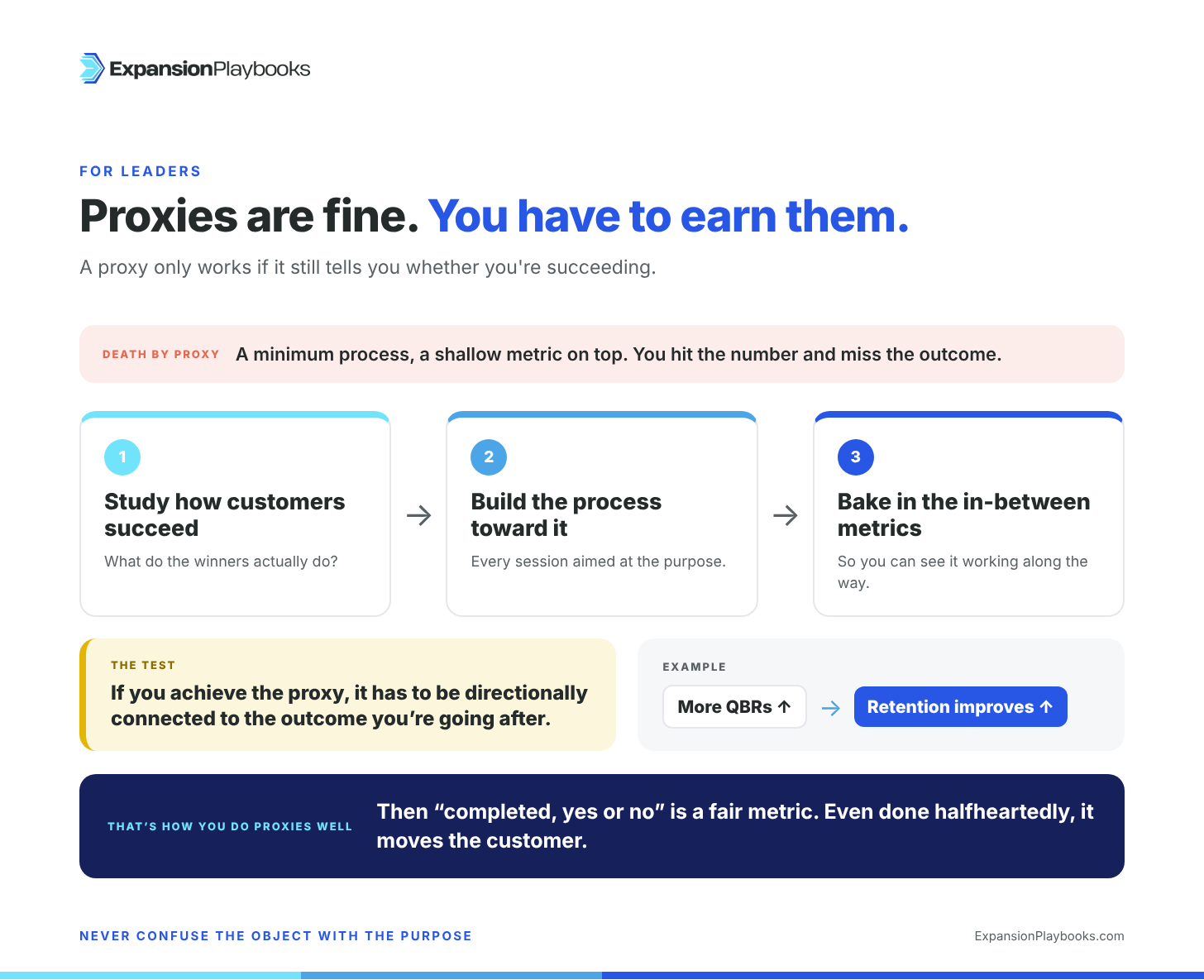
You can only use those proxies if they accurately predict and tie to the real purpose. The proxy, if achieved, has to be directionally connected to the outcome you're trying to go after. If you're trying to drive customer retention and you're using running QBRs as the proxy, then when you run more QBRs, retention should improve. If it doesn't, the QBR count isn't telling you anything about retention.
If you've designed your onboarding sessions to be really effective, and they truly are focused on driving the customer to first results, then you can use completed onboarding sessions and behavior checklists with the customer as a proxy for a successful onboarding, because the sessions are built toward the purpose.
Same with the QBR. If your QBR is properly designed, it focuses on customer results and pulls in the right information. If somebody goes through that deck even halfheartedly, it will still communicate the value to the customer, update their strategy, and help them go forward. Then "QBR completed, yes or no" is a fair value metric.
The mistake is that we do a minimum level of process on each of our core elements: the QBR deck, the onboarding deck, the save play, and the renewal conversation. Then we put a shallow metric on top to judge performance. What we should be doing is studying how customers succeed and how our processes actually drive that success, and then baking those in-between metrics into the standardized processes, so the proxies mean something.
Skip that work and you get death by proxy, where you hit the number and miss the outcome. Proxies only work if they still ultimately tell you whether you're succeeding.
I learned it from two reps
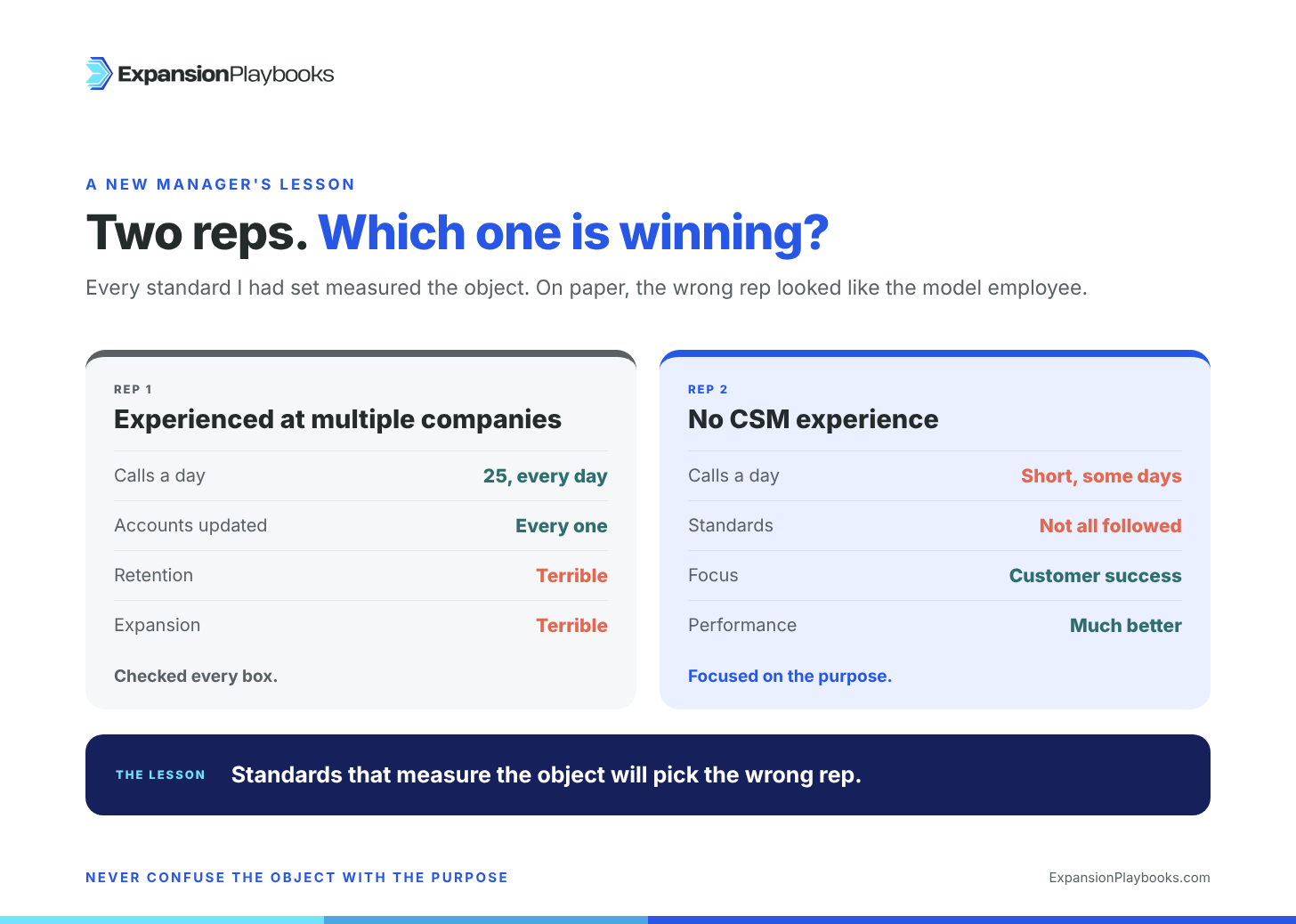
Early on, I hired two people. One had no experience as a customer success manager. The other had been at multiple companies, and he was the one I thought of as experienced.
He loved to check the box. He would do his 25 phone calls every day. He would update all of his accounts really well. And he had terrible retention and terrible expansion.
The other rep didn't follow all the standards, and he had much better performance, because he was actually focused on making the customer successful. Some days he didn't make enough phone calls, because he was trying to do this the right way.
I was a new manager, and I didn't understand how to do this well yet. Every standard I had set measured the object, and so on paper the wrong rep looked like the model employee.
Start from the purpose and work back
The QBR, the onboarding session, the dashboard and the 25 calls are all ways to get to the job. None of them is the job. The job is making the customer measurably more successful at their own business, and every one of those objects is only as good as how well it gets you there.
I don't knock doors because I like doors, and nobody should run a QBR because they like decks.
Try this on one process this week
Pick one process your team runs: the QBR, onboarding, the save play, or the renewal conversation. Write down its purpose in one sentence, in terms of what changes for the customer.
Then look at the metric you use to judge it. If that metric hit 100%, would the purpose be guaranteed? If not, what would the process have to include so that even someone doing it halfheartedly still moves the customer forward? And what in-between number would tell you it's working?
That's the work that turns a box you check into a proxy you can trust.
Build the QBR from the customer's results
Most teams skip that work because it's hard to do by hand for every customer. If you want help doing this, that's why I built Expansion Playbooks. It's software that maps how your customers win, from their economics down to your product, and turns that map into the playbooks you run every week.
For this piece, that means the purpose behind every process written down once: what each customer bought you for, the results they've gotten so far, and a QBR deck drafted from those results instead of from usage data.
Founding membership opens soon, and founding rates lock for as long as you stay. See the plans and founding rates
Hit reply and tell me which of your processes is knocking doors at noon, the one that looks great in the report and doesn't move the customer. I read every reply.
Jeff