

I have sat in the meeting where marketing asks customer success for a success story, and the whole room goes quiet.
And it goes quiet for a reason. Somewhere in the company there is a success story that has been "in progress" for eight months. Somebody scoped it like a research project. Baseline the workflow for a quarter, run the comparison, get the customer to validate the numbers, send it to their legal team, add three paragraphs about who the company is. And so it almost never ships. The few that do ship show up so late, and so lawyered, that the customer barely remembers the win they were thrilled about a year ago.
So here is the question nobody in that room is asking. What is a success story actually for?
What is a success story actually for?
Let me ask it the way I ask customers. Does a success story need a control group? Does it need a signed-off methodology? Does it need several months of baselining before it counts? Most teams act like the answer to all three is yes. And so they almost never produce one.
Everybody stinks at getting success stories, and part of it is ownership. Marketing owns the asset, but marketing cannot generate it. They need customer success to surface the win, and customer success already has a million things on the list. So it falls into the gap between the two teams and nothing happens.
But the deeper reason is the definition. We have all quietly agreed that a success story is a peer-reviewed paper. A scientifically validated, baselined, customer-signed, legally-blessed study of a workflow over several months.
A success story is not a case study. It is a real win, from a real customer, captured in the moment it happens.
What I mean by that is the PhD version is not what success stories are for, it is not necessary, and it is way overblown. And so the net result of holding that bar is that you create far fewer of them than you should. The ones you do create sit unapproved, because the customer suddenly feels like they have to validate whether all of it is really true. You do not need an abstract. You need a before, an after, and a customer willing to put their name next to it.
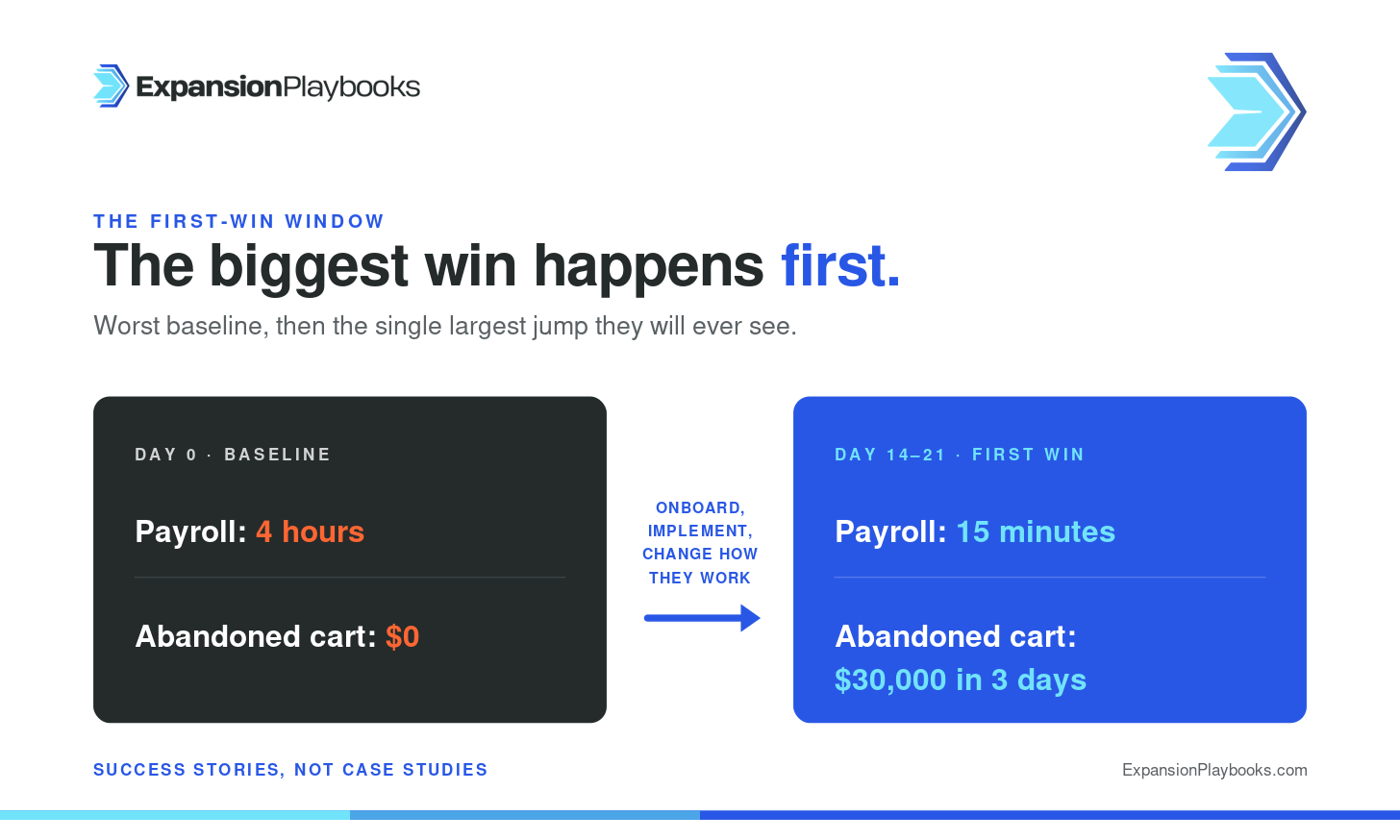
The biggest win happens first, not last.
Here is what conventional wisdom gets backwards. We assume a customer win has to be studied for months, even years, before it is real. And common sense says the opposite.
So think about where a customer is the moment they sign with you. They are coming from no solution at all, or from a competitor that was not working, which is why they left. And so either way, the day before they start working with you is the worst their performance will ever be. That is the bottom. That is rock-bottom baseline.
The moment a customer onboards, implements your solution, and changes how they actually work is the single biggest jump in performance they will ever experience. Everything after that is optimization.
This is not about flipping a switch. The jump comes from them starting to operate a new way with your help. They onboard, they implement the change, they put the new process into their week. And so that is what moves the number, and it moves fast.
Take Timeero, a client of mine. They are a time tracking and mileage tracking tool for companies with field teams out visiting job sites. A lot of their customers show up doing it on pen and paper, or with some rudimentary tool. And one of the biggest things Timeero solves is how long it takes to run payroll, because manual mileage tracking can eat several hours.
So you onboard the customer, you get it set up properly, the reps start tracking. And by that first pay period, at the latest the second, the customer hits the moment: "It used to take me four hours to do the mileage portion of payroll. I just did it in fifteen minutes." That win is capturable in as little as 14 days. And so you can put that customer's quote, their name, and their photo on your website immediately. Right onto your wall of love.
Now take Drip, the email marketing platform. During onboarding they helped customers set up the automations that actually make money. As an example, the classic for e-commerce is an abandoned cart sequence, and they would get it live inside the first 21 days. Plenty of customers came in with no abandoned cart at all, or one inherited from a previous tool that was set up badly. So Drip rebuilds it, and now they can say: you were making nothing from abandoned cart, we put the new sequence live, and by day 20 you made thirty thousand dollars in your first three days.
That is not a number you study for a year. That is a number you catch before the customer is even fully onboarded.
You cannot show the win if you never locked the baseline.
Look at both of those stories again. They only work because somebody captured the before.
"It used to take four hours" only lands because you know it used to take four hours. "You were making nothing" only lands because you confirmed they were making nothing. And so the baseline is not paperwork. The baseline is the story. Skip it, and the most impressive result in the world is just a number floating with nothing to stand against.
Capture the baseline during the sale or early in onboarding. You cannot demonstrate the win if you never measured the start.
And it does not have to be a scientific exercise. As an example, you ask during the sale or the first onboarding call: "Generally, how long does it take you to run payroll right now with the mileage and time tracking?" Or, "How much are you currently making from your abandoned cart?" Maybe the answer is "we do not have one, so zero." Maybe it is "about a thousand a week." Either one is a fine baseline. Write it down, agree on it, move on.
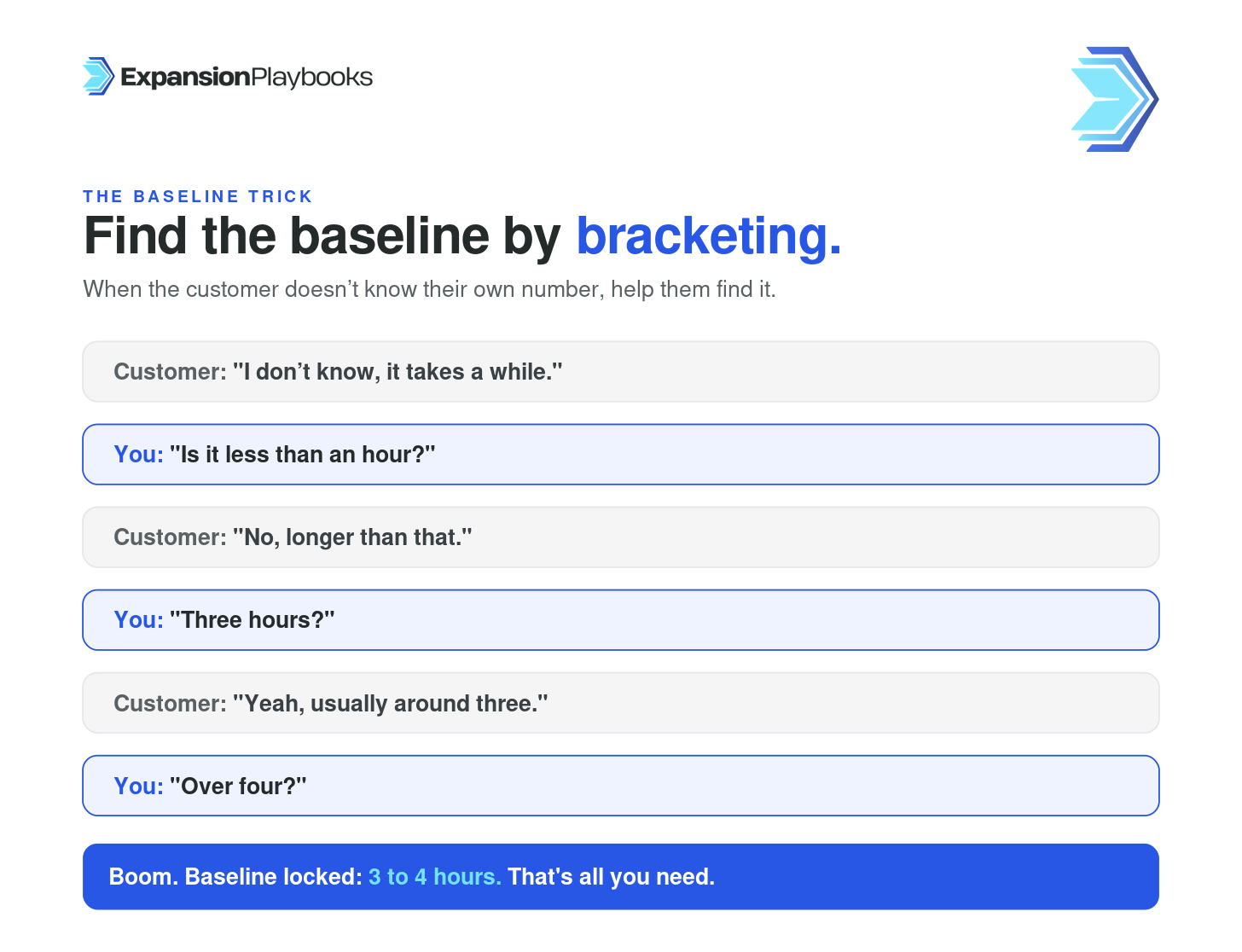
Now here is the powerful little move for when the customer does not actually know their own number. Do not let them off the hook with "I am not sure." You help them find it by bracketing.
"I don't know, it takes a while." "Sure. Is it less than an hour?" "No, longer than that." "Less than two hours?" "No, more than two." "Three hours?" "Yeah, usually around three." "Over four?" "Rarely over four."
Boom. Lock it in. You now have a baseline of three to four hours that the customer agreed to out loud. And that is all you need. It lets you call your shot on the enhancement you are about to deliver during onboarding. You can refine it a year down the road if you want a more precise number, but the first win is the one worth catching now.
Capture the win like a human, not like a lawyer.
The fastest way to kill a success story is to make the moment feel weird. The second it feels like a procurement event, the customer's guard goes up, and now they want to run it past legal, past finance, past the person who validates whether any of this is real. And so you did that. You took a human moment and made it feel like an audit.
This is a human-to-human situation, so treat it like one. The best place to do this is a later-stage onboarding call, or the implementation graduation wrap-up. That is the call where you say: here are the commitments we made, here is what we accomplished, and I want to review a couple of the wins. "I noticed your abandoned cart did thirty thousand dollars this month."
And then you let them react. Nine times out of ten they light up. "Oh my gosh, this month has been amazing. I cannot believe we pulled thirty thousand from the abandoned cart in the first weekend. We have never had anything like that."
Pause. And then, simply: "That is so great, I am really glad you shared that with us. Would it be all right if we put that win on our website, with your name next to it?"
Nine times out of ten the answer is heck yes. They love you right now. You just made them money or gave them hours back, the momentum is entirely with you, and saying yes feels like a thank-you. But wait two years and that same ask becomes a project. Now it is a financial analysis, a sign-off, a "well, I think it was a win, let me check." And so the relationship capital you had in the moment is gone, and the easy yes turns into a slow maybe.
Do it on purpose, and everybody wins.
Make this a real part of your process, with a structured portion built right into the graduation call or survey, and three things happen at once.
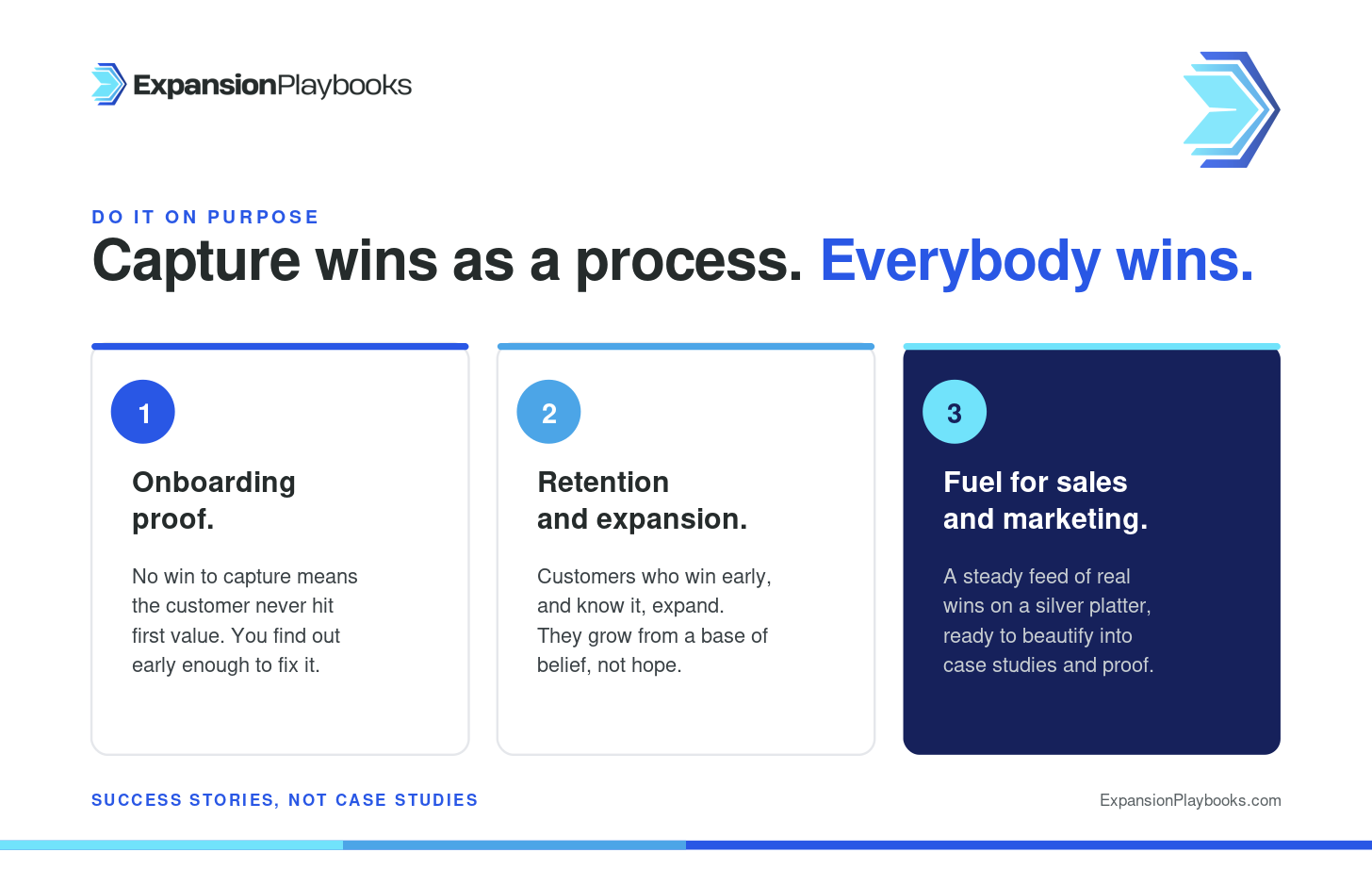
First, capturing the first win forces you to confirm onboarding actually worked. If you cannot find a win to capture, that is not a missing testimonial. That is a customer who never reached first value, and you just found out early enough to do something about it.
Second, you move retention. Customers who win early, and who know they have won because you named it out loud, are the ones who expand. They go from success to success, they adopt more, and they grow from a base of belief instead of hope.
Third, you hand marketing and sales a gift. Instead of begging customer success for stories that never come, they get a steady feed of real wins on a silver platter, ready to beautify into case studies, slides, and proof. And so you become the team that feeds the whole revenue engine, versus the bottleneck everyone complains about.
That is why this is so powerful. You get to cash the check on the value you create, because the value is finally written down where everyone can see it.
Catch the win while it is still warm.
So stop scoping success stories like research projects. The research project almost never ships, and when it does, the win is cold.
The biggest wins happen first, not last. Lock the baseline, catch the win in the moment, ask permission while the customer is still glowing, and let everyone downstream build on it.
A case study is something marketing assembles from a win you already captured. A success story is the win itself, caught in the two weeks when it is biggest and the customer is happiest. And so if you get the second one right, the first one almost writes itself. That is why the moment, not the methodology, is the whole game.
What to do this week.
Pick one customer who is in onboarding right now, or who just graduated. And ask yourself one question: do you know their baseline? The before number, the one that makes their win mean something.
If you do not have it, go get it this week, even if you have to bracket your way to it on a call. And if you do have it, find the win that sits on top of it, get on a call, and ask the one question that turns a happy customer into a name on your wall of love.
So when you try this, hit reply and tell me what happened. What was the baseline you locked in, and what was the first win you caught that you would normally have let slip by? The early ones are usually the biggest, and they are the ones most teams never write down.