My first time leading a customer success team, our customers ran door-to-door sales teams. Field operators, strong-willed, used to being in control of any room they walked into.
My team was getting walked all over.
Our onboarding back then was loose. We would jump into the app, help the customer set things up, and sort out the rest as we went. There was no clear 14-day plan. No named sessions. No framing of why any of it mattered to the customer or what outcome each step was supposed to produce. It was ripe for being hijacked, and it got hijacked constantly.
I sat in on a call between one of my CSMs and a customer who owned a 30-person field team. Two minutes in, the customer took the wheel.
"We don't need to go through all of this. Just turn it on. We'll give it to the reps and they'll start going."
My CSM had nothing concrete to push back with. No plan on the screen. No outcomes tied to any session. So the call went exactly where the customer wanted it to go.
A few weeks later that customer was done. And the feedback was worse than "you didn't set us up for success." It was "this doesn't work, our team didn't adopt it."
We were failing, and at the time we didn't fully understand why. Two things were true. My team was early in their careers and not inclined to take the lead with a strong-willed customer. And our onboarding was loose enough that any of those customers could grab it and run.
Underneath both of those was the real problem. We had never put ourselves in the driver's seat. We had not captured what we actually knew from working with hundreds of sales teams, and we had not turned that knowledge into a clear, visible process we could lead a customer through.
There are really only two ways a customer success engagement fails. The customer doesn't do the work. Or you weren't the one driving when it mattered.
The customer is not always right.
Most customer success teams already know the customer is not always right. They might even disagree with what the customer is asking for. But their actions tell a different story. The customer says do this, so they do it. The customer asks for that, so they give it. Whatever the customer wants, they accommodate.
The customer has an idea of what they think success is and what it looks like. They have an idea of how to get there. Most of the time that idea is incomplete. Sometimes it's just wrong. Our job is to help shape what success actually looks like for them, and to lead them down the path that gets them there.
The whole reason they bought your product is that whatever they were doing on their own hasn't been getting them the result they wanted. They bought your expertise. The customer domain expertise you have built from watching hundreds of teams succeed and fail is the whole reason they want access to what you know. They did not buy your willingness to bend to whatever they ask for. If you let them keep running the playbook that wasn't working, you're not serving them. You're confirming their bad habits with your time on the meter.
The customer didn't pay for your willingness to accommodate. They paid for your expertise, and for the judgment that comes with it. They paid for the one person in the room who has seen this movie a hundred times and can say, with conviction, "I know how this ends. Let's not do that. Do this instead."
There is nothing arrogant about that. It is the precise job they hired you for, and the one most of their vendors are too timid to do.
The Driver's Seat is four things being true at once.
Being in the Driver's Seat with a customer means four things are simultaneously true. You know exactly where this customer needs to go. You know the route and the sequence. You know the decision criteria when something forks. And you're willing to say all three of those out loud, in plain language, on the first call.
If any one of those four things is missing, the customer will sense it. And the moment they sense it, they take the wheel. Not because they want to. Because somebody has to drive, and you weren't.
You lose the Driver's Seat one of two ways.
The first is that you were never in it. You showed up to the kickoff without a real point of view. You asked the customer what they wanted out of the engagement. You let them set the agenda. You confused listening with deferring. By the end of that first hour they had decided you were a vendor who responds to requests, and that's the role you played for the rest of the relationship.
The second is that you had it, and you gave it back. Almost always at a moment of stress. A bug. An escalation. A missed deadline. An aggressive new stakeholder added to the account. A renewal conversation that started going sideways. Stress is the moment customers grab for the wheel. If you flinch, they get it.
Both failure modes have the same root cause. You don't believe, deep down, that you have more right to the Driver's Seat than the customer does. So let's fix that.
How you earn the seat: four moves we ran at Sales Rabbit.
After enough of those failed onboardings, I knew we had to change something fundamental. We didn't fix it by telling the CSMs to be more confident. Confidence without earned authority is worse than humility, and customers can smell it from across the table. We fixed it in four moves.
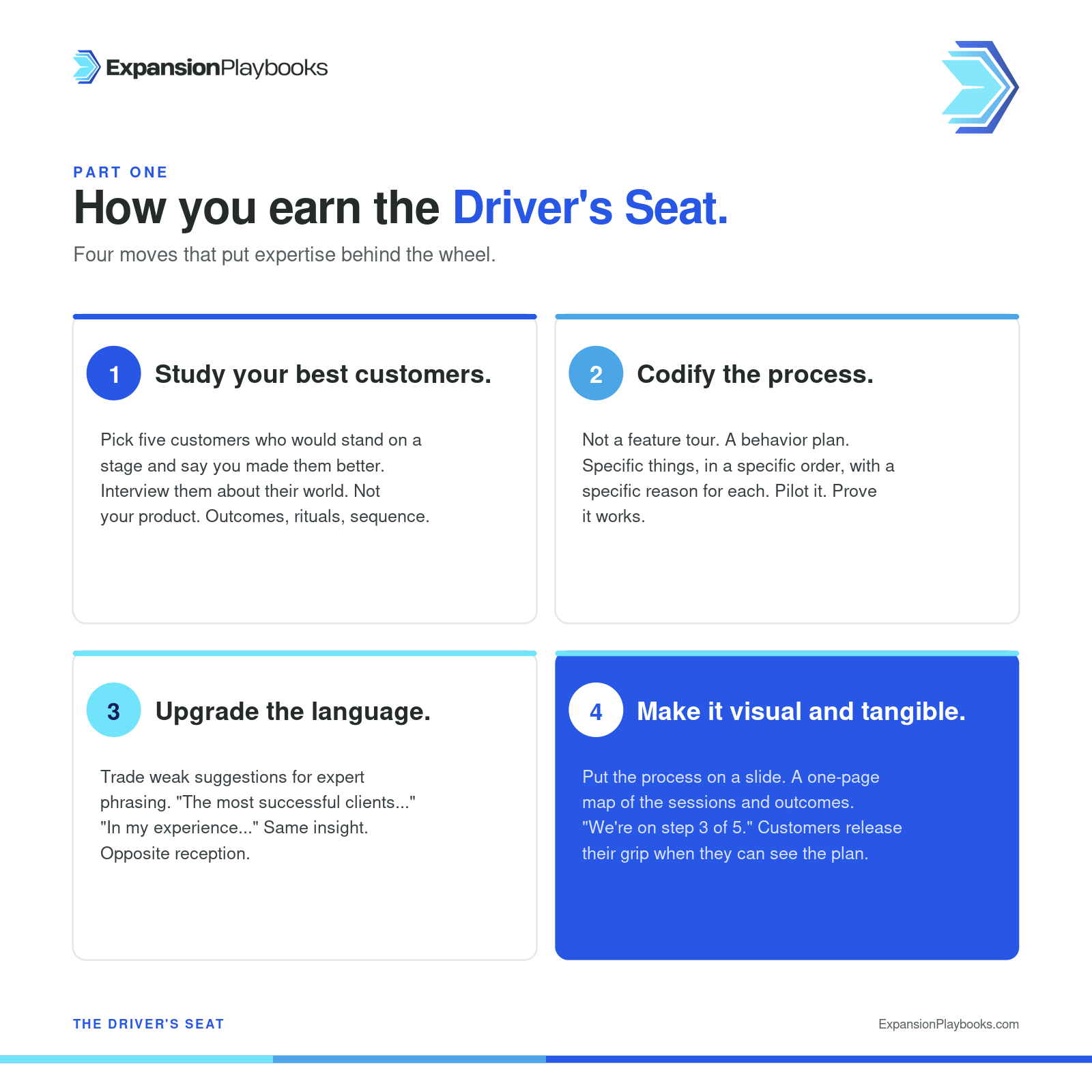
Move one: we studied our best customers to capture the expertise. I picked five accounts that, if you put their sales managers on stage at a conference, would stand up and say Sales Rabbit had made their team measurably better. We interviewed them. Not about the product. About their world. What outcomes actually matter when you're running a field sales team? What are the exact steps the best teams take in their first 60 days? What rituals do they run weekly? What do they measure?
None of my CSMs had ever knocked a door for a living. After five interviews, they didn't need to have. They had the customer domain expertise of the best operators in our base. They could speak in specifics a brand-new customer couldn't, and they had earned the right to an opinion about how a field sales team should run.
Move two: we codified it into a standardized process. Not a feature tour. A behavior plan. Five sessions over 14 days, each one tied to an outcome the customer actually cared about. Build the dashboard that lets them run the business. Lock in the territories that make the team more efficient. Get the reps live and run the first weekly sales competition. Specific things, in a specific order, with a specific reason for each. Then we piloted it and proved it worked. The behaviors that predicted whether a customer would stick got adopted at twice the rate.
Move three: we changed our language. There's a way to deliver the exact same insight that sounds like a weak suggestion, and a way to deliver it that sounds like expertise. Same content. Opposite reception.
"One option could be to configure your settings first and then integrate. There are multiple ways to do this, and it kind of depends on your situation."
versus:
"The most successful teams configure their settings first and integrate second. In my experience, that's the order that gets you to a working leaderboard the fastest."
Same recommendation. Two different relationships. The first one invites debate. The second one closes it. We wrote out the lists.
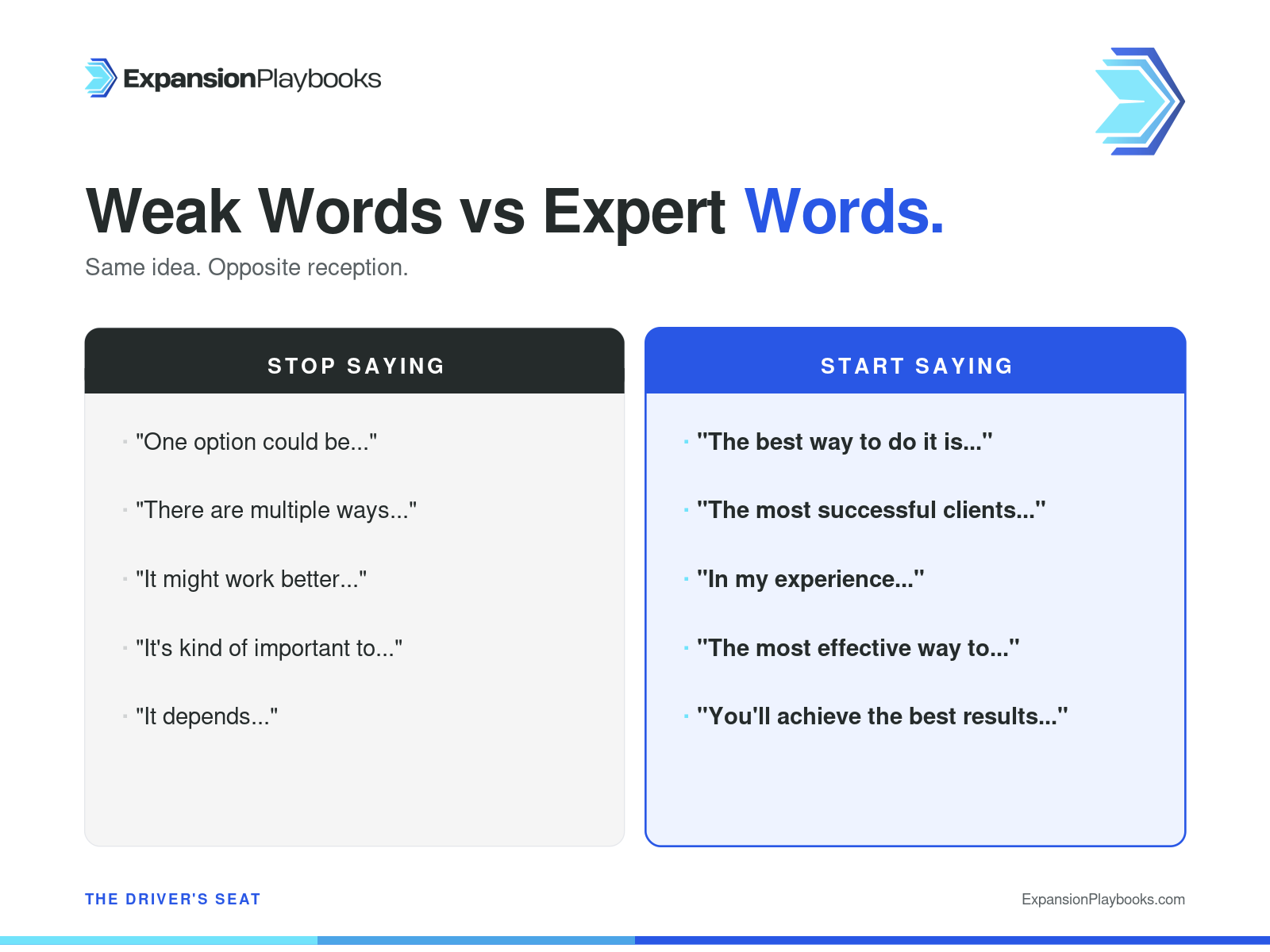
Stop saying: "One option could be..." / "There are multiple ways to do it..." / "It might work better..." / "It's kind of important to..." / "It depends..."
Start saying: "The best way to do it is..." / "The most successful clients..." / "In my experience..." / "The most effective way to..." / "You'll achieve the best results when..."
The most common weak phrase is "it depends." That isn't expertise. Expertise is knowing exactly what it depends on, and being able to walk the customer through both branches in plain language.
Move four: we made it visual and tangible. This is the move most teams never make, and it's the one that does the most work. It is one thing to know the best way to run an onboarding. It is another thing entirely to put it on a slide the customer can see.
We built the whole 14-day plan into materials. A one-page map of the five sessions and the outcome each one delivered. A project plan that showed exactly where we were at any moment. Every call opened the same way. Here is the five-step process. We are on step three. Here is what we did last session, here is what we are doing today, here is what comes next, and here is your homework before we talk again.
Something happens when a customer sees that. They release their grip on the wheel. Not because you argued them out of holding it, but because they can see the process existed before they showed up and will keep working after they're gone. They can see you have done this many times before. The plan on the screen does the work that a nervous CSM trying to sound confident never could.
The same strong-willed customer who would have hijacked us six months earlier would watch that opening and sit back. We had taken the job they thought was theirs, figuring out how to be successful, and replaced it with the one they actually wanted: follow the path that already works.
By the time we were done, our own sales reps were selling the process before the contract was signed. "You'll be assigned an expert who has worked with hundreds of sales teams. We have the exact 14-day process that gets your reps their first sale, your dashboard built, and your first competition running." That pitch closed deals, and it meant the customer never got near the wheel, because we were already holding it before day one.
And when a customer did try to jump ahead, we had the standing to hold the line. "You want to hand it straight to your reps and get going. That's exactly why getting the reps live is step five, not step one. We lock in the dashboard and the territories first, so your reps' very first time in the product is a home run. They see their numbers, their territories already mapped, hours of setup already gone. That first experience is what makes them keep using it, which is what makes you more sales."
That is what it means to earn the seat. Not through force or a stronger personality, but through a captured expertise, a proven process, and a plan the customer can see.
Where you defend the seat: four scenarios that decide every relationship.
Earning the Driver's Seat is the first half of the work. Staying in it is the second. There are four scenarios where you either keep it or lose it, and they happen on every account, every quarter.
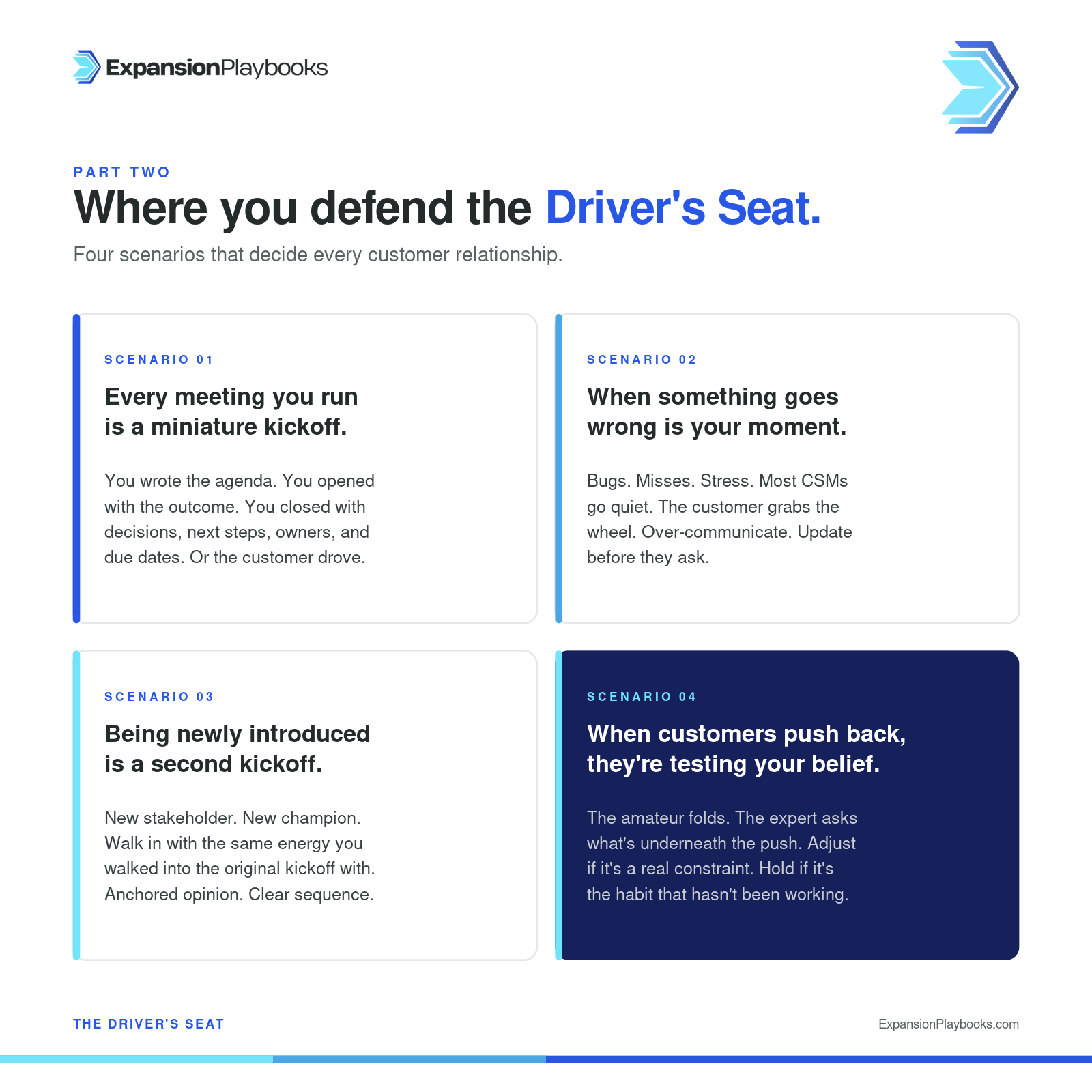
Scenario one: every meeting you run is a miniature kickoff. You either drive it or it drives you. Driving it means you wrote the agenda before the meeting started. You opened by stating the outcome you're working toward and the two or three things you need to walk out with. You kept the conversation on the rails when it drifted. You closed by summarizing the decisions made, the next steps, who owns what, and by when. Every meeting that ends without that summary is a meeting where the customer left in the Driver's Seat.
Scenario two: when something goes wrong is your moment, not the customer's. Bugs happen. Product breaks. A feature you promised slips. These are the moments most CSMs go quiet because they don't have answers yet. That's exactly when the customer grabs the wheel. The expert move is the opposite. Over-communicate. Be the first to surface the problem, the first to name what you understand, the first to lay out the next three steps, the first to follow up with an update before they asked for one. When something goes wrong is when the adult in the room becomes obvious.
Scenario three: being newly introduced to an account is a second kickoff. Maybe you inherited the account. Maybe an executive sponsor just got added. Maybe the customer reorged and you're meeting a new champion. The customer's new stakeholder is forming a first impression of you in real time, and that impression decides whether they treat you like a partner or like a vendor for the next twelve months. Walk in with the same energy you walked into the original kickoff with. Anchored opinion. Clear sequence. Specific outcomes.
Scenario four: when the customer pushes back, they're testing whether you believe your plan. They try to override your sequence. They want to skip a step. They want to do it their way. The amateur move is to fold. The expert move is to ask what's underneath the push. If it's a real constraint, you adjust and explain why. If it's a preference rooted in a habit that hasn't been working, you say so. "I hear that, and I want to share what we see across our most successful customers, because the version you're describing is the version that hasn't been getting you the result you told me you wanted." You're not arguing. You're doing your job.
If you master those four scenarios, the customer never has to grab the wheel. Because you're never out of it.
They'd be knocking down your door for this if anyone offered it.
The reason this works isn't because you're being aggressive. It works because it's what the customer secretly wants. Nobody buys software because they want to make more decisions. They buy software because they want a result, and they want someone competent to help them get there.
When you walk in with a clear opinion, a sequenced playbook, and a way of speaking that signals you have done this many times before, you are the rarest thing in the customer's vendor stack. The version most CS teams offer is rainbows and butterflies. Smiles. Accommodation. Custom everything. The version the customer actually needs is somebody who looks them in the eye and says, "Here's what we see working. Here's what we see failing. Here's the order. Let's go."
The synthesis.
Your customer doesn't pay you to do what they say. They pay you to take them somewhere they couldn't go on their own. That's only possible if you're in the Driver's Seat. If you're in the passenger seat, you're not earning the check. You're just along for the ride.
What to try this week.
Pick one account where you've quietly been in the passenger seat. Before your next meeting with them, write down three things. The outcome you're driving toward. The exact next three steps you believe they should take, in order. The reason each step matters, in the language of their world, not your product.
Then make it visual. Put it on a single slide or a one-page plan the customer can actually see. Here is where we are headed. Here are the steps to get there. Here is where we are right now. Give them something tangible that shows you have a plan for their success, something they can follow and engage with.
Walk into the meeting and lead with it. Close with what was decided, what's next, who owns what, and by when. You won't take the Driver's Seat back in one meeting. But the moment the customer sees you have a plan they can follow, they start to loosen their grip.
Where did you last lose the Driver's Seat? Hit reply and tell me which of the four scenarios you're going to tighten up first, or where you think I'm getting this wrong. I read every reply.