Every time you take over a new portfolio, or step in as a new leader at a company, the mandate from above is the same. Reduce churn.
And churn is always thought of as the time and place of the renewal. That's where the problem is, so that's where you solve it.
But anybody who has been in customer success for any amount of time knows that churn and the causes of churn are not co-located in time and space. How we sell. How we onboard. How we engage the customer to reduce risk and clear barriers while we help them through the change. All of those things decide whether the customer succeeds, renews, and expands. Renewals are won at month two, not month eleven.
So by all means, fix it upstream. We should be constantly working on the things that keep a customer from ever ending up in this place.
The reality is, in any job, at any company, you'll still be in this position. Even while you're feverishly fixing the upstream problems, you'll have legacy customers renewing now, next week, next month. Maybe you weren't there when they were onboarded. Maybe the account just landed in your portfolio. They never got the improved process that would have kept them out of trouble in the first place.
And so you still have to "save the customer."
The problem is the save playbook everybody runs doesn't save anybody.
The save playbook everybody already knows
We've all seen this play from the other side. Try to cancel a gym membership or a cable subscription, and you'll watch them pull three levers.
1. Lean on the contract. They strong-arm you into the renewal. They lean into obligations, into what you committed to, into why you can't leave. Or they just pester you, as if engaging you more aggressively will get you to stay.
2. Discount it. At one level, discounts make sense. If you don't feel like you're getting enough value, I'll lower the price and hopefully it matches the value you think you're getting.
The problem is, all you've done is validate to the customer that they've been overpaying. That they were taken advantage of.
And value isn't only about the features I'm paying for and not using. I still have to get a meaningful result. If I'm not getting that result, I can feel like I'm overpaying for the extra features, and I can feel like I'm overpaying for the ones I do use. Those may be the words the customer says. The real problem underneath is that they aren't winning, and a discount doesn't touch it.
3. Give it away for free. If they're not happy with what they have, maybe another product will give them more value.
The reason the customer hasn't gotten value so far is typically because they haven't been committed enough. They haven't made the changes necessary to achieve the value they should have gotten. And so handing them more product is a doomed strategy. They aren't taking advantage of what they already have. Giving them more without requiring an increase in their commitment may help them feel slightly better in the moment, and it may even get the renewal in the moment. But they will churn at the next available opportunity.
The save play with a 100% save rate
Now, I'm not saying these tactics don't get the renewal. Some of them help you secure it. That's exactly what makes them so convincing.
I did a project with a company called InMoment, and they had a save play they swore by. When a customer was frustrated and about to churn, they gave away a free analysis service. They were pretty happy about it. Their save rate was almost 100%. Give this away free at renewal, and we save them nearly every time.
Boom. Great play. Keep it up.
Wrong.
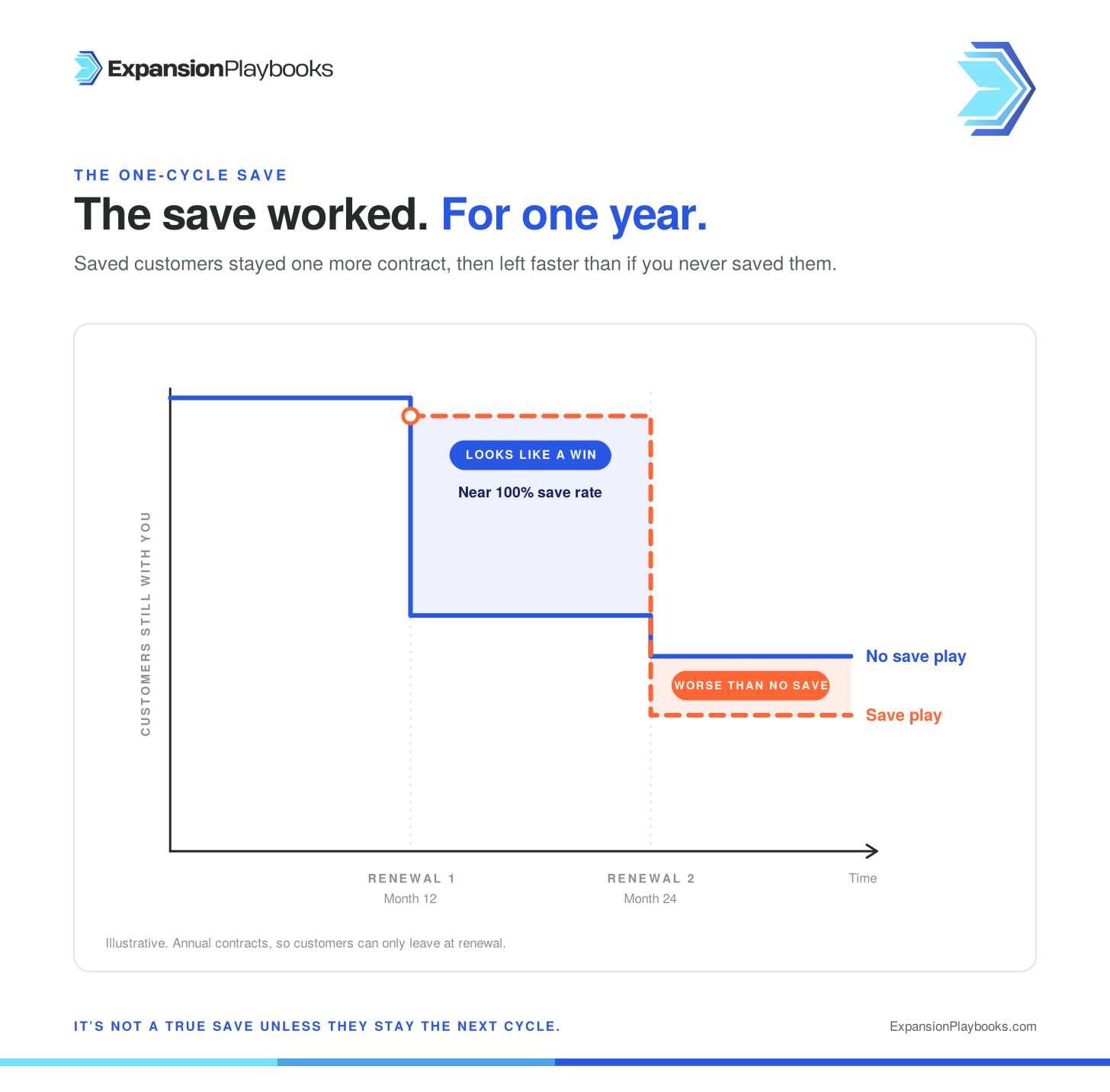
We looked at the next renewal, twelve months later, and asked two questions. Of the customers who received the save play and stayed, how many renewed at the next renewal? And of the customers who did not receive the save play but stayed anyway, how many of them renewed at the next renewal?
The same save play that had an almost 100% renewal rate in the short term churned worse at the next renewal than if those customers had never received the save play at all. They were worse off.
The one-cycle save
I call this the one-cycle save: a save that buys the customer one more contract without changing anything about whether they win, and so the churn shows up at the next renewal instead of this one.
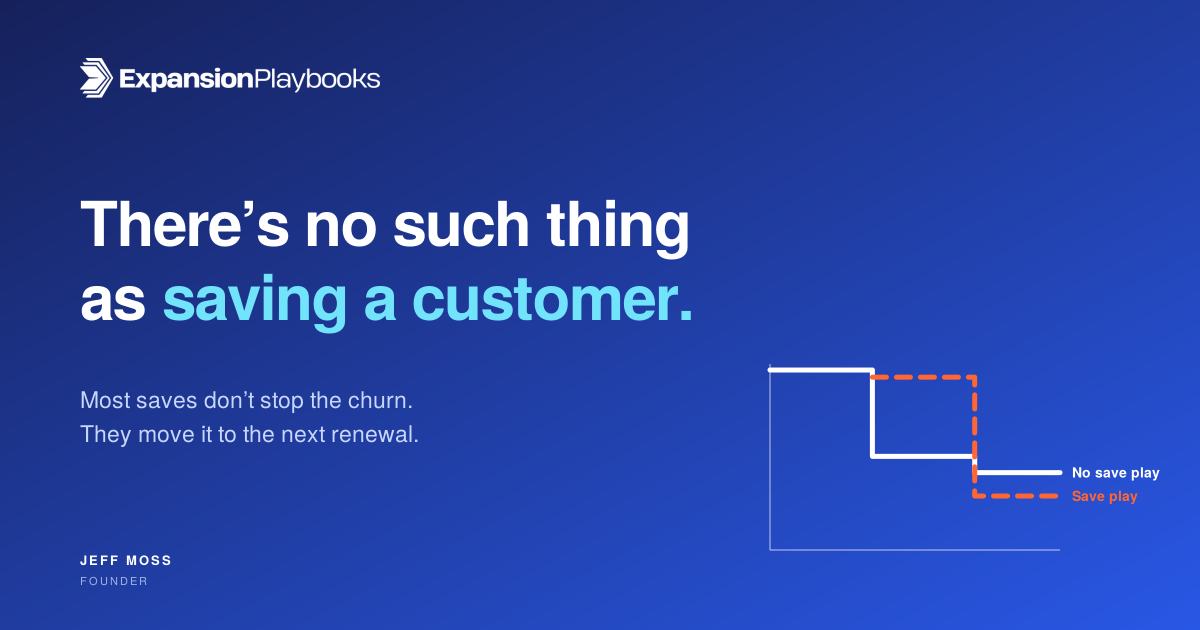
That's what I mean by "there's no such thing as saving a customer." Saving refers to the immediate renewal in front of you. And the way almost every company approaches that moment doesn't save anybody. It just prolongs their death one more cycle.
Everybody says, "We just have to get them to renew now, and then we'll save them. We'll do everything over the next twelve months to win back their business." Without a true plan, without a true commitment, without addressing reality, that never happens.
The mistake people make is they only track saves. I got this customer to stay. I got them to commit to another year. The real question is: did the customer renew the following cycle? Not the cycle you ran the save play in. The next one. It's not a true save unless they stay the next cycle.
Ask what has to be true at the next renewal
So if I can't use the three traditional save tactics, what am I supposed to do?
You can only do the things that can work. Look at this long term. What would have to be true, not for the customer to renew this cycle, but to renew at the next one? If the contract is annual, what has to be true twelve months from now?
Three things:
- They've achieved meaningful results with your product that actually matter to their business.
- They're making progress beyond where they are right now.
- They have a clear plan for where they're going next, whether that's increasing their results, adding outcomes they aren't going after yet, or bringing on additional teams.
And so the question becomes, what levers make that reality come true?
Three levers that work instead
There are three, and each one replaces one of the levers that doesn't work.
1. Get clear on their goals and failures instead of leaning on the contract. Get absolutely clear with the customer about what they're trying to achieve, where they fell short, and what it would take to get to success. What changes have to happen on their side? What changes have to happen on your side? What steps need to be taken, and how quickly can it be remediated?
The important thing here is that it's never 100% one team's fault. There are things the customer failed at, and there are things you failed at. Be honest and clear about both, then invite the recommitment.
2. Recommit instead of discounting. Recommit the customer to those exact steps, and to the effort required to be successful. If we can agree that this is your goal, that this is where we fell short, and that these are the steps that weren't being taken, then we can agree that if these things get done, you'll get better results. We're willing to recommit to you and do the work necessary to get you there within a set number of days. Are you willing to recommit with us?
It's the only thing that works long term. The only way the customer actually gets results is by recommitting the time, effort, and resources necessary to achieve them.
And here's the other reality. The customer still has that outcome, that gap, whether they stay with you or leave. They still have to solve it. If they go to another provider, they'll have to commit to that provider, and that will take additional work and effort too. The recommitment is coming either way. The only question is whether it happens with you.
3. Right-size instead of giving it away. If they're paying too much for what they're using, move them to a smaller plan or package. If that's not an option at your company, work with your team to make it an option. If there are legitimate use cases that don't require the full package, we should be offering them to our customers. The value has to match what they're purchasing.
There's another side to this coin. It seems almost impossible, but I've seen it done many times. Sometimes the customer failed because they didn't buy enough of your solution. They had lofty goals and high performance targets, and they bought an insufficient solution to hit them. In that case, saving them doesn't mean giving them free stuff. It means teaching them why they should have, and now need to, move up to the plan or package that gives them the resources to meaningfully improve their results and hit those targets, if they recommit.
What happened when DearDoc stopped saving customers
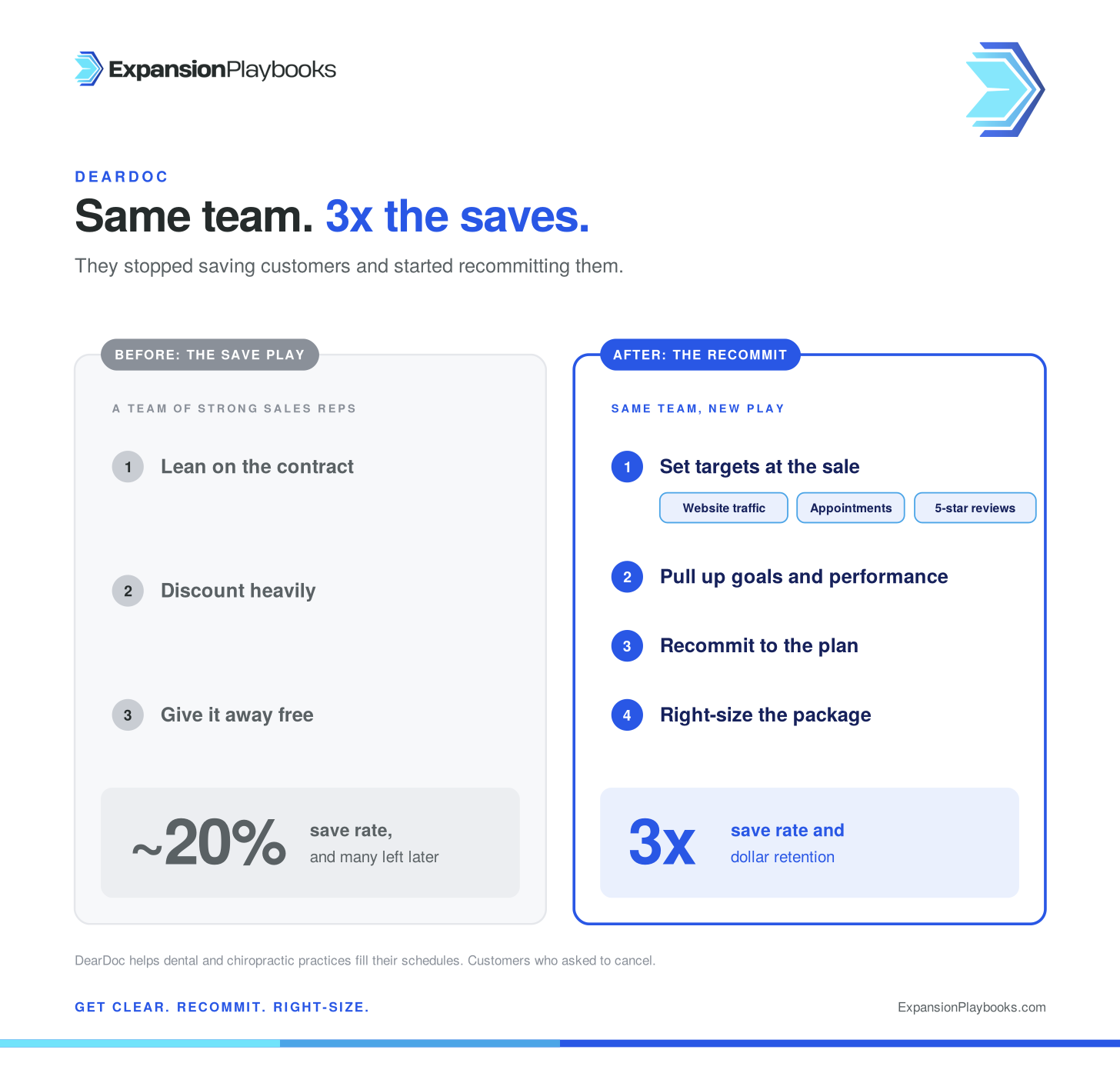
One of my customers, DearDoc, helps medical practices (mostly dental offices and chiropractors) grow their business by getting more leads, improving their website traffic, and filling their schedules. They sell on a one-call close. That model brings in a larger share of customers who end up with some buyer's remorse, or who never truly commit, and so they don't get the results they were hoping for.
At first, the company put a team of sales reps on the traditional retention approach. The "save the customer" approach. They leaned into the contract. They discounted heavily. They gave things away for free. Even with strong sellers on that team, their save rate was close to 20%, and many of those customers left at the next available opportunity.
Then they changed how the whole company operated. They embraced achieving measurable outcomes for their customers. Even on a one-call close, their sellers got really clear with customers about which metrics mattered to their business. They set targets together, and they carried those targets into onboarding.
That changed what the retention team could do. When a customer requested cancellation, the team could first pull up the customer's goals and their current performance. They could get clear and aligned on where the customer was falling short and what it would take to succeed. Then they recommitted the customer to what it would take to hit their targets, whether that was:
- traffic on their website
- more appointments on their schedule
- more 5-star reviews
And instead of reaching for discounts and free stuff, they focused on right-sizing, making sure each customer had the right package to succeed.
Their save rate and their dollar retention on customers who request cancellation went up 3x. And the company overall is seeing the highest retention and expansion it has ever experienced.
Does that mean you never discount?
I don't speak in absolutes. The real lesson here is that you never get something for nothing. Everything has to be in service of the customer truly succeeding.
If a discount helps the customer get over the hill and recommit to the key actions that will actually lead to their success, you may need to use it. As an example: "Okay, fine, I'll give you three free months. But in return, you're going to meet with your CSM three times over the next three weeks. We're going to get this bug figured out, we're going to get your team running this process, and we're going to meet together in three weeks to go over your results."
What loses is using the discount as a catchall. Handing it over instead of figuring out where the customer is failing, and instead of recommitting them, is a losing strategy. It just buys you one more cycle.
The only save there is
There's no such thing as a save play. There's only operating in a way that actually makes customers successful.
That's the only way customers improve their results. And if you operate that way, customers will succeed more often than not. They'll renew more often than not. And they'll expand as well.
Before your next save call
1. Pull the data you've never looked at. Take every customer your team "saved" last year and check what happened at their next renewal. Then compare them to the at-risk customers who stayed without a save play. If the saved customers churned faster, you have a one-cycle save.
2. Walk in with the goal, not the offer. Before the call, write down what the customer was trying to achieve, where they are today, and the two or three changes (theirs and yours) that would close the gap. Lead with that. The discount, the right-size, or the upgrade comes after the recommitment, never before it.
You can't run the recommitment conversation if you don't know what the customer is trying to achieve. I built the Customer Results Map into Expansion Playbooks for exactly this: the outcomes your customers are trying to hit, how each one is measured, and the actions that move them. It opens October 15. Get founding access.
The founding rates: Land the role is $29 a month, Own the role is $59 a month, and Lead the team is coming soon. Founding means you keep that price for as long as you stay.
What's the save play your team swears by, and do you know how many of those customers renewed the time after? Hit reply and tell me. I read every reply.