

Every customer-facing team has a version of this conversation. Somebody gets off a call, drops into a chair, and starts the list.
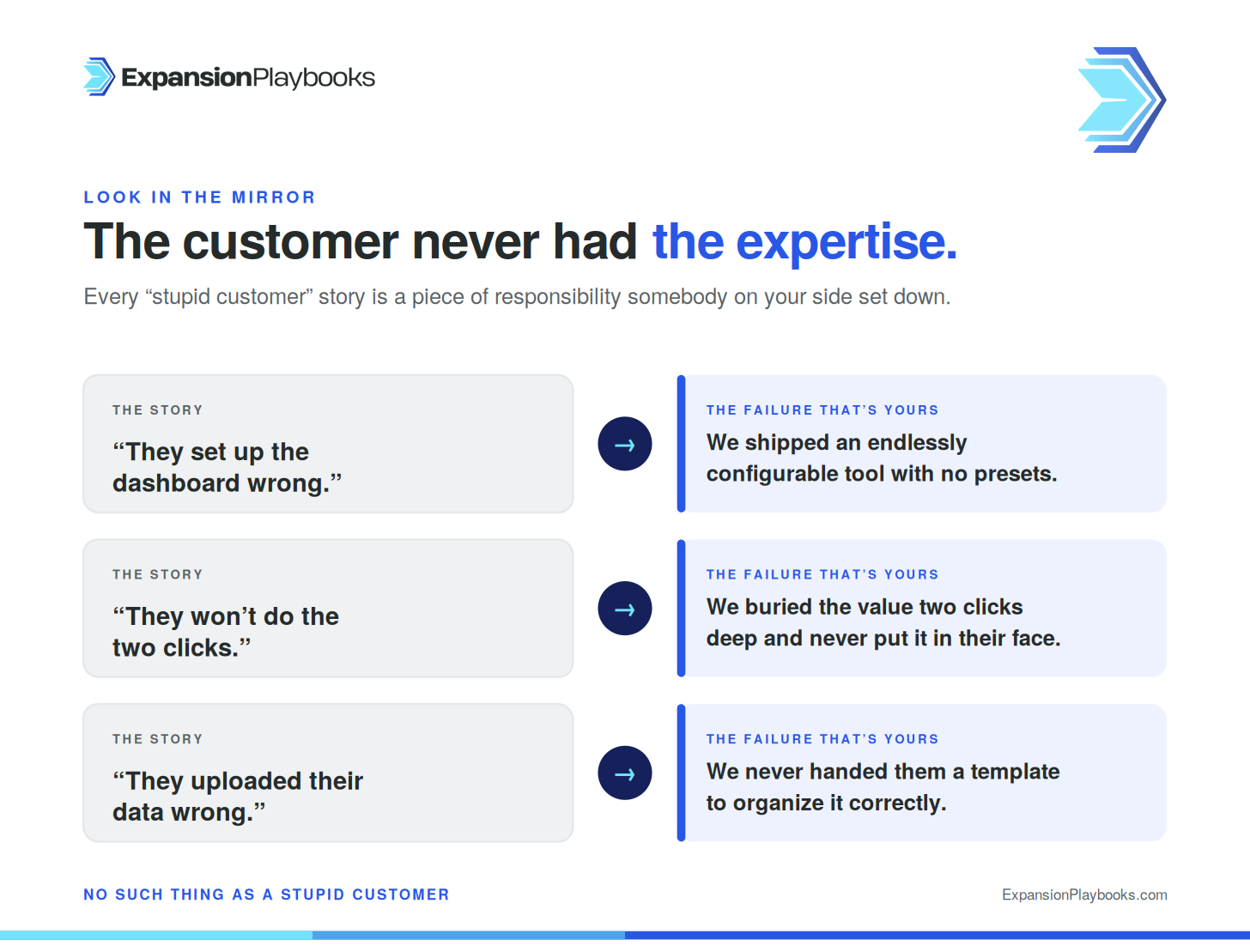
The customer configured the system in the dumbest way possible. They won't budge from their current process, even though it's obviously slower and more painful than the one you built for them. They won't share their financial data, so now you can't even build the ROI case that would save the account. They set up their dashboard wrong. They can't manage the two clicks it takes to open their analytics and see how much value they're getting from the thing they're paying you for.
And the list goes on. You've heard it, and if you're honest, you've said some version of it yourself. I have too.
There's a phrase that hangs over all of it, spoken or not. The customer is stupid.
So before you decide somebody else is the dumb one here, come look in the mirror with me for a minute. Because the situation is not what you think it is.
The customer was never the one with the expertise
Here's the mistake everybody makes. We treat the customer's failure as a statement about the customer. Foolish. Careless. Doesn't get it.
But the customer is not the one with the expertise to know what they're doing and why. That was never their job. And it was never their responsibility either.
Think about what the act of buying your product actually is. It's an admission. When a customer buys your solution to solve a problem, they are telling you, out loud, that they need your help. Not just your product. Your guidance. Your insight. The thing you know that they don't. They're paying you to help them do more than they've been able to do up until this point, on their own, with the tools they already had.
You and your company have worked with hundreds, maybe thousands, of customers in a specific niche of what your product does and the use cases it lives in. You've seen what works and what doesn't. You know why it works and why it doesn't. You live and breathe this every single day. The customer does this thing among the 99 other things they're responsible for in their job and their company.
So when they misconfigure the dashboard, whose failure is that, really? Who's actually the one without the expertise in the room? You gave a person who does this once a fully configurable product and a couple hours of training, and then you were surprised when they didn't build it the way the person who does this ten thousand times would have.
Any failure the customer makes is not a verdict on their intelligence. It's a gap in your ownership. Where responsibility is abdicated, opportunity lies. And every "stupid customer" story is a piece of responsibility somebody on your side quietly set down.
Design out the failure
So here's the move. Instead of blaming the customer, you look in the mirror.
You figure out exactly what it takes for a customer to succeed. The specific actions, the specific configuration, the specific behaviors that separate the customers who win from the ones who don't. And then you spend your time doing one thing: eliminating every way they could fail to take those actions.
I call it designing out the failure. You are not hoping the customer gets it right. You are engineering the situation so that getting it wrong is hard to do. That's the whole discipline. Find what success requires, then remove the paths to failure one by one, until the successful path is the easy one and the wrong one is hard to stumble into.
Let me show you two versions of the same lesson. One is sixty years old. One is mine.
My grandfather and the medication nobody could use
My grandfather was a pharmaceutical salesman back in the 1960s. I was telling him about this exact idea, figuring out what it takes for a customer to succeed and then eliminating all the ways they could fail, and a story came to his mind.
He said, "I learned that exact principle once."
He had sold a brand-new medication to a physician. He explained the benefits, taught the value of it, all of it. And the physician said, "Yes, I need this. I have several patients that would benefit from this medication." So my grandfather helped him place the order. They estimated together how many times he might use it, and my grandfather said he'd come back in a month or two to talk about the next order.
A couple months later he came back. "How do you like the medication, Doc?"
"I think it's a great medication."
"Well, how much more do you need to buy?"
"Well, I haven't actually administered any of it. I don't know how to."
The doctor had patients who needed it. He'd seen for himself that it would help them. This was a new wave of medicine, a real breakthrough. And the single simplest thing had stopped all of it. Nobody had ever shown him how to administer it to a patient. So it sat there, unused, doing nothing for anybody.
Now, you could take the easy reaction. What a foolish doctor. He couldn't figure that out? He couldn't ask somebody? But my grandfather didn't. He said that's the moment he realized he had to own all the pieces that would let the physician actually succeed. Not just sell the medication and its benefits. Own the whole path, all the way down to the part where the doctor puts it in a patient and the patient gets better. Because if any piece of that path is missing, the benefit never shows up, and the reorder never comes.
Sixty years later, in software, I had to learn the same thing.
SalesRabbit and the metrics that didn't add up
I was working at SalesRabbit, a door-to-door sales app. We had a really powerful, endlessly configurable dashboard. Sales teams could build out their own custom metrics to track everything: lead development, close rates, appointment-setting percentages, all of it. Every customer got multiple hours of training on how to set the dashboard up properly.
Then we'd go into their account a couple days after they started using it, and we'd look at their metrics. They'd be all over the place. They wouldn't make any sense. We'd click into how they'd built them, into the little equations behind each one, and the equations wouldn't even make mathematical sense. Not "wrong for their business" wrong. "A fifth grader could see this doesn't add up" wrong.
And the first temptation, every time, was the one you already know. How dumb are these customers? We just showed them how to do this. You set up a couple of simple equations and it produces a number. How do you get that wrong?
Whose fault was it, really? Who was the dumb one?
We were. We had handed people an endlessly configurable product and expected them to configure it like experts on day two. So we stopped blaming them and we changed what we built.
We created presets. We'd ask the customer a couple of quick questions up front, and then we'd automatically drop in the exact metrics they'd need to be successful. On top of that, we built a menu of additional metrics they might find interesting, each one with the exact copy-and-paste equation ready to go, so if they wanted to add one, they could do it without inventing the math themselves.
And what happened? We never had a problem with customers building broken metrics again. Better than that, our customers were consistently measuring their performance from the first day they used our product. The number of tickets we got about wrong dashboard numbers and inconsistencies went from around ten a week to less than one.
Same lesson as my grandfather's. The customer was never the problem. The missing piece of the path was the problem, and the missing piece was ours to build.
How you actually do this
So how do you put this into practice? Three things.
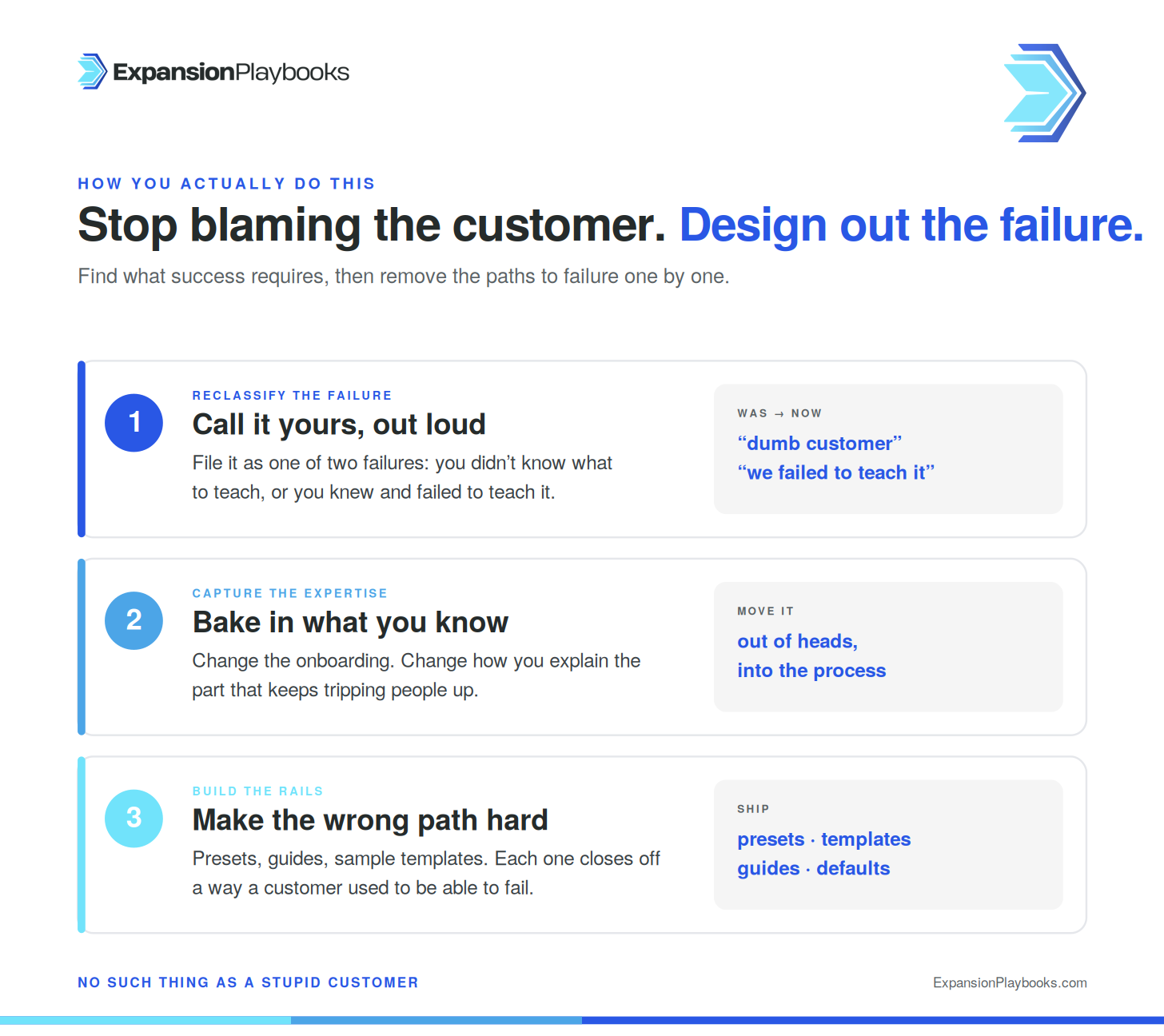
One: reclassify the failure. The next time you catch yourself, or your team, filing a customer under stupid or foolish, stop and flag it as a failure on your end instead. One of two failures, specifically. Either you didn't understand what the customer needed to be taught in order to succeed, or you understood it and failed to teach it, apply it, or convince them to do it the right way. Both of those are yours. Say it out loud that way, and the whole problem changes shape.
Two: capture the expertise. Once you've named the failure as yours, fix the thing underneath it. Change the onboarding. Change how you explain the confusing part. Take the knowledge that's currently living in your best people's heads, the stuff they know because they've seen it a thousand times, and bake it into the process so it doesn't depend on the customer already knowing it.
Three: build the rails. Create the help materials, the guides, the presets, the sample templates. Give people something they can just download and upload. A template that organizes their data correctly so they don't load it into your migration tool wrong in the first place. The presets that put the right metrics in front of them before they can build the wrong ones. Every one of these is a way a customer used to be able to fail, closed off.
And then flip the whole thing around. Stop counting all the ways your customers are failing as if each one is a risk factor to log and move past. Start paying attention to every time they're succeeding instead. Watch the successful path light up, and build more of it.
The scoreboard changes
You might say some customers really will fight you. They won't share the data, they won't change the process, they won't do the two clicks. And sometimes that's true. But far more often, the resistance is information. It's telling you that you haven't yet made the right path clear enough, easy enough, or worth it enough to them. That's still a design problem. It's still yours to solve.
When we made these changes at SalesRabbit, the tickets about broken dashboards went from ten a week to less than one. And that number isn't really the headline. The headline is that every one of those customers was now measuring their own success from day one, seeing the value, and staying because they could see it.
There's no such thing as a stupid customer. There's only a failure you haven't designed out yet.
Look in the mirror this week
Find one "stupid customer" story on your team this week. The account everybody rolls their eyes about. The person who set it all up wrong. Take that exact story and rewrite it as a sentence that starts with "we failed to." Then go build the one preset, template, or guide that would have made that failure impossible.
I promise you this. When you start doing this, you'll understand more deeply what your customers are actually going through as they learn not just a new system but a whole new way of operating and working. And you'll come away with a much deeper appreciation for the insight and expertise you and your team have built, and the power it has for your customers when it's applied correctly.
So here's my question for you. What's one "stupid customer" moment from the last month that, if you're honest, was really a failure on your side to design the path? Hit reply and tell me the story, and what you'd build to make sure it never happens again. I read every reply.